
When home is too chaotic, work is off-limits, and school isn’t an option—here’s how to ace your IELTS prep in the spaces in between.
Are you juggling a full-time job, living in a cramped apartment with roommates, or simply can’t focus at home? You’re not alone. Thousands of IELTS candidates worldwide find themselves preparing for one of the most important exams of their lives without access to traditional study spaces. The solution? Third spaces—those public and semi-public environments like coffee shops, libraries, parks, and community centers that exist outside your home, workplace, or educational institution.
This comprehensive guide will show you exactly how to transform these unconventional spaces into your personal IELTS preparation headquarters, complete with strategies that actually work, common pitfalls to avoid, and answers to the questions you’re probably already asking yourself. You can watch this YouTube video explainer by IELTS Guide Phil.
What Are Third Spaces and Why They Matter for IELTS Prep
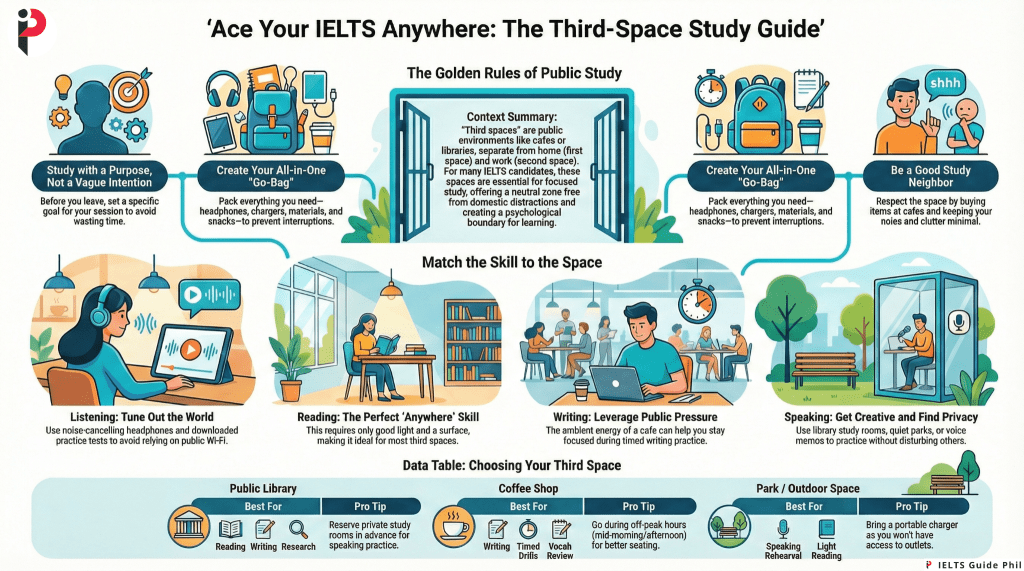
Third spaces are social environments separate from our usual home (first space) and work or school (second space). For IELTS preparation, these might include public libraries, coffee shops, bookstores with seating areas, parks, community centers, co-working spaces, hotel lobbies, university common areas (if you’re not a student there), or even quiet corners of shopping malls.
These spaces offer something your home might not: a neutral environment free from domestic distractions, the ambient energy of other people working, and psychological separation that signals to your brain “this is study time.” When you’re living with family who don’t understand why you need quiet, sharing a small apartment with multiple roommates, or dealing with unreliable internet at home, third spaces become not just convenient but essential.
Why IELTS Candidates Turn to Third Spaces
The reasons are as varied as the students themselves. Perhaps you’re an immigrant working two jobs with no quiet space at home. Maybe you’re a young professional whose employer doesn’t allow personal studying during breaks. You could be living in a studio apartment where your bed is your desk is your dining table, making it psychologically impossible to create study boundaries. Or you might simply focus better with a bit of background noise and the presence of other productive people.
Whatever your situation, understanding how to maximize these spaces for IELTS preparation can mean the difference between a score that opens doors and one that holds you back.
The Four IELTS Components: Adapting Each to Third Spaces
Listening Section Strategies
The Listening section might seem like the trickiest to tackle in public spaces, but it’s entirely manageable with the right approach. Invest in good quality noise-cancelling headphones or in-ear monitors—this is not the time to cheap out on audio equipment. Your ability to hear every word clearly directly impacts your score.
Download official IELTS listening practice tests onto your device beforehand so you’re not dependent on public WiFi, which might cut out at crucial moments. Use apps like IELTS Prep or British Council’s IELTS learning resources that work offline. Time yourself strictly, replicating exam conditions as closely as possible even in a bustling coffee shop.
Practice during different times of day to expose yourself to various noise levels. If you can concentrate during the afternoon rush at Starbucks, the quiet exam hall will feel like a gift. Some candidates actually perform better having trained in noisier environments because they’ve developed laser focus.
Reading Section Success
The Reading section is your third-space golden ticket. Unlike Speaking, it doesn’t disturb others. Unlike Listening, it doesn’t require perfect audio conditions. You can practice Reading anywhere with decent lighting and a flat surface.
Print out practice tests or use a tablet to minimize screen fatigue—many libraries offer free printing services. Bring a physical timer or use your phone’s timer in airplane mode to avoid distractions from notifications. Work through complete sections in one sitting to build stamina; the actual IELTS Reading test is 60 minutes of intense concentration.
Create a portable “Reading kit”: highlighters (if working on printouts), pencils, erasers, and a small ruler to keep your place. Some test-takers find that the slight inconvenience of setting up their materials in a public space actually helps them take the practice more seriously.
Writing Section Execution
Writing in third spaces requires more setup but offers huge advantages. The change of scenery can spark creativity and help you overcome writer’s block that might plague you at home. Cafes and libraries provide the perfect environment for timed writing practice.
Bring your laptop or tablet if you prefer typing (useful for organizing ideas), but also practice handwriting since the actual test might be paper-based depending on your location. Use Google Docs or Microsoft Word with internet turned off to simulate exam conditions without distractions.
Practice both Task 1 (describing graphs, charts, or processes) and Task 2 (essay writing) in realistic time frames: 20 minutes for Task 1, 40 minutes for Task 2. The ambient pressure of a coffee shop—knowing others can see you working—can actually help you stay on task better than the comfort of your bedroom.
One powerful technique: vary your locations. Write one practice essay at a library, another at a cafe, a third in a park. This prevents you from becoming dependent on one specific environment and builds adaptability for test day.
Speaking Section Innovation
Here’s where third spaces get creative. You can’t exactly have a full conversation with yourself in a library without attracting concerned looks, but you absolutely can prepare effectively.
Use private study rooms in libraries (book them in advance if your local library offers this service). Practice speaking quietly in parks or outdoor seating areas where you’re less likely to disturb others. Record yourself using voice memo apps while walking through quieter retail spaces like bookstores.
For interactive practice, schedule video calls with language exchange partners, online tutors, or IELTS speaking buddies while sitting in hotel lobbies or quiet corners of cafes with good WiFi. Many co-working spaces have phone booths designed for calls—perfect for IELTS speaking practice.
Shadow native speakers using YouTube videos with headphones. Mouth the words if you can’t speak aloud, focusing on intonation and stress patterns. This silent practice is remarkably effective for improving fluency.
The Dos: Best Practices for Third-Space IELTS Prep
Do scout locations in advance. Visit potential study spots at different times to assess noise levels, seating availability, WiFi reliability, and whether there are electrical outlets. What’s perfect on a Tuesday morning might be unusable on Saturday afternoon.
Do establish routines. Once you find spots that work, return to them regularly. Your brain will begin associating these locations with focused study, making it easier to slip into concentration mode. Some candidates report that simply walking into “their” library corner triggers immediate focus.
Do respect the space and other patrons. Buy something if you’re at a cafe (refresh your drink every couple of hours). Don’t monopolize tables during peak times. Keep your materials organized and your noise levels appropriate. Being a considerate patron ensures you’ll be welcomed back.
Do bring everything you need. Create a comprehensive IELTS study pack: headphones, chargers, practice materials, writing supplies, water bottle, snacks, and any reference books. Forgetting something and breaking your concentration to go find it wastes precious study time.
Do leverage different spaces for different tasks. Use the quiet library for Reading practice, the moderate buzz of a cafe for Writing, a park bench for Speaking rehearsal, and a bookstore corner for Listening. Matching the task to the environment optimizes your preparation.
Do set specific goals for each session. Before leaving home, know exactly what you’ll accomplish: “Complete two Reading passages and review vocabulary” or “Write three Task 2 introductions on different topics.” This prevents aimless studying and maximizes limited time.
Do take strategic breaks. Use the Pomodoro Technique: 25 minutes of focused work, 5-minute break. During breaks, step outside, grab a coffee, or walk around. The variety of a third space makes breaks more refreshing than they’d be at home.
Do protect your belongings. Never leave your materials unattended. When using restrooms, pack everything up or ask a trustworthy-looking neighbor to watch your things. Keep valuables in sight and backed up important digital work to cloud storage.
The Don’ts: Common Mistakes to Avoid
Don’t rely solely on public WiFi for essential resources. Download practice tests, vocabulary lists, and study guides in advance. Public networks are unreliable and often unsecured. If you must use them, avoid logging into sensitive accounts.
Don’t study without a plan. Wandering into a coffee shop with vague intentions to “study IELTS” leads to wasted time scrolling through your phone. Have a specific agenda: which section, which tasks, how many questions.
Don’t ignore your energy levels. Some people are morning warriors; others come alive in the evening. Schedule your third-space sessions during your peak cognitive hours. Forcing yourself to tackle IELTS Reading at 8 PM when you’re exhausted is counterproductive.
Don’t stay too long in one spot. Most cafes expect turnover. Three to four hours is reasonable with purchases; beyond that, you’re overstaying. Rotate locations or take a long break and return later if needed.
Don’t practice Speaking at full volume in inappropriate spaces. Yes, you need to rehearse, but shouting IELTS responses in a crowded Starbucks will get you kicked out. Use quiet spaces, outdoor areas, or private rooms for vocal practice.
Don’t forget headphones are a public necessity. Even if you’re just listening to practice tests, always use headphones. Playing audio aloud is inconsiderate and will likely get you asked to leave.
Don’t compare yourself to others around you. The person typing furiously next to you might be writing a novel, finishing a work project, or messaging friends. Your IELTS preparation is just as valid. Stay in your lane and focus on your goals.
Don’t neglect basic needs. Bring water and snacks. Hunger and dehydration destroy concentration faster than almost anything. Many candidates report better focus after eating protein-rich snacks like nuts or string cheese.
Common Mistakes and How to Fix Them
Mistake #1: Choosing comfort over productivity. You pick the coziest cafe with plush sofas, amazing pastries, and perfect lighting for Instagram. Two hours later, you’ve completed one Reading passage and consumed 800 calories.
Fix: Select spaces that are comfortable enough for extended sitting but not so cozy that you get drowsy. Opt for tables and chairs over sofas. Think “productive workspace” not “relaxation lounge.”
Mistake #2: No transition ritual. You arrive at the library, dump your bag, and immediately wonder what to study, spending 20 minutes deciding.
Fix: Create a five-minute start-up routine. Arrange your materials in the same order every time, review your session goals, silence your phone, and take three deep breaths. This ritual signals your brain that work is beginning.
Mistake #3: Attempting all four sections in one session. You’re ambitious and try to practice Listening, Reading, Writing, and Speaking all in three hours at a cafe. You end up doing each half-heartedly.
Fix: Focus on one or two sections per session, doing them thoroughly. Quality beats quantity. If you have three hours, spend it mastering two full Reading tests rather than skimming all four skills.
Mistake #4: Not tracking progress. You study regularly but can’t remember which practice tests you’ve completed or where you’re improving.
Fix: Maintain a simple log, either digital or in a small notebook. Record the date, location, what you practiced, and your scores or observations. This provides motivation and identifies weak areas.
Mistake #5: Ignoring security. You leave your laptop unattended “just for a second” or connect to unsecured networks without protection.
Fix: Pack up everything when leaving your seat, even for bathroom breaks. Use a VPN on public WiFi. Keep a phone tracking app active and backup your study materials to cloud storage nightly.
Mistake #6: Studying the same material repeatedly. You’ve done the Cambridge IELTS Book 15 five times because you haven’t organized access to other resources.
Fix: Diversify your materials. Use the British Council website, IDP IELTS resources, Road to IELTS online course (often free through libraries), and apps like IELTS Prep App or Magoosh. Fresh material prevents memorization and better simulates real test conditions.
Mistake #7: Never practicing Speaking. Because it’s awkward in public, you skip it entirely and focus only on Reading and Listening.
Fix: Book library study rooms weekly for Speaking practice. Use the commute to your third space to record yourself answering Part 1 questions. Find one outdoor spot where speaking quietly is acceptable and commit to using it.
Maximizing Different Types of Third Spaces
Public Libraries
Advantages: Free, quiet, access to computers and printers, WiFi, extended hours, study rooms, often have language learning resources.
Best for: Reading and Writing practice, researching vocabulary, printing practice tests.
Pro tips: Get a library card to access online resources like Mango Languages or Pronunciator from home. Reserve study rooms for Speaking practice. Many libraries have silent zones and collaborative zones—choose based on your task.
Coffee Shops and Cafes
Advantages: Ambient noise (which some find focusing), food and drinks, WiFi, comfortable for longer sessions, energizing atmosphere.
Best for: Writing practice, light Reading review, planning study schedules.
Pro tips: Go during off-peak hours (mid-morning or mid-afternoon) for best seating. Order something every 90 minutes or so. Use apps like SpotFinder or Yelp to identify “laptop-friendly” cafes.
Parks and Outdoor Spaces
Advantages: Fresh air, natural lighting, free, good for mental health breaks, private enough for quiet Speaking practice.
Best for: Speaking rehearsal, Reading practice on pleasant days, memorizing vocabulary while walking.
Pro tips: Bring a portable phone charger since you won’t have outlets. Use a clipboard for writing tasks. Check weather forecasts and have an indoor backup plan.
Co-working Spaces
Advantages: Designed for productivity, reliable WiFi, printing services, meeting rooms, professional atmosphere, networking opportunities.
Best for: All IELTS sections if you can access private spaces, particularly good for full mock tests.
Pro tips: Many offer day passes or hourly rates. Check if any provide free trial days. Student discounts may be available. The professional environment can boost motivation significantly.
University Common Areas
Advantages: Academic atmosphere, often quiet, WiFi, access to libraries, surrounded by other students (motivating).
Best for: All sections, especially if the university has language learning centers you can quietly use.
Pro tips: Be aware of university policies—some restrict non-student access. Go during regular semester when it’s busy and you’ll blend in. Respect that enrolled students have priority for spaces.
Bookstores
Advantages: Quiet, book-friendly environment, cafe areas, free WiFi, access to IELTS prep books for browsing.
Best for: Reading practice, browsing supplementary materials, light reviewing.
Pro tips: Don’t overstay—two hours maximum. Buy something occasionally to support the business. Use their cafe area if available for longer sessions.
Creating Your Personalized Third-Space Study Schedule
Here’s a sample weekly schedule for someone working full-time and preparing for IELTS:
Monday & Wednesday (Early Morning): 6:30-8:00 AM at 24-hour cafe or early-opening library. Focus: Reading practice (two passages each session). The morning quiet enhances concentration.
Tuesday & Thursday (Lunch Break): 12:00-1:00 PM at park or outdoor seating. Focus: Speaking practice (recording yourself, shadowing exercises). Fresh air midday recharges your workday too.
Friday (After Work): 6:00-8:30 PM at co-working space or library. Focus: Complete Writing practice (both tasks, timed). Friday energy helps you power through the demanding writing section.
Saturday (Morning): 9:00 AM-12:00 PM at coffee shop. Focus: Listening practice plus vocabulary review. Cafe buzz tests your concentration for Listening.
Sunday (Afternoon): 2:00-5:00 PM at library study room. Focus: Full mock test (one section) or Speaking practice with online tutor. Reserved room provides privacy and simulates test conditions.
Adjust this template to your schedule, but maintain consistency. Your brain thrives on routine, and regular third-space sessions become powerful habits.
Essential Tools and Resources for Mobile IELTS Prep
Physical Items:
- Noise-cancelling headphones (Sony WH-1000XM4 or Bose QuietComfort recommended for serious students)
- Portable charger (10,000+ mAh capacity)
- Laptop or tablet with protective case
- Physical timer (or phone timer in airplane mode)
- Notebook dedicated to IELTS vocabulary and errors
- Folder with printed practice tests
- Pencils, pens, highlighters, eraser
- Water bottle and healthy snacks
- Wireless mouse (if you work better with one than trackpad)
Digital Resources:
- British Council IELTS Learning Hub (free account)
- IELTS Prep App by British Council (offline capability)
- Quizlet for vocabulary flashcards (create sets or use shared ones)
- Evernote or OneNote for organizing study notes
- Forest app or similar for maintaining focus and timing
- Grammarly for checking Writing practice (understand it won’t be available in real test)
- BBC Learning English podcasts (downloaded for offline Listening practice)
- TED Talks (for accent variety in Listening practice)
- YouTube channels: IELTS Liz, E2 IELTS, IELTS Advantage (download videos via YouTube Premium)
Building a Support System Beyond Physical Spaces
Just because you’re studying in third spaces doesn’t mean you’re alone. Connect with other IELTS candidates through online forums like Reddit’s r/IELTS, Facebook groups, or language exchange apps like HelloTalk or Tandem. Schedule video calls for mutual Speaking practice during your third-space sessions.
Consider finding a study buddy who’s also preparing in third spaces. You can compare notes on good locations, share resources, and hold each other accountable. Even if you study separately, knowing someone else is also grinding through practice tests at another cafe across town can be motivating.
Managing Test Anxiety Through Environmental Control
One underrated benefit of third-space studying: exposure therapy for test anxiety. By practicing in various environments with different noise levels, lighting conditions, and distractions, you become adaptable and resilient. On test day, when you’re in an unfamiliar exam center surrounded by strangers, your brain will already be trained to focus despite environmental imperfections.
Deliberately vary your study conditions. One day practice Reading in a busy cafe; the next, in a silent library. This variance builds mental flexibility and confidence that you can perform anywhere, under any conditions.
When Third Spaces Aren’t Available: Backup Strategies
Sometimes your regular spots are unavailable—construction work at the library, your favorite cafe closes unexpectedly, or weather cancels outdoor plans. Have a backup list: five to seven alternative locations you’ve scouted. Keep this list on your phone with addresses and hours of operation.
Consider unconventional third spaces: museum cafes (often quiet with beautiful views), hospital cafeterias (surprisingly functional during off-hours), airport lounges if you have access, large hotel lobbies, 24-hour diners during slow periods, or even your parked car with a phone hotspot if you’re desperate (not ideal for extended sessions but workable for an hour).
Measuring Progress and Staying Motivated
Set monthly milestones. For example: “By end of Month 1, complete all Reading passages in Cambridge Books 14-15.” Track your scores in a simple spreadsheet noting the location where you practiced—you might discover you perform better in certain environments.
Reward yourself after achieving goals, perhaps with something related to your target destination (if taking IELTS for immigration to Canada, try a Canadian coffee shop; if for UK university, visit a British bookstore). These rewards create positive associations with your hard work.
Join online IELTS score-sharing communities where people post their results and preparation stories. Seeing others succeed through similar circumstances provides powerful motivation during challenging weeks.
Financial Considerations: Studying Smart on a Budget
Third-space studying doesn’t have to be expensive. Libraries are completely free. If using cafes, calculate costs: a $5 coffee for three hours of study is $1.66 per hour—cheaper than most co-working spaces and quieter than home if you’re in a crowded living situation.
Buy coffee shop gift cards when they’re on sale or use cashback credit cards. Many cafes offer loyalty programs; sign up and let your necessary study time accumulate toward free drinks. Look for community centers that offer free or very low-cost meeting room rentals.
Some candidates work part-time in cafes specifically to get free access to the space and WiFi during slow periods—this can be a strategic choice if your schedule allows.
The Long Game: Building Skills Beyond IELTS
The discipline you develop studying in third spaces—the focus amid distractions, time management, self-directed learning, adaptability—these skills transfer far beyond IELTS. You’re not just preparing for a test; you’re building the concentration abilities you’ll need in university lecture halls, the self-motivation for independent research, and the environmental adaptability for global work contexts.
Future you, sitting in a university library writing a thesis or working in a international company’s busy office, will be grateful for the mental toughness you’re building right now in that coffee shop where someone’s toddler won’t stop shrieking.
Frequently Asked Questions
Q: How do I handle people asking what I’m working on or trying to chat?
A: Have a polite script ready: “I’m preparing for an English proficiency exam, so I need to focus. Thanks for understanding!” Most people respect this. Wearing headphones (even if not always listening to something) signals “please don’t disturb.” Choosing seats facing walls rather than walkways also reduces unwanted interactions.
Q: What if I can’t afford a laptop or tablet for digital practice?
A: Use library computers for online practice tests. Print materials using free library printing (many libraries offer limited free pages). Focus on paper-based practice, which is valid since many IELTS centers still use paper tests. Borrow a smartphone from friends or family for Listening practice if you don’t have one.
Q: How do I practice Speaking without disturbing others or feeling self-conscious?
A: Start by mouthing answers silently while reading the prompts—this helps formulate responses. Record answers very quietly (whisper-level) in your phone’s voice memos during outdoor walks. Book library study rooms specifically for Speaking practice. Use the commute to your study location for phone-based practice with language partners. Remember: your goals matter more than strangers’ opinions.
Q: Can I really prepare effectively without a quiet room of my own?
A: Absolutely. Thousands of successful IELTS candidates have scored 7+ bands while preparing entirely in third spaces. In fact, some argue that learning to concentrate amid distractions makes you more resilient on test day. The key is consistency, strategic location choice, and adapting techniques to your environment.
Q: What should I do if a cafe asks me to leave because I’ve been there too long?
A: Be gracious, pack up, and move to your backup location. Keep a mental note that this spot isn’t suitable for extended sessions. Generally, buying something every 90-120 minutes and being considerate (not spreading out excessively, staying during off-peak hours) prevents this issue. If asked politely, simply explain you’re studying for an exam and ask how long is reasonable—many baristas will be accommodating if you’re respectful.
Q: How do I maintain focus when there are so many distractions in public spaces?
A: Use the Pomodoro Technique with a visible timer to create urgency. Noise-cancelling headphones are non-negotiable for serious concentration. Position yourself facing a wall or window rather than the entrance or busy walkways. Practice mindfulness techniques: when you notice your attention wandering, acknowledge it without judgment and redirect to the task. The more you practice public focus, the better you’ll become.
Q: Is it safe to study in public spaces late at night?
A: Use judgment based on your location and personal safety concerns. Well-lit 24-hour cafes, libraries with evening hours, and staffed co-working spaces are generally safe. Avoid isolated parks or sketchy areas. Trust your instincts—if a space feels unsafe, leave. Consider studying with a friend during evening hours if possible.
Q: How do I deal with unreliable Wi-Fi for online practice tests?
A: Always download materials in advance. Save practice tests as PDFs, download videos when on reliable home or work Wi-Fi, and use apps with offline functionality. Treat public Wi-Fi as a bonus, not a necessity. For tasks requiring internet (like submitting Writing for feedback online), compile everything offline and upload in batch when you return home.
Q: What if I’m an introvert and find public spaces draining?
A: Choose quieter third spaces like libraries over buzzing cafes. Go during off-peak hours when fewer people are around. Take regular breaks to step outside and recharge. Consider early morning or late evening slots when spaces are emptier. Balance your schedule: maybe three sessions per week in third spaces, supplemented by practice at home during your roommates’ work hours. Even introverts can adapt to public study, and it builds valuable skills.
Q: How long before my test date should I start third-space studying?
A: Ideally, start as soon as you decide to take IELTS, even if it’s six months away. Third-space studying is about building consistent habits, and that takes time. If you’re short on time, even four weeks of focused, daily practice in third spaces can yield significant improvement. The key is regularity, not duration.
Q: Should I join a paid co-working space or stick to free options?
A: Evaluate your budget and needs. If free options (libraries, cafes) meet your requirements, there’s no need to pay. However, if you need absolutely reliable WiFi, private rooms for Speaking practice, professional atmosphere for motivation, or longer uninterrupted sessions, a co-working day pass ($10-30 depending on location) once or twice a week might be worth it. Calculate cost versus benefit personally.
Q: How do I explain to family or roommates why I’m always leaving to study elsewhere?
A: Be honest and specific: “I concentrate better in different environments, and I need quiet to prepare for this exam that will help me [achieve specific goal: get into university, qualify for immigration, advance my career]. I’m not avoiding you; I’m investing in my future.” Most people respect goal-oriented behavior. If they’re hurt, perhaps schedule specific family time to reassure them you value the relationships.
Q: What’s the best way to organize all my IELTS materials for mobile studying?
A: Use a dedicated backpack with compartments. One section for digital devices and chargers, one for paper materials, one for writing supplies. Color-code folders: red for Reading, blue for Listening, green for Writing, yellow for Speaking. Keep a master checklist in your phone of what to pack for each session. Before leaving home, review your session goals and pack accordingly. A well-organized pack saves time and reduces stress.
Q: Can third-space studying work for IELTS Academic or only General Training?
A: Both. The strategies apply equally to Academic and General Training modules. For Academic Reading (more complex passages), you might prefer quieter libraries. For General Training Reading (more practical texts), cafes work well. Writing and Listening preparation techniques are identical for both versions when using third spaces.
Q: What if I feel embarrassed about my English level while studying in public?
A: Remember: everyone studying is learning something they don’t yet know. That’s the entire point of studying. No one is born speaking perfect English. Your willingness to improve demonstrates strength, not weakness. Besides, most people around you are focused on their own work and aren’t paying attention to yours. And if someone judges you for trying to better yourself? That reflects poorly on them, not you.
Q: How do I handle technical issues like my laptop dying or headphones breaking during a session?
A: Always carry a portable charger. Keep a spare pair of inexpensive earbuds in your bag. Have paper backup materials for when technology fails. Build flexibility into your schedule—if tech issues derail one session, you can make it up. Over time, you’ll learn what can go wrong and prepare accordingly. This adaptability is itself a valuable lesson.
Final Thoughts: Your Third Space, Your Success
Preparing for IELTS without traditional study spaces isn’t a disadvantage—it’s an opportunity to develop extraordinary focus, flexibility, and self-reliance. Every session you complete in a coffee shop surrounded by conversations, every Reading passage you master in a park while birds chirp overhead, every Writing task you time yourself on in a library while others type around you—these build not just English proficiency but character.
You’re proving that determination transcends circumstance. You’re demonstrating that where there’s a will, there’s a third space. And when you walk into that exam center on test day, confident and prepared, you’ll know that if you can focus amid the chaos of public spaces, you can certainly excel in the quiet, controlled environment of an IELTS test.
Your journey might look different from the traditional student with a private room and unlimited resources, but your 7+ band score will look exactly the same. The English proficiency you build, the life you’re working toward—they don’t care where you studied. They only care that you did.
So grab your headphones, pack your materials, find your third space, and get to work. Your future is waiting, and it’s closer than you think.
#IELTSPreparation #IELTSTips #StudyInPublic #ThirdSpaceStudying #IELTSSuccess #EnglishLearning #IELTSWriting #IELTSReading #IELTSListening #IELTSSpeaking #SelfStudy #LanguageLearning #IELTSGoals #StudyMotivation #IELTSExam #TestPrep #LanguageTest #IELTSScore #ProductivityHacks #StudyAbroadPrep #ImmigrationPrep #CoffeeShopStudying #LibraryLife #StudySmart #IELTS2025 #EnglishProficiency #IELTSJourney #StudyAnywhere #IELTSCommunity #LanguageLearningJourney
Ready to start your IELTS third-space journey? Save this guide, share it with fellow test-takers facing similar challenges, and remember: your circumstances don’t define your potential—your commitment does.
 IELTS Guide Phil
Leave a comment