
The Uncomfortable Truth About Templates, Tricks, and Shortcuts
Every week, thousands of IELTS candidates search for “quick tricks,” “secret formulas,” and “guaranteed templates” that promise to boost their scores overnight. YouTube videos with millions of views claim you can master IELTS Writing in 3 days. Online forums share “examiner-approved” phrases to memorize. The promise is seductive: skip the hard work and game the system.
Here’s the uncomfortable truth: these shortcuts are precisely what’s holding you back.
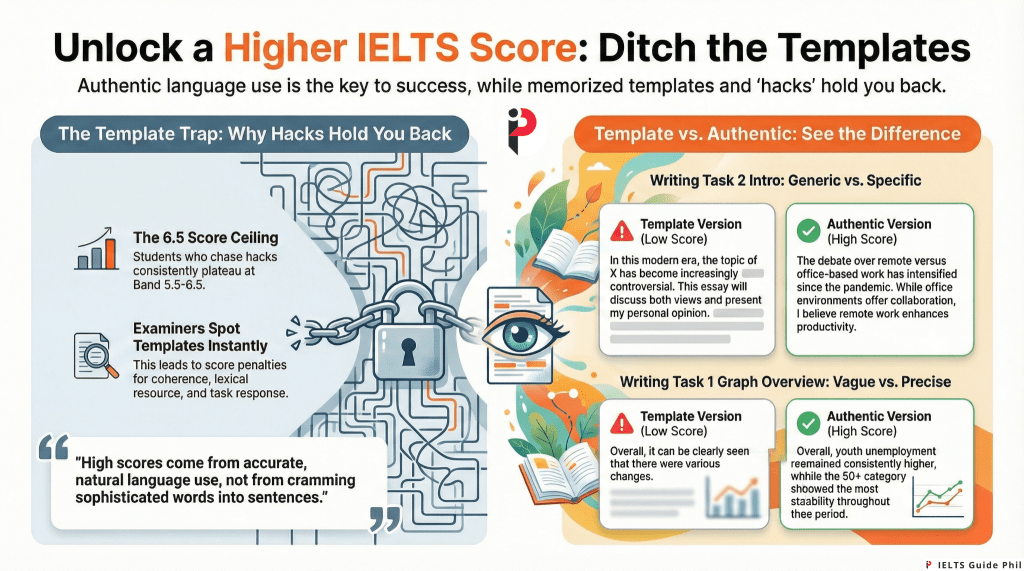
After working with hundreds of IELTS candidates and analyzing thousands of test results, I’ve witnessed a consistent pattern. Students who chase hacks plateau at Band 5.5-6.5. Meanwhile, those who focus on genuine language development and strategic test preparation consistently break through to Band 7.0 and beyond.
The Hidden Cost of IELTS Shortcuts
Why Templates Actually Lower Your Score
Memorized templates feel like a safety net. They’re comfortable and predictable. But IELTS examiners are trained to spot them instantly, and here’s what happens:
- Coherence penalties: Generic phrases like “It is often argued that…” or “There are those who believe…” don’t connect to YOUR specific argument. Examiners notice when your introduction sounds like it could fit any topic.
- Lexical resource damage: Using memorized vocabulary that doesn’t precisely fit the context signals to examiners that you’re regurgitating rather than thinking. This caps your Lexical Resource score at Band 6.0 maximum.
- Awkward transitions: Templates force you to squeeze your ideas into predetermined structures. The result? Unnatural flow that sounds mechanical rather than fluent.
- Task Response limitations: When you’re focused on filling a template, you’re not fully addressing the question. You’re completing a form, not developing a response.
Real example: A student scoring 6.0 used the template opening “In this modern era, the topic of X has become increasingly controversial” for every essay. When she switched to directly addressing each specific question with her own words, her Writing score jumped to 7.5 in two months—not because her English magically improved, but because she stopped hiding behind formulas.
The Speaking Section Trap
Speaking “hacks” are particularly dangerous because they’re so obviously rehearsed. Examiners conduct 10-15 interviews daily. They can spot memorized responses within seconds.
Warning signs examiners recognize:
- Unnatural enthusiasm for random topics (“Oh, I’m SO passionate about public transportation!”)
- Overly complex sentences that don’t match the candidate’s ability elsewhere
- Responses that don’t quite answer the question but sound impressive
- Identical vocabulary and sentence structures across different topics
- Sudden drop in quality when asked follow-up questions that deviate from the script
Why “Magic Phrases” Don’t Work
Lists of “Band 8 vocabulary” or “advanced linking words” miss a crucial point:
High scores come from accurate, natural language use, not from cramming sophisticated words into sentences.
Consider these common mistakes:
- Using “plethora” when “many” would be more natural
- Forcing “moreover” and “furthermore” into every paragraph
- Writing “in this day and age” repeatedly instead of being specific about time periods
Common (Ineffective) Writing Task 2 Templates You Should Avoid
Let me show you exactly what NOT to use. These templates circulate widely online and consistently hold students back:
Template 1: The Generic Opinion Essay Opening
What students memorize:
“In this modern era, the topic of [TOPIC] has become increasingly controversial. It is often argued that [POSITION A], while others believe that [POSITION B]. This essay will discuss both views and present my personal opinion. In my view, I strongly agree/disagree with this statement for several reasons.”
Why it fails:
- “Modern era” and “increasingly controversial” are filler phrases that add no meaning
- The structure is so generic it could apply to literally any topic
- “Several reasons” is vague and doesn’t preview your actual argument
- Examiners recognize this word-for-word
What you should do instead: Directly address the specific question with precise language. For example, if the question asks: “Some people believe working from home is more productive than office work. Discuss both views and give your opinion.”
Write something like:
“The debate over remote versus office-based work has intensified since the pandemic forced millions to work from home. While office environments offer collaboration benefits, I believe remote work typically enhances productivity for most knowledge workers due to reduced commute time and fewer workplace distractions.”
Notice: Specific context, clear position, actual reasons previewed.
Template 2: The “Magic” Body Paragraph Structure
What students memorize:
“Firstly, one of the main reasons why [POSITION] is that [REASON]. For instance, according to recent research, [VAGUE STATISTIC]. Moreover, this demonstrates that [RESTATE REASON]. Furthermore, another point to consider is that [SECOND REASON]. Therefore, it is clear that [CONCLUSION].”
Why it fails:
- Excessive linking words that don’t actually link ideas logically
- “According to recent research” without citing actual research is a red flag
- “Furthermore” and “Moreover” used in the same paragraph is overkill
- The paragraph structure is robotic and unnatural
What you should do instead: One paragraph = one main idea, developed naturally. For example:
“Remote work eliminates commuting, which directly increases productive hours. The average American spends 54 minutes daily traveling to and from work, according to the U.S. Census Bureau. This represents over 4.5 hours weekly that remote workers can redirect toward actual work or personal recovery. In my own experience transitioning to remote work, I gained an extra hour daily that I now use for focused morning work when my concentration is highest.”
Notice: Clear topic sentence, specific evidence, personal example, natural flow without forced transitions.
Template 3: The Cookie-Cutter Conclusion
What students memorize:
“In conclusion, after analyzing both sides of the argument, it is clear that [RESTATE POSITION]. Although there are some drawbacks, the advantages outweigh the disadvantages. It is recommended that [VAGUE SUGGESTION]. In the future, [PREDICTION].”
Why it fails:
- “After analyzing both sides” claims work you may not have actually done
- “Advantages outweigh disadvantages” is a cliché
- Vague recommendations and predictions add no value
- This sounds like every other Band 6.0 essay
What you should do instead: Briefly synthesize your main points and end decisively:
“While office work offers valuable face-to-face collaboration, the productivity gains from remote work—time saved, flexibility gained, and focus improved—make it the superior option for most professional roles in today’s digital economy.”
Notice: Acknowledges the counterpoint, restates your position with your specific reasons, ends cleanly.
Template 4: The Advantage/Disadvantage Essay Formula
What students memorize:
“There are several advantages of [TOPIC]. The first benefit is [ADVANTAGE 1]. The second benefit is [ADVANTAGE 2]. However, there are also some disadvantages. The main drawback is [DISADVANTAGE 1]. Another negative aspect is [DISADVANTAGE 2].”
Why it fails:
- List-like structure with no development or depth
- “Several,” “some,” “main” are all vague
- No examples, evidence, or real analysis
- Reads like a grocery list, not an essay
What you should do instead: Develop each advantage/disadvantage as a full paragraph with explanation and examples:
“Online education offers unprecedented accessibility to learners worldwide. Students in rural Bangladesh can now access MIT lectures that would have been impossible to attend in person. This democratization of knowledge has enabled millions to pursue degrees and skills training regardless of geographic or economic constraints. However, this same accessibility comes with a significant limitation: the absence of hands-on learning experiences. Medical students cannot perform virtual surgeries, and chemistry students cannot conduct actual experiments through a screen.”
Notice: Each point is fully developed, specific, with concrete examples.
Common (Ineffective) Writing Task 1 Academic Templates You Should Avoid
Task 1 Academic requires describing visual data (graphs, charts, tables, diagrams, maps). Templates here are especially problematic because they ignore the specific data patterns.
Template 1: The Robotic Introduction
What students memorize:
“The [graph/chart/table] shows/illustrates/depicts/demonstrates information about/regarding/concerning [TOPIC] in/from/during [TIME PERIOD]. Overall, it can be clearly seen that [VAGUE OVERVIEW].”
Why it fails:
- Uses synonyms (“shows/illustrates/depicts”) unnecessarily—just pick one
- “Information about/regarding/concerning” adds no value—the visual already shows this
- “It can be clearly seen that” is wordy filler
- The overview is usually too vague to be useful
What you should do instead: Paraphrase the title efficiently and give a specific overview:
Original title: “UK unemployment rates by age group, 2010-2020”
Template version:
“The line graph depicts information regarding unemployment rates across different age groups in the United Kingdom during the period from 2010 to 2020. Overall, it can be clearly seen that there were various changes.”
Better version:
“The line graph compares unemployment rates across three age groups in the UK between 2010 and 2020. Overall, youth unemployment remained consistently higher than other age groups, while the 50+ category showed the most stability throughout the period.”
Notice: Concise paraphrase, specific overview identifying the main trends.
Template 2: The Mechanical Data Description
What students memorize:
“According to the graph, [CATEGORY A] stood at [NUMBER] in [YEAR]. Then it increased/decreased to [NUMBER] in [YEAR]. After that, it went up/down to [NUMBER]. Finally, it reached [NUMBER] in [YEAR].”
Why it fails:
- Describes every single data point chronologically without grouping or comparing
- “According to the graph” is redundant—where else would the data come from?
- “Then… After that… Finally” creates a monotonous list
- No analysis of trends, just data dumping
What you should do instead: Group similar trends and compare categories:
Template version:
“According to the graph, Category A stood at 25% in 2010. Then it increased to 30% in 2012. After that, it went up to 35% in 2015. Finally, it reached 40% in 2020. Category B stood at 15% in 2010. Then it decreased to 12% in 2012…”
Better version:
“Category A experienced steady growth throughout the period, rising from 25% in 2010 to 40% by 2020. In contrast, Category B showed a declining trend, dropping from 15% to 8% over the same timeframe. The gap between these two categories widened significantly, particularly after 2015 when Category A’s growth accelerated.”
Notice: Trends are analyzed, categories are compared, patterns are identified, no repetitive listing.
Template 3: The Useless Comparison Phrases
What students memorize: Students collect these phrases and force them into every Task 1:
- “It is interesting to note that…”
- “It is worth mentioning that…”
- “It is clear/apparent/evident that…”
- “As can be seen from the graph…”
- “Another striking feature is that…”
Why they fail:
- They add no actual information—just filler
- “Interesting” and “striking” are subjective opinions you shouldn’t include
- “As can be seen” is redundant—the examiner can see the graph too
What you should do instead: Just state the facts clearly without these crutches:
Template version:
“It is interesting to note that sales increased significantly. As can be seen from the graph, it is clear that there was a dramatic rise. Another striking feature is that profits also went up considerably.”
Better version:
“Sales increased by 150% between March and June, while profits grew more modestly at 45% over the same period.”
Notice: Specific data, clear comparison, no filler phrases.
Template 4: The Process Diagram Formula
What students memorize: For process diagrams:
“The diagram shows/illustrates the process of [PROCESS]. There are [NUMBER] stages in this process. First/Firstly, [STEP 1]. Second/Secondly, [STEP 2]. Then/Next/After that, [STEP 3]. Finally/Lastly, [FINAL STEP].”
Why it fails:
- Too mechanical and repetitive
- “There are X stages” wastes words stating the obvious
- “First, Second, Then, Next” becomes monotonous
- No connecting logic—just numbered steps
What you should do instead: Describe the process with logical connections and groupings:
Template version:
“The diagram illustrates the process of chocolate production. There are seven stages in this process. First, cocoa pods are harvested. Second, the pods are opened. Third, the beans are fermented. Fourth, the beans are dried. Fifth, the beans are roasted. Sixth, the beans are crushed. Finally, the chocolate is produced.”
Better version:
“The diagram illustrates how chocolate is produced from cocoa pods through a seven-stage process. Initially, ripe cocoa pods are harvested and opened to extract the beans, which then undergo fermentation for several days to develop flavor. Once fermented, the beans are sun-dried before being roasted at high temperatures. The roasted beans are crushed to remove their shells, yielding cocoa nibs that are ground into a liquid paste. This paste is then processed and refined to produce the final chocolate product.”
Notice: Stages are grouped logically, passive voice used appropriately, connections between steps are clear, variety in sentence structure.
Common (Ineffective) Writing Task 1 General Training Templates You Should Avoid
Task 1 General Training requires writing a letter (formal, semi-formal, or informal). Templates here create particularly obvious problems.
Template 1: The Formulaic Letter Opening
What students memorize: Formal:
“Dear Sir or Madam, I am writing this letter to express my [complaint/concern/interest] regarding [TOPIC]. I would like to bring to your attention that [ISSUE].”
Informal:
“Dear [NAME], Hi! How are you? I hope you are doing well and everything is fine. I’m writing to tell you about [TOPIC].”
Why they fail: Formal:
- “I am writing this letter to…” is redundant—of course you’re writing a letter
- “Express my complaint/concern” is unnecessarily formal
- “Bring to your attention” is bureaucratic padding
Informal:
- “How are you? I hope you are doing well and everything is fine” wastes 11 words saying nothing
- Real friends don’t write like this
- Every informal letter sounds identical
What you should do instead:
Formal – Better version: If you’re complaining about a damaged product:
“Dear Sir or Madam,
I recently purchased a laptop from your online store (Order #12345, dated January 15th) and received it with a cracked screen. I am requesting a replacement or full refund.”
Notice: Gets straight to the point, includes specific details, states the purpose clearly.
Informal – Better version: If you’re inviting a friend to your wedding:
“Dear Sarah,
I have exciting news! I’m getting married on June 15th, and I’d love for you to be there. The ceremony is at 3pm at Riverside Gardens in Manchester.”
Notice: Natural, warm, immediately shares the news, no padding.
Template 2: The Mechanical Letter Body
What students memorize:
“Firstly, I would like to mention that [POINT 1]. Secondly, another point I would like to make is that [POINT 2]. Moreover, I would also like to add that [POINT 3]. Furthermore, it is important to note that [POINT 4].”
Why it fails:
- “Firstly, Secondly, Moreover, Furthermore” in a letter sounds like an essay, not correspondence
- “I would like to mention/make/add” is repetitive padding
- No natural flow or personality
- Doesn’t adapt to letter type (complaint vs. request vs. invitation)
What you should do instead:
For a complaint letter:
Template version:
“Firstly, I would like to mention that the service was poor. Secondly, another point I would like to make is that the food was cold. Moreover, I would also like to add that the staff was rude. Furthermore, it is important to note that I am very disappointed.”
Better version:
“I have three main concerns about my dining experience. The service was unacceptably slow—we waited 45 minutes for our appetizers. When the food finally arrived, it was cold and appeared to have been sitting under a heat lamp. Additionally, when I politely asked to speak with the manager, the server responded dismissively and walked away.
This experience was particularly disappointing because I had recommended your restaurant to my colleagues, and we were celebrating an important business milestone.”
Notice: Natural progression, specific details, personal context, appropriate tone.
Template 3: The Generic Letter Closing
What students memorize:
Formal:
“I look forward to hearing from you at your earliest convenience. Thank you for your time and consideration. Yours faithfully/sincerely, [NAME]”
Semi-formal:
“I hope to hear from you soon. Thanks a lot. Best regards, [NAME]”
Informal:
“I hope to see you soon. Take care and stay in touch. Love, [NAME]”
Why they fail:
- “At your earliest convenience” is a cliché that everyone uses
- “Thank you for your time and consideration” adds no value
- These closings are identical regardless of the letter’s purpose or urgency
- Don’t match the specific situation or relationship
What you should do instead:
Match your closing to the letter type:
For a complaint requiring action:
“I expect a full refund within 14 days. Please confirm the refund process by email within 48 hours.
Yours faithfully, John Smith”
For a job application:
“I am available for an interview at your convenience and can be reached at 07700 900123.
Yours sincerely, Emma Wilson”
For an invitation to a friend:
“Let me know by March 1st if you can make it—I need to finalize numbers with the caterer. Really hope you can be there!
Love, Rachel”
Notice: Each closing includes specific next steps or timelines, matches the formality level, feels purposeful.
Template 4: The One-Size-Fits-All Tone
What students memorize: Students use the same formal phrases for ALL letter types:
- “I am writing to inform you…”
- “I would like to request…”
- “I would appreciate it if you could…”
- “Thank you for your attention to this matter…”
Why it fails: Using formal business language in a letter to a friend makes you sound like a robot. The examiner assesses whether you can adjust your tone appropriately.
What you should do instead:
Recognize the three formality levels:
Formal (someone you don’t know: company, official, stranger):
“I am writing to request information about your photography courses. Could you please send me details about start dates, fees, and entry requirements?”
Semi-formal (someone you know professionally: colleague, teacher, neighbor):
“I’m writing to ask if you could recommend a good accountant for my small business. I remember you mentioned using an excellent one last year.”
Informal (friend, family member):
“Guess what? I finally passed my driving test! Want to go for a road trip next weekend to celebrate?”
Notice: Vocabulary, sentence length, contractions, and directness all shift based on relationship.
What Actually Works for Writing Task 1 Academic
Instead of templates, master these essential skills:
1. Write a Meaningful Overview
The overview is the most important part—it should identify the main trend, highest/lowest values, or most significant feature.
Poor overview:
“Overall, there were various changes over the period.”
Strong overview:
“Overall, while fossil fuel consumption declined steadily, renewable energy sources tripled their share of total energy production, with solar power showing the most dramatic growth.”
2. Group Data Logically
Don’t describe every data point. Group similar trends:
Poor organization:
Describe Country A, then Country B, then Country C separately…
Strong organization:
“Countries A and B both experienced population decline, falling by 12% and 15% respectively. In contrast, Country C saw substantial growth of 23%.”
3. Use Precise Vocabulary for Changes
Vary your language for trends:
Increases: rose, climbed, grew, surged, peaked at, reached a high of Decreases: fell, dropped, declined, plummeted, hit a low of Stability: remained stable, plateaued, stayed constant, fluctuated around Degree: dramatically, sharply, gradually, slightly, marginally, substantially
4. Include Specific Data
Band 7+ requires supporting your description with figures:
Vague: “Exports increased significantly.” Specific: “Exports surged from $2.5 million to $8.3 million, representing a 232% increase.”
5. Make Relevant Comparisons
Link data points:
“While urban population grew by 15%, rural population declined by 8%, resulting in a widening gap between these demographics.”
What Actually Works for Writing Task 1 General Training
Instead of templates, focus on these fundamentals:
1. Identify the Letter Type Correctly
The task will tell you the situation and relationship. Read carefully:
Complaint to company = Formal Request to teacher/employer = Semi-formal
Invitation to friend = Informal
2. Address All Bullet Points
The task gives you three bullet points to cover. Plan one paragraph for each, plus introduction and closing.
Example task: “You recently purchased a product online that arrived damaged. Write to the company to:
- Explain what you ordered and what was wrong
- Describe how this affected you
- Say what you want the company to do”
Structure:
- Para 1: State purpose—damaged product received
- Para 2: Specific details of order and damage
- Para 3: Impact (couldn’t use for important event, wasted time)
- Para 4: Resolution desired (refund/replacement, timeframe)
- Closing
3. Match Your Tone to the Relationship
Formal:
- Full sentences, no contractions, polite indirect requests
- “I would be grateful if you could…”
- “Could you please confirm…”
Semi-formal:
- Mix of formal and casual, occasional contractions acceptable
- “I’d appreciate if you could…”
- “Could you let me know…”
Informal:
- Contractions, casual language, direct questions
- “Can you…?”
- “Let me know…”
4. Use Natural, Purpose-Driven Language
Every sentence should serve the letter’s purpose. Cut padding:
Padded: “I am writing this letter for the purpose of informing you about the fact that I will not be able to attend.”
Natural: “I’m writing to let you know I can’t attend the meeting on Friday.”
5. End with Appropriate Action
Tell the recipient what you want to happen next:
Complaint: “I expect a replacement within 7 days.” Request: “Please let me know by Friday if this is possible.” Invitation: “RSVP by March 15th so I can finalize arrangements.”
Common (Ineffective) Speaking Templates You Should Avoid
Part 1 Template: The Over-Extended Answer
What students memorize:
Q: “Do you like reading?” A: “Well, that’s an interesting question. Actually, I would have to say that yes, I’m quite keen on reading, particularly in my leisure time. To be more specific, I’m really into mystery novels because they help me unwind after a long day at work. For instance, recently I read a book called [MEMORIZED BOOK NAME] which was absolutely fascinating and kept me on the edge of my seat.”
Why it fails:
- Part 1 requires brief, natural answers—this is too long and formal
- “That’s an interesting question” is a filler everyone uses
- “Quite keen on,” “to be more specific,” “absolutely fascinating” all sound rehearsed
- The answer follows an obvious formula: yes + why + example
What you should do instead: Be conversational and genuine:
“Yes, I love reading, especially before bed. Mystery novels are my favorite—they help me relax. I just finished Agatha Christie’s ‘Murder on the Orient Express.’”
Notice: Natural, concise, authentic. This is how real people talk.
Part 2 Template: The Memorized Story
What students memorize: For any “Describe a person” topic:
“I would like to talk about my grandmother, who is an incredibly inspiring individual. She was born in [YEAR] in [PLACE] and has had a fascinating life journey. What makes her special is her determination and kindness. She has always been there for me during difficult times and has taught me valuable life lessons. I remember one particular incident when [MEMORIZED STORY]. This experience taught me the importance of [VIRTUE]. In conclusion, she is someone I deeply admire and respect.”
Why it fails:
- The same structure works for every person, making it obviously templated
- “Incredibly inspiring,” “fascinating life journey,” “valuable life lessons” are clichés
- The conclusion signals you’ve run out of things to say
- If the examiner asks follow-up questions outside this script, you’ll struggle
What you should do instead: Use your preparation minute to note specific details about THIS topic, then speak naturally:
“I’ll talk about my uncle Chen, my mother’s younger brother. He’s a chef in Shanghai, and what makes him interesting is how he completely changed careers at 40. He was an accountant for 15 years—stable job, good income—but he was miserable. One day he quit and enrolled in culinary school. His parents thought he was crazy, throwing away security like that. But now, five years later, he owns a small restaurant that’s always packed. What I admire most is his courage to start over. When I visit, he lets me help in the kitchen, and I’ve learned that it’s never too late to pursue what you actually love. He’s proof that taking risks can work out.”
Notice: Specific person, specific story, specific details, natural delivery, genuine reflection.
Part 3 Template: The “Academic” Response
What students memorize:
“That’s a really thought-provoking question. From my perspective, there are several factors to consider. On the one hand, [POINT A]. On the other hand, [POINT B]. However, in my opinion, I believe that [POSITION]. This is mainly because [REASON]. For example, in my country [VAGUE EXAMPLE]. Therefore, I would conclude that [RESTATE POSITION].”
Why it fails:
- “Thought-provoking question” is overused filler
- “On the one hand… on the other hand” structure is fine occasionally, but not for every answer
- The language is unnaturally formal and structured
- “In my country” examples are often vague and generic
What you should do instead: Engage with the question directly and develop your ideas naturally:
Q: “Why do you think some people prefer living in cities while others prefer rural areas?”
“I think it comes down to priorities. City people value convenience and opportunity—everything’s close by, there are more job options, better schools, entertainment. But that comes at a cost: noise, pollution, higher expenses, less space. Rural people prioritize peace, nature, community. They’re willing to drive 30 minutes to a store in exchange for quiet and open space. Personally, I grew up in a small town and moved to the city for university. I miss the tranquility, but I wouldn’t give up the access to museums, diverse restaurants, and career opportunities the city offers.”
Notice: Direct answer, balanced perspective, specific trade-offs, personal connection, natural flow.
The Universally Memorized Phrases That Backfire
Students memorize these “high-level” phrases and jam them into every response:
❌ “It goes without saying that…”
❌ “There’s no denying that…”
❌ “It is worth mentioning that…”
❌ “To cut a long story short…”
❌ “As far as I’m concerned…”
❌ “If my memory serves me correctly…”
❌ “I’m really into…”
❌ “I’m quite keen on…”
❌ “Absolutely fascinating”
❌ “Incredibly inspiring”
❌ “Extremely beneficial”
Why they fail: When examiners hear these phrases repeatedly, in the exact same contexts, from dozens of candidates daily, they know you’ve memorized them. These phrases don’t demonstrate language ability—they demonstrate memorization.
What to use instead: Natural English that comes from actual language use: ✅ “I think…”
✅ “In my experience…”
✅ “What I’ve noticed is…”
✅ “I really enjoy…”
✅ “I’m interested in…”
✅ “That was really interesting”
✅ “That inspired me”
✅ “That’s really helpful”
The simpler, natural version actually scores higher because it sounds genuine.
What Actually Works: The Two-Pillar Approach
Successful IELTS preparation balances two essential elements:
- Genuine language development (building actual English proficiency)
- Strategic test technique (understanding and practicing the specific IELTS format)
Neither alone is sufficient. You need both working together. Let’s break down exactly how to approach each.
Pillar 1: Build Real Language Skills
Reading: Active Engagement Over Passive Consumption
Reading comprehension isn’t about speed reading tricks or skimming strategies. It’s about developing genuine understanding skills.
What to do:
- Read critically: Choose articles from The Guardian, The Economist, Scientific American, or BBC. After reading, summarize the main argument in your own words. What’s the author really saying?
- Track unknown vocabulary in context: Don’t just memorize word lists. When you encounter “mitigate,” note the entire sentence: “Governments must mitigate climate change effects.” This teaches collocation and usage patterns.
- Practice inference: Ask yourself, “What does the author imply but not state directly?” This skill is essential for “True/False/Not Given” questions.
- Analyze structure: How do writers organize complex information? Notice topic sentences, transitions, and how paragraphs build arguments. You’ll internalize these patterns for your own writing.
What NOT to do:
- Don’t only practice IELTS reading tests. Real improvement comes from broader reading.
- Don’t look up every word immediately. Try to infer meaning first.
- Don’t read passively for quantity. Better to deeply understand 2 articles weekly than skim 20.
Writing: Develop Your Voice and Precision
Writing skill develops through regular practice with feedback, not through memorizing model answers.
What to do:
- Write daily, even briefly: Keep a 10-minute journal responding to prompts: “Should cities ban cars from downtown areas?” Focus on clearly expressing YOUR position with specific reasons.
- Study paragraph development: Each paragraph needs: topic sentence + explanation + example/evidence + concluding sentence that links back. Practice this structure until it becomes automatic.
- Get specific feedback: Generic praise doesn’t help. You need comments like: “Your thesis isn’t clear” or “This example doesn’t support your point.” Consider online IELTS tutors or writing exchange partners.
- Rewrite, don’t just move on: After receiving feedback, rewrite the same essay addressing the issues. This is where real learning happens.
- Analyze your errors: Keep an error log. If you repeatedly confuse “affect” and “effect,” create focused practice exercises.
- Practice describing visuals: For Academic candidates, practice describing any graph or chart you encounter—news articles often include them. For General Training candidates, write emails and letters for real purposes (booking appointments, making requests, inviting friends).
What NOT to do:
- Don’t memorize entire sample essays. This creates dependency, not skill.
- Don’t write without timing yourself occasionally. You need to know your natural pace.
- Don’t use vocabulary you don’t fully understand. Accuracy beats complexity.
Listening: Active Processing
Listening skills improve through engaged attention to diverse English accents and contexts.
What to do:
- Diverse exposure: Listen to BBC podcasts, TED talks, Australian news broadcasts, academic lectures on YouTube. IELTS includes British, American, Australian, and other accents.
- Predictive listening: Before hearing answers, predict what information you’ll need. If the question asks for a date, listen for time markers.
- Note-taking practice: Listen to a 3-minute segment. Take notes. Summarize the main points. Compare with the transcript. Where did you miss information?
- Shadowing technique: Play audio, pause, and repeat what you heard, imitating pronunciation and intonation. This builds both listening and speaking skills.
What NOT to do:
- Don’t only listen to materials at your comfort level. Challenge yourself progressively.
- Don’t rely on subtitles. Use them only for checking comprehension afterward.
Speaking: Fluency Through Genuine Communication
Speaking fluency emerges from regular, meaningful use of English, not from rehearsing scripts.
What to do:
- Speak daily: Use language exchange apps, join English conversation groups, or even record yourself discussing topics. Consistency matters more than duration.
- Think in English: Narrate your day internally in English. “I’m making coffee. I prefer it black because…” This builds automatic language generation.
- Extend your answers: Practice the 3-E technique: Express your opinion, Explain why, give an Example. “Do you like reading? Yes, I enjoy mystery novels. They help me relax after work. For instance, I recently read…”
- Record and analyze: Record yourself answering IELTS Part 2 topics. Listen critically. Did you hesitate? Repeat words? Use varied vocabulary? Make specific improvement goals.
- Learn chunks, not individual words: Instead of memorizing “beneficial,” learn phrases like “beneficial for society,” “mutually beneficial,” “prove beneficial in the long run.”
What NOT to do:
- Don’t memorize answers to predicted questions. Examiners will deviate from your script.
- Don’t focus solely on “impressive” vocabulary at the expense of natural communication.
- Don’t avoid topics you find difficult. That’s precisely where you need practice.
Pillar 2: Master Strategic Test Techniques
Once your language foundation is developing, strategic test preparation makes a significant difference. But notice the order: technique enhances existing skills; it can’t replace them.
Reading Strategies
- Skim first, then scan: Read the passage title, first sentences of paragraphs, and any headings. Understand the overall structure before tackling questions. Then scan for specific details.
- Keywords and synonyms: Questions rarely use the exact words from the passage. If a question mentions “economic benefits,” the passage might say “financial advantages.” Practice identifying paraphrases.
- Time management discipline: Allocate 20 minutes per passage maximum. If stuck on a question, mark it and move on. Return if time permits.
- True/False/Not Given mastery: True = stated in passage. False = contradicted in passage. Not Given = neither confirmed nor contradicted. Don’t use outside knowledge.
Writing Task 1 Academic Strategies
- Spend 2 minutes analyzing the visual: Identify the main trend, highest/lowest points, most significant changes. This becomes your overview.
- Don’t describe every data point: Group similar trends. If three countries all increased, discuss them together.
- Use appropriate graph language: Line graphs show trends over time. Bar charts compare categories. Pie charts show proportions. Tables present detailed data. Match your language to the visual type.
- Include specific numbers: “Increased significantly” is vague. “Rose from 25% to 68%” is precise.
- Aim for 170-180 words: Minimum is 150, but slightly over gives you room for detail without rushing.
Writing Task 1 General Training Strategies
- Identify formality level immediately: Read who you’re writing to. Stranger/company = formal. Teacher/colleague = semi-formal. Friend/family = informal.
- Cover all three bullet points: Plan one paragraph per bullet point. Don’t merge them or you might miss requirements.
- Use appropriate opening/closing:
- Formal: “Dear Sir or Madam,” / “Yours faithfully,”
- Semi-formal: “Dear Mr./Ms. [Name],” / “Yours sincerely,” or “Best regards,”
- Informal: “Dear [First Name],” / “Love,” or “Best wishes,” or “Cheers,”
- Make your purpose clear immediately: Don’t waste words with “How are you?” in formal letters. State why you’re writing in the first sentence.
- Include specific requests/next steps: “Please confirm by Friday” or “Let me know your decision” gives clear direction.
Writing Task 2 Strategies
- Analyze the question thoroughly: Spend 2-3 minutes identifying task type, key words, and what’s specifically required. “Discuss both views and give your opinion” requires different structure than “To what extent do you agree?”
- Plan before writing: 5 minutes of planning saves you from mid-essay confusion. Outline: position, main points, supporting examples.
- Clear thesis statement: Your introduction should clearly state your position. Don’t leave the examiner guessing what you think.
- Paragraph = One idea: Each body paragraph develops one main point thoroughly. Don’t scatter multiple ideas across paragraphs.
- Specific examples: Vague support like “many people” or “these days” weakens arguments. Use: “According to recent research from the University of Oxford…” or “In my home country, Japan…”
Listening Strategies
- Use reading time strategically: Preview questions, underline keywords, predict answer types (number, name, date?). This primes your brain for what to listen for.
- Watch for distractors: IELTS often presents information then corrects it. “The meeting is at 3pm… actually, let’s make it 4pm.” The answer is 4pm, not 3pm.
- Spelling and grammar count: Write clearly. If the answer is “February,” spelling it “Febuary” loses the point.
- Transfer answers carefully: You get 10 minutes at the end. Double-check word limits and that you’ve transferred every answer.
Speaking Strategies
- Part 1 – Be natural and conversational: Answer directly, then add 1-2 sentences of detail. Don’t overthink these questions.
- Part 2 – Structure your 2 minutes: Use the preparation minute to note: Introduction (what/when/where), Main points (why/how), Personal reflection (what it meant to you). This gives your talk clear organization.
- Part 3 – Develop abstract thinking: These questions require analysis and opinion. Practice answering “why” and “how” questions with multiple reasons.
- Buy thinking time naturally: Instead of “umm,” use: “That’s an interesting question. Let me think…” or “Well, from my perspective…”
Common Mistakes and How to Fix Them
| Mistake | Why It Hurts Your Score | The Fix |
|---|---|---|
| Over-preparing Part 2 Speaking topics | Your answer sounds rehearsed, lacks spontaneity, and doesn’t respond to the actual question nuances | Practice organizing thoughts in 1 minute, not memorizing content. Focus on delivery skills. |
| Writing Task 1 Academic without an overview | Missing the overview (identifying main trends) caps your Task Achievement score at Band 5 | Always write 1-2 sentences identifying the most significant feature or overall trend. |
| Using informal language in Task 1 General formal letters | Shows you can’t adjust register appropriately, limiting your score | Learn the difference: “I want” (informal) vs. “I would like to request” (formal) |
| Describing every data point in Task 1 Academic | Creates a list, not an analysis. Shows poor selectivity. | Group similar trends and compare categories instead of listing chronologically. |
| Writing without planning | Ideas become disorganized mid-essay, weak coherence, off-topic paragraphs | Always spend 5 minutes outlining position and main points before writing. |
| Ignoring word limits in Writing | Under 150/250 words = penalty. Far over = rushed conclusion or incomplete proofreading | Practice writing to length. Know your handwriting density (words per line). |
| Leaving Reading questions blank | Zero points guaranteed. No penalty for guessing. | Always answer every question. Make educated guesses when necessary. |
| Panicking when you don’t know a word in Listening | You lose focus and miss subsequent answers | Write what you hear phonetically. Move immediately to the next question. Audio doesn’t repeat. |
| Not addressing all bullet points in Task 1 GT letters | Automatic penalty for incomplete task response | Before you finish, check that you’ve covered all three bullet points explicitly. |
| Using the same level of formality for all Task 1 GT letters | Shows inability to adjust tone to audience, limiting your score | Practice identifying: formal (stranger), semi-formal (acquaintance), informal (friend). |
Frequently Asked Questions
Q: How long does it realistically take to improve from Band 6.0 to 7.5?
A: It depends on your starting proficiency and daily practice intensity. With focused daily study (2-3 hours), most students see 0.5 band improvement every 2-3 months. So 6.0 to 7.5 typically requires 6-9 months of consistent effort. This isn’t about cramming; it’s about genuine language development. Shortcuts can’t accelerate this fundamental growth process.
Q: Can I still use some templates for Writing, just more flexibly?
A: The problem isn’t structure; it’s rigidity. Having a mental framework is fine: introduction that states position, body paragraphs with topic sentences, conclusion that summarizes without introducing new ideas. What damages scores is pre-written language that doesn’t fit the specific question. Learn organizational patterns, not memorized sentences.
Q: What if I don’t have access to a tutor for Writing feedback?
A: Several alternatives: (1) Online IELTS forums where experienced candidates provide peer feedback, (2) Language exchange where you correct someone’s work in your language and they correct your English, (3) AI writing assistants for grammar checking (but not for generating content), (4) Self-assessment using official IELTS band descriptors, honestly comparing your work against Band 7+ criteria.
Q: Is it worth taking the test multiple times?
A: Yes, if you’re using gaps between attempts to actually improve, not just hoping for better luck. Each test costs $200-250. Before rebooking, honestly assess: Have I addressed my weaknesses? Have I practiced new strategies? Am I measurably better than last time? If the answer is “I hope so,” you’re not ready. Wait until you can confidently say yes.
Q: Should I focus on my weakest section or strengthen my strongest?
A: Both strategically. You need minimum scores in all sections for most purposes (usually 6.5 or 7.0 across all bands). So first, bring all sections to acceptable levels. Once you’re there, improving strengths is often easier and faster than fixing deep weaknesses. A 7.5 in Reading can sometimes compensate for a 6.5 in Writing when overall band score matters.
Q: Are official Cambridge practice tests enough, or do I need other materials?
A: Official tests are essential for realistic practice and understanding formats. But they’re limited in quantity. Use them as periodic assessments, not daily practice. Supplement with: authentic English materials (news articles, podcasts, academic lectures), skills-building exercises (grammar workbooks, vocabulary apps), and strategic technique practice. Save official tests for timed simulation closer to your test date.
Q: For Task 1 Academic, should I write about every category in the graph?
A: No. Select and report the main features. If a graph shows 8 countries but 5 follow similar patterns, group them: “Five countries (A, B, C, D, and E) all experienced growth between 15-20%.” Focus on the most significant data—highest, lowest, biggest changes, overall trends.
Q: In Task 1 General Training, how do I know if it’s formal, semi-formal, or informal?
A: Look at who you’re writing to:
- Formal: Someone you’ve never met (company representative, government office, service provider)
- Semi-formal: Someone you know professionally but not personally (teacher, employer, neighbor you’re not friends with)
- Informal: Someone you have a personal relationship with (friend, family member, close colleague)
The task wording gives clues: “Write to the manager” = formal. “Write to your friend” = informal.
Q: What’s the single most important thing to focus on?
A: Consistency. Not any particular technique or resource. Daily engagement with English, even 30 minutes, beats weekend cramming sessions. Your brain needs regular exposure to build language patterns. Students who study 30 minutes daily for 6 months outperform those who study 3 hours on weekends. Build sustainable habits.
The Bottom Line
IELTS success isn’t mysterious or exclusive to naturally talented language learners. It’s the predictable result of two factors working in tandem:
- Genuine English proficiency developed through consistent, engaged practice across all skills
- Strategic test technique that helps you demonstrate your abilities effectively under time pressure
The shortcuts promise you can skip step 1. They can’t deliver on that promise. Templates, hacks, and memorized responses are substitutes for the real work, and examiners recognize them immediately.
Here’s what actually works:
- Read actively and analytically every day
- Write regularly with feedback and revision
- Listen to diverse English content
- Speak English in genuine communication contexts
- Practice test formats strategically
- Analyze and address your specific weaknesses
- Learn to describe data naturally (Academic Task 1)
- Practice adjusting formality levels (General Training Task 1)
This path requires more time and effort than downloading a template PDF. But it’s the only path that leads where you want to go.
The students who achieve Band 7.5+ aren’t using secrets you don’t know about. They’re simply doing the work that shortcuts promise to bypass. They’re building real skills that serve them not just on test day, but in their academic programs, professional careers, and daily lives in English-speaking environments.
Stop looking for the easy way. There isn’t one.
Start building genuine proficiency. That’s what works.
#IELTSPreparation #IELTSTips #IELTSWriting #IELTSSpeaking #IELTSReading #IELTSListening #EnglishLearning #IELTSExam #Band7Plus #IELTSSuccess #TestPreparation #EnglishProficiency #AcademicEnglish #LanguageLearning #IELTSStudy #IELTSAdvice #NoShortcuts #RealResults #IELTSStrategies #EnglishTest #StudyAbroad #IELTSGoals #EffectiveLearning #LanguageSkills #IELTSJourney #IELTSWritingTask1 #IELTSAcademic #IELTSGeneralTraining #GraphDescription #LetterWriting #IELTSGuidePhil
 IELTS Guide Phil
Leave a comment