
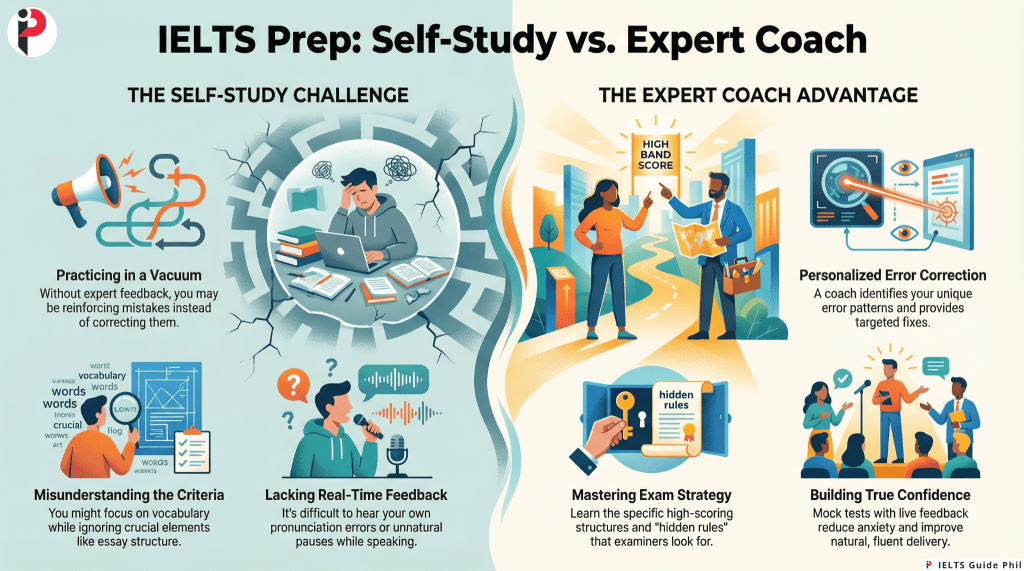
Preparing for the IELTS exam can feel like navigating a maze blindfolded. You know where you want to go—that coveted band score—but the path isn’t always clear. While self-study has its place, working with an expert IELTS coach can be the difference between struggling to reach your target score and achieving it with confidence. This is especially true for the Writing and Speaking sections, where subjective assessment meets strict criteria.
Let me walk you through exactly why an experienced coach matters and how they can transform your IELTS preparation journey.
The Problem with Self-Study Alone
Many test-takers spend months practicing essays and recording themselves speaking, only to see minimal improvement in their scores. Why? Because they’re practicing in a vacuum. Without expert feedback, you might be reinforcing mistakes rather than correcting them. You could be using sophisticated vocabulary incorrectly, organizing your essays in ways that don’t meet examiner expectations, or speaking with pronunciation issues you can’t even hear yourself.
An expert coach acts as your mirror, your guide, and your strategic partner in this journey.
How an Expert Coach Transforms Your IELTS Writing Skills
Understanding the Hidden Assessment Criteria
The IELTS Writing section isn’t just about good English. It’s about meeting four specific criteria: Task Achievement/Response, Coherence and Cohesion, Lexical Resource, and Grammatical Range and Accuracy. Each carries equal weight, and many candidates focus on the wrong areas.
What a coach does: An experienced coach knows exactly how examiners think because they understand the marking rubric inside and out. They can tell you that your beautiful vocabulary won’t save an essay that doesn’t fully address the task, or that your grammatical perfection means little if your ideas lack logical progression.
Example: A student once told me she always wrote five-paragraph essays because that’s what she learned in school. Her Task 2 essays were well-written but consistently scored 6.5 because she was following an American academic format rather than the IELTS structure. Within two sessions, we restructured her approach, and her score jumped to 7.5.
Personalized Error Correction
We all have blind spots. Maybe you consistently misuse articles, or perhaps your sentence structures are repetitive. These patterns are invisible to you but glaringly obvious to a trained eye.
What a coach does: They identify your specific error patterns and create targeted exercises to eliminate them. Instead of generic grammar drills, you work on exactly what you need.
Example: One common mistake I see is students overusing transition words, thinking more is better. They write things like “Moreover, furthermore, in addition, the government should…” A coach teaches you that one transition per idea is sufficient and that overuse actually reduces your Coherence and Cohesion score.
Teaching the Architecture of High-Scoring Essays
There’s a specific architecture to IELTS essays that isn’t intuitive. Task 1 reports require different organizational patterns depending on whether you’re describing a process, comparing data, or explaining a map. Task 2 essays need clear thesis statements, topic sentences, and supporting evidence presented in specific ways.
What a coach does: They provide you with proven templates and frameworks while teaching you to adapt them authentically so your writing doesn’t sound robotic.
How an Expert Coach Elevates Your IELTS Speaking Performance
Real-Time Feedback That Books Can’t Provide
You can read a hundred articles about speaking fluently, but only a live coach can tell you in the moment that you’re pausing too long, using filler words excessively, or not extending your answers sufficiently.
What a coach does: They conduct mock speaking tests that replicate real exam conditions and provide immediate, actionable feedback. They catch issues like these:
- You’re answering Part 1 questions with just one sentence when you should add a reason or example
- Your Part 2 monologue lacks structure and jumps between ideas
- You’re not using a range of tenses in Part 3, sticking only to present simple
- Your pronunciation of certain sounds is affecting intelligibility
Example: Many students from certain language backgrounds struggle with word stress, saying “PHOtograph, phoTOgraphy, photoGRAphic” with the same stress pattern. This significantly impacts the Pronunciation criterion. A coach can drill these patterns until they become automatic.
Building Confidence and Reducing Anxiety
The IELTS Speaking test is inherently stressful. You’re being judged by a stranger, often recorded, and expected to discuss complex topics spontaneously. Anxiety kills fluency.
What a coach does: Through regular practice sessions, they desensitize you to the exam environment. You become comfortable thinking on your feet and maintaining fluency even when you don’t know the perfect word.
Teaching Strategic Conversation Management
High-scoring candidates don’t just speak well; they speak strategically. They know how to extend answers naturally, use discourse markers effectively, and demonstrate range without sounding rehearsed.
What a coach does: They teach you techniques like the “Why-Example-Alternative” method for Part 1, the “PREP” structure (Point-Reason-Example-Point) for Part 2, and how to engage analytically in Part 3 discussions.
Example: When asked “Do you like cooking?” a band 5 candidate might say “Yes, I like cooking.” A coached band 7+ candidate might say “I’d say I’m quite passionate about it, actually. I find it therapeutic after a long day, and I love experimenting with different cuisines. Just last week I attempted making Thai green curry from scratch, which turned out surprisingly well.”
Common Mistakes and How Coaches Fix Them
Writing Mistakes
Mistake 1: Memorizing and regurgitating essays
Many students memorize entire essays or large chunks of text, hoping to reproduce them in the exam. Examiners are trained to spot this, and it results in severe penalties.
The fix: A coach teaches you flexible frameworks and idea banks, not scripts. You learn principles, not paragraphs.
Mistake 2: Ignoring word count requirements
Writing significantly under or over the word count (150 for Task 1, 250 for Task 2) affects your score.
The fix: Coaches train you to gauge length instinctively and develop concise writing habits. They also teach you what to cut if you’re over and what to add if you’re under.
Mistake 3: Using informal language in formal tasks
Phrases like “a lot of,” “kids,” or “stuff” are too casual for academic IELTS writing.
The fix: Coaches provide appropriate alternatives and help you develop a formal register naturally. “A lot of” becomes “a significant number of” or “considerable,” “kids” becomes “children,” and “stuff” becomes “items” or “things” depending on context.
Mistake 4: Not answering all parts of the question
Task 2 questions often have multiple parts: “Discuss both views and give your opinion” or “What are the causes and solutions?” Missing any part tanks your Task Response score.
The fix: Coaches teach you to underline and number each question component, ensuring your essay addresses everything explicitly.
Speaking Mistakes
Mistake 1: One-word or very short answers in Part 1
Answering “Where are you from?” with just “Italy” suggests limited ability.
The fix: Coaches drill the “direct answer + extension” formula. “I’m from Italy, specifically from Milan in the north. It’s a bustling city known for fashion and design.”
Mistake 2: Stopping mid-monologue in Part 2
If you run out of things to say after one minute in Part 2, it signals poor fluency and limits your score.
The fix: Coaches teach you techniques to extend ideas, such as comparing past and present, discussing different perspectives, or adding relevant personal anecdotes.
Mistake 3: Using overly simple vocabulary repetitively
Constantly saying “good,” “bad,” or “important” without variety limits your Lexical Resource score.
The fix: Coaches expand your active vocabulary with synonyms and collocations. “Good” becomes “beneficial,” “advantageous,” or “valuable” depending on context.
Mistake 4: Correcting yourself excessively
While some self-correction is natural, constantly stopping and restarting sentences disrupts fluency.
The fix: Coaches encourage you to keep moving forward. If you make a small error, continue speaking. The Fluency criterion values smooth delivery over perfect accuracy.
The Strategic Advantage: Dos and Don’ts
IELTS Writing Dos
- Do spend time planning before writing (5 minutes for Task 1, 5-10 for Task 2)
- Do use a clear paragraph structure with topic sentences
- Do include specific examples and evidence to support your points
- Do proofread in the last 2-3 minutes, focusing on your common errors
- Do use a range of complex sentences, not just simple or compound ones
- Do write in a formal academic style for both tasks
- Do answer the question directly and completely
IELTS Writing Don’ts
- Don’t give your personal opinion in Task 1 (it’s a report, not an essay)
- Don’t copy phrases directly from the question
- Don’t use bullet points or informal formatting
- Don’t introduce completely new ideas in your conclusion
- Don’t use contractions (can’t, don’t) in formal writing
- Don’t rely on templates so heavily that your writing sounds unnatural
- Don’t spend more than 20 minutes on Task 1 (leave 40 for Task 2, which is worth more)
IELTS Speaking Dos
- Do extend your answers naturally with reasons and examples
- Do use a variety of grammatical structures and tenses
- Do make eye contact with the examiner to show confidence
- Do ask for clarification if you don’t understand a question
- Do use discourse markers naturally (however, additionally, for instance)
- Do speak at a natural pace, not too fast or too slow
- Do show your personality and engage naturally with topics
IELTS Speaking Don’ts
- Don’t memorize and recite scripted answers (examiners notice immediately)
- Don’t use overly complicated words you’re not comfortable with
- Don’t worry excessively about minor mistakes; fluency matters more
- Don’t give yes/no answers without elaboration
- Don’t go silent for long periods; keep talking even if you need thinking time
- Don’t use informal slang unless discussing it as a topic
- Don’t argue with the examiner or become defensive
Frequently Asked Questions
Q: How long does it take to see improvement with a coach?
Most students notice improvements within 3-4 weeks of regular coaching (2-3 sessions per week). However, moving from one band score to the next typically requires 6-8 weeks of focused work, depending on your starting level and target score.
Q: Can’t I just watch YouTube videos instead of hiring a coach?
YouTube videos provide general information, but they can’t give you personalized feedback on your specific errors. A coach tailors instruction to your needs, identifies your blind spots, and holds you accountable. Think of it like learning to swim: videos help, but you need someone watching to tell you when your form is off.
Q: What’s the difference between a general English teacher and an IELTS coach?
An IELTS coach specializes in exam strategy and understands the specific assessment criteria. They know what examiners look for and can teach you to meet those expectations efficiently. A general English teacher focuses on overall language development, which is valuable but not always aligned with IELTS scoring.
Q: Is group coaching as effective as one-on-one sessions?
One-on-one coaching provides more personalized attention and faster progress. However, small group sessions (3-5 students) can be valuable for practicing Speaking Part 3 discussions and getting exposure to different perspectives. The ideal approach often combines both.
Q: How do I know if a coach is experienced and qualified?
Look for coaches who have official IELTS examiner training or extensive experience preparing students. Ask about their students’ success rates and average score improvements. A good coach should provide a sample assessment in your first session to diagnose your current level.
Q: What if I’m already at band 7 but need 8 or 8.5?
This is where expert coaching becomes even more critical. The jump from 7 to 8+ requires eliminating subtle errors and demonstrating exceptional range and precision. An experienced coach can fine-tune your performance at this advanced level.
Q: Should I focus on Writing or Speaking first?
Most coaches recommend addressing both simultaneously but with different emphases depending on your weaker area. Writing improvements often take longer because they involve changing ingrained writing habits, while Speaking can show quicker gains with regular practice.
Q: How much practice do I need outside of coaching sessions?
Expect to dedicate at least 1-2 hours daily to practice between sessions. Your coach will assign specific tasks, and the more consistently you practice, the faster you’ll improve. Quality practice with feedback loops is more valuable than quantity alone.
The Bottom Line: Investment vs. Return
Hiring an expert IELTS coach is an investment, but consider the alternative costs. Retaking the IELTS exam costs approximately $200-300 each time. If coaching helps you achieve your target score on your first or second attempt instead of your third or fourth, it pays for itself. Beyond the financial aspect, there’s the emotional cost of repeated disappointment and the opportunity cost of delayed applications for university or immigration.
An experienced coach doesn’t just teach you English; they teach you the game. They’ve seen thousands of essays and speaking performances. They know what works, what doesn’t, and how to get you from where you are to where you need to be in the most efficient way possible.
Your IELTS score can open doors to your dream university, career opportunities abroad, or a new life in another country. With stakes this high, why leave your success to chance? An expert coach ensures you’re not just preparing hard, but preparing smart.
Ready to transform your IELTS preparation? Seek out a qualified, experienced coach who can provide the personalized guidance you need. Your future self will thank you for making this investment.
#IELTS #IELTSPreparation #IELTSWriting #IELTSSpeaking #IELTSCoaching #IELTSTips #IELTSExam #EnglishLearning #StudyAbroad #IELTSTest #BandScore #IELTSSuccess #EnglishTest #IELTSStrategies #TestPreparation #LanguageLearning #IELTSHelp #AcademicEnglish #IELTSBand7 #IELTSBand8 #ExamPreparation #IELTSGuidePhil
 IELTS Guide Phil
Leave a comment