
Every year, millions of candidates sit for the IELTS (International English Language Testing System) exam, hoping to achieve their target band scores for university admission, professional registration, or immigration purposes. While test-takers focus intensely on improving their English skills, there’s a whole dimension of IELTS success that often goes unnoticed: understanding how IELTS examiners think and what they’re actually looking for. After years of examining IELTS tests across all four components—Listening, Reading, Writing, and Speaking—examiners have accumulated invaluable insights that could dramatically improve your test performance.
This comprehensive guide reveals the insider perspectives that IELTS examiners wish every test-taker understood before sitting for their exam.
Understanding the IELTS Examiner’s Perspective
IELTS examiners aren’t adversaries trying to trip you up—they’re trained professionals tasked with fairly assessing your English language proficiency according to specific band descriptors and criteria. Most IELTS examiners genuinely want you to demonstrate your best abilities and achieve the score you deserve. Understanding their role and the strict assessment criteria they must follow can transform how you approach the test.
What IELTS Examiners Are Really Assessing
Beyond just checking if your English is correct, IELTS examiners evaluate several dimensions of your language performance across four key criteria (for Writing and Speaking). They’re assessing your Task Achievement/Response (how well you address all parts of the task), Coherence and Cohesion (how well-organized and logically connected your ideas are), Lexical Resource (your range and accuracy of vocabulary), and Grammatical Range and Accuracy (your use of varied and correct grammar structures). For Listening and Reading, they’re evaluating your ability to understand main ideas, details, opinions, and implied meanings. Different question types test different skills, and recognizing this helps you tailor your responses appropriately.
The Hidden Rules of IELTS Success
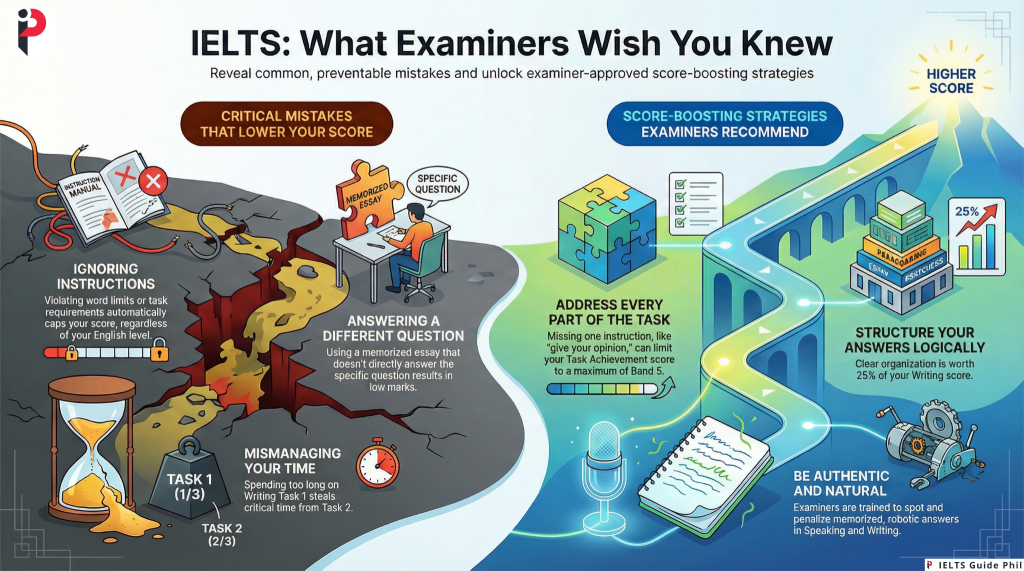
Read Instructions Like Your Band Score Depends on It (Because It Does)
One of the most frustrating experiences for IELTS examiners is marking answers from candidates who clearly didn’t read the instructions carefully. In Writing Task 2, when the question asks you to “discuss both views and give your opinion,” but you only discuss one view, you’re immediately limited to a maximum Band 5 for Task Achievement, regardless of how well you write. In Listening, when the instruction says “write NO MORE THAN TWO WORDS,” writing three words means zero marks for that answer, even if the content is correct.
Example scenario: An IELTS Writing Task 2 question reads: “Some people think that universities should provide graduates with the knowledge and skills needed in the workplace. Others think that the true function of a university should be to give access to knowledge for its own sake, regardless of whether the course is useful to an employer. Discuss both these views and give your own opinion.” A candidate who only writes about why universities should focus on employability, without discussing the alternative view, will receive a maximum of Band 5 for Task Achievement, even if their grammar and vocabulary are Band 8 level.
Answer the Actual Question Being Asked
IELTS examiners frequently encounter what they call “off-topic” responses—when candidates write extensively about a related topic instead of directly addressing what was asked. This happens because candidates often prepare certain topics thoroughly (like environmental problems or technology) and then try to force that prepared material into whatever question appears, regardless of fit.
Real-world example: Writing Task 2 asks: “Some people believe that unpaid community service should be a compulsory part of high school programs. To what extent do you agree or disagree?” A candidate writes extensively about the benefits of volunteer work and why it’s important for society, but never clearly states whether they agree or disagree with making it compulsory in high schools. The examiner must award low Task Response marks because the specific question wasn’t answered, despite the response showing good English ability.
Time Management Is a Skill, Not a Suggestion
IELTS examiners can immediately spot when a candidate ran out of time in the Writing test. The quality drops dramatically, handwriting becomes rushed and illegible, Task 2 essays become incomplete, and the conclusion is missing or rushed. Interestingly, spending too long on Task 1 (which should take about 20 minutes) often costs more marks than making minor mistakes on that task would have cost, because you don’t leave adequate time for Task 2 (which is worth twice as many marks and should take 40 minutes).
The golden rule IELTS examiners wish candidates followed: Task 1 deserves 20 minutes (150 words minimum), Task 2 deserves 40 minutes (250 words minimum). In the Speaking test, don’t give one-word answers in Part 1 or ramble for 5 minutes in Part 2—examiners are looking for specific response lengths that demonstrate fluency without excessive filler.
The DOs That Boost Your IELTS Band Score
DO structure your answers clearly. In Writing, use paragraphs with clear topic sentences and logical progression. IELTS examiners assess Coherence and Cohesion as a separate criterion worth 25% of your Writing score. A well-structured essay with clear introduction, body paragraphs, and conclusion makes it easier for examiners to award high marks.
DO address all parts of the task. In Writing Task 2, if the question asks you to discuss both views and give your opinion, you must do all three. Missing any part automatically limits your Task Achievement/Response score to Band 5, regardless of how good your English is.
DO use a range of vocabulary accurately. IELTS examiners are specifically looking for Lexical Resource. Use less common vocabulary and collocations where appropriate, but accuracy matters more than complexity. Saying “environmental degradation” correctly is better than attempting “ecological deterioration” and spelling it wrong.
DO vary your sentence structures. Grammatical Range and Accuracy is another 25% of your Writing score. Mix simple, compound, and complex sentences. Use different tenses, passive voice, conditionals, and relative clauses where natural. But remember: accuracy is more important than showing off—one error-free simple sentence is better than a complex sentence full of mistakes.
DO use cohesive devices appropriately. Words like “however,” “furthermore,” “consequently,” and “on the other hand” show sophisticated English, but only when used correctly and not overused. Examiners can spot mechanical overuse of linking words, which actually reduces your Coherence and Cohesion score.
DO write the minimum word count. For Writing Task 1, write at least 150 words. For Task 2, write at least 250 words. Writing significantly under the word count will reduce your Task Achievement score. Examiners don’t count words, but they can estimate, and short responses lose marks.
DO stay on topic throughout your response. Every sentence should relate to answering the question. IELTS examiners mark you down for irrelevant information, even if it’s well-written. Quality and relevance matter more than quantity.
DO write legibly. If an IELTS examiner cannot read your handwriting, they cannot award marks. In the Writing test, your handwriting will naturally become less perfect under time pressure, but it must remain decipherable. If your handwriting is genuinely poor, consider writing more slowly or printing in a clear style.
DO directly answer the question in Speaking Part 3. When the examiner asks “Why do you think some people prefer living in the countryside?” answer the question directly: “I think people prefer the countryside mainly because of the peaceful environment and lower cost of living…” Don’t start with “That’s an interesting question” or “In my country…” before getting to the actual answer.
DO extend your answers in Speaking Part 1. While you shouldn’t ramble, one-word answers will hurt your Fluency and Coherence score. Aim for 2-3 sentences per question. For example, if asked “Do you like cooking?” don’t just say “Yes.” Say “Yes, I really enjoy cooking, especially on weekends when I have more time. I find it relaxing and I like experimenting with different cuisines.”
DO speak naturally in the Speaking test. IELTS examiners are trained to recognize memorized or over-rehearsed answers, which will reduce your score. It’s fine to prepare ideas and vocabulary, but your delivery should sound natural and spontaneous, not like you’re reciting a script.
The DON’Ts That Lower Your IELTS Band Score
DON’T memorize and recite entire essays or Speaking answers. IELTS examiners are extensively trained to recognize memorized responses, and this will significantly reduce your score. Examiners may even stop you in Speaking and change the topic if they suspect memorization. Prepare ideas and vocabulary, but deliver them naturally.
DON’T write under the word count. Writing significantly fewer than 150 words for Task 1 or 250 words for Task 2 will result in a lower Task Achievement score. IELTS examiners are experienced at estimating word counts at a glance.
DON’T write informal language in Writing unless the task requires it. For Academic Writing, avoid contractions (don’t, can’t), phrasal verbs when there are formal alternatives (use “distribute” instead of “hand out”), and informal expressions. This reduces your score for Lexical Resource and tone appropriateness.
DON’T write bullet points in Writing Task 2. Essays must be written in full paragraphs with proper sentences. Bullet points or note form will result in a significant penalty to your Coherence and Cohesion score.
DON’T copy directly from the question. In Writing, paraphrase the question when introducing the topic. Copying whole phrases from the question doesn’t count toward your word count assessment for vocabulary range, and examiners view this negatively.
DON’T over-use transition words. Many candidates think that using “moreover,” “furthermore,” “in addition” in every sentence will increase their Coherence score. Actually, mechanical or inappropriate use of cohesive devices reduces your score. Use them naturally and accurately.
DON’T correct yourself repeatedly in Speaking. One or two self-corrections are fine and show self-awareness, but constantly stopping to correct minor errors breaks your fluency and reduces your Fluency and Coherence score. It’s often better to continue naturally than to interrupt yourself repeatedly.
DON’T give memorized examples that don’t fit. In Writing, if you use your prepared example about Steve Jobs’ innovation regardless of the actual question topic, examiners will notice the disconnect. Your examples must directly support your argument for the specific question asked.
DON’T write about topics the question doesn’t ask about. If the question is about whether governments should fund the arts, don’t write paragraphs about education or healthcare unless they directly relate to the arts funding question. Off-topic content receives no credit.
DON’T ignore the specific question type. “To what extent do you agree or disagree?” requires a different structure than “Discuss both views and give your opinion” or “Do the advantages outweigh the disadvantages?” Each requires a specific approach, and using the wrong structure limits your Task Achievement score.
DON’T leave questions blank in Listening or Reading. There’s no penalty for wrong answers, so always guess. You have a chance of being correct, whereas blank answers guarantee zero marks. In Listening, make sure you transfer your answers to the answer sheet—the examiner only marks what’s on the answer sheet.
DON’T try to use complex vocabulary you don’t understand. IELTS examiners prefer accurate, appropriate vocabulary over ambitious attempts that are incorrect. Using “ameliorate” incorrectly is worse than using “improve” correctly.
Common IELTS Mistakes and How to Fix Them
Mistake 1: Not Addressing All Parts of the Task
What it looks like: Writing Task 2 asks “Discuss both views and give your opinion,” but the candidate only discusses one view and states their opinion. Or the question asks “To what extent do you agree or disagree?” and the candidate writes about advantages and disadvantages instead.
Why it happens: Nervousness, not reading the question carefully, or using a memorized essay structure regardless of the actual question type.
The fix: Underline the key instruction words in the question (“discuss both views,” “to what extent,” “advantages outweigh disadvantages”). Plan your essay structure to match the specific question type. If it says “both views,” your essay must include paragraphs discussing BOTH perspectives, not just one.
Mistake 2: Poor Time Allocation in Writing
What it looks like: Spending 35 minutes on Writing Task 1 (worth 1/3 of your Writing score) and then having only 25 minutes left for Task 2 (worth 2/3 of your score). Task 2 ends up incomplete or rushed.
Why it happens: Lack of practice under timed conditions, perfectionism on Task 1, or not understanding the relative weighting of the two tasks.
The fix: Set clear time limits before you start: 20 minutes for Task 1 (including planning and checking), 40 minutes for Task 2. Practice with a timer until this becomes automatic. If you’re running over time on Task 1, stop and move to Task 2 even if Task 1 isn’t perfect—Task 2 is worth twice as much.
Mistake 3: Using Memorized or Formulaic Language
What it looks like: Starting every Speaking answer with “That’s a really interesting question, I’ve never thought about that before…” or beginning every Writing essay with “In this modern era” or “It is often said that…” IELTS examiners recognize these phrases instantly.
Why it happens: Over-reliance on templates from IELTS preparation courses or YouTube videos without understanding that examiners are trained to spot and penalize memorization.
The fix: Develop your own natural style. It’s fine to have some prepared ideas or vocabulary for common topics, but deliver them conversationally in Speaking and adapt your Writing structure to each specific question. Natural, relevant language always scores better than memorized phrases.
Mistake 4: Ignoring Word Count Requirements
What it looks like: Writing 120 words for Task 1 (minimum 150) or 200 words for Task 2 (minimum 250).
Why it happens: Poor time management, not practicing enough to develop a sense of length, or running out of ideas.
The fix: During practice, count your words until you develop an intuitive sense of how much 150 or 250 words looks like in your handwriting. Aim slightly above the minimum (170-180 words for Task 1, 270-280 for Task 2) to ensure you’re safely over the requirement. Plan your essays before writing to ensure you have enough ideas to reach the word count.
Mistake 5: Inappropriately Informal Language in Academic Writing
What it looks like: Using contractions (can’t, won’t, shouldn’t), phrasal verbs (put up with, get rid of), or colloquial expressions (stuff, a lot of, kids) in Academic IELTS Writing.
Why it happens: Writing the way you speak in casual English, or not understanding the difference between formal and informal register.
The fix: Learn the formal equivalents: cannot instead of can’t, tolerate instead of put up with, eliminate instead of get rid of, things/items instead of stuff, many/much instead of a lot of, children instead of kids. Practice rewriting informal sentences in formal style until it becomes natural.
Mistake 6: Not Transferring Listening Answers to the Answer Sheet
What it looks like: Writing answers in the question booklet during the Listening test but forgetting to transfer them to the answer sheet, or making mistakes during transfer.
Why it happens: Running out of time, panic, or not using the 10-minute transfer time effectively.
The fix: Use the 10 minutes given at the end of the Listening test wisely. Transfer answers carefully, check spelling (especially of names and addresses), and verify you’ve transferred to the correct number. Remember: only answers on the answer sheet are marked—the question booklet is not seen by the examiner.
Mistake 7: Giving Too-Short Answers in Speaking Part 1
What it looks like: Examiner: “What do you do in your free time?” Candidate: “I like sports.” Examiner: “What kinds of sports?” Candidate: “Football.”
Why it happens: Nervousness, misunderstanding that this is a test of fluency and range, or thinking short answers are more accurate.
The fix: Extend every Part 1 answer to 2-3 sentences. Use the strategy: direct answer + reason/detail + example/extra information. For example: “I like playing sports, especially football. I find it’s a great way to stay fit and relieve stress after work. I usually play with friends on weekends at a local park.” This shows better fluency, more vocabulary, and more grammatical range.
IELTS Examiner Insights by Test Component
Writing (Academic and General Training)
IELTS Writing examiners emphasize that successful responses demonstrate clear task achievement, coherent organization, appropriate vocabulary, and accurate grammar. They wish candidates understood that Writing is not about showing off the most complex English you know, but rather about communicating clearly and appropriately for the task.
The most impressive essays to IELTS examiners show a clear position (in Task 2), logical organization with well-developed paragraphs, relevant examples that support the argument, appropriate use of cohesive devices (not mechanical overuse), a range of vocabulary used accurately and appropriately, varied sentence structures with good control of grammar and punctuation, and formal academic tone maintained throughout (for Academic IELTS).
For Task 1 (Academic), examiners want you to describe trends and make comparisons, not just list every number in the chart. Identify the most significant features, group similar information, and describe general trends with specific data to support them. For Task 1 (General Training letters), use appropriate tone (formal, semi-formal, or informal as required), include all three bullet points from the task, and use appropriate letter conventions.
Reading
IELTS Reading examiners (who create and validate the tests) wish candidates knew that the answers follow the order of the text in most question types. They also emphasize that you should read the questions carefully—many candidates lose marks by not following instructions like “NO MORE THAN TWO WORDS” or “choose TWO letters.”
Examiners design distractors (wrong answers in multiple choice) based on common misunderstandings. Words that appear in both the text and a wrong answer option are often traps. The correct answer usually paraphrases the text rather than using identical words.
For True/False/Not Given and Yes/No/Not Given questions, examiners stress that “Not Given” means the information isn’t in the text—don’t use your own knowledge to assume something is true. Only use what’s stated or clearly implied in the passage.
Listening
IELTS Listening examiners wish candidates knew that spelling and grammar count. If the answer is “accommodation” but you write “accomodation,” you get zero marks, even though you heard correctly. Plural/singular matters too—if the recording says “computers” and you write “computer,” it’s wrong.
Pay attention to word limits: “NO MORE THAN TWO WORDS AND/OR A NUMBER” means exactly that. “Three young children” is three words—you’ll get zero marks even though the content is correct. The acceptable answer might be “3 young children” or just “3 children.”
Examiners report that candidates often don’t use the time before each section to read the questions and predict the type of information needed (a number? a name? a place?). This prediction skill helps you catch answers when they appear.
Speaking
IELTS Speaking examiners emphasize that they’re not marking your opinions or the truth of what you say—they’re marking your English. You can talk about a book you never read or a place you never visited, as long as you speak fluently and accurately. However, authenticity often makes it easier to speak naturally.
The most impressive Speaking performances to IELTS examiners show: natural fluency without long pauses or hesitations, extended answers in Part 1 (not one-word responses), clear organization in Part 2 (following the task card points), analytical responses in Part 3 (not just personal examples), a range of vocabulary including less common words and idiomatic expressions used naturally, varied and accurate grammar including complex structures, and clear pronunciation with natural intonation.
Examiners can tell when you’re reciting memorized answers, especially in Part 2. Your intonation becomes flat, you stare at a fixed point, and if they interrupt or ask a follow-up question, you struggle. Memorization can reduce your score by several bands. It’s fine to prepare ideas and vocabulary, but deliver them naturally and adapt to the specific question asked.
In Part 3, examiners want abstract discussion and analysis, not more personal stories. When asked “Why do some people prefer traditional ways of learning?” don’t just say “In my country, many people study with books…” Instead, analyze: “I think some people prefer traditional methods because they find face-to-face interaction more engaging, and perhaps because they’re more familiar with these approaches from their own educational background…”
The Psychology of IELTS Marking
Understanding how IELTS marking works can improve your strategic approach. All IELTS examiners work with detailed band descriptors that clearly define what each band score (1-9) looks like for each assessment criterion. They’re trained extensively and must pass certification and regular standardization checks to ensure consistency. They’re looking for opportunities to award marks, not reasons to deduct them.
For Writing and Speaking, there are four criteria, each worth 25% of your score. Your final score is the average of the four. This means you can’t compensate for very weak performance in one area with excellence in another. A Band 8 in Vocabulary doesn’t offset a Band 4 in Task Achievement—you need balanced competence across all criteria.
IELTS examiners are trained to be objective, but they’re human. Clear, well-organized responses that directly address the task make their job easier. Illegible handwriting, rambling answers, and unclear structure makes marking more difficult and may result in lower scores—not through bias, but because the examiner genuinely cannot assess your English if they can’t follow your meaning.
In Speaking, examiners note that candidates who engage naturally with them, make eye contact, and show genuine communication (even if imperfect) create a better impression than those who stare at the ceiling reciting memorized speeches. While impressions don’t change the band descriptors examiners must follow, natural communication helps you demonstrate your true speaking ability.
IELTS Question Types: What Examiners Look For
Listening and Reading: Multiple Choice
IELTS examiners design distractors (wrong answers) very carefully based on common misunderstandings. Often, words from the recording or text appear in wrong options to trap candidates who match words without understanding meaning. The correct answer usually paraphrases what you hear or read.
The best approach: Read the question and options before you listen/read, predict the type of information needed, listen/read for meaning not just word matching, and eliminate obviously wrong answers if unsure.
Reading: True/False/Not Given and Yes/No/Not Given
This question type frustrates many candidates, but examiners say the rule is simple: True/Yes means the statement matches the text, False/No means the statement contradicts the text, and Not Given means there’s no information about this in the text (or not enough to determine if it’s true or false).
Many candidates struggle with “Not Given” because they use their own knowledge or make assumptions. Examiners stress: only use information actually stated in the text. If it’s not there, it’s Not Given, even if you know it’s true in real life.
Reading: Matching Headings
Examiners report this is one of the most challenging question types. You need to identify the main idea of each paragraph, not just match a word that appears in both the heading and paragraph. Often the correct heading uses different vocabulary than the paragraph—it’s testing your ability to understand the overall meaning.
Strategy: Read the paragraph, identify the main idea in your own words, then find the heading that best matches that idea. Don’t just match keywords.
Listening: Form/Note/Table Completion
Examiners emphasize that spelling must be correct and you must follow word limits exactly. “NO MORE THAN TWO WORDS” means one or two words only—three words gets zero marks. The answers come directly from the recording, so don’t change words or paraphrase.
Also watch for plural/singular—if you hear “students” and write “student,” it’s wrong. And if the answer is a number, write the numeral (15) not the word (fifteen) unless the recording spells it out.
Writing Task 1 (Academic): Data Description
Examiners look for: clear overview statement identifying the most significant trends/features, logical organization (perhaps by time period or category), appropriate data selection (don’t describe every number—select significant data), accurate use of data (don’t misread the graph), and appropriate language for describing trends (rose, declined, fluctuated, remained stable).
Common mistake: Writing a conclusion with your opinion. Task 1 is descriptive only—don’t add personal views or explanations not shown in the data.
Writing Task 1 (General Training): Letter Writing
Examiners assess whether you’ve: addressed all three bullet points from the task, used appropriate tone (formal: Dear Sir/Madam, Yours faithfully; semi-formal: Dear Mr. Smith, Yours sincerely; informal: Dear John, Best wishes), included appropriate letter conventions (opening, paragraphing, closing), and achieved the purpose (complaining, requesting, explaining, etc.).
Writing Task 2: Essay
IELTS examiners evaluate essays against four criteria, and each criterion is equally important. For Task Achievement/Response, they check whether you’ve addressed all parts of the question, presented a clear position, developed your ideas adequately, and stayed relevant throughout.
Different question types require different approaches:
- “To what extent do you agree or disagree?” → State your position and support it
- “Discuss both views and give your opinion” → Discuss BOTH views before giving yours
- “Do advantages outweigh disadvantages?” → Discuss both then make a judgment
- “What are the causes and solutions?” → Identify causes AND propose solutions
Examiners report that many candidates lose marks by not matching their essay structure to the specific question type.
Speaking Part 1: Introduction and Interview
Examiners want extended but not excessive responses—2-3 sentences per question is ideal. They’re assessing whether you can communicate basic information about familiar topics fluently and accurately. One-word answers significantly reduce your Fluency score.
Speaking Part 2: Individual Long Turn
You have one minute to prepare and should speak for 1-2 minutes. Examiners provide a task card with a topic and 3-4 prompt points. They expect you to address all the prompts on the card. Speaking for only 30 seconds will limit your score, but rambling beyond 2 minutes (examiners will stop you) doesn’t help.
Examiners can tell if you’ve memorized a speech—your intonation becomes unnatural. It’s better to speak naturally about the actual topic than to recite a memorized speech about a different topic.
Speaking Part 3: Discussion
This is where examiners assess your ability to discuss abstract ideas, give opinions with reasons, analyze issues, and speculate. They want more developed, analytical responses than Part 1. Personal anecdotes are less appropriate here—focus on general analysis.
For example: Part 1: “Do you like reading?” → “Yes, I enjoy reading, especially before bed. I find it relaxing.” Part 3: “Why do you think reading is less popular among young people today?” → “I think several factors contribute to this. Primarily, digital entertainment offers more immediate gratification than reading requires…”
Frequently Asked Questions
Q: Should I write in pen or pencil for IELTS Writing?
A: You must use pencil for the IELTS Writing test (both Task 1 and Task 2). However, for the Listening and Reading answer sheets, pen is recommended (but pencil is also acceptable). Check your test center guidelines, but generally, Writing is always done in pencil so you can erase errors cleanly.
Q: What if I make a mistake and need to cross something out in Writing?
A: Simply draw a single line through the error so it’s still legible, and continue. Don’t spend time trying to erase perfectly or scribble it out completely—this wastes precious time. Examiners will mark your corrected answer and ignore crossed-out material. Clean erasures with pencil are fine if you have time.
Q: Do I lose marks for going over the word count in IELTS Writing?
A: No, there’s no penalty for writing more than the minimum (150 for Task 1, 250 for Task 2). However, writing excessively long responses (400+ words for Task 2) can hurt you if it means you run out of time, make more errors, or include irrelevant information. Quality matters more than quantity once you’ve met the minimum.
Q: Can I use American English or must I use British English?
A: Either is acceptable, and mixing them doesn’t directly lose marks. However, consistency looks more professional. Don’t write “colour” in one sentence and “color” in another, or “organise” then “organize.” Choose one variety and stick with it. Examiners accept both, plus Canadian and Australian English.
Q: Will I lose marks for spelling and grammar errors in IELTS?
A: Yes, spelling and grammar are part of your score. For Writing, “Grammatical Range and Accuracy” is one of four criteria (25% of your score). For Speaking, grammar is also 25% of your score. However, IELTS allows some errors—even Band 8 candidates make occasional mistakes. It’s about the frequency and whether errors impede communication.
Q: What if I don’t know the answer to a Reading or Listening question?
A: Always guess. There’s no penalty for wrong answers in IELTS, so a blank answer guarantees zero marks while a guess gives you a chance. In Listening, if you’re unsure, write your best guess on the answer sheet during the transfer time. Don’t leave anything blank.
Q: Can I use examples from my IELTS preparation course in Writing?
A: Yes, you can use any examples you know, whether from courses, reading, or personal knowledge. However, examples must be relevant to the specific question. Using your memorized Steve Jobs example for a question about environmental issues will look forced and irrelevant. Adapt your prepared material to fit each question.
Q: How much should I write for Writing Task 1 and Task 2?
A: Minimum 150 words for Task 1, minimum 250 words for Task 2. These are absolute minimums—writing significantly under loses marks. Aim for 170-180 words for Task 1 and 270-280 for Task 2 to safely exceed requirements. Examiners don’t count exactly but can estimate, and obviously short responses are penalized.
Q: What if the Speaking examiner interrupts me in Part 2?
A: This is normal after 2 minutes—examiners are instructed to stop you so the test stays on schedule. It doesn’t mean you did anything wrong. If you speak for less than 1 minute, that may indicate you need to extend your answers more. Aim for the full 1-2 minute range.
Q: Can I memorize essays and Speaking answers?
A: No. IELTS examiners are extensively trained to recognize memorized responses. If they suspect memorization in Speaking, they may ask unexpected follow-up questions or change topics. Memorized responses can reduce your score by several bands. Prepare ideas and vocabulary, but deliver them naturally and adapt to each specific question.
Q: How important is pronunciation in the Speaking test?
A: Pronunciation is one of four criteria (25% of your Speaking score). Examiners aren’t looking for perfect native-speaker pronunciation—they’re assessing whether you’re understandable and whether you use appropriate intonation and stress. A strong accent is fine as long as you’re clear. Practice individual sounds you find difficult and work on word stress and sentence intonation.
Q: Do I need to write a conclusion in Writing Task 1?
A: No, Task 1 is a report describing visual information (graphs, charts, diagrams, or processes). You should include an overview statement identifying the main trends or most significant features, but not a conclusion with your opinion. Save conclusions for Task 2 essays. Task 1 should be purely descriptive.
Q: What’s the difference between Task Achievement (Task 2) and Task Response (Task 1)?
A: These are actually the same criterion with different names. Task 1 calls it “Task Achievement” and assesses whether you’ve described the visual information appropriately. Task 2 calls it “Task Response” and assesses whether you’ve answered the essay question fully. Both evaluate how well you’ve completed the assigned task.
Q: Should I give my opinion in every Writing Task 2 essay?
A: Only if the question asks for it. “To what extent do you agree or disagree?” and “Discuss both views and give your opinion” explicitly require your opinion. “What are the causes and solutions?” does not—giving your personal opinion here is off-topic. Always let the specific question guide your approach.
Q: Can I see my IELTS answer sheets after the test?
A: No, answer sheets are confidential and not returned. You can request an Enquiry on Results (EOR) if you believe your score is incorrect. During EOR, your test is re-marked, but you still won’t see the original answer sheets. This is why it’s important to be confident in your performance as you complete each section.
Q: What if I finish Reading or Listening early?
A: In Reading, you have exactly 60 minutes, and you can use any remaining time to review your answers, check spelling, and ensure you’ve transferred answers to the answer sheet (Reading doesn’t have separate transfer time—you write directly on the answer sheet). In Listening, you have 30 minutes listening time plus 10 minutes to transfer answers. Use all the transfer time to check spelling, ensure proper capitalization, verify word limits, and check you’ve written answers in the correct numbered spaces.
Q: Does handwriting matter in IELTS Writing?
A: Yes. If the examiner cannot read your handwriting, they cannot award marks. Your handwriting doesn’t need to be beautiful, but it must be legible. If your handwriting is genuinely poor, consider writing more slowly, leaving slight spaces between words, and ensuring letters are distinct. Illegible responses can significantly hurt your score simply because the examiner cannot assess your English if they can’t read it.
Q: What’s the difference between “advantages/disadvantages” and “positive/negative developments”?
A: These are different question types requiring slightly different approaches. “Advantages/disadvantages” typically asks whether advantages outweigh disadvantages (requiring a judgment), or to discuss both (requiring balanced discussion). “Positive or negative development” asks whether something is positive, negative, or mixed (requiring evaluation and your position). Both need balanced discussion, but the focus differs slightly.
Final IELTS Success Strategies Examiners Recommend
As you prepare for your IELTS test, keep these examiner-approved strategies in mind:
Prioritize genuine English proficiency over test tricks. IELTS examiners can distinguish between genuine English ability and memorized templates or tricks. While understanding the test format is important, your fundamental goal should be improving your actual English skills—vocabulary range, grammatical accuracy, fluency, and comprehension.
Practice under timed conditions regularly. Knowing English is only half the battle; being able to demonstrate that knowledge under strict time limits is the other half. Regular timed practice for Writing (20 minutes Task 1, 40 minutes Task 2) and Speaking (11-14 minutes total) helps you develop both speed and the ability to perform under pressure.
Study the band descriptors, not just practice tests. The public band descriptors reveal exactly what examiners look for at each band level. This is invaluable—you can see precisely what distinguishes Band 6 from Band 7 or Band 7 from Band 8. Align your preparation with these criteria.
Develop a question analysis routine. Before writing anything in Writing or before speaking in Part 2, take time to analyze what’s being asked. In Writing, underline command words (discuss, agree/disagree, advantages/disadvantages) and identify the specific topic and all parts of the question. This prevents off-topic responses.
Master the art of task fulfillment. IELTS isn’t about showing off—it’s about completing tasks appropriately. For Writing, this means addressing every part of the question. For Speaking, this means answering what was asked without memorized speeches. For Listening and Reading, this means following instructions exactly (word limits, format requirements).
Quality and relevance over quantity. A concise, focused Writing Task 2 essay of 270 words that directly addresses all parts of the question will always outscore a 400-word response that rambles off-topic. In Speaking, a 2-minute response with clear organization and relevant ideas beats a 3-minute rambling monologue.
Learn from feedback on practice tests. When you receive feedback on Writing or Speaking from qualified IELTS instructors, don’t just look at the band score—analyze specifically which criteria cost you marks. Was it Task Achievement? Coherence? Vocabulary? Grammar? Identify patterns in your weaknesses and address them systematically.
Understand that IELTS tests communication, not perfection. Even Band 9 candidates make occasional errors. Examiners assess your overall ability to communicate effectively in English, not whether you’re perfect. Don’t let fear of mistakes prevent you from attempting more sophisticated language or expressing your ideas fully.
Practice authentic English use. Read English newspapers, watch English videos, listen to English podcasts, and speak English with practice partners. The candidates who score highest on IELTS are usually those who actively use English beyond just test preparation. IELTS tests your English ability, so improving your English itself is the most effective preparation.
For Speaking, practice naturally expressing ideas, not scripts. Record yourself answering practice questions, but don’t memorize your recordings. Instead, practice expressing the same ideas in different ways. This develops the flexibility and spontaneity that examiners value highly.
For Writing, read high-quality examples with analysis. Don’t just read sample essays—study why they received high scores. Which features demonstrate good Task Achievement? How is Coherence achieved? What vocabulary and grammar structures are used? Learn principles, not templates.
For Listening, develop prediction skills. Use the time before each section to read questions and predict: What type of information am I listening for? A number? A name? A place? A reason? This helps you catch answers when they appear in the recording.
For Reading, improve your scanning and skimming. You don’t have time to read every word carefully. Practice skimming paragraphs for main ideas and scanning for specific information. This skill is essential for completing 40 questions in 60 minutes.
The Bottom Line for IELTS Success
After speaking with IELTS examiners across multiple test centers and countries, one theme emerges consistently: most candidates lose band scores not through poor English ability but through preventable test-taking errors. Not reading questions carefully, poor time management, using memorized responses, not following instructions (especially word limits in Listening), inappropriate register in Writing, and failing to address all parts of the task account for significant band score reductions.
The good news is that these are entirely within your control to fix. You don’t need to study harder—you need to test smarter. Understand what IELTS examiners are looking for in each component, practice the specific skills each section tests as deliberately as you study vocabulary and grammar, and approach each question strategically.
Remember that IELTS examiners want to award you the band score your English deserves. They’re using objective criteria, not trying to trick you. Make their job easy by answering questions clearly and directly, following instructions precisely, managing your time wisely, and demonstrating your English ability authentically rather than through memorized scripts.
Your IELTS success depends on two types of preparation: improving your English proficiency and learning how to demonstrate that proficiency effectively within the IELTS format. Master both, and you’ll not only meet examiners’ expectations—you’ll exceed them and achieve the band score you need.
Good luck with your IELTS test!
#IELTS #IELTSPreparation #IELTSTips #IELTSWriting #IELTSSpeaking #IELTSReading #IELTSListening #IELTSExam #IELTSTest #IELTSStudy #IELTSBandScore #IELTSSuccess #IELTSExamTips #IELTSStrategy #IELTSPractice #EnglishTest #LearnEnglish #EnglishLanguage #StudyAbroad #IELTSGoals #IELTSMotivation #IELTSAdvice #IELTSExaminer #BandScore7 #BandScore8 #ImmigrationEnglish #IELTSAcademic #IELTSGeneral #EnglishProficiency #TestPreparation #IELTSGuidePhil
Have your own IELTS experiences or tips that worked for you? Share your thoughts in the comments below to help fellow test-takers achieve their target band scores!
 IELTS Guide Phil
Leave a comment