
For anyone navigating the world of English language assessment, two frameworks consistently appear: IELTS (International English Language Testing System) and CEFR (Common European Framework of Reference for Languages). While IELTS provides scores that institutions use for admissions and immigration, CEFR offers a standardized description of language ability across Europe and increasingly worldwide. Understanding how these two systems align is essential for learners, educators, and institutions alike.
What Are IELTS and CEFR?
IELTS is one of the world’s most popular English language proficiency tests, accepted by over 11,000 organizations globally. Test-takers receive scores from 0 to 9 in four skills: Listening, Reading, Writing, and Speaking, along with an Overall Band Score averaging these components.
CEFR is a descriptive framework that categorizes language proficiency into six levels, from A1 (beginner) to C2 (mastery). Originally developed for European languages, CEFR has become the international standard for describing language ability, providing detailed descriptors of what learners can do at each level.
The IELTS-CEFR Alignment
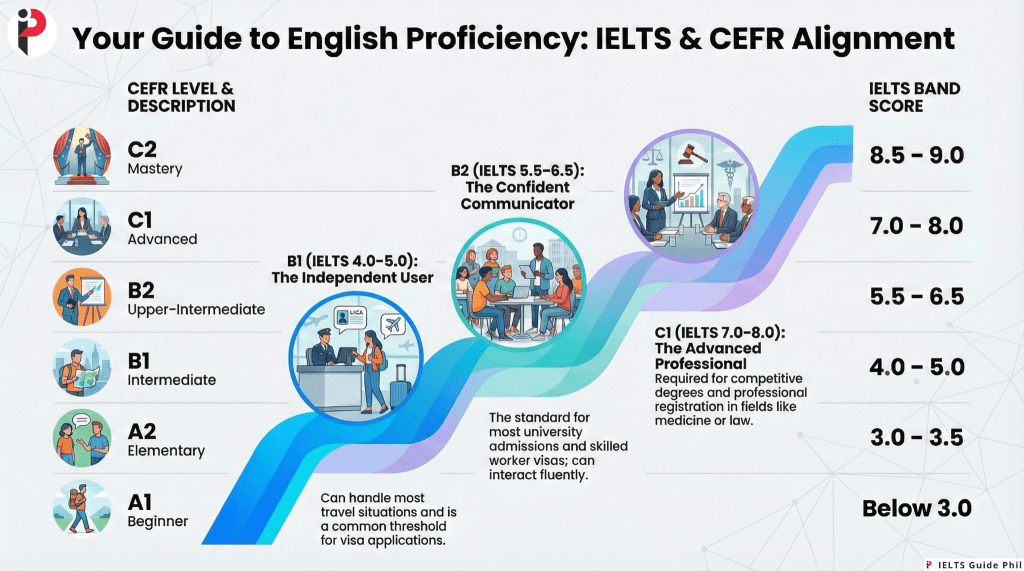
Research and official guidance from Cambridge Assessment English and other examining bodies have established clear correspondences between IELTS band scores and CEFR levels. Here’s how they align:
CEFR A1: Below IELTS Band 3
CEFR A2: IELTS Band 3.0–3.5
CEFR B1: IELTS Band 4.0–5.0
CEFR B2: IELTS Band 5.5–6.5
CEFR C1: IELTS Band 7.0–8.0
CEFR C2: IELTS Band 8.5–9.0
Let’s explore what language abilities characterize each level and what learners can typically accomplish.
A1 Level: Beginner (Below IELTS 3.0)
At the A1 level, learners are taking their first steps in English. This foundational stage involves basic communication in familiar everyday situations.
Listening Skills: A1 learners can understand simple phrases and the highest frequency vocabulary related to areas of immediate personal relevance, such as basic personal and family information, shopping, and local geography. They need speakers to talk slowly and clearly with pauses for comprehension.
Reading Skills: At this level, readers can understand familiar names, words, and very simple sentences, such as notices, posters, and catalogs. They typically read very short, simple texts one expression at a time, picking up familiar names and basic phrases.
Writing Skills: A1 writers can produce simple isolated phrases and sentences. They might fill in forms with personal details, write a short simple postcard, or compose basic texts about themselves with heavy reliance on memorized phrases.
Speaking Skills: Beginners can interact in a simple way if their conversation partner speaks slowly and is prepared to help. They can use simple phrases and sentences to describe where they live and people they know, asking and answering basic questions about familiar topics.
A2 Level: Elementary (IELTS 3.0–3.5)
A2 represents a progression into elementary proficiency, where learners can handle simple, routine communication about familiar matters.
Listening Skills: Learners at A2 can understand phrases and the highest frequency vocabulary related to personal and family information, shopping, employment, and immediate surroundings. They can catch the main point in short, clear, simple messages and announcements.
Reading Skills: A2 readers can understand short, simple texts on familiar matters containing high-frequency everyday or job-related language. They can find specific, predictable information in simple everyday material like advertisements, prospectuses, menus, and timetables.
Writing Skills: At this level, writers can produce simple connected text on familiar topics or personal interest. They can write short, simple notes and messages, personal letters describing experiences and impressions, and basic descriptions of events.
Speaking Skills: A2 speakers can communicate in simple, routine tasks requiring direct exchange of information on familiar topics. They can describe their background, immediate environment, and matters of immediate need using simple language and connected phrases.
B1 Level: Intermediate (IELTS 4.0–5.0)
B1 marks the threshold to independent language use. Learners can maintain interaction and get across what they want to in familiar contexts, though with noticeable limitations.
Listening Skills: B1 learners can understand the main points of clear standard speech on familiar matters regularly encountered in work, school, and leisure. They can understand the main point of many radio or television programs on current affairs or topics of personal interest when delivery is relatively slow and clear.
Reading Skills: Intermediate readers can understand texts consisting mainly of high-frequency everyday or job-related language. They can grasp descriptions of events, feelings, and wishes in personal letters, and follow the general meaning of straightforward factual texts on familiar topics.
Writing Skills: B1 writers can produce simple connected text on familiar topics or personal interest. They can write personal letters describing experiences, impressions, events, and feelings with reasonable accuracy, and can express opinions though with some difficulty in complex arguments.
Speaking Skills: At this level, speakers can deal with most situations likely to arise while traveling in an English-speaking area. They can enter unprepared into conversation on familiar topics, narrate a story or describe something, and briefly give reasons and explanations for opinions and plans.
B2 Level: Upper-Intermediate (IELTS 5.5–6.5)
B2 represents solid intermediate proficiency and is often the minimum level required for university admission in English-speaking countries. Learners demonstrate increasing fluency and spontaneity.
Listening Skills: B2 learners can understand extended speech and lectures, following even complex lines of argument when the topic is reasonably familiar. They can understand most television news and current affairs programs, as well as the majority of films in standard dialect.
Reading Skills: Upper-intermediate readers can read articles and reports concerned with contemporary problems where writers adopt particular attitudes or viewpoints. They can understand contemporary literary prose and grasp complex ideas, though may occasionally need to verify particular details, especially if the text is idiomatic.
Writing Skills: B2 writers can produce clear, detailed text on a wide range of subjects. They can write essays or reports, passing on information or giving reasons supporting or opposing a particular point of view. Their writing shows good control of grammar and vocabulary, though some errors may persist.
Speaking Skills: At this level, speakers can interact with a degree of fluency and spontaneity that makes regular interaction with native speakers quite possible without strain for either party. They can present clear, detailed descriptions on a wide range of subjects, explain viewpoints on topical issues, and discuss the advantages and disadvantages of various options.
C1 Level: Advanced (IELTS 7.0–8.0)
C1 marks the advanced stage where learners demonstrate effective operational proficiency. This level indicates the ability to use language flexibly and effectively for social, academic, and professional purposes.
Listening Skills: C1 learners can understand extended speech even when it’s not clearly structured and relationships between ideas are only implied rather than signaled explicitly. They can follow extended discussion and complex technical information, understanding films without too much effort even when speakers use idioms and slang.
Reading Skills: Advanced readers can understand long, complex texts, appreciating subtle distinctions of style and implicit as well as explicit meaning. They can read contemporary literary texts with ease and understand specialized articles outside their field, though may need to check technical terminology.
Writing Skills: C1 writers can express themselves fluently and spontaneously in clear, well-structured, detailed text on complex subjects. They can write clear, well-structured expositions of complex subjects, underlining relevant salient issues and expanding points of view at some length with supporting detail and examples. Their writing demonstrates controlled use of organizational patterns and a wide range of cohesive devices.
Speaking Skills: At this level, speakers can express themselves fluently and spontaneously without much obvious searching for expressions. They can use language flexibly and effectively for social and professional purposes, formulating ideas and opinions with precision and relating their contributions skillfully to those of other speakers. They can present clear, detailed descriptions of complex subjects, developing particular points and rounding off with an appropriate conclusion.
C2 Level: Mastery (IELTS 8.5–9.0)
C2 represents mastery or proficiency, the highest level on the CEFR scale. Learners at this level can understand and produce language with precision, appropriateness, and ease in virtually all contexts.
Listening Skills: C2 learners can understand any kind of spoken language with ease, whether live or broadcast, even when delivered at fast native speed. They can follow complex interactions between third parties in group discussion and debate, understanding implicit attitudes and relationships between speakers.
Reading Skills: Mastery-level readers can understand virtually all forms of written language, including abstract, structurally complex, or highly colloquial literary and non-literary writings. They can appreciate subtle distinctions of style and understand texts containing plays on words, cultural references, and obscure allusions.
Writing Skills: C2 writers can produce clear, smoothly flowing, complex text in an appropriate and effective style with a logical structure that helps the reader find significant points. They can write summaries and reviews of professional or literary works, employing an appropriate style and demonstrating sophisticated control of language and humor where appropriate.
Speaking Skills: At the mastery level, speakers can take part effortlessly in any conversation or discussion with complete fluency and accuracy. They can present ideas articulately, convey finer shades of meaning precisely, and handle difficult questions smoothly. Their speech demonstrates sophisticated language control, allowing them to backtrack and restructure around a difficulty so smoothly that the interlocutor is hardly aware of it.
Why This Equivalency Matters
Understanding the IELTS-CEFR correspondence serves several important purposes. For learners, it provides a clearer picture of what their IELTS score means in terms of real-world language ability. Someone with IELTS 6.5 (B2) knows they’re expected to handle most everyday situations with reasonable fluency but may still struggle with highly specialized or nuanced content.
For institutions, the equivalency helps standardize admission requirements across different testing systems. A university can accept students at B2 level whether they present IELTS, TOEFL, or Cambridge certificates, ensuring consistent language proficiency among admitted students.
For employers, understanding these frameworks helps in recruitment and placement decisions, ensuring candidates have the English proficiency needed for their roles.
Visa Application Requirements by CEFR Level
Understanding the IELTS-CEFR equivalency becomes particularly crucial when navigating immigration requirements. Different visa categories across English-speaking countries have specific language proficiency thresholds that correspond to these levels.
A1 Level (Below IELTS 3.0): This level is rarely sufficient for visa applications to major English-speaking countries. However, some countries may accept A1 for specific family reunion visas or spouse visas where applicants will have support from family members. For example, the UK previously accepted A1 for certain spouse visa applications, though requirements have since increased.
A2 Level (IELTS 3.0–3.5): A2 typically meets the minimum requirement for some family-based immigration categories. In the UK, the Family of a Settled Person visa may accept this level for partners and spouses who will be living with English-speaking family members. Some countries also accept A2 for citizenship applications where applicants have resided long-term and integrated into the community.
B1 Level (IELTS 4.0–5.0): B1 is a common threshold for several important visa categories. In the UK, indefinite leave to remain and naturalization typically require B1 in speaking and listening. Australia accepts B1 equivalent scores (around IELTS 4.5–5.0) for some trade occupation skilled migration applications. This level is generally considered sufficient for basic integration into an English-speaking society, allowing holders to handle everyday interactions independently.
B2 Level (IELTS 5.5–6.5): B2 represents the standard for many skilled worker and student visas. Most universities in the UK, Australia, Canada, and New Zealand require IELTS 6.0–6.5 (B2 level) for undergraduate admission. For skilled migration programs, B2 is often the minimum requirement. Australia’s General Skilled Migration program typically requires IELTS 6.0 across all components (competent English), while higher scores in the B2–C1 range can earn additional points. Canada’s Express Entry system awards points beginning at this level, with candidates demonstrating ability to work in professional environments.
C1 Level (IELTS 7.0–8.0): C1 proficiency is required for more competitive visa categories and professional registration. In Australia, achieving IELTS 7.0 or higher (proficient English) in the points-based skilled migration system earns maximum language points, significantly improving chances of receiving an invitation to apply. Many professional registration bodies, such as medical councils and nursing boards across English-speaking countries, require C1 level for international graduates seeking to practice. Top-tier universities often require IELTS 7.0–7.5 for postgraduate programs, particularly in fields like law, medicine, and education. The UK’s Global Talent visa and similar high-skilled categories typically expect this level of proficiency.
C2 Level (IELTS 8.5–9.0): While C2 is rarely a strict requirement for any visa category, achieving this level can provide significant advantages in competitive immigration pathways. In points-based systems, these exceptional scores maximize language points. For academic visas, C2 level proficiency may strengthen applications for prestigious scholarships, research positions, and teaching roles at universities.
It’s important to note that visa requirements frequently change, and different components may have different minimum scores. For instance, some healthcare professional visas require minimum scores in each of the four skills rather than just an overall band score. Additionally, some countries may accept other English tests like PTE Academic or TOEFL, which have their own equivalencies to CEFR levels.
Moving Between Levels
Progress between CEFR levels typically requires significant time and effort. Research suggests that moving from one major level to the next (for example, from B1 to B2) requires approximately 200 hours of guided learning, though this varies considerably based on factors like the learner’s first language, learning context, motivation, and previous language learning experience.
The journey from beginner to advanced proficiency is not linear. Learners often experience periods of rapid progress followed by plateaus where improvement feels slower. This is entirely normal and reflects the increasing complexity of language skills at higher levels.
Practical Applications
For test-takers preparing for IELTS, understanding the CEFR descriptors can guide preparation strategies. If you’re targeting IELTS 7.0 (C1 level), you know you need to develop the ability to follow complex arguments, write well-structured essays on abstract topics, and speak fluently on a wide range of subjects with minimal hesitation.
For language teachers, the CEFR framework provides detailed can-do statements that help in curriculum design and assessment. Rather than teaching toward a test score, educators can focus on developing the comprehensive language abilities described at each level.
For self-directed learners, these frameworks offer benchmarks for setting realistic goals and measuring progress. You might aim to reach B1 within a year, knowing this means handling most everyday situations independently, then work toward B2 for academic or professional purposes.
Conclusion
The relationship between IELTS and CEFR provides a valuable bridge between assessment scores and descriptive proficiency levels. While IELTS gives a numerical measure of ability in test conditions, CEFR describes what learners can actually do with language in real-world contexts.
Whether you’re a student planning to study abroad, a professional seeking international opportunities, or simply someone committed to mastering English, understanding these frameworks helps you chart a clear path forward. Each level represents not just a score to achieve but a set of capabilities to develop, from the basic interactions of A1 to the sophisticated mastery of C2.
The journey through these levels is challenging but deeply rewarding, opening doors to education, employment, travel, and cultural exchange. By understanding where you are and where you want to be on this continuum, you can approach English learning with clarity, purpose, and confidence.
Here are 15 relevant hashtags for this blog post:
#IELTS #CEFR #EnglishProficiency #LanguageLearning #IELTSPreparation #EnglishTest #StudyAbroad #VisaRequirements #SkilledMigration #LanguageAssessment #EnglishLanguage #ImmigrationTips #CEFRLevels #IELTSScore #LearnEnglish #IELTSGuidePhil
 IELTS Guide Phil
Leave a comment