
Working in healthcare abroad is a dream for many medical professionals seeking better opportunities, professional growth, and the chance to serve diverse communities. Whether you’re a nurse, doctor, pharmacist, or allied health professional, one hurdle stands between you and your international career: the IELTS exam.
The International English Language Testing System (IELTS) is more than just a language test for healthcare workers—it’s your gateway to registration with medical boards, visa applications, and professional recognition in English-speaking countries like the UK, Australia, Canada, and New Zealand. This comprehensive guide will walk you through everything you need to know about IELTS for healthcare workers, from understanding requirements to mastering test-day strategies. You can watch this YouTube video explainer by IELTS Guide Phil.
Understanding IELTS Requirements for Healthcare Professionals
Healthcare workers typically need higher IELTS scores than other professions because patient safety depends on clear communication. Regulatory bodies set these standards to ensure you can understand patients, collaborate with colleagues, and respond appropriately in emergencies.
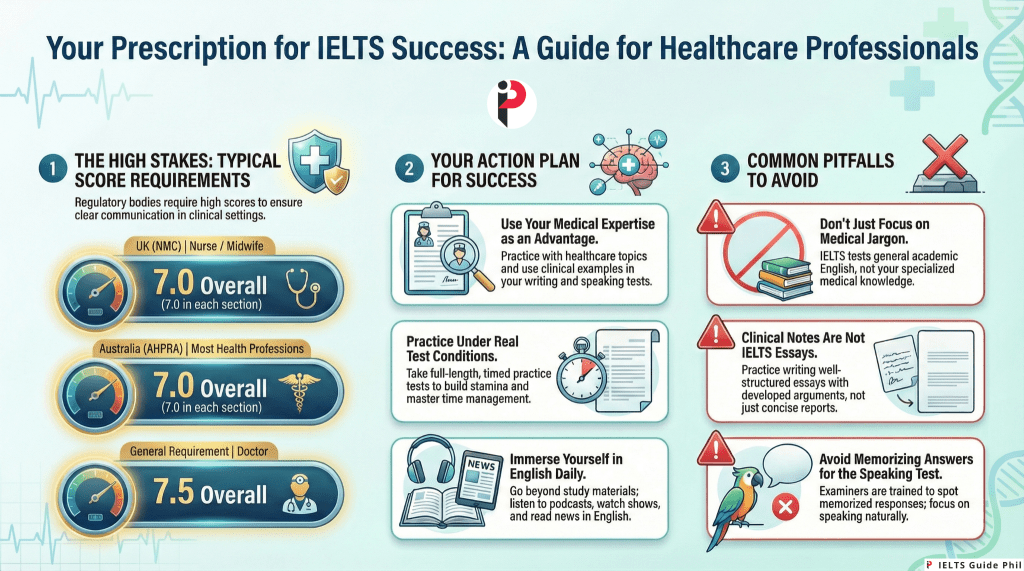
Most healthcare regulatory bodies require IELTS Academic (not General Training), with minimum scores typically ranging from 6.5 to 7.5 overall, with no individual band below 6.5 or 7.0. For example, the Nursing and Midwifery Council (NMC) in the UK requires an overall score of 7.0 with at least 7.0 in each section, while the Australian Health Practitioner Regulation Agency (AHPRA) generally requires 7.0 overall with no band less than 7.0 for most professions.
The four test sections—Listening, Reading, Writing, and Speaking—each assess different language skills you’ll use daily in healthcare settings. The Listening section tests your ability to understand patient concerns, follow instructions, and comprehend medical discussions. Reading evaluates how well you can understand medical literature, patient records, and clinical guidelines. Writing assesses your ability to document patient information, write reports, and communicate professionally. Speaking measures your capacity to explain procedures, provide patient education, and interact with the healthcare team.
Preparing for Each IELTS Section: Healthcare-Focused Strategies
Listening Section Strategies
The Listening test lasts 30 minutes plus 10 minutes for transferring answers. You’ll hear four recordings of increasing difficulty, from everyday social contexts to academic lectures. For healthcare workers, this mirrors real situations like taking patient histories, understanding handover reports, and attending medical briefings.
Practice with healthcare-specific materials by listening to medical podcasts, watching hospital documentaries with English audio, and using IELTS preparation materials focused on health topics. Pay attention to different English accents since you’ll encounter British, Australian, American, and other varieties in the test and in your future workplace. Train yourself to recognize medical vocabulary in context—terms like “acute,” “chronic,” “adverse reaction,” and “prognosis” appear frequently.
During the test, read questions carefully before each section begins. Predict possible answers and listen for synonyms and paraphrasing, as the recording rarely uses the exact words from the questions. Don’t panic if you miss an answer; move on immediately to avoid missing subsequent questions.
Reading Section Strategies
The Reading test contains three long passages with 40 questions to complete in 60 minutes. Passages become progressively more complex and may include diagrams, graphs, or illustrations. Healthcare workers often find this section challenging due to unfamiliar academic vocabulary and time pressure.
Develop your skimming and scanning techniques to quickly identify main ideas and locate specific information. Practice with academic journals, health policy documents, and medical research summaries. Focus on understanding passage structure—introduction, body paragraphs with supporting evidence, and conclusions—as this helps you navigate complex texts efficiently.
Common question types include multiple choice, True/False/Not Given, matching headings, and sentence completion. For True/False/Not Given questions, remember that “False” means the statement contradicts the passage, while “Not Given” means there’s insufficient information to confirm or deny it. Many test-takers confuse these two.
Time management is crucial in the Reading section. Allocate approximately 20 minutes per passage, leaving time to transfer answers. If a question is too difficult, mark your best guess and move on rather than wasting precious minutes.
Writing Section Strategies
The Writing test has two tasks to complete in 60 minutes. Task 1 requires you to describe visual information like graphs, charts, or diagrams in at least 150 words (suggested time: 20 minutes). Task 2 asks you to write an essay responding to an argument or problem in at least 250 words (suggested time: 40 minutes).
For healthcare workers, Task 1 might involve describing medical statistics, treatment outcomes, or healthcare trends. Focus on identifying key features, making comparisons, and describing changes over time. Use varied vocabulary to describe increases and decreases—”rose sharply,” “declined gradually,” “remained stable.” Avoid giving opinions in Task 1; stick to reporting what the data shows.
Task 2 carries more weight in your overall Writing score and often addresses topics like healthcare policy, medical ethics, or public health issues. Structure your essay with a clear introduction stating your position, body paragraphs with supporting arguments and examples, and a conclusion summarizing your main points. Use topic sentences to begin each paragraph, and employ linking words like “furthermore,” “however,” “consequently,” and “in addition” to connect ideas.
Healthcare professionals should draw on their medical knowledge for relevant examples. If asked about obesity prevention, you might discuss patient education programs, dietary interventions, or community health initiatives you’ve encountered. This authentic expertise strengthens your response.
Speaking Section Strategies
The Speaking test is an 11-14 minute face-to-face interview with an examiner, divided into three parts. Part 1 covers familiar topics like your work, studies, or hobbies (4-5 minutes). Part 2 gives you a task card with a topic to speak about for 1-2 minutes after one minute of preparation. Part 3 involves a deeper discussion related to the Part 2 topic (4-5 minutes).
Many healthcare workers feel anxious about the Speaking test because they’re not used to casual conversation in English or worry about making mistakes. Remember that fluency matters more than perfect grammar—the examiner wants to hear you communicate naturally, just as you would with patients and colleagues.
In Part 1, extend your answers beyond simple yes/no responses. If asked “Do you enjoy your work as a nurse?” don’t just say “Yes, I do.” Explain why you enjoy it, give an example of a rewarding experience, or mention what aspects you find most fulfilling.
Part 2 requires you to speak uninterrupted for up to two minutes. Use the preparation minute wisely to jot down key points and organize your thoughts. If you’re asked to describe a memorable patient interaction, structure your talk with a beginning (setting the scene), middle (describing the situation), and end (explaining the outcome and why it was memorable).
Part 3 questions are more abstract and analytical. You might discuss healthcare system challenges, medical advances, or the role of technology in medicine. Think critically and provide balanced perspectives. It’s acceptable to say “That’s an interesting question” or “Let me think about that for a moment” to buy thinking time.
Common Mistakes Healthcare Workers Make and How to Fix Them
One frequent mistake is focusing too heavily on medical vocabulary while neglecting everyday English. IELTS tests general academic English, not specialized medical terminology. While healthcare knowledge helps with examples and context, you need strong foundational English skills across all topics. Balance your preparation by engaging with diverse content—news articles, podcasts on various subjects, and general academic texts.
Many healthcare professionals underestimate the writing requirements. They’re accustomed to clinical notes and medical reports, which differ significantly from IELTS essays. Clinical writing is concise and formulaic, while IELTS essays require elaboration, argumentation, and varied sentence structures. Practice writing longer, more discursive pieces that develop ideas fully.
Another common error is not practicing under timed conditions. Healthcare workers are busy, and many prepare by studying materials without simulating actual test pressure. Take full-length practice tests to build stamina and develop pacing strategies. You’ll discover which sections need more work and become comfortable with the time constraints.
Some candidates make the mistake of memorizing prepared answers for Speaking, particularly for Part 2. Examiners are trained to detect memorized responses, which can negatively impact your score. Instead, practice speaking spontaneously on various topics. Record yourself, listen back, and identify areas for improvement.
Neglecting pronunciation is another pitfall. Word stress, sentence stress, and intonation patterns affect how well you’re understood. For instance, “record” is pronounced differently as a noun (RE-cord) versus a verb (re-CORD). Practice minimal pairs like “ship/sheep” and “tree/three” that non-native speakers often confuse.
Finally, many healthcare workers don’t familiarize themselves with the test format before exam day. Understanding question types, instructions, and timing reduces anxiety and prevents simple errors. Complete several practice tests using official IELTS materials to become thoroughly familiar with the format.
Dos and Don’ts for IELTS Success
Do start preparing early. Give yourself at least three months of consistent study, or longer if you’re starting from a lower English level. Cramming rarely works for language tests.
Do create a study schedule. Balance all four skills rather than focusing only on your weakest areas. Dedicate specific days to different sections and stick to your plan.
Do use official IELTS practice materials. These accurately reflect the test difficulty and format. Books from the British Council, IDP, and Cambridge are reliable sources.
Do immerse yourself in English daily. Change your phone language to English, watch English TV shows without subtitles, read English news, and think in English when possible.
Do focus on your pronunciation. Work with tutors, use pronunciation apps, and practice speaking regularly. Clear pronunciation prevents misunderstandings in both the test and clinical practice.
Do learn from your mistakes. Review incorrect practice test answers carefully. Understand why you got them wrong and what the correct approach should have been.
Don’t rely solely on IELTS preparation courses. While helpful, they’re not sufficient on their own. Supplement formal classes with self-study, authentic English materials, and real-world practice.
Don’t translate from your native language. This slows you down and often results in awkward or incorrect English. Train yourself to think directly in English.
Don’t leave sections blank. There’s no penalty for wrong answers, so always guess if you’re unsure. In Listening and Reading, you might guess correctly and earn points.
Don’t exceed word limits. Writing more than the specified word count wastes time without gaining extra marks. Focus on quality over quantity.
Don’t panic on test day. Anxiety affects performance. Practice relaxation techniques, get adequate sleep beforehand, and trust your preparation.
Don’t ignore feedback. If you take a preparation course or work with a tutor, implement their suggestions actively. Feedback is invaluable for improvement.
Practical Preparation Timeline
Create a structured three-month preparation plan for optimal results. In month one, focus on assessment and foundation building. Take a diagnostic test to identify your current level and weak areas. Build your general vocabulary through reading diverse materials, and review fundamental grammar concepts like tenses, conditionals, and passive voice. Start listening to English content daily.
During month two, shift to intensive skill development. Practice each IELTS section regularly using official materials. Join online forums or study groups with other healthcare professionals preparing for IELTS. Work on writing essays and getting feedback from teachers or online services. Increase your speaking practice through language exchange partners or tutors.
In month three, concentrate on test simulation and refinement. Take weekly full-length practice tests under timed conditions. Analyze your mistakes and focus on patterns in errors. Fine-tune your time management for each section. In the final week, do lighter review rather than intense studying to avoid burnout. Rest well before test day.
Resources for Healthcare Workers
Several resources are particularly valuable for healthcare professionals preparing for IELTS. The official IELTS websites (ielts.org, britishcouncil.org, and idp.com) offer free practice materials, test information, and preparation tips. The Cambridge IELTS book series provides authentic past papers for realistic practice.
Online platforms like IELTS Liz, IELTS Advantage, and E2Language offer video lessons, practice tests, and study tips. Many have specific content for healthcare workers. Apps like IELTS Prep App by British Council and IELTS Word Power provide mobile study options for busy healthcare professionals.
For healthcare-specific English, resources like English for Nursing by Cambridge University Press and Professional English in Use Medicine help you build relevant vocabulary while improving general English skills. Medical journals and health websites like the British Medical Journal, The Lancet, and WHO publications expose you to academic health writing.
Consider joining online communities of healthcare workers preparing for IELTS, such as Facebook groups for nurses moving abroad or forums on immigration websites. These provide peer support, study tips, and motivation from people in similar situations.
Frequently Asked Questions
How long are IELTS scores valid? IELTS scores are typically valid for two years from the test date. However, some regulatory bodies or immigration authorities may accept older scores, so check specific requirements with your destination country’s healthcare regulator.
Can I take IELTS on paper or computer? Both formats are available, and the content is identical. Computer-delivered IELTS offers more frequent test dates and faster results (3-5 days versus 13 days for paper-based). Choose based on your comfort with typing versus handwriting. The Speaking test remains face-to-face in both formats.
What’s the difference between IELTS Academic and General Training? Healthcare professionals need IELTS Academic, which focuses on academic language skills suitable for university and professional registration. General Training is for immigration and work experience requirements in non-professional contexts.
What score do I need as a healthcare worker? Requirements vary by profession and country. Nurses typically need 7.0 overall with 7.0 in each band for the UK (NMC), 7.0 overall with no band less than 7.0 for Australia (AHPRA), and similar scores for Canada. Doctors might need 7.5 overall. Always verify current requirements with the specific regulatory body.
How many times can I take IELTS? You can take IELTS as many times as needed, but you must wait for your previous test results before registering again. Most testing centers allow registration for a new test date before receiving results from a previous attempt.
Can I use medical terminology in the test? Yes, if relevant to the question or topic. However, IELTS assesses general English proficiency, so focus on demonstrating broad vocabulary and language skills rather than specialized jargon. Explain technical terms if you use them.
Will my accent affect my Speaking score? No, IELTS accepts all standard varieties of English (British, American, Australian, etc.). You’re assessed on intelligibility, not accent. Focus on clear pronunciation and natural speech rather than trying to mimic a particular accent.
What happens if I don’t achieve my required score? You can retake the test. Use your score report to identify weak areas and target your preparation accordingly. Many healthcare workers need 2-3 attempts to achieve their required scores, which is completely normal.
Should I take preparation classes? Preparation classes can be beneficial, especially for guidance on test strategies and structured study. However, they’re not mandatory. Self-study with quality materials works well for motivated, disciplined learners. Consider your learning style and budget when deciding.
How much does IELTS cost? Test fees vary by country but typically range from $200-$250 USD. While this seems expensive, consider it an investment in your international career. Budget for multiple attempts if needed, as achieving the required score is essential for registration.
Final Thoughts
Preparing for IELTS as a healthcare worker requires dedication, strategic preparation, and patience. The scores demanded by medical regulatory bodies are high because effective communication in healthcare settings directly impacts patient safety and care quality. While the journey may feel challenging, remember that thousands of healthcare professionals successfully achieve their required scores every year and go on to rewarding international careers.
Your medical knowledge and professional experience are valuable assets during IELTS preparation. Draw on patient interactions, clinical scenarios, and healthcare insights when providing examples in Writing and Speaking. Your expertise makes your responses authentic and compelling.
Consistency matters more than intensity in language learning. Daily practice, even for 30 minutes, yields better results than occasional marathon study sessions. Integrate English into your daily life, stay motivated by connecting your preparation to your career goals, and celebrate small improvements along the way.
The IELTS test is just one step in your journey toward an international healthcare career. The English skills you develop while preparing will serve you throughout your professional life, enabling you to provide excellent patient care, collaborate effectively with colleagues, and continue your professional development in English-speaking environments.
Approach your preparation with confidence, use the strategies and resources outlined in this guide, and trust in your ability to succeed. Your dedication to improving lives through healthcare has brought you this far—IELTS is simply the next challenge to overcome on your path to making a global impact in your profession.
#IELTSForHealthcare #NursingAbroad #IELTSPreparation #HealthcareProfessionals #InternationalNursing #IELTSAcademic #MedicalEnglish #IELTSTips #NursesMigration #IELTSExam #HealthcareEnglish #NMCTest #StudyAbroad #IELTSWriting #IELTSSpeaking #NurseLife #DoctorsAbroad #AlliedHealth #IELTSSuccess #EnglishForHealthcare #ProfessionalEnglish #IELTSListening #IELTSReading #HealthcareCareer #GlobalHealthcare #NursingJobs #MedicalProfessionals #IELTSGuide #HealthcareWorkers #IELTSScores
 IELTS Guide Phil
Leave a comment