
In an era where misinformation spreads faster than truth, the ability to think critically about what we read has never been more essential. While the IELTS Reading test is primarily designed to assess English language proficiency, it simultaneously serves as a rigorous training ground for critical thinking skills that are increasingly vital in our information-saturated world. This connection between IELTS preparation and critical literacy offers benefits that extend far beyond exam success.
The Misinformation Crisis and the Need for Critical Reading
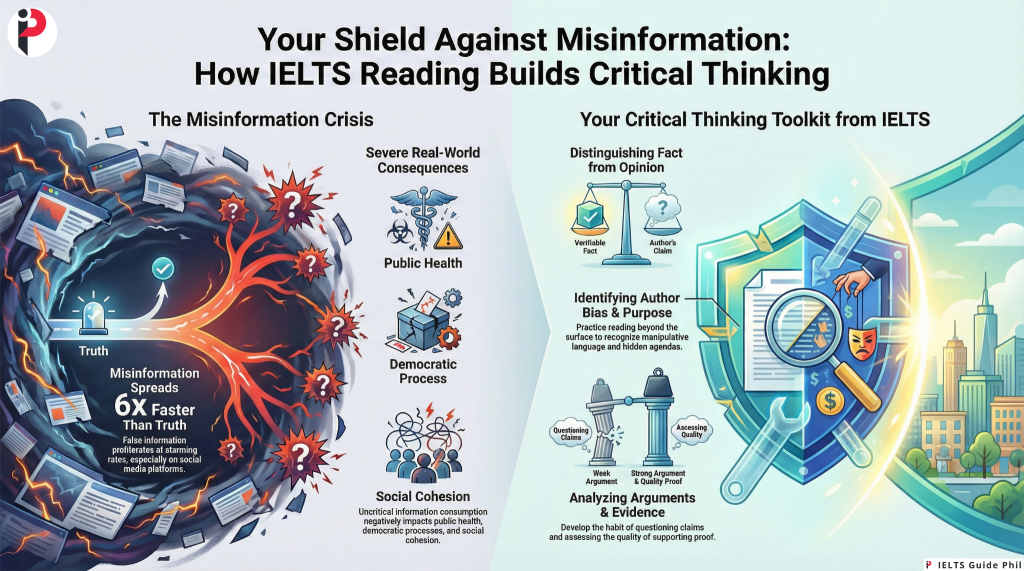
We live in a digital landscape where false information proliferates at alarming rates. Studies have shown that misinformation on social media spreads six times faster than accurate information. From manipulated health claims during global pandemics to fabricated political narratives, the consequences of uncritical information consumption can be severe, affecting public health decisions, democratic processes, and social cohesion.
Against this backdrop, the skills required to excel in IELTS Reading—careful analysis, evidence evaluation, and logical reasoning—are precisely the tools we need to navigate today’s information ecosystem. The test doesn’t just measure whether you understand English; it assesses whether you can engage with complex texts in sophisticated, analytical ways.
How IELTS Reading Develops Critical Thinking
Distinguishing Fact from Opinion
One of the fundamental skills tested in IELTS Reading is the ability to differentiate between factual statements and opinions or claims. Question types like True/False/Not Given and Yes/No/Not Given require test-takers to carefully evaluate whether statements align with information explicitly stated in the passage, represent the author’s opinion, or lack sufficient evidence in the text.
This skill directly transfers to real-world scenarios where we must distinguish between verified facts and unsupported assertions. When you encounter a social media post claiming a particular treatment cures a disease, the same analytical approach applies: Is this claim supported by evidence in the source? Is it the author’s opinion? Or is there simply not enough information to verify it?
Identifying Author Bias and Purpose
IELTS Reading passages often require candidates to identify the writer’s purpose, attitude, or viewpoint. Understanding whether an author is attempting to persuade, inform, entertain, or criticize requires reading beyond the surface level and recognizing rhetorical strategies and loaded language.
This analytical lens is crucial when evaluating modern content. A reader trained through IELTS preparation learns to ask: What is the author trying to achieve? What perspective are they promoting? What information might they be omitting? These questions are fundamental to spotting biased reporting, propaganda, and manipulative content designed to shape opinions rather than inform.
Analyzing Arguments and Evidence
Many IELTS Reading passages present arguments with supporting evidence, requiring test-takers to follow logical progressions, identify main ideas, and recognize how evidence supports or undermines claims. Questions often test whether you can identify what evidence is provided for specific assertions or whether you understand the logical relationships between different parts of the text.
This skill is invaluable for evaluating the quality of sources encountered daily. When reading an article about climate change, economic policy, or health advice, the ability to ask “What evidence supports this claim?” and “Is this evidence credible and sufficient?” can mean the difference between accepting misinformation and making informed decisions.
Making Inferences and Reading Between the Lines
IELTS Reading regularly tests inferential comprehension through questions that require candidates to understand implied meanings, draw logical conclusions from presented information, and recognize what the text suggests without stating explicitly.
This capacity for inference is essential when dealing with sources that may present information selectively or use euphemistic language to obscure uncomfortable truths. It enables readers to recognize when something important is being left unsaid or when language is being used to manipulate perception rather than convey reality clearly.
Evaluating Source Credibility
While IELTS passages come from reputable academic and mainstream publications, the test trains readers to pay attention to source details, publication contexts, and the credentials of cited experts. This attention to provenance becomes second nature through repeated practice with diverse, high-quality texts.
In the real world, this translates to asking critical questions about sources: Who wrote this? What are their qualifications? Where was it published? Is this a peer-reviewed journal or a personal blog? Was it published by an organization with a particular agenda? These foundational questions often reveal misinformation before deeper analysis is even necessary.
Processing Complex, Nuanced Information
IELTS Reading passages deliberately present complex, nuanced perspectives rather than simplistic narratives. Test-takers must grapple with academic discussions that acknowledge multiple viewpoints, present conflicting evidence, or explore topics with appropriate complexity.
This exposure to nuance inoculates readers against the oversimplified, black-and-white narratives that characterize much online misinformation. When you’re accustomed to engaging with texts that say “research suggests” rather than “scientists prove” or that acknowledge limitations and alternative interpretations, you become skeptical of sources that present contested issues as settled or complex questions as simple.
Developing Patience and Precision
The IELTS Reading test demands careful, precise reading. Rushing through passages or making assumptions leads to errors. Success requires slowing down, re-reading when necessary, and paying attention to qualifying words like “some,” “often,” “may,” and “typically” that dramatically alter meaning.
This patience and precision directly counter the hasty, reactive consumption of information that makes people vulnerable to misinformation. When you’re trained to notice the difference between “studies show” and “a study suggests” or between “experts agree” and “some experts believe,” you’re far less likely to be misled by headlines and viral posts designed for emotional impact rather than accuracy.
Practical Applications Beyond the Test
Social Media Literacy
The skills developed through IELTS Reading preparation are particularly valuable when navigating social media, where misinformation thrives. When encountering a viral post claiming a shocking statistic or making an outrageous claim, a critically trained reader asks the same questions they would during the IELTS test: What evidence is presented? Does the claim align with the source cited? Is there language suggesting opinion rather than fact? Is important context missing?
News Consumption
IELTS-trained critical reading transforms news consumption from passive reception to active analysis. Rather than accepting headlines at face value, readers evaluate the evidence presented, consider alternative interpretations, identify potential biases, and seek additional sources for important claims. They recognize the difference between news reporting and opinion pieces, between correlation and causation in reported studies, and between expert consensus and individual opinions.
Academic and Professional Contexts
The critical thinking skills honed through IELTS Reading are directly applicable to academic research and professional decision-making. Whether evaluating research papers, analyzing market reports, or assessing policy proposals, the ability to critically engage with complex written material while identifying arguments, evaluating evidence, and recognizing unstated assumptions is invaluable.
Strengthening These Skills Through IELTS Preparation
To maximize the critical thinking benefits of IELTS Reading preparation, consider these strategies:
Engage actively with passages. Don’t just hunt for answers. Read to understand the author’s argument, the evidence provided, and the logical structure. Ask yourself questions about what you’re reading before even looking at the test questions.
Practice identifying logical fallacies. While reading practice passages, look for common reasoning errors like false dichotomies, appeals to emotion, or unwarranted generalizations. This sharpens your ability to spot flawed arguments in any context.
Question everything systematically. Develop a mental checklist of critical reading questions to apply to every passage: Who wrote this and why? What claims are being made? What evidence supports them? What’s missing from this account? What assumptions underlie the argument?
Compare sources on the same topic. After reading an IELTS passage on a topic like renewable energy or archaeological discoveries, find other sources discussing the same subject. Compare how different sources present the information, what evidence they prioritize, and what perspectives they represent.
Analyze your own reasoning. When you get practice questions wrong, don’t just identify the correct answer. Analyze why you made the error. Did you make an unsupported inference? Did you confuse the author’s opinion with a factual claim? Understanding your reasoning patterns improves both test performance and real-world critical thinking.
Read diversely and widely. While preparing for IELTS, expose yourself to various types of texts from different disciplines and perspectives. This breadth develops flexibility in thinking and helps you recognize different rhetorical styles and argumentative approaches.
The Broader Implications
The intersection of IELTS Reading preparation and critical thinking development highlights an important truth about language learning: it’s never just about language. When we develop sophisticated reading skills in any language, we’re simultaneously developing cognitive capacities that transcend linguistic boundaries.
In a world where information warfare, deepfakes, and algorithmic manipulation are increasingly sophisticated, the critical reading skills fostered by rigorous exams like IELTS represent a form of cognitive self-defense. They enable individuals to be not just consumers of information but evaluators and analysts of it.
Moreover, these skills have collective benefits. A population trained in critical reading is more resistant to manipulation, better equipped for democratic participation, and more capable of making informed decisions on complex issues from public health to environmental policy. When multiplied across millions of test-takers worldwide, the critical thinking development fostered by IELTS Reading contributes to a more informed, discerning global citizenry.
Conclusion
The IELTS Reading test is far more than an assessment of English proficiency. It’s a systematic training program in critical thinking skills that are essential for navigating our complex, information-dense world. By teaching readers to distinguish fact from opinion, evaluate evidence, recognize bias, make sound inferences, and engage patiently with nuanced arguments, IELTS Reading preparation builds exactly the cognitive toolkit needed to combat misinformation and disinformation.
As you prepare for the IELTS Reading test, recognize that you’re developing skills with applications far beyond exam day. You’re training yourself to be a more discerning consumer of information, a more analytical thinker, and a more informed citizen. In an age where the ability to think critically about what we read may be one of the most important skills we can possess, the rigorous reading practice demanded by IELTS offers benefits that will serve you throughout your academic, professional, and personal life.
The question isn’t just whether you can pass the IELTS Reading test. It’s whether you can carry the critical thinking habits it develops into every article you read, every claim you encounter, and every decision you make based on written information. That transfer of skills from test preparation to daily life is where the true value of IELTS Reading lies, and where its contribution to combating misinformation becomes most significant.
#IELTSGuidePhil #IELTSReading #CriticalThinking #MediaLiteracy #Misinformation #Disinformation #IELTSPreparation #DigitalLiteracy #FakeNews #InformationLiteracy #IELTSExam #CriticalReadingSkills #FactChecking #EnglishLearning #AcademicEnglish #21stCenturySkills
 IELTS Guide Phil
Leave a comment