
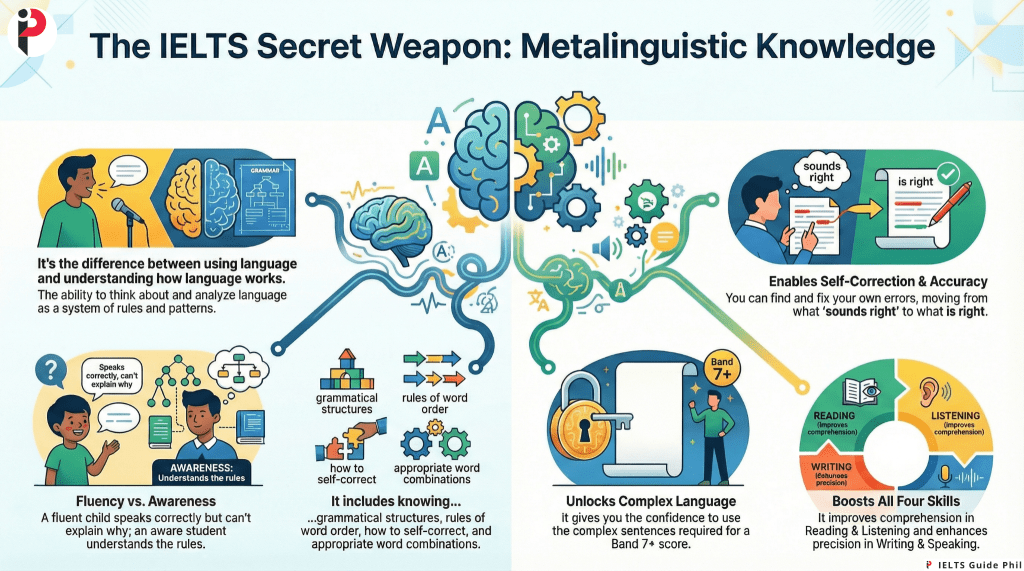
While grammar, vocabulary, and pronunciation form the foundation of IELTS preparation, there’s another layer of skills that can dramatically impact your test performance. These “meta skills” – the skills about skills – are often overlooked but can be the difference between a good score and an exceptional one. Let’s explore these crucial competencies that every IELTS candidate should master.
What Are Meta Skills?
Meta skills are higher-order thinking abilities that help you learn, adapt, and perform more effectively. In the context of IELTS, they’re the strategic and cognitive tools that allow you to navigate the test with confidence and maximize your existing language abilities. Think of them as the operating system that runs your language software.
1. Time Management Mastery
Time is your most precious resource during the IELTS test. Effective time management isn’t just about watching the clock – it’s about developing an intuitive sense of pacing and priority.
Key Components:
- Sectional awareness: Understanding how much time each section requires and allocating accordingly
- Task prioritization: Knowing when to move on from a difficult question to maximize overall score
- Buffer time planning: Building in small time cushions for review and unexpected challenges
Practical Application: In the Reading section, spend no more than 20 minutes per passage. If you’re stuck on a question, mark it and return later. In Writing, allocate 20 minutes for Task 1 and 40 minutes for Task 2, leaving 5 minutes for final review.
2. Strategic Test-Taking
IELTS isn’t just a language test – it’s a standardized assessment with patterns and conventions you can learn to navigate strategically.
Essential Strategies:
- Question analysis: Learning to decode what each question type is actually asking
- Answer prediction: Using context clues to anticipate answers before hearing or reading them
- Elimination techniques: Systematically ruling out incorrect options in multiple-choice questions
- Keyword identification: Spotting the most important words that signal correct answers
Example Strategy: In Listening, read the questions before the audio begins. Underline key words and predict what type of information you’re listening for (names, numbers, dates, etc.). This primes your brain to catch the right information.
3. Cognitive Flexibility
The ability to switch between different thinking modes and adapt to various question types is crucial for IELTS success.
Core Elements:
- Task switching: Moving smoothly between different question formats within the same section
- Perspective shifting: Adapting your writing style between formal reports and personal essays
- Problem-solving adaptation: Adjusting your approach when your first strategy isn’t working
Real-World Application: In the Speaking test, you might need to shift from describing a personal experience to discussing abstract concepts. Cognitive flexibility allows you to adjust your language register and thinking approach seamlessly.
4. Emotional Regulation
Test anxiety can significantly impact performance, even for highly proficient English speakers. Emotional regulation helps you maintain optimal performance under pressure.
Key Skills:
- Anxiety management: Techniques to stay calm and focused during the test
- Confidence building: Maintaining self-assurance even when encountering difficult questions
- Resilience: Bouncing back from mistakes without letting them affect subsequent performance
- Motivation maintenance: Staying engaged and focused throughout the entire test duration
Practical Techniques: Practice deep breathing exercises, develop positive self-talk patterns, and create mental reset routines you can use between sections.
5. Metacognitive Awareness
This is perhaps the most important meta skill – the ability to think about your own thinking and learning processes.
Components:
- Self-monitoring: Recognizing when you understand or don’t understand something
- Strategy evaluation: Assessing whether your current approach is working
- Learning reflection: Understanding how you learn best and adapting accordingly
- Performance analysis: Objectively evaluating your strengths and weaknesses
Implementation: After each practice test, spend 15 minutes analyzing not just your mistakes, but why you made them. Were they due to vocabulary gaps, misunderstanding instructions, or poor time management?
6. Information Processing Efficiency
IELTS requires you to process large amounts of information quickly and accurately. Developing efficient processing skills can significantly improve your performance.
Key Areas:
- Selective attention: Focusing on relevant information while filtering out distractions
- Pattern recognition: Identifying recurring structures in texts and conversations
- Information synthesis: Combining information from multiple sources to form coherent responses
- Memory optimization: Techniques for retaining and recalling information effectively
Practical Example: In Reading, practice skimming for main ideas first, then scanning for specific details. This two-stage approach is more efficient than trying to understand everything in detail on the first read.
7. Adaptive Communication
Beyond just knowing English, you need to adapt your communication style to different contexts and audiences within the IELTS framework.
Essential Aspects:
- Register awareness: Understanding when to use formal vs. informal language
- Audience consideration: Tailoring your communication to the intended reader or listener
- Purpose alignment: Ensuring your communication achieves its intended goal
- Cultural sensitivity: Being aware of cultural nuances in communication styles
Application: In Writing Task 1, your tone should be formal and objective when describing charts or graphs. In Task 2, while still formal, you can be more persuasive and personal in your argumentation.
Developing These Meta Skills
1. Deliberate Practice Don’t just do practice tests – do them with specific meta skill goals. Focus on one or two meta skills per practice session.
2. Reflection and Analysis After each practice session, spend time reflecting on your meta skill application. What worked? What didn’t? What would you do differently?
3. Simulation Training Practice under test-like conditions regularly. This helps develop the meta skills needed for actual test performance.
4. Feedback Integration Seek feedback not just on your language accuracy, but on your strategic approach and test-taking techniques.
5. Gradual Complexity Start with simpler tasks and gradually increase complexity as your meta skills develop.
The Compound Effect
The beauty of meta skills is their compound effect. As you develop stronger time management, you’ll feel less anxious. As you become more strategically aware, you’ll process information more efficiently. These skills build upon each other, creating a virtuous cycle of improvement.
Conclusion
While language proficiency will always be the foundation of IELTS success, meta skills are the accelerators that can take your performance to the next level. They’re the difference between a test-taker who struggles despite good English and one who performs confidently and strategically.
Remember, these skills take time to develop. Start incorporating meta skill practice into your IELTS preparation routine today. Focus on one or two areas at a time, be patient with yourself, and watch as these higher-order skills transform not just your IELTS performance, but your overall learning capacity.
The investment in developing these meta skills will pay dividends not only in your IELTS score but in your academic and professional endeavors beyond the test. They’re truly skills for life, not just for the exam room.
#IELTSGuidePhil Here are 15 relevant hashtags for the IELTS meta skills blog post:
#IELTS #IELTSPreparation #IELTSTips #IELTSSuccess #EnglishTest #TestTakingStrategies #StudySkills #MetaSkills #IELTSWriting #IELTSSpeaking #IELTSReading #IELTSListening #ExamPreparation #EnglishLearning #IELTSStudy
 IELTS Guide Phil
Leave a comment