
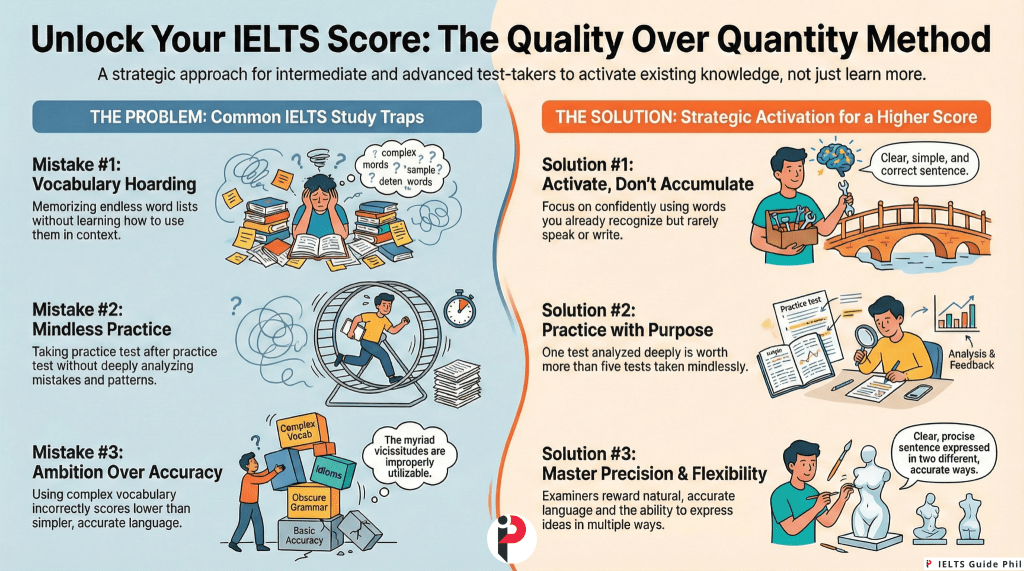
If you’re an intermediate or advanced English learner preparing for IELTS, you’ve probably heard conflicting advice: memorize 10,000 words, study grammar rules for hours, practice tests endlessly. The truth? More studying doesn’t always mean better results. What separates IELTS 6.0 from 7.5+ isn’t quantity of English knowledge but quality of application.
This guide will show you how to work smarter with the English you already know.
Understanding the Real Challenge
Most intermediate and advanced students fail to reach their IELTS target not because they lack English knowledge, but because they haven’t mastered how to use it effectively under exam conditions. You likely already know enough vocabulary and grammar to achieve your target score. The problem is activation, not acquisition.
Consider this: a student with 5,000 active words who uses them precisely will outscore someone with 8,000 words who uses them awkwardly. IELTS rewards natural, accurate language use over impressive but inappropriate vocabulary.
The Strategic Approach: Quality Over Quantity
Focus on Activation, Not Accumulation
Instead of learning new words daily, focus on activating the vocabulary you already recognize but rarely use. Your passive vocabulary (words you understand when reading) is likely much larger than your active vocabulary (words you confidently use when speaking or writing).
Example: You probably recognize words like “implement,” “substantial,” “predominantly,” and “adverse” when reading. But do you use them naturally in your Speaking or Writing responses? If not, you’re sitting on untapped potential.
Strategic Practice: Take 20 familiar but underused words each week. Write sentences using them in IELTS-relevant contexts. Record yourself using them in speech. This activation process is more valuable than memorizing 100 new words you’ll forget.
Master Flexibility, Not Complexity
IELTS examiners value range and flexibility over complex vocabulary. Learning to express one idea in multiple ways demonstrates linguistic competence better than using advanced vocabulary awkwardly.
Example of Flexibility:
- “Many people believe that…”
- “It is widely held that…”
- “There is a common perception that…”
- “A significant number of individuals argue that…”
Each phrase serves the same function but demonstrates vocabulary range. This is smarter than forcing in words like “plethora” or “myriad” where they don’t fit naturally.
Develop Accuracy Before Ambition
Ambitious vocabulary with errors scores lower than simpler, accurate language. An intermediate student writing error-free sentences with precise word choice will outscore an advanced student making frequent mistakes with sophisticated vocabulary.
Common Mistake: “The government should make strict laws to avoid pollution.” Better: “The government should enforce stricter regulations to reduce pollution.”
The second sentence isn’t dramatically more complex, but it’s more accurate and natural. “Avoid” doesn’t collocate with “pollution” in this context, while “reduce” does. This attention to collocation and natural phrasing matters more than vocabulary level.
The Four Skills: Strategic Improvement
Listening: Train Your Brain, Not Your Ears
Your ears probably work fine. The challenge is processing speed and focus management under pressure.
Don’t: Listen to hours of random English content hoping to improve Do: Practice predictive listening and keyword recognition
Before each Listening section, use the preparation time to underline keywords and predict what type of information you’ll hear (a number, a name, a place, a reason). This focused approach trains exam-specific skills.
Strategic Practice: Listen to a 2-minute segment, pause, and summarize the main points. Then listen again to catch details you missed. This trains both general understanding and detail recognition, exactly what IELTS tests.
Reading: Read Strategically, Not Extensively
Reading novels for hours won’t directly improve your IELTS Reading score. You need to develop skimming, scanning, and paraphrasing recognition skills.
Don’t: Read every word carefully Do: Learn to identify question types and apply specific strategies for each
Different question types require different approaches. TRUE/FALSE/NOT GIVEN questions need precise reading of specific sections. Heading matching requires understanding main ideas. Multiple choice needs elimination strategies.
Strategic Practice: Take one reading passage and answer the questions. Then analyze each question: What type is it? What strategy should you use? Where in the text is the answer? Understanding the exam’s logic is more valuable than reading volume.
Writing: Precision Over Sophistication
Task 2 essays don’t need to be literary masterpieces. They need clear organization, relevant examples, and cohesive arguments expressed in accurate English.
Common Mistake: Trying to impress with overly complex sentences Better Approach: Use a mix of simple and complex sentences with perfect accuracy
Example of Over-Ambition: “Notwithstanding the fact that technological advancement has precipitated unprecedented ramifications for contemporary society, one must acknowledge the multifaceted dimensions of its impact.”
Better: “While technology has significantly changed modern society, its effects are complex and multifaceted.”
The second sentence is clearer, more direct, and less prone to errors. It still demonstrates good vocabulary (“significantly,” “multifaceted”) without being pretentious.
Strategic Practice: Write one paragraph, then review it specifically for:
- Subject-verb agreement
- Article usage (a/an/the)
- Preposition accuracy
- Verb tense consistency
These common errors lower scores more than lack of sophisticated vocabulary.
Speaking: Natural Fluency Over Rehearsed Perfection
Examiners can easily spot memorized responses, which are penalized. Natural communication with minor hesitations scores better than scripted perfection.
Don’t: Memorize answers for every possible topic Do: Develop frameworks for extending responses naturally
Framework for Part 2:
- Direct answer to the question
- Specific example or personal experience
- Explain why/how (add detail)
- Personal reflection or broader point
This framework works for any topic and sounds natural because you’re thinking and speaking, not reciting.
Strategic Practice: Record yourself answering random Part 1 questions without preparation. Listen back. Are you using fillers naturally (“Well, that’s an interesting question…”)? Are you self-correcting when you make mistakes? This is authentic communication.
Common Mistakes and Strategic Fixes
Mistake 1: Vocabulary Hoarding
The Problem: Learning dozens of new words daily without context or application.
The Fix: The “Active 20” method. Each week, select 20 words you recognize but don’t use. Create a personalized sentence for each in an IELTS context. Use them in practice responses. By week’s end, these words should feel natural.
Mistake 2: Grammar Perfectionism
The Problem: Spending hours on advanced grammar structures you rarely need.
The Fix: Master the most common error patterns first. Focus on:
- Present perfect vs. simple past
- Conditional sentences (especially second and third conditionals)
- Relative clauses
- Passive voice
These structures appear constantly in IELTS and are high-value targets.
Mistake 3: Ignoring Exam Strategy
The Problem: Practicing English generally without understanding IELTS-specific requirements.
The Fix: Learn the assessment criteria. For Writing, understand exactly what “Coherence and Cohesion” means. For Speaking, know how “Lexical Resource” is evaluated. When you understand what examiners look for, you can deliver it precisely.
Mistake 4: Quantity Over Analysis
The Problem: Taking practice test after practice test without reviewing performance.
The Fix: The “Deep Practice” approach. After each practice test:
- Review every mistake and understand why
- Identify patterns (Do you always miss the last Listening question?)
- Note which question types you struggle with
- Create targeted practice for weak areas
One test analyzed deeply is worth five tests taken mindlessly.
Mistake 5: Neglecting Timing Skills
The Problem: Running out of time or finishing too early without checking work.
The Fix: Practice under timed conditions from the start. Develop time awareness. For Writing Task 2, spend 5 minutes planning, 30 minutes writing, 5 minutes reviewing. This discipline prevents both rushing and incomplete responses.
The 80/20 Approach to IELTS Preparation
The Pareto Principle applies perfectly to IELTS: 80% of your score comes from 20% of what you know and do. Identify your high-impact areas.
High-Impact Activities:
- Understanding question types and specific strategies for each
- Mastering common collocations and natural phrases
- Developing timing and pacing skills
- Learning to paraphrase effectively
- Practicing error correction in your own writing
Low-Impact Activities:
- Memorizing obscure vocabulary you’ll never use
- Studying every grammar rule in existence
- Reading extensively without focused practice
- Taking tests without analysis
- Worrying about accent in Speaking (it doesn’t affect your score)
Building an Intelligent Study Plan
Week 1-2: Diagnostic and Strategy
Take a full practice test under exam conditions. Analyze results thoroughly. Identify your weakest section and most common error types. Research specific strategies for your problem areas.
Time Investment: 6-8 hours per week Focus: Understanding the exam and your current level
Week 3-6: Targeted Skill Development
Focus 60% of your time on your weakest section, 40% maintaining other sections. For each practice session, have a specific goal: “Today I’m improving my paraphrasing skills” or “Today I’m working on Part 3 Speaking extension.”
Time Investment: 8-10 hours per week Focus: Deliberate practice on specific weaknesses
Week 7-10: Integration and Refinement
Take weekly full practice tests, analyzing each thoroughly. Focus on exam technique, timing, and stress management. By now, you’re not learning new English; you’re optimizing performance.
Time Investment: 10-12 hours per week Focus: Exam simulation and performance optimization
Frequently Asked Questions
Q: How much vocabulary do I really need for IELTS 7.0+?
A: Most research suggests 6,000-7,000 word families for 7.0 and 8,000-9,000 for 8.0+. However, these numbers are less important than how well you use the words you know. Focus on using your existing vocabulary naturally and precisely rather than expanding aggressively.
Q: Should I use British or American English?
A: Either is acceptable, but be consistent. Don’t switch between “colour” and “color” in the same essay. The examiners don’t care which variety you use as long as you’re consistent and accurate.
Q: How can I improve my Writing score from 6.5 to 7.5?
A: The jump from 6.5 to 7.5 typically requires:
- More sophisticated cohesive devices (not just “firstly, secondly”)
- Better paragraph development with extended explanations
- More precise vocabulary (fewer errors, better collocations)
- Greater grammatical range with accuracy
Focus on writing fewer practice essays but reviewing each one meticulously for these specific criteria.
Q: Is one month enough to prepare for IELTS?
A: If you’re already intermediate/advanced, one month can be enough to optimize your exam technique and target weak areas. However, this requires focused, strategic practice of 2-3 hours daily, not passive English exposure.
Q: Should I take an IELTS preparation course?
A: Courses are valuable if they provide structured practice, expert feedback, and accountability. But they’re not magic. The same principles apply: quality practice focused on your specific weaknesses beats generic English lessons.
Q: How important is the Speaking accent?
A: Pronunciation is assessed, but accent is not. You can have any accent as long as you’re intelligible. Focus on clear articulation, word stress, and sentence intonation rather than trying to sound British or American.
Q: Can I reuse phrases across different Writing topics?
A: Yes, but do it intelligently. Memorizing entire paragraphs for specific topics is obvious and penalized. However, learning versatile phrases for introducing ideas, contrasting points, or concluding arguments is smart preparation.
Q: What’s the fastest way to improve Listening?
A: There’s no “fast” way, but the most efficient method is practicing with IELTS-format materials while focusing on these skills:
- Predicting content from questions
- Recognizing paraphrasing (questions rarely use the same words as the audio)
- Maintaining concentration for 30+ minutes
- Writing answers quickly while listening
Q: How do I stop running out of time in Reading?
A: Develop a strict time allocation: no more than 20 minutes per passage. Practice skimming (getting the general idea quickly) and scanning (finding specific information). Don’t read every word, and move on if you’re stuck on a question.
Q: Should I focus on my weakest section or strengthen my strong sections?
A: Generally, focus 60% on your weakest section (where improvement potential is highest) and 40% on maintaining other sections. However, if you only need a specific section score (like Writing for university admission), allocate accordingly.
Final Thoughts: The Mindset Shift
The journey from intermediate to advanced IELTS scores isn’t about accumulating more English. It’s about using what you know with greater precision, fluency, and strategic awareness. The student who uses 5,000 words expertly will always outscore the one who uses 10,000 words poorly.
Stop measuring progress by how many hours you study or how many new words you learn. Instead, measure it by:
- How accurately you use vocabulary in context
- How well you understand and apply exam strategies
- How consistent your performance is under timed conditions
- How effectively you learn from mistakes
This mindset shift from quantity to quality, from accumulation to activation, from passive learning to strategic practice is what separates IELTS success from IELTS struggle.
Remember: you likely already know enough English to achieve your target score. Now you just need to learn how to demonstrate it effectively on exam day.
Ready to transform your IELTS preparation? Start with one strategic change today: choose 20 words you recognize but never use, and make them active in your vocabulary this week. That’s learning better, not more.
#IELTS #IELTSPreparation #IELTSTips #IELTSWriting #IELTSSpeaking #IELTSReading #IELTSListening #EnglishLearning #StudySmart #TestPrep #IELTSSuccess #EnglishExam #IELTSStrategy #LearnEnglish #IELTSExam #LanguageLearning #IELTSScore #StudyTips #ExamStrategy #EnglishTest #IELTSAdvice #SmartLearning #IELTSGoals #EffectiveLearning #IELTSBand7 #IELTSBand8 #IELTSGuidePhil
 IELTS Guide Phil
Leave a comment