
If you’re a beginner preparing for IELTS, you might be tempted to learn impressive vocabulary, complex grammar structures, and sophisticated phrases. After all, doesn’t IELTS reward advanced English?
Here’s the truth that could save you months of frustration: IELTS rewards accurate English before advanced English. A beginner who writes simple sentences perfectly will score higher than someone who attempts complex structures filled with errors.
This guide will show you why building a strong, accurate foundation is your fastest path to IELTS success.
Understanding the Beginner’s Challenge
Many beginner IELTS students make the same critical mistake: they try to sound like advanced speakers before mastering basic accuracy. They use vocabulary they don’t fully understand, attempt grammar structures they can’t control, and prioritize impression over communication.
The result? Responses filled with errors that significantly lower their scores across all four skills.
The Reality Check:
- A Band 5.0 essay with simple, accurate sentences scores better than a Band 4.0 essay with ambitious but error-filled language
- Clear pronunciation with basic vocabulary outperforms unclear speech with advanced words
- Understanding simple texts completely beats partially understanding complex ones
Your goal as a beginner isn’t to impress the examiner with sophistication. It’s to communicate clearly and accurately within your current ability level.
The Foundation Principle: Walk Before You Run
Think of language learning like building a house. You can’t start with the decorative finishes when the foundation is shaky. Similarly, you can’t use advanced English effectively if your basics aren’t solid.
What Does a Strong Foundation Look Like?
Grammar Accuracy:
- Consistent use of present, past, and future tenses
- Correct subject-verb agreement
- Proper use of articles (a, an, the)
- Basic sentence structure (subject + verb + object)
- Simple and compound sentences without errors
Vocabulary Precision:
- Using common words correctly rather than advanced words incorrectly
- Understanding connotations and appropriate contexts
- Matching words with their correct prepositions
- Building vocabulary through word families
Pronunciation Clarity:
- Clear articulation of individual sounds
- Correct word stress patterns
- Appropriate sentence intonation
- Speaking at a pace listeners can follow
Comprehension Accuracy:
- Understanding main ideas in listening and reading
- Recognizing key details
- Following logical sequences
- Identifying speaker attitudes and purposes
Why Accuracy Matters More Than You Think
IELTS uses descriptors that explicitly penalize errors. Let’s look at what this means for each section.
Writing: The Error Cost
In IELTS Writing, grammatical errors and inappropriate vocabulary directly lower your score in two criteria: Grammatical Range and Accuracy, and Lexical Resource.
Band 5.0 Descriptor: “May make frequent grammatical errors… errors can cause some difficulty for the reader”
Band 6.0 Descriptor: “Uses a mix of simple and complex sentence forms… makes some errors but they rarely reduce communication”
Notice the difference? At Band 6.0, errors are occasional and don’t block understanding. At Band 5.0, errors are frequent and create difficulty. The key isn’t complexity but frequency of errors.
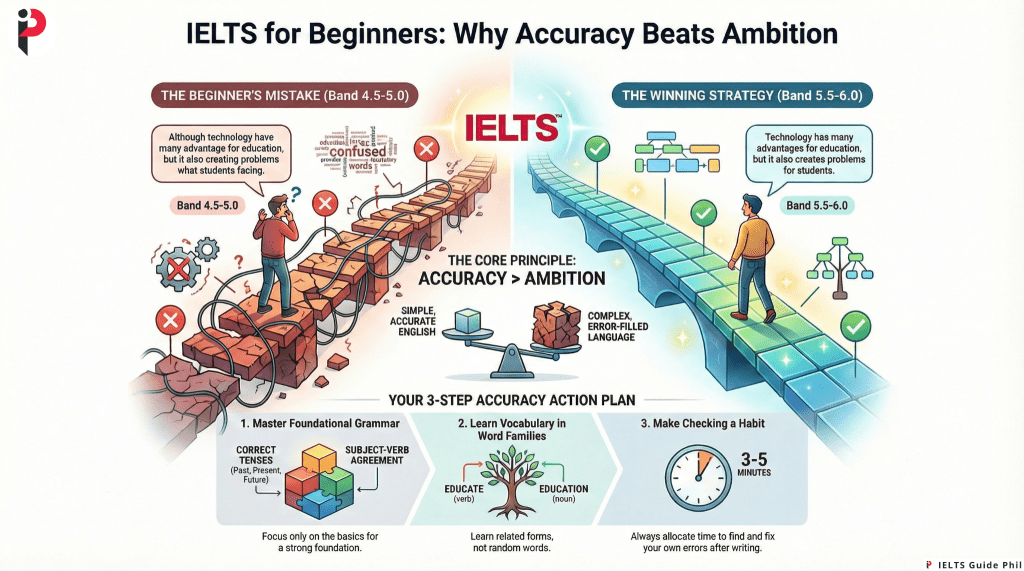
Example – Ambitious but Inaccurate (Band 4.5-5.0): “Although technology have many advantage for education, but it also creating problems what students facing nowadays. Teacher should to teach student how for using technology in correct way, otherwise they will addicted.”
Errors:
- Subject-verb agreement: “technology have” should be “has”
- Redundancy: “Although…but” (choose one)
- Tense: “creating” should be “creates”
- Relative pronoun: “what” should be “that/which”
- Infinitive: “should to teach” should be “should teach”
- Article: “student” should be “students”
- Preposition: “how for using” should be “how to use”
- Adjective: “in correct way” should be “in the correct way”
- Future tense: “will addicted” should be “will become addicted”
Simple but Accurate (Band 5.5-6.0): “Technology has many advantages for education, but it also creates problems for students. Teachers should teach students how to use technology correctly. If they don’t learn this, students may become addicted.”
Differences:
- Shorter, simpler sentences
- Correct grammar throughout
- Appropriate vocabulary
- Clear meaning
The second example demonstrates control. The first shows ambition without ability.
Speaking: Natural Over Impressive
In Speaking, examiners assess your ability to communicate naturally and be understood. Stumbling over advanced vocabulary you barely know signals weak language control.
Common Beginner Mistake: Trying to use words like “contemporary,” “substantial,” “deteriorate,” “implement” when you’re not comfortable with them.
Better Approach: Using words like “modern,” “large,” “get worse,” “use” with confidence and accuracy.
Example – Over-Ambitious: Examiner: “Do you like reading?” Student: “Yes, I am very enthusiastic about literature consumption. I predominantly peruse contemporary novels which furnish substantial intellectual stimulation…”
Problems:
- Unnatural phrasing (“literature consumption,” “peruse”)
- Forced vocabulary that doesn’t sound conversational
- Risk of mispronunciation or misuse
Accurate and Natural: Examiner: “Do you like reading?” Student: “Yes, I really enjoy reading. I mostly read modern novels because they’re interesting and help me learn new things.”
Strengths:
- Natural, conversational tone
- Accurate vocabulary and grammar
- Easy to understand
- Shows genuine communication ability
Listening and Reading: Understanding Over Guessing
For receptive skills, accuracy means truly understanding rather than guessing based on familiar words.
Beginner Trap: Hearing one familiar word and assuming you know the answer.
Example: Audio: “The museum opens at 9 AM on weekdays, but on Saturdays and Sundays, it doesn’t open until 10 AM.” Question: “What time does the museum open on Saturday?”
Inaccurate Approach: Hearing “9 AM” first and writing that as the answer. Accurate Approach: Listening for the complete information and noting “10 AM” for weekends.
This requires patience and complete listening, not jumping to conclusions.
Building Your Accurate Foundation: The Core Skills
1. Master Present, Past, and Future Tenses
Before touching perfect tenses or conditionals, ensure you can use these three tenses without errors.
Present Simple:
- “I work in an office.”
- “She studies every day.”
- “They don’t like cold weather.”
Past Simple:
- “I worked yesterday.”
- “She studied last night.”
- “They didn’t like the movie.”
Future (will/going to):
- “I will study tomorrow.”
- “She is going to travel next month.”
- “They won’t attend the meeting.”
Practice Method: Write 10 sentences about your daily routine (present), yesterday (past), and tomorrow (future). Check each sentence for accuracy. Repeat until you make zero errors.
2. Conquer Subject-Verb Agreement
This is one of the most common errors for beginners and one of the easiest to fix with focused practice.
The Rule: Singular subjects take singular verbs. Plural subjects take plural verbs.
Common Errors:
- ✗ “The students is studying.”
- ✓ “The students are studying.”
- ✗ “Everyone are ready.”
- ✓ “Everyone is ready.”
Practice Method: Read your writing aloud. Your ear will often catch agreement errors your eyes miss. Circle every subject and verb in your sentences and check they match.
3. Learn Articles Systematically
Articles (a, an, the) are challenging but critical for accuracy. Errors with articles won’t completely destroy your score, but consistent mistakes lower it.
Basic Rules:
- A/An: Use for singular, countable nouns mentioned for the first time (“I saw a dog”)
- The: Use for specific things both speaker and listener know (“The dog was brown”)
- No article: Use for plural general statements (“Dogs are animals”) or uncountable nouns (“I like music”)
Common Beginner Errors:
- ✗ “I want to be teacher.”
- ✓ “I want to be a teacher.”
- ✗ “Internet is useful.”
- ✓ “The Internet is useful.”
Practice Method: Choose 5 sentences from a practice test answer key. Remove all articles. Then add them back based on rules. Compare with the original.
4. Build Vocabulary Through Word Families
Instead of learning random words, learn word families. This multiplies your vocabulary while ensuring you understand how words function.
Example – The “educate” family:
- Verb: educate (“Schools educate children”)
- Noun: education (“Education is important”)
- Adjective: educational (“This is an educational program”)
- Adverb: educationally (“The program is educationally valuable”)
Practice Method: Take 10 common verbs (work, study, communicate, develop, etc.). Learn the noun, adjective, and adverb forms. Create sentences using each form correctly.
5. Focus on High-Frequency Collocations
Collocations are words that naturally go together. Using correct collocations shows language accuracy even with basic vocabulary.
Common Collocations to Master:
- Make: make a decision, make a mistake, make progress, make an effort
- Do: do homework, do research, do business, do your best
- Have: have a conversation, have an opportunity, have experience, have difficulty
- Take: take action, take responsibility, take time, take notes
Common Errors:
- ✗ “do a mistake” → ✓ “make a mistake”
- ✗ “make homework” → ✓ “do homework”
- ✗ “take a decision” → ✓ “make a decision”
Practice Method: Create a collocation notebook. Each week, learn 10 common collocations and use them in sentences about IELTS topics.
The Four Skills: Accuracy-First Strategies
Listening: Active and Complete
Don’t: Try to catch every single word Do: Focus on understanding complete ideas accurately
Strategy 1 – Predict Before You Listen: Use the preparation time to read questions and predict what type of answer you need (name, number, place, reason). This prepares your brain for accurate listening.
Strategy 2 – Don’t Panic at Unknown Words: If you hear an unfamiliar word, don’t stop listening. Often the speaker will rephrase or the context will make the meaning clear.
Strategy 3 – Write Exactly What You Hear: Spelling errors cost points. If you hear “Wednesday,” write “Wednesday,” not “Wensday.” Practice spelling days, months, numbers, and common IELTS words.
Accuracy Practice: Listen to a short recording (2 minutes). Write down every number, name, and date you hear. Check your spelling. Repeat until you achieve 100% accuracy.
Reading: Understand, Don’t Skim
Don’t: Try to read at advanced speeds before you can understand accurately Do: Read at a comfortable pace ensuring you understand each paragraph
Strategy 1 – Understand Question Types: Different questions need different approaches. TRUE/FALSE/NOT GIVEN requires precise understanding of statements. Multiple choice needs careful comparison of options. Know what each question type asks for.
Strategy 2 – Find Evidence in the Text: Every answer is in the passage. Don’t guess based on general knowledge. Find the specific sentence or paragraph that contains your answer.
Strategy 3 – Match Keywords: Questions paraphrase the text. Practice identifying when “children” in the question matches “young people” in the text, or “increase” matches “rise.”
Accuracy Practice: Read one paragraph from a practice test. Summarize the main idea in one simple sentence. Then find three specific details. Check your understanding against answer explanations.
Writing: Simple Sentences, Perfect Grammar
Don’t: Try to write complex sentences you can’t control Do: Write simple and compound sentences without errors
Simple Sentence Structure:
- Subject + Verb + Object: “Students need motivation.”
- Subject + Verb + Complement: “Technology is useful.”
Compound Sentences (joining simple sentences):
- “Technology is useful, and it helps students learn.”
- “Some people like cities, but others prefer countryside.”
Complex Sentences (add when you’re ready):
- “Although technology is useful, it can be distracting.”
- “Students who work hard usually succeed.”
Strategy 1 – Plan Before Writing: Spend 3-5 minutes planning. Know your main ideas before you start. This prevents rambling and reduces errors.
Strategy 2 – Check As You Go: After each sentence, quickly check:
- Subject-verb agreement ✓
- Correct tense ✓
- Articles present where needed ✓
- Spelling ✓
Strategy 3 – Use Linking Words Simply: Beginners often overuse or misuse linking words. Start with basics:
- Addition: “and,” “also,” “in addition”
- Contrast: “but,” “however”
- Result: “so,” “therefore”
- Example: “for example,” “such as”
Accuracy Practice: Write a 150-word paragraph about any IELTS topic. Then review it three times:
- First review: Check every verb tense
- Second review: Check every article
- Third review: Check every plural/singular agreement
Speaking: Fluency Through Accuracy
Don’t: Memorize complex phrases you’ll deliver robotically Do: Practice speaking naturally with your current vocabulary
Strategy 1 – Extend Answers Naturally: For Part 1, don’t just answer “yes” or “no.” Add one reason or example using accurate English.
Question: “Do you enjoy cooking?” Weak: “Yes.” Better: “Yes, I do. I enjoy cooking because it helps me relax after work.”
Strategy 2 – Use Fillers Naturally: It’s okay to think. Use natural fillers:
- “Well, that’s a good question…”
- “Let me think… I would say…”
- “Actually, I think…”
These give you thinking time and sound natural, better than silence or “umm… err…”
Strategy 3 – Self-Correct When Needed: If you make a mistake and catch it, correct yourself naturally:
- “Yesterday I go… sorry, I went to the library.”
This shows language awareness and doesn’t hurt your score. It’s better than continuing with errors.
Strategy 4 – Speak in Complete Thoughts: Even if your sentences are simple, make them complete:
- ✗ “Cooking… relaxing… after work… good.”
- ✓ “Cooking is relaxing. I like to cook after work. It makes me feel good.”
Accuracy Practice: Record yourself answering 5 Part 1 questions. Listen back and count errors. Note what types of errors you make most. Practice those specific patterns.
Common Beginner Mistakes and Fixes
Mistake 1: Vocabulary Showing Off
The Problem: Using advanced words incorrectly to impress the examiner.
Example: “I am very fond of perusing literature in my leisure time.” Issue: “Peruse” is overly formal and rarely used in speech. “Leisure time” is correct but sounds unnatural in this context.
The Fix: Use words you’re 100% confident about. It’s better to say “I really like reading books when I have free time.” This is clear, natural, and error-free.
Practice: Before using any “impressive” word, ask yourself: Do I know exactly what this means? Have I heard native speakers use it? Can I use it in three different sentences correctly? If not, choose a simpler word.
Mistake 2: Grammar Complexity Too Soon
The Problem: Attempting conditional sentences, passive voice, or perfect tenses before mastering basic tenses.
Example: “If I would have more money, I would have bought that house.” Issue: Incorrect third conditional. Should be “If I had had more money, I would have bought that house.”
The Fix: Stick to first conditional and basic structures:
- “If I have more money, I will buy a new house.”
- “I want to buy a house, but I don’t have enough money.”
These simple sentences communicate the same idea without errors.
Practice: Master these structures in this order:
- Simple tenses (present, past, future)
- Present continuous and past continuous
- Simple conditionals (first conditional)
- Present perfect (only after all above are solid)
Mistake 3: Ignoring Pronunciation Basics
The Problem: Focusing on accent rather than clarity and word stress.
Example: Pronouncing “record” (noun) and “record” (verb) the same way.
- RE-cord (noun): “I bought a new record.”
- re-CORD (verb): “Please record the meeting.”
The Fix: Learn word stress patterns. Many common words change meaning based on stress:
- PRE-sent (noun: a gift) vs. pre-SENT (verb: to give)
- CON-tent (noun: what’s inside) vs. con-TENT (adjective: satisfied)
Practice: Use online dictionaries with audio. Listen to how words are pronounced. Mark stress in your vocabulary notebook. Practice saying words with correct stress.
Mistake 4: Writing Like Speaking
The Problem: Using informal language and contractions in Academic Writing.
Example: “Nowadays, lots of people don’t like going to school ’cause it’s boring and they can’t see the point.”
Issues:
- “lots of” → “many” (more formal)
- “don’t,” “can’t,” “it’s” → write out fully in Academic Writing
- “’cause” → “because”
- Generally too informal in tone
The Fix: “Currently, many people dislike attending school because they find it uninteresting and cannot understand its purpose.”
Practice: After writing, review for:
- Contractions (can’t → cannot, don’t → do not)
- Informal words (lots of → many, kids → children, get → receive/obtain)
- Conversational phrases (at the end of the day → ultimately)
Mistake 5: Not Checking Work
The Problem: Finishing writing with 5 minutes left but not reviewing for errors.
The Fix: Always leave 3-5 minutes to check:
- Minute 1: Check all verbs for tense and agreement
- Minute 2: Check articles (a, an, the)
- Minute 3: Check spelling and punctuation
- Minutes 4-5: Check that you answered the question completely
Practice: Set a timer when practicing. For Task 2, stop writing at 35 minutes no matter what. Use the remaining 5 minutes only for checking.
Mistake 6: Learning Words in Isolation
The Problem: Learning “happy” but not “happiness,” “happily,” “unhappy.”
The Fix: Learn word families together:
- happy (adjective): “I am happy.”
- happiness (noun): “Happiness is important.”
- happily (adverb): “They lived happily.”
- unhappy (adjective): “She was unhappy.”
Practice: Create a word family chart. Each week, take 5 common adjectives and learn all forms. Use each form in a sentence.
Mistake 7: Translating from Native Language
The Problem: Creating English sentences by translating word-for-word from your first language.
Example (from a Spanish speaker): “I have 25 years.” English: “I am 25 years old.”
Example (from a Chinese speaker): “My English is not enough good.” English: “My English is not good enough.”
The Fix: Learn English phrases as complete units, not word-by-word translations. Notice how English structures ideas differently than your native language.
Practice: When you make an error, check if you’re translating directly. Ask yourself: “How would a native English speaker say this?” Use examples from authentic materials.
The Beginner’s Study Plan: Building Accuracy
Month 1: Foundation Consolidation
Week 1-2: Basic Tenses
- Review present simple, past simple, future (will/going to)
- Write 20 sentences in each tense about your daily life
- Goal: 95%+ accuracy in basic tenses
Week 3-4: Sentence Structure
- Practice subject-verb-object order
- Learn to form questions correctly
- Create simple and compound sentences
- Goal: Write 10 error-free sentences daily
Daily Practice: 60-90 minutes
- 30 min: Grammar accuracy exercises
- 20 min: Vocabulary (word families and collocations)
- 20 min: Pronunciation practice
- 10 min: Review and correct errors
Month 2: Skill Application
Week 5-6: Writing Practice
- Write one Task 1 and one Task 2 per week
- Focus on error correction, not complexity
- Use only grammar and vocabulary you’ve mastered
- Goal: Reduce errors by 50%
Week 7-8: Speaking Practice
- Record yourself answering Part 1 questions daily
- Listen back and count errors
- Re-record with corrections
- Goal: Speak for 1 minute on common topics with minimal errors
Daily Practice: 90 minutes
- 30 min: Writing with error checking
- 30 min: Speaking practice and review
- 20 min: Listening comprehension
- 10 min: Reading practice
Month 3: Exam Familiarization
Week 9-10: Reading & Listening
- Practice one Reading passage every other day
- Practice one Listening section daily
- Focus on understanding accurately, not speed
- Goal: Understand main ideas and specific details accurately
Week 11-12: Full Practice Tests
- Take one full practice test per week
- Spend equal time reviewing and correcting errors
- Identify your most common error types
- Goal: Recognize your error patterns
Daily Practice: 90-120 minutes
- 40 min: Timed practice (rotating skills)
- 40 min: Error analysis and correction
- 20 min: Targeted practice on weak areas
Measuring Your Progress
Track accuracy, not just effort. Use these metrics:
Writing Accuracy:
- Count errors per 100 words
- Target: Start at 15-20 errors per 100 words, reduce to 8-10
Speaking Accuracy:
- Record 2 minutes of speech
- Count grammatical errors
- Target: Reduce from 10-15 errors to 5-7 per 2 minutes
Listening/Reading Accuracy:
- Percentage of correct answers
- Target: Improve from 50-60% to 70-75%
Error Log: Keep a notebook of every error type:
- Subject-verb agreement: ||||
- Articles: ||| ||
- Tense: || ||||
- Spelling: ||
This visual representation helps you see which errors to prioritize.
Frequently Asked Questions
Q: How long should beginners prepare for IELTS?
A: Most beginners need 3-6 months of focused study to reach Band 5.5-6.0, assuming 1.5-2 hours of daily practice. However, this varies based on your starting level and target score. If you’re currently at A2 level aiming for Band 6.0, expect closer to 6 months.
Q: Should I take IELTS as a beginner or wait until I’m more advanced?
A: It depends on your timeline. If you have 4-6 months, build your foundation first. If you need scores urgently, take the test but set realistic expectations. A beginner realistically targets Band 4.5-5.5, not 6.5-7.0.
Q: Is it better to learn British or American English for IELTS?
A: Either is acceptable. Choose one and be consistent. Don’t write “colour” in one paragraph and “color” in another. Most importantly, don’t worry about accent in Speaking—clarity matters, not sounding British or American.
Q: How many words do beginners need to know for IELTS?
A: Research suggests approximately 3,000-4,000 word families for Band 5.0-6.0. However, knowing these words accurately (including their collocations and forms) matters more than knowing 5,000 words poorly.
Q: Can I use simple vocabulary and still get Band 6.0 in Writing?
A: Absolutely. Band 6.0 descriptors require “an adequate range of vocabulary” with “some errors in spelling and word formation.” Simple, accurate vocabulary demonstrates better control than complex vocabulary with frequent errors.
Q: Should I focus on one skill at a time or practice all four skills together?
A: Practice all four skills, but prioritize based on your weakest area. If Writing is your biggest challenge, spend 40% of your time there and 20% each on the others. This builds overall proficiency while addressing specific weaknesses.
Q: How do I stop making the same grammar mistakes repeatedly?
A: Create an error correction routine:
- Identify your top 3 error types
- Learn the rule for each
- Create 10 correct examples for each
- Review these daily for one week
- Practice using these structures in new sentences
Focused, repetitive correction is more effective than general grammar study.
Q: Is it necessary to take an IELTS preparation course?
A: Not necessary, but helpful for beginners who need structure and feedback. A good course provides systematic progression, error correction, and accountability. However, self-study with quality materials and consistent practice can achieve the same results if you’re disciplined.
Q: How important is handwriting in IELTS Writing?
A: Your handwriting must be legible. If examiners can’t read your writing, they can’t score it. Practice writing clearly at a reasonable speed. If your handwriting is poor, consider typing practice (for computer-delivered IELTS) or improving handwriting separately from content practice.
Q: Can I improve my Speaking score without a speaking partner?
A: Yes. Record yourself answering practice questions, listen back critically, identify errors, and re-record with corrections. This self-assessment develops awareness. Additionally, use online platforms to find language exchange partners or join IELTS speaking practice groups.
Q: What’s the minimum score I can realistically achieve as a beginner in 3 months?
A: With consistent, focused practice (1.5-2 hours daily), beginners can realistically achieve Band 5.0-5.5 overall in 3 months. Some skills may score higher (Listening often improves fastest) while others lag (Writing typically takes longest). Set realistic expectations based on your starting point.
Final Thoughts: The Power of Solid Foundations
The IELTS journey for beginners isn’t about shortcuts or impressive language you can’t control. It’s about building a solid foundation of accurate, natural English that you can use confidently under exam conditions.
Every time you’re tempted to use a complex structure or impressive vocabulary you’re not sure about, remember: clarity and accuracy always beat complexity with errors.
The beginner who writes: “Many people think technology is very important for education. It helps students learn new things quickly. However, technology can also cause problems if students use it too much.”
…will score higher than the beginner who writes: “Numerous individuals are considering that technological advancement are tremendously significant for educational purpose. It facilitate learners for acquiring knowledge in rapid manner. Nevertheless, technology also generate complications if students utilizes it excessively.”
The first example demonstrates control. The second shows ambition without ability.
Your path forward is clear:
- Master basic grammar without errors
- Build vocabulary through word families and collocations
- Speak and write naturally within your ability level
- Practice all four skills with focus on accuracy
- Track your errors and systematically eliminate them
This accuracy-first approach might feel slower initially, but it builds the unshakable foundation you need for sustainable progress. The beginner who achieves Band 5.5 with solid fundamentals will reach Band 7.0 faster than the beginner who scrapes Band 6.0 with shaky basics.
Start today: Write 5 simple sentences about your life with zero errors. Then write 5 more tomorrow. Build your confidence through accuracy, and ambition will follow naturally.
#IELTS #IELTSBeginners #IELTSPreparation #IELTSTips #LearnEnglish #EnglishLearning #IELTSWriting #IELTSSpeaking #IELTSListening #IELTSReading #GrammarAccuracy #EnglishGrammar #IELTSStudy #IELTSExam #TestPrep #EnglishTest #IELTSSuccess #StudyEnglish #IELTSBand5 #IELTSBand6 #LanguageLearning #EnglishForBeginners #IELTSGoals #AccuracyFirst #BasicEnglish #IELTSStrategy #EnglishFoundation #LearnBetter #IELTSGuidePhil
 IELTS Guide Phil
Leave a comment