
In an era defined by rapid technological change, artificial intelligence, and instant global connectivity, one might assume that language barriers would become irrelevant. After all, we have sophisticated translation apps, AI-powered communication tools, and increasingly automated workplaces. Yet paradoxically, English proficiency has never been more valuable. Far from diminishing the importance of language skills, globalization, automation, and the information age have actually amplified the strategic advantage that English fluency provides.
The Global Language of Digital Commerce
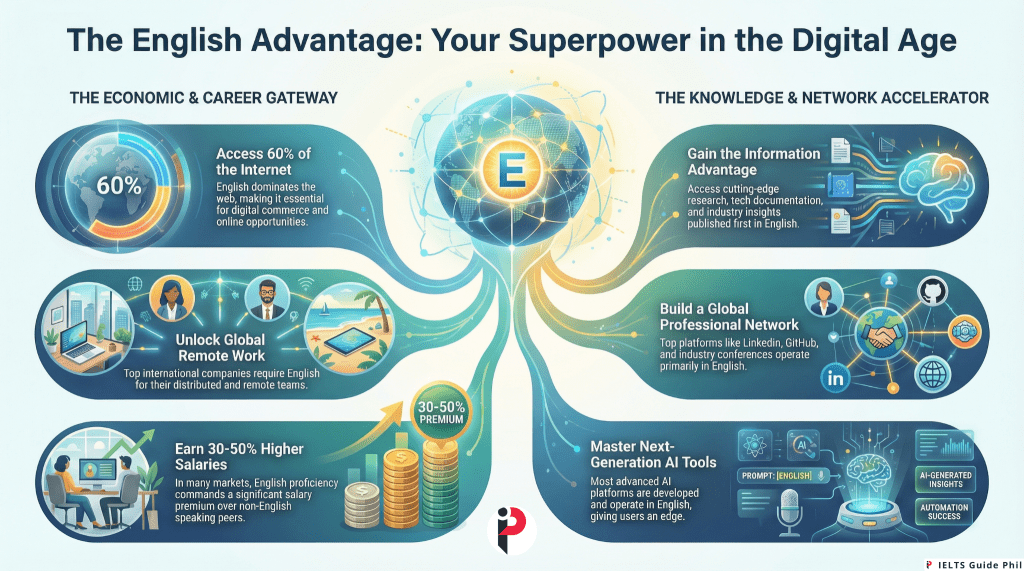
English has emerged as the default language of international business, but the digital economy has taken this reality to new heights. According to recent data, over 60% of global internet content is in English, despite native English speakers comprising only about 5% of the world’s population. This dominance creates a powerful network effect: the more people use English online, the more valuable English proficiency becomes for accessing information, opportunities, and markets.
E-commerce platforms, digital marketing, remote work opportunities, and international collaborations all predominantly operate in English. A software developer in Vietnam, a graphic designer in Colombia, or a marketing consultant in Kenya all find that English proficiency directly correlates with their ability to access global clients, command higher rates, and compete in international marketplaces. The digital economy doesn’t just favor English speakers—it fundamentally requires English competency for full participation.
Automation Paradox: Technology Increases Language Value
One of the most counterintuitive aspects of our automated age is how technology has actually increased rather than decreased the premium on sophisticated language skills. While basic translation has become easier, the most valuable work in our economy increasingly requires nuanced communication, creative expression, and complex problem-solving—areas where human language mastery remains irreplaceable.
Consider how automation has transformed workplaces. Routine tasks are increasingly handled by machines, but the work that remains requires collaboration, persuasion, negotiation, and relationship-building. These fundamentally human activities depend on sophisticated communication skills. A manager coordinating a global team, an entrepreneur pitching to international investors, or a researcher collaborating across continents all need more than functional English—they need the ability to communicate with clarity, cultural sensitivity, and strategic precision.
Moreover, as AI tools become more prevalent, the ability to craft effective prompts, understand nuanced outputs, and communicate complex requirements to AI systems has become a distinct skill set. Most advanced AI platforms operate primarily in English, meaning that proficiency in English provides privileged access to these transformative technologies.
The Information Advantage
We live in an information economy where knowledge itself has become a primary form of capital. English serves as the master key to this knowledge vault. Academic research, technical documentation, cutting-edge industry insights, and specialized expertise are overwhelmingly published and shared in English first—and often exclusively.
This creates a significant information asymmetry. English speakers have immediate access to the latest research papers, industry reports, technical tutorials, professional development resources, and thought leadership content. They can participate in global conversations through social media, forums, and professional networks where industry trends emerge and evolve. By the time valuable information is translated into other languages, the competitive advantage it offered may have already diminished.
For professionals in rapidly evolving fields like technology, medicine, finance, or digital marketing, this information advantage translates directly into career advancement and innovation capacity. Being able to learn from global best practices, stay current with emerging trends, and access specialized knowledge gives English speakers a substantial head start.
Global Professional Networks
In our interconnected world, professional success increasingly depends on network effects. The most valuable professional networks, industry conferences, online communities, and collaborative platforms operate primarily in English. LinkedIn, GitHub, Stack Overflow, academic conferences, and industry associations predominantly use English as their lingua franca.
This networking advantage compounds over time. Access to mentors, collaborators, investors, clients, and thought leaders in English-speaking networks creates opportunities that would be difficult or impossible to replicate in more linguistically isolated contexts. For ambitious professionals in any field, English proficiency determines whether they can access global versus merely local or regional opportunities.
Educational and Cultural Access
The world’s top universities, online learning platforms, professional certifications, and educational resources are heavily concentrated in English-speaking countries or use English as their primary language. Coursera, edX, Khan Academy, MIT OpenCourseWare, and countless specialized learning platforms offer their best content in English.
This educational advantage extends beyond formal credentials. YouTube tutorials, podcasts, documentaries, books, and informal learning resources are vastly more abundant and diverse in English. Someone learning to code, master digital marketing, understand advanced physics, or develop any specialized skill will find exponentially more resources available in English than in most other languages.
Beyond professional development, English provides access to global culture, entertainment, and ideas. While this might seem less critical than economic factors, cultural literacy and the ability to engage with global conversations increasingly matter for professional positioning and personal development.
The Remote Work Revolution
The shift toward remote work, dramatically accelerated by recent global events, has made English proficiency even more valuable. Digital nomads, remote workers, and distributed teams have become normalized across industries. Companies increasingly hire talent globally rather than locally, but they typically require English as the common working language.
This trend has created unprecedented opportunities for skilled professionals anywhere in the world to access high-paying jobs with international companies—provided they have strong English skills. A talented developer in Eastern Europe, a creative designer in Southeast Asia, or a customer service specialist in Latin America can now work for Silicon Valley companies, European startups, or global corporations without relocating, but English proficiency typically serves as the gateway to these opportunities.
Competitive Differentiation in Emerging Markets
In many developing and emerging economies, English proficiency serves as a powerful differentiator. It can mean the difference between low-wage local employment and high-value international opportunities. Countries like India, the Philippines, and Singapore have strategically leveraged English proficiency to attract foreign investment, build service industries, and integrate into global value chains.
At the individual level, professionals in non-English-speaking countries with strong English skills often command salary premiums of 30-50% or more compared to equally qualified peers without English proficiency. This wage differential reflects the tangible economic value that bilingualism provides in global markets.
The AI Translation Caveat
Skeptics might argue that AI-powered translation tools are rapidly improving and will soon eliminate language barriers entirely. While translation technology has indeed made impressive strides, this argument overlooks several crucial limitations.
First, machine translation still struggles with context, nuance, cultural references, humor, and the subtle shadings of meaning that characterize sophisticated communication. Professional work often depends precisely on these subtleties—the ability to persuade, build rapport, detect unstated concerns, or navigate cultural sensitivities.
Second, real-time collaboration, creative work, and spontaneous communication don’t work well with translation intermediaries. Effective teamwork, brainstorming, negotiation, and relationship-building require direct communication without the friction and delay of translation layers.
Third, even perfect translation wouldn’t eliminate the network effects and information advantages described earlier. Being able to directly consume vast amounts of English-language content, participate authentically in English-language communities, and think fluently in the language of global business provides advantages that translation alone cannot replicate.
Strategic Investment for the Future
Given these realities, developing strong English skills represents one of the highest-return investments an individual can make. Unlike many forms of professional development that may become obsolete as technologies and industries evolve, language skills provide durable, transferable value across careers and contexts.
For parents, educators, and policymakers, prioritizing English education alongside other critical skills like digital literacy, critical thinking, and technical expertise makes strategic sense. For professionals at any career stage, improving English proficiency opens doors that might otherwise remain closed.
The goal isn’t necessarily perfect native-like fluency. Rather, developing strong professional English—the ability to read technical content, write clearly, participate in meetings, and communicate effectively with international colleagues—provides most of the practical benefits.
Conclusion: Language as Leverage
Far from making English skills obsolete, globalization, automation, and the information age have made them more valuable than ever. English serves as a gateway to global markets, information, networks, and opportunities that increasingly define success in the 21st-century economy.
This reality isn’t necessarily just or ideal—the dominance of any single language creates inequities and barriers for those without access to quality English education. But recognizing this reality allows individuals, organizations, and societies to respond strategically.
In an age of rapid technological change where many skills and credentials quickly become outdated, English proficiency remains a remarkably durable asset. It’s not just about language—it’s about access, opportunity, and the ability to fully participate in an increasingly interconnected world. For anyone seeking to maximize their potential in our digital, globalized age, investing in English skills isn’t optional—it’s essential.
Here are 15 relevant hashtags for the blog post:
#EnglishLanguage #IELTSGuidePhil #GlobalCommunication #LanguageLearning #DigitalEconomy #RemoteWork #ProfessionalDevelopment #Globalization #CareerGrowth #LanguageSkills #FutureOfWork #InternationalBusiness #Education #Bilingualism #WorkplaceSkills #DigitalTransformation
 IELTS Guide Phil
Leave a comment