
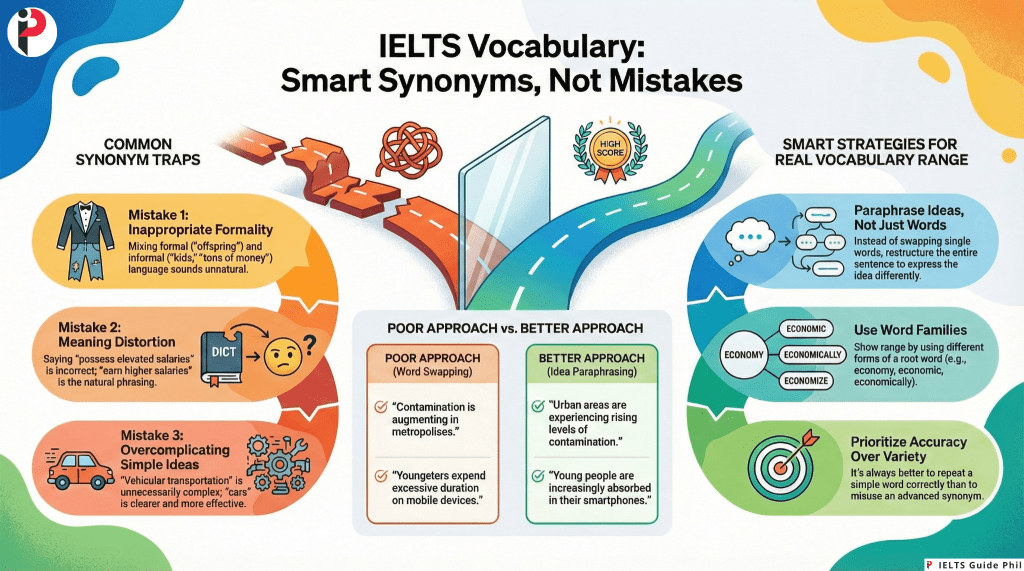
Many IELTS candidates believe that using synonyms extensively will automatically boost their scores. While vocabulary range is indeed assessed in both Writing and Speaking, the misuse or overuse of synonyms can actually damage your performance. This guide explores how to use synonyms effectively and cautiously in your IELTS exam. You can watch this YouTube video explainer by IELTS Guide Phil.
Why Synonyms Matter in IELTS
The IELTS scoring criteria for both Writing and Speaking include lexical resource (vocabulary). Examiners look for:
- Range of vocabulary
- Precision and appropriateness
- Awareness of style and collocation
- Ability to convey precise meanings
However, forcing synonyms where they don’t fit naturally can signal a lack of genuine language proficiency rather than demonstrating it.
The Problem with Synonym Overuse
Explanation
The core issue is that true synonyms are rare in English. Most words that appear similar have subtle differences in meaning, formality, or context. When candidates mechanically replace words with supposed synonyms, they often create awkward, unnatural, or even incorrect sentences.
Examiners can easily spot when someone is using a thesaurus without understanding the nuances. This approach typically results in:
- Unnatural language that native speakers wouldn’t use
- Collocational errors (words that don’t naturally go together)
- Register mismatches (mixing formal and informal language inappropriately)
- Meaning distortions that confuse the reader or listener
Common Mistakes and How to Fix Them
Mistake 1: Changing Keywords Unnecessarily
Incorrect approach: “Climate change is a serious problem. Global warming affects everyone. Temperature increase threatens our future.”
Why it’s wrong: Using different terms (climate change, global warming, temperature increase) in quick succession suggests you’re avoiding repetition rather than communicating clearly. It can also confuse whether you’re discussing the same or different concepts.
Better approach: “Climate change is a serious problem that affects everyone. This global phenomenon threatens our future in multiple ways.”
Fix: It’s acceptable to repeat key terms when discussing a specific topic. Use pronouns (it, this, these) or general references (this issue, this phenomenon) for variety.
Mistake 2: Inappropriate Formality Shifts
Incorrect approach: “Offspring require substantial fiscal resources. Kids need tons of money.”
Why it’s wrong: “Offspring” is extremely formal and more suitable for scientific contexts, while “kids” and “tons of” are too informal for IELTS Writing. Mixing these registers sounds bizarre.
Better approach: “Children require significant financial resources for their upbringing, education, and wellbeing.”
Fix: Maintain consistent formality throughout your response. For IELTS Writing, aim for a semi-formal to formal tone. For Speaking, a neutral to semi-formal register works best.
Mistake 3: Collocational Errors
Incorrect approach: “The government should take measures to tackle the difficulty of unemployment.”
Why it’s wrong: We don’t “tackle difficulties” in this context. The collocation is “tackle the problem/issue” or “address the challenge.”
Better approach: “The government should take measures to tackle the problem of unemployment” or “…to address the challenge of unemployment.”
Fix: Learn words in context with their natural partners. Study collocations rather than isolated synonyms.
Mistake 4: Meaning Distortion
Incorrect approach: “Educated individuals often possess elevated salaries.”
Why it’s wrong: People don’t “possess” salaries, they earn or receive them. “Elevated” is awkward here; we say “higher salaries.”
Better approach: “Educated individuals often earn higher salaries.”
Fix: Verify that your synonym works in the specific grammatical and semantic context. Don’t rely solely on thesaurus suggestions.
Mistake 5: Overcomplicating Simple Ideas
Incorrect approach: “Vehicular transportation is utilized by the majority of the populace for quotidian commutation.”
Why it’s wrong: This is unnecessarily complex and pompous. Simple ideas don’t need complicated vocabulary.
Better approach: “Most people use cars for their daily commute.”
Fix: Match your vocabulary to the complexity of the idea. Clarity trumps complexity.
Dos and Don’ts
DO:
Learn vocabulary in context. Study how words are actually used in authentic English texts, not just their dictionary definitions.
Use natural paraphrasing. Instead of swapping individual words, rephrase entire ideas using different grammatical structures.
Example:
- Original: “Many people think that technology has improved our lives.”
- Natural paraphrase: “There is a widespread belief that technological advances have enhanced quality of life.”
Repeat key terms when appropriate. In academic and formal writing, repeating precise terminology is often better than using vague synonyms.
Vary your sentence structures. This shows linguistic flexibility without forcing unnatural vocabulary.
Check collocations. Use resources like the Oxford Collocations Dictionary or online tools to verify word partnerships.
Use pronouns and general references. These provide natural variety without synonym hunting.
Example: “Climate change → this issue, this phenomenon, it”
Prioritize accuracy over variety. It’s better to repeat a word correctly than to misuse a synonym.
DON’T:
Don’t use a thesaurus without verification. Many thesaurus suggestions are inappropriate for your specific context.
Don’t change every repeated word. Some repetition is natural and expected, especially for technical terms or topic-specific vocabulary.
Don’t use words you don’t fully understand. If you’re uncertain about a word’s meaning or usage, don’t use it.
Don’t mix formality levels. Maintain consistent register throughout your response.
Don’t sacrifice clarity for variety. Your primary goal is clear communication, not showing off vocabulary.
Don’t memorize synonym lists. This leads to mechanical substitution rather than genuine language use.
Don’t use overly complex words for simple ideas. This appears pretentious and suggests insecurity with the language.
Effective Strategies for Lexical Variety
Strategy 1: Paraphrase Ideas, Not Words
Instead of finding synonyms for individual words, express the same idea differently.
Example:
- Original: “Pollution is increasing in cities.”
- Word substitution (poor): “Contamination is augmenting in metropolises.”
- Idea paraphrase (better): “Urban areas are experiencing rising levels of environmental contamination.”
Strategy 2: Use Word Families
Demonstrate vocabulary range by using different forms of the same root word.
Example:
- “The economy is growing” → “economic growth” → “economists predict” → “economically viable”
Strategy 3: Employ General-to-Specific Movement
Move between general and specific terms naturally.
Example:
- “Vehicles” (general) → “cars, buses, and motorcycles” (specific) → “transportation” (more general)
Strategy 4: Master Common Academic Phrases
Learn natural academic expressions that add sophistication without forcing synonyms.
Examples:
- “This suggests that…”
- “One possible explanation is…”
- “This trend can be attributed to…”
- “The evidence indicates that…”
Speaking-Specific Considerations
In IELTS Speaking, the expectations differ slightly from Writing:
Natural fluency matters more. Don’t pause awkwardly while searching for synonyms. It’s better to speak smoothly with some repetition than to hesitate constantly.
Conversational vocabulary is appropriate. You don’t need to sound like an academic essay. Natural, clear expression is valued.
Self-correction is acceptable. If you use a word and then think of a better one, it’s fine to correct yourself naturally: “It’s very important… actually, I’d say it’s essential…”
Examples and elaboration show range. Instead of synonym hunting, expand your answers with examples, reasons, and personal experiences using varied language naturally.
Examples of Good Practice
Writing Task 2 Extract
Topic: Should governments invest more in public transportation?
Good approach: “Governments should prioritize investment in public transportation systems. Enhanced bus and rail networks would encourage commuters to leave their private vehicles at home, reducing traffic congestion and air pollution. This investment would not only benefit the environment but also improve quality of life for residents. While such infrastructure projects require substantial initial funding, the long-term advantages for urban communities are considerable.”
What works here:
- Key term “public transportation” repeated once, then referenced as “bus and rail networks” and “infrastructure projects”
- Natural variety through paraphrasing (“encourage commuters to leave their private vehicles” rather than forcing synonyms for “use”)
- Consistent formal register
- Correct collocations (“prioritize investment,” “reduce congestion,” “substantial funding”)
Speaking Part 2 Extract
Topic: Describe a place you like to visit
Good approach: “I’d like to talk about a small coastal town I visit regularly. It’s about two hours from where I live, and I try to go there whenever I need to relax. What I love most about this place is how peaceful it is. Unlike the city where I live, which is always busy and noisy, this town has a really calm atmosphere. The beaches aren’t crowded, and you can actually hear the waves. I usually spend my time there walking along the shore or sitting in small cafes. It’s become my go-to destination when I want to escape the stress of daily life.”
What works here:
- Natural repetition (“this place,” “this town,” “there”)
- Variety through description rather than synonym substitution
- Conversational yet clear language
- Natural flow without awkward pauses for word-searching
Frequently Asked Questions
Q: How many times can I repeat a word before it becomes a problem?
A: There’s no magic number. In academic writing, repeating key terminology is often necessary and appropriate. Focus on whether your writing sounds natural and clear rather than counting repetitions. If you’re repeating common words (like “important” or “good”) frequently, then variety would help, but technical or topic-specific terms should be repeated as needed.
Q: Should I prepare synonym lists for common IELTS topics?
A: No. Instead, read sample essays and authentic articles on IELTS topics to see how vocabulary is naturally used in context. Build your understanding of how words work together rather than memorizing isolated substitutions.
Q: Is it better to use a simple word correctly or risk using a more advanced synonym?
A: Always choose the simple word used correctly. Accuracy is more important than complexity. Examiners penalize errors more than they reward ambitious vocabulary that fails.
Q: How can I tell if two words are really interchangeable?
A: Check them in multiple example sentences from reliable sources (dictionaries, corpus databases, academic texts). If you can’t find natural examples of the word used in your specific context, don’t use it. When in doubt, stick with what you know.
Q: Will I lose points for repeating words in IELTS Writing?
A: You won’t lose points for appropriate repetition of key terms. You might score lower on lexical resource if you repeatedly use very basic vocabulary (like “good,” “bad,” “big”) when more precise alternatives exist, or if you show very limited vocabulary range overall. But intelligent repetition of precise terminology is preferable to awkward synonym substitution.
Q: In IELTS Speaking, should I try to avoid repeating words?
A: Natural speech includes some repetition. Don’t interrupt your fluency to hunt for synonyms. If a word feels right and communicates clearly, use it. Show vocabulary range through expanding your answers and discussing different aspects of topics rather than through forced synonym use.
Q: What’s the difference between paraphrasing and using synonyms?
A: Synonyms involve swapping individual words with similar meanings. Paraphrasing involves restructuring entire ideas using different grammatical patterns and vocabulary. Paraphrasing is far more effective and natural than simple synonym substitution.
Example:
- Original: “Children spend too much time on phones.”
- Synonym substitution: “Youngsters expend excessive duration on mobile devices.”
- Paraphrasing: “Young people are increasingly absorbed in their smartphones for extended periods.”
Q: Are there any words I should definitely try to vary?
A: Yes, overused basic adjectives and adverbs benefit from variety: “very,” “good,” “bad,” “important,” “big,” “small,” “nice.” Learn more precise alternatives, but make sure they’re appropriate for your context. For example, instead of “very good,” you might use “excellent,” “outstanding,” “beneficial,” or “valuable” depending on what you’re describing.
Q: How do I improve my vocabulary for IELTS appropriately?
A:
- Read extensively on IELTS-relevant topics (education, environment, technology, health, society)
- Notice how words are used in context, including what words commonly appear together
- Keep a vocabulary journal with example sentences, not just definitions
- Practice using new words in your own writing and speaking
- Get feedback on whether your vocabulary use sounds natural
- Study collocations and academic phrases rather than isolated synonyms
Q: Can using too many advanced words hurt my score?
A: Yes, if those words are used incorrectly, inappropriately, or unnaturally. Examiners recognize when candidates are forcing vocabulary that doesn’t fit. A Band 7 essay with precise, natural language use will score higher than a Band 6 essay stuffed with misused advanced vocabulary.
Final Thoughts
The key to success in IELTS vocabulary is authenticity over ambition. Examiners value natural, precise, and appropriate language use far more than a forced display of complex words. Your goal should be clear communication that demonstrates a good range of vocabulary used accurately and naturally.
Think of your vocabulary as a tool for expressing ideas clearly rather than as a way to impress. When you prioritize meaning and natural expression over synonym hunting, your language will sound more confident and competent, leading to better scores in both Writing and Speaking.
Remember that developing genuine vocabulary range takes time and exposure to authentic English. There are no shortcuts, but with consistent reading, listening, and practice using new words in appropriate contexts, you’ll build the natural lexical resource that IELTS examiners are looking for.
#IELTS #IELTSGuidePhil #IELTSWriting #IELTSSpeaking #IELTSPreparation #IELTSTips #EnglishVocabulary #IELTSVocabulary #EnglishLearning #IELTSExam #LearnEnglish #IELTSTest #VocabularyTips #AcademicEnglish #IELTSAdvice #EnglishGrammar #IELTSStudy #TestPreparation #IELTSHelp #EnglishFluency #IELTSSuccess
 IELTS Guide Phil
Leave a comment