
When IELTS examiners assess your speaking performance, they’re not just listening to your vocabulary or grammar. One of the most overlooked yet crucial elements that separates band 6 candidates from band 8+ achievers is connected speech. This natural feature of spoken English can dramatically transform how fluent and native-like you sound.
What Exactly Is Connected Speech?
Connected speech refers to the way native English speakers naturally join words together when speaking at a normal pace. Instead of pronouncing each word separately and distinctly, sounds blend, merge, change, or even disappear altogether. This isn’t lazy speech; it’s simply how English naturally flows in conversation.
Think about the difference between a robot saying “What are you doing?” (with clear pauses between each word) versus a native speaker saying “Whaddya doing?” That smooth, flowing quality is connected speech in action.
Why Connected Speech Matters for IELTS Speaking
The IELTS Speaking test assesses you on four criteria: Fluency and Coherence, Lexical Resource, Grammatical Range and Accuracy, and Pronunciation. Connected speech directly impacts your Fluency and Pronunciation scores.
When you use connected speech naturally, you demonstrate that you can speak English smoothly and effortlessly, without awkward pauses between words. Examiners recognize this as a marker of natural fluency rather than memorized or overly rehearsed speech. Candidates who speak word-by-word often sound robotic and hesitant, which can lower their fluency score even if their grammar and vocabulary are excellent.
The Main Types of Connected Speech
Understanding the different forms of connected speech will help you recognize and practice them effectively.
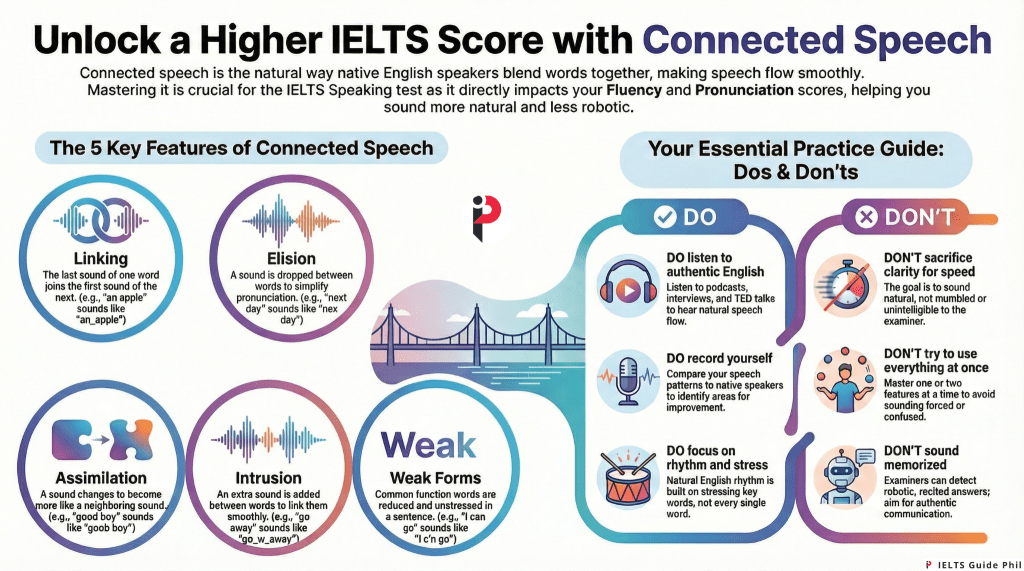
Linking occurs when the final sound of one word connects smoothly to the first sound of the next word. For example, “an apple” becomes “an_apple” with the ‘n’ sound flowing directly into the vowel. Similarly, “come in” sounds like “co_min” with the ‘m’ sound bridging the gap.
Elision involves dropping certain sounds that would be pronounced if words were said in isolation. The phrase “next day” often becomes “nex day” with the ‘t’ disappearing. “Handbag” typically sounds like “hambag” in natural speech, with the ‘d’ vanishing.
Assimilation happens when adjacent sounds influence each other, causing one sound to change to become more like its neighbor. “Good boy” often becomes “goob boy” as the ‘d’ transforms into a ‘b’ sound before another ‘b’. The phrase “white bag” frequently sounds like “whipe bag” with the ‘t’ shifting to a ‘p’ sound.
Intrusion involves adding an extra sound between words to make the transition smoother. When we say “go away,” a ‘w’ sound naturally appears between the two vowels, making it sound like “go_w_away.” Similarly, “the end” often includes a slight ‘y’ sound, becoming “the_y_end.”
Weak forms occur when common function words like articles, prepositions, and auxiliary verbs are pronounced with reduced vowel sounds. The word “and” rarely sounds like its strong form; instead, it becomes a quick “an” or even just “n” in rapid speech. “Can” in “I can go” sounds like “I c’n go” with barely a vowel sound.
Practical Examples for IELTS Topics
Let me show you how connected speech works with typical IELTS Speaking topics.
When discussing hobbies, instead of saying each word separately as “I am interested in photography,” natural speech flows as “I’m interested_in photography” with clear linking between “interested” and “in.”
For work topics, rather than “I used to work in an office,” you would naturally say “I use_tuh work_in_an office” with the ‘d’ in “used” becoming very soft or disappearing entirely.
When talking about travel, “I want to go to Italy next year” transforms into “I wanna go_tu_Italy nex_year” with multiple connected speech features working together.
Describing food preferences, “I really like eating out with friends” becomes “I really like_eating_out with frien(d)s” where the ‘d’ in “friends” often disappears in casual speech.
The Essential Dos
Practice connected speech by listening extensively to natural English. Watch interviews, TED talks, podcasts, and authentic conversations rather than scripted news broadcasts. Pay attention to how words flow together rather than just focusing on individual words.
Record yourself speaking and compare your speech patterns to native speakers. This self-awareness is invaluable for identifying areas where you’re speaking too formally or word-by-word.
Learn the most common weak forms first, particularly for high-frequency words like “to,” “and,” “of,” “for,” “can,” and “have.” These appear constantly in spoken English, so mastering them provides immediate benefits.
Focus on natural rhythm and stress patterns rather than trying to pronounce every word perfectly. English is a stress-timed language, which means connected speech is essential for achieving natural rhythm.
Practice with common IELTS topics and questions. Rehearse your answers until the connected speech feels automatic rather than forced.
Start slowly and gradually increase your speed. Connected speech should emerge naturally as you become more comfortable, not be artificially imposed on slow speech.
The Critical Don’ts
Don’t try to use all forms of connected speech simultaneously. This overwhelming approach often results in unclear or overly fast speech. Instead, gradually incorporate one or two features at a time.
Don’t sacrifice clarity for speed. The examiner must understand every word you say. Connected speech should make your English sound natural, not garbled or unintelligible.
Don’t force connected speech in formal situations or when emphasizing important information. Native speakers naturally slow down and articulate more clearly when making crucial points.
Don’t assume connected speech means speaking faster overall. Natural fluency includes appropriate pausing, thinking time, and varied pacing.
Don’t ignore word stress and sentence stress while focusing on connected speech. These elements work together to create natural-sounding English.
Don’t memorize chunks of connected speech patterns and recite them robotically. Examiners can detect memorized answers, which hurts your authenticity score.
Don’t use connected speech features that are too informal or belong to specific dialects unless you’re consistently using that dialect throughout your test. Stick with standard features of connected speech.
Common Mistakes and Their Fixes
Many candidates make the mistake of speaking too slowly and carefully, pronouncing each word with equal stress. This makes speech sound unnatural and robotic. The fix is to identify content words (nouns, main verbs, adjectives, adverbs) and stress these while reducing function words (articles, prepositions, auxiliary verbs).
Another frequent error is dropping sounds incorrectly or in the wrong contexts, leading to confusion. For example, some learners drop sounds that shouldn’t be dropped, making words incomprehensible. The solution is to focus on the most common and predictable patterns first, such as the silent ‘d’ in “next day” or “handbag,” before attempting more complex elision.
Overusing contractions represents another pitfall. While contractions like “I’m,” “you’re,” and “they’ve” are natural, using them excessively can sound too casual for an exam setting. The fix is to use contractions naturally but maintain some full forms, especially when you want to emphasize something.
Some candidates ignore linking entirely, creating awkward pauses between words that should flow together. For instance, saying “an … apple” with a pause instead of “an_apple” disrupts fluency. Practice linking consonants to vowels and vowels to vowels systematically to overcome this.
Maintaining the same pace throughout speaking is another common mistake. Natural speech includes variation, with speakers slowing down for complex ideas and speeding up for familiar ones. Vary your pace appropriately, using connected speech more in comfortable, familiar parts of your answer.
Finally, many learners focus obsessively on connected speech while neglecting intonation and stress patterns. Remember that English prosody involves the interplay of all these features. Practice with audio resources that model natural intonation patterns alongside connected speech.
Practical Exercises to Master Connected Speech
Shadow native speakers by playing audio or video of natural English and repeating what you hear immediately after, mimicking the rhythm, stress, and connected speech patterns as closely as possible.
Use minimal pair practice to train your ear and mouth. Work with pairs like “an aim” versus “a name,” focusing on how linking changes the sound.
Read aloud from transcripts while listening to the original audio. This helps you see how written words transform in spoken form.
Practice tongue twisters and phrases designed to highlight connected speech, such as “I want to go to work” (I wanna go tuh work) or “She used to live here” (She use tuh live here).
Record mock IELTS answers and analyze them specifically for connected speech features. Identify missed opportunities for natural linking or places where you’re over-articulating.
Frequently Asked Questions
Will using connected speech make my English sound unclear? Not when done correctly. Connected speech is how native speakers naturally communicate clearly. The key is maintaining the right balance—don’t drop so many sounds that words become unrecognizable, but do allow natural blending to occur.
Should I use connected speech in all three parts of the IELTS Speaking test? Yes, connected speech should be present throughout your test as it’s a natural feature of fluent English. However, you might naturally use slightly less in Part 3 when discussing complex ideas, which is perfectly normal even for native speakers.
How long does it take to master connected speech? This varies by individual, but with focused daily practice, most learners begin noticing improvement within 4-6 weeks. Full mastery can take several months of consistent exposure and practice.
Can connected speech help me if my vocabulary is limited? Absolutely. Natural-sounding speech with simpler vocabulary often scores better than robotic speech with advanced words. Connected speech demonstrates genuine fluency, which significantly impacts your overall impression.
Is connected speech the same as speaking fast? No. Connected speech is about how words flow together, not overall speed. You can speak at a moderate pace and still use connected speech effectively. In fact, speaking too fast often reduces clarity.
Do different English accents use different connected speech patterns? While the fundamental principles remain the same, some specific patterns vary between British, American, Australian, and other English varieties. Focus on the accent you’re most exposed to and comfortable with.
Will examiners think I’m trying to show off if I use connected speech? Not at all. Examiners are trained to recognize natural fluency, and connected speech is a marker of genuine language proficiency. What they penalize is obviously memorized or artificial-sounding speech.
Should I practice connected speech more than vocabulary? Both are important. A balanced approach works best—build your vocabulary while simultaneously training your ear and mouth for natural speech patterns. They complement each other in creating effective communication.
Your Action Plan
Start by spending 15-20 minutes daily listening to natural English with the specific goal of noticing connected speech. Use podcasts, YouTube interviews, or TV shows with subtitles so you can see how written forms become spoken forms.
Choose one type of connected speech (like linking or weak forms) and focus on it for a week before moving to the next. This focused approach prevents overwhelm and builds solid foundations.
Practice with real IELTS Speaking questions, recording your answers and listening back critically. Ask yourself: “Do I sound natural and fluent, or am I pronouncing each word separately?”
Find a study partner or tutor who can provide feedback on your connected speech. Sometimes we can’t hear our own patterns, and external feedback proves invaluable.
Remember that connected speech is just one component of effective speaking. Continue developing your vocabulary, grammar, and ideas while simultaneously making your delivery more natural.
Final Thoughts
Connected speech is not a trick or a shortcut—it’s simply how English naturally sounds when spoken fluently. By understanding and practicing these patterns, you’re not gaming the IELTS system; you’re genuinely improving your English communication skills.
The most successful IELTS candidates aren’t those who memorize fancy vocabulary or complex grammar structures. They’re the ones who can communicate their ideas clearly, naturally, and confidently. Connected speech is an essential ingredient in that recipe for success.
Start small, be patient with yourself, and celebrate small victories as your speech becomes increasingly natural. Before long, connected speech will feel automatic, and you’ll wonder why you ever spoke any other way.
#IELTSSpeaking #IELTSPreparation #IELTSTips #ConnectedSpeech #EnglishPronunciation #EnglishFluency #IELTSSuccess #LearnEnglish #EnglishLearning #IELTSExam #SpeakingTest #EnglishPronunciationTips #FluentEnglish #IELTSBand7 #IELTSBand8 #EnglishLanguageLearning #IELTSStudy #TestPreparation #ESL #EFL #EnglishSpeaking #LanguageLearning #StudyAbroad #IELTSCoaching #IELTSGuidePhil
 IELTS Guide Phil
Leave a comment