
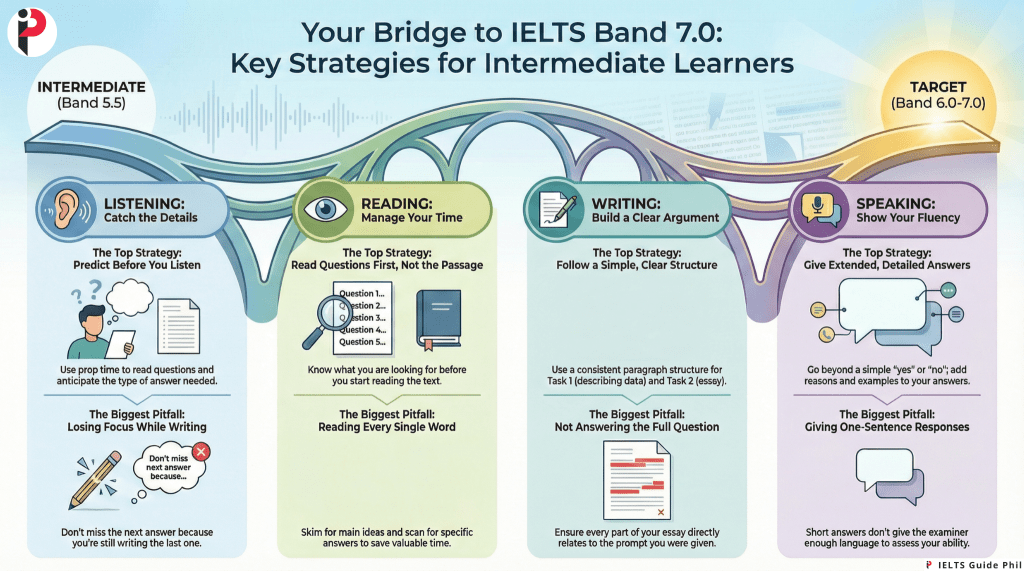
If you’re an intermediate English learner preparing for the IELTS, you’re at an exciting stage of your language journey. You can handle everyday conversations, understand the main ideas in texts, and express yourself reasonably well. Now, your goal is to develop the skills and strategies needed to achieve a solid band 6.0 to 7.0 score.
This comprehensive guide will help you build confidence, develop essential exam skills, and avoid the common pitfalls that prevent intermediate learners from reaching their target scores.
Understanding Your Starting Point
As an intermediate learner, you likely have a working knowledge of English grammar, a vocabulary of several thousand words, and can communicate in most daily situations. However, you might struggle with complex academic texts, expressing nuanced ideas, understanding fast native speakers, or writing extended responses under time pressure.
The good news? The IELTS is designed to test practical communication skills, not perfect English. A band 6.0 indicates you’re a “competent user” who can handle complex language reasonably well despite some inaccuracies. A band 7.0 shows you’re a “good user” with operational command of the language. Both are achievable with focused preparation.
Listening Section: Building Your Foundation
Understanding the Challenge
The Listening section can feel overwhelming at first because you only hear the audio once, speakers have various accents, and you must listen, understand, and write answers simultaneously. However, this section often becomes the highest-scoring area for intermediate learners with proper practice.
Essential Strategies You Need
Learn to predict before you listen. When you have preparation time, read the questions carefully and think about what kind of answer makes sense. If a question asks “The meeting will be held in room ___,” you know you’re listening for a number or room name. This mental preparation helps you catch the right information.
Write while you listen, transfer later. During the test, write your answers directly on the question paper. Don’t worry about perfect handwriting or capital letters yet. At the end, you get 10 minutes to transfer answers to the answer sheet—use this time to check spelling and formatting.
Focus on key words, not every word. You don’t need to understand every single word you hear. Train yourself to catch the essential information: names, numbers, times, places, and key nouns. The other words provide context but aren’t usually the answer.
Learn common spelling traps. Practice spelling numbers (forty, not fourty), days of the week, months, common place names, and frequent vocabulary like “accommodation” (double c, double m) and “necessary” (one c, double s).
Use the example to tune in. Every section begins with an example. Use this time to adjust to the speaker’s accent, speed, and volume. This warm-up is valuable.
Follow the questions in order. Answers come in sequence. If you miss question 5, don’t panic and lose questions 6 and 7 trying to find it. Move forward with the audio.
Common Mistakes and How to Fix Them
Mistake: Mishearing information because you’re still writing the previous answer.
Fix: Develop a quick shorthand system. Instead of writing “computer science,” write “comp sci” or “CS.” You can write the full answer when transferring to the answer sheet.
Mistake: Writing too many words (e.g., writing “the local library” when the instruction says “NO MORE THAN TWO WORDS”).
Fix: Count every single word including “a,” “an,” and “the.” If your answer is too long, look at what can be removed. Often you can drop articles: “local library” instead of “the local library.”
Mistake: Not using correct capitalization (e.g., writing “monday” instead of “Monday”).
Fix: Always capitalize: days of the week, months, names of people, places, streets, buildings, and countries. When transferring answers, check every word.
Mistake: Getting distracted by unfamiliar words and losing focus.
Fix: If you hear a word you don’t know, don’t stop to think about it. Keep listening. The main information you need is usually simple and clear.
Practice Approach for Intermediate Learners
Start with slower, clearer audio and gradually increase difficulty. Listen to BBC Learning English, which offers clear pronunciation and transcripts. Watch English TV shows with English subtitles—this trains your ear while showing you the written forms. Practice with IELTS Cambridge materials, starting from older tests (1-8) which are slightly easier than recent ones (15+).
Try this exercise: Listen to a 5-minute news segment. Pause after each sentence and try to write what you heard. Check against the transcript. This builds your listening stamina and accuracy.
Reading Section: Understanding and Managing Time
Understanding the Challenge
The Reading section gives you 60 minutes to read three passages (about 2,750 words total) and answer 40 questions. For intermediate learners, the main challenges are complex vocabulary, time pressure, and question types you may not be familiar with.
Essential Strategies You Need
Don’t read every word carefully. This is the biggest mistake intermediate learners make. You don’t have time to read like you’re studying. Instead, learn to skim (read quickly for main ideas) and scan (search for specific information).
Always read the questions first. This tells you what information to look for. Then skim the passage to understand the overall topic and structure. Finally, read more carefully to find specific answers.
Underline key words in questions. This helps you know what to scan for in the passage. If the question asks about “the main reason for population growth,” underline “main reason” and “population growth.” Then scan the passage for these concepts.
Learn to find synonyms. The IELTS loves to use different words with the same meaning. The question might say “children” but the passage says “youngsters” or “young people.” Practice recognizing these word substitutions:
- difficult = challenging, hard, problematic
- important = significant, crucial, essential, vital
- show = demonstrate, indicate, reveal, display
- many = numerous, various, several, multiple
Manage your time strictly. Spend no more than 20 minutes per passage. Use a watch or the exam room clock. If you’re stuck on a question after 1 minute, mark it and move on. You can return if you have time at the end.
Understand True/False/Not Given. This question type confuses many intermediate learners:
- True = the passage says this information
- False = the passage says the opposite
- Not Given = the passage doesn’t give this information
Remember: use only information from the passage, not your own knowledge.
Answer every question. There’s no penalty for wrong answers, so never leave a blank. If you don’t know, make your best guess based on the passage.
Common Mistakes and How to Fix Them
Mistake: Spending 10 minutes on the first two questions and then rushing through the rest.
Fix: Set a timer for 20 minutes per passage. When time is up, move to the next passage even if you haven’t finished. You can return at the end if you have extra time.
Mistake: Choosing “False” instead of “Not Given” because something seems unlikely or you don’t think it’s true.
Fix: Ask yourself: “Does the passage actually say the opposite, or does it just not mention this information?” If the passage is silent on the topic, choose “Not Given.”
Mistake: Looking for exact words from the question in the passage.
Fix: Train yourself to look for meanings, not matching words. The passage will usually paraphrase the question. Create your own synonym lists for common IELTS words.
Mistake: Reading passages from beginning to end before looking at questions.
Fix: This wastes valuable time. Always check the questions first so you know what information you’re searching for.
Practice Approach for Intermediate Learners
Read articles from BBC News, National Geographic, or The Guardian. After reading, write down the main idea in one sentence and the key details in bullet points. This trains you to identify important information quickly.
Practice with one passage at a time, setting a strict 20-minute limit. Focus on improving your speed while maintaining accuracy. As you get better, take full three-passage practice tests.
Writing Section: Building Clear, Organized Responses
Understanding the Challenge
Writing is often the most challenging section for intermediate learners because it requires you to produce language, not just understand it. You need to organize ideas, use correct grammar, spell accurately, and complete two different tasks in 60 minutes.
Task 1 (Academic): Essential Strategies
Understand what you’re describing. Task 1 asks you to describe visual information: a graph, chart, table, diagram, or map. You must write at least 150 words in about 20 minutes.
Follow a simple four-paragraph structure:
- Introduction: Paraphrase what the graph shows (1-2 sentences)
- Overview: Describe the main trends or most important features (2-3 sentences)
- Body Paragraph 1: Describe specific details with data
- Body Paragraph 2: Describe more specific details with data
Learn the language for describing trends:
- Increases: go up, rise, grow, increase, climb
- Decreases: go down, fall, drop, decrease, decline
- No change: remain stable, stay the same, remain constant
- Describing speed: gradually, slowly, steadily, rapidly, sharply, dramatically
Include specific numbers. Don’t just say “the number increased.” Say “the number increased from 20% to 45%.” Always include units (%, million, thousand, etc.).
Write an effective overview. This is crucial for scoring well. The overview summarizes the main trend or most noticeable feature without including specific numbers. Example: “Overall, while online shopping increased significantly over the period, traditional retail sales declined.”
Don’t give opinions. Task 1 is objective description only. Never write “I think” or “in my opinion.” Just describe what you see.
Task 2: Essential Strategies
Understand the question type. Task 2 presents an opinion, argument, or problem and asks you to respond. Common question types include:
- Agree or Disagree: Do you agree with this statement?
- Advantages and Disadvantages: Discuss the pros and cons
- Problem and Solution: What are the problems and how can they be solved?
- Discussion: Discuss both views and give your opinion
Use a clear five-paragraph structure:
- Introduction: Rephrase the question and state your main position (2-3 sentences)
- Body Paragraph 1: First main point with explanation and example
- Body Paragraph 2: Second main point with explanation and example
- Body Paragraph 3 (optional): Third point or counterargument
- Conclusion: Summarize your main points (2-3 sentences)
Make your position clear. Don’t sit on the fence. The examiner wants to see you can express and support an opinion clearly.
Develop your ideas with examples. Don’t just make statements. For each main idea, include:
- Topic sentence (main idea)
- Explanation (explain what you mean)
- Example (give a specific example)
- Concluding sentence (link back to the main question)
Learn useful connecting words:
- Adding ideas: Furthermore, Moreover, Additionally, Also
- Contrasting: However, On the other hand, Nevertheless, Although
- Giving examples: For example, For instance, Such as
- Showing results: Therefore, Consequently, As a result, Thus
- Concluding: In conclusion, To summarize, Overall
Watch your grammar basics. Focus on getting these right:
- Subject-verb agreement (The students are, not The students is)
- Verb tenses (especially present simple, past simple, present perfect)
- Articles (a, an, the)
- Plural forms
- Basic sentence structure
Keep sentences relatively simple. It’s better to write short, correct sentences than long, complicated sentences with many errors. Once you’re comfortable, you can try more complex structures.
Common Mistakes and How to Fix Them
Mistake: Writing too little (under 150 words for Task 1 or under 250 words for Task 2).
Fix: Practice writing by hand and count your words. Learn approximately how many words you write per line. If you write about 10 words per line, 250 words = 25 lines. This helps you estimate during the exam.
Mistake: Poor handwriting that the examiner can’t read.
Fix: Practice writing neatly at speed. If your handwriting is naturally messy, slow down slightly. Illegible writing cannot be scored.
Mistake: Copying large chunks from the question.
Fix: Paraphrase the question in your introduction using different words. If the question says “Some people believe online education is better than traditional learning,” you could write “There is an opinion that digital learning platforms offer more benefits than conventional classroom teaching.”
Mistake: Writing off-topic or not fully addressing the question.
Fix: Read the question carefully. Underline the key words. Make sure every paragraph relates directly to what you’re asked to discuss.
Mistake: No paragraphs or poor paragraph organization.
Fix: Always indent or leave a space between paragraphs. Start a new paragraph for each new main idea. The examiner should be able to see your structure clearly.
Mistake: Using informal language (gonna, wanna, kids, stuff, things).
Fix: Keep your writing formal. Use full forms (going to, want to), formal vocabulary (children, items, matters), and avoid contractions (don’t = do not, can’t = cannot).
Practice Approach for Intermediate Learners
Start by writing untimed essays, focusing on structure and developing ideas. Once comfortable, practice with time limits: 20 minutes for Task 1, 40 minutes for Task 2.
For Task 1, describe graphs and charts you find online. For Task 2, write about topics that interest you: technology, education, environment, health, work. This makes practice more engaging.
Get feedback on your writing. Use online IELTS writing communities, find a study partner, or consider working with a tutor. Understanding your specific errors helps you improve faster.
Speaking Section: Building Confidence and Fluency
Understanding the Challenge
The Speaking test is a face-to-face conversation with an examiner lasting 11-14 minutes. Many intermediate learners feel nervous, which affects their performance. Remember: the examiner wants you to do well and is trained to make you comfortable.
Part 1: Essential Strategies (4-5 minutes)
Part 1 consists of general questions about yourself, your home, family, job, studies, or interests.
Give extended answers. Don’t answer with just one word or sentence. The examiner needs to hear you speak. Use this pattern:
- Direct answer
- Additional detail or reason
- Example or personal experience
Example: Q: “Do you like reading?” Weak answer: “Yes, I do.” Better answer: “Yes, I enjoy reading quite a lot. I usually read before bed because it helps me relax after a long day. Recently, I’ve been reading mystery novels—I find them really exciting.”
Use common phrases to buy thinking time:
- “That’s an interesting question…”
- “Let me think about that…”
- “Well, I would say…”
- “Actually,…”
Don’t memorize answers. Memorized answers sound unnatural and don’t address the specific question. Instead, prepare ideas about common topics but speak naturally.
Practice common Part 1 topics:
- Your home/hometown
- Your work or studies
- Your family
- Hobbies and free time
- Daily routines
- Food
- Weather
- Technology
Part 2: Essential Strategies (3-4 minutes)
You receive a topic card and must speak for 1-2 minutes. You have 1 minute to prepare and can make notes.
Use the preparation time wisely. Read the card carefully. Write down key words for each point on the card, not full sentences. Quickly plan the order you’ll talk about things.
Follow the card’s structure. The card has bullet points. Make sure you address each one:
- What/who/where
- When
- Why/how
- Your feelings or why it’s important
Start with a brief introduction. Tell the examiner what you’re going to talk about: “I’d like to talk about a teacher who influenced me greatly. Her name was Mrs. Johnson, and she taught me English in high school.”
Keep talking for the full time. If you finish early, add more details, describe your feelings, or explain why this topic is meaningful to you. Aim to speak until the examiner stops you.
Use the notes you made. Glance at your notes to remember what to say next, but don’t read from them.
Organize your answer with simple time markers:
- First / To begin with
- Then / After that / Next
- Finally / In the end
Part 3: Essential Strategies (4-5 minutes)
The examiner asks more abstract questions related to the Part 2 topic. This tests your ability to discuss ideas and give opinions.
Give your opinion clearly. It’s okay to say “I think…” or “In my opinion…” or “I believe…” The examiner wants to hear your views.
Provide reasons for your opinions. Don’t just state what you think—explain why: “I think technology has improved education because it makes learning more interactive and accessible to people everywhere.”
Give examples to support your points: “For example, students can now watch lectures from top universities online, even if they live in remote areas.”
Show you can discuss different perspectives: “Some people believe that… However, others argue that… Personally, I think…”
Use conditional sentences naturally: “If governments invested more in public transport, cities would be less polluted.”
Don’t worry if you don’t know much about the topic. You can say “I’m not an expert on this, but I think…” or “From my experience…” or “Based on what I’ve seen in my country…”
Common Mistakes and How to Fix Them
Mistake: Speaking too quietly or unclearly.
Fix: Practice speaking at a normal conversational volume. Record yourself and listen back. Ask friends if they can understand you easily. Speak clearly and don’t rush.
Mistake: Stopping speaking after 30 seconds in Part 2.
Fix: Practice Part 2 responses with a timer. Keep talking even if you feel you’ve run out of things to say. Add descriptions, feelings, comparisons, or reflections.
Mistake: Using very simple vocabulary and grammar throughout.
Fix: Learn some “upgrades” for common words. Instead of always saying “good,” try “beneficial,” “positive,” “excellent.” Instead of “bad,” try “problematic,” “negative,” “harmful.” Use a mix of present, past, and future tenses naturally.
Mistake: Giving very short answers in Part 3.
Fix: Challenge yourself to speak for at least 30-40 seconds per answer. Develop your ideas: state an opinion, give a reason, provide an example, and perhaps mention an alternative view.
Mistake: Apologizing constantly for your English.
Fix: Don’t say “Sorry, my English is not good” or “I don’t know this word in English.” This wastes time and highlights problems. Instead, if you don’t know a word, describe it: “I don’t know the exact word, but I mean the place where doctors work” (hospital).
Mistake: Using the same connecting words repeatedly (always starting with “And” or “Because”).
Fix: Learn a variety: Additionally, Furthermore, Also, Since, As, Therefore, Consequently, However, Although, Despite this, On the other hand.
Practice Approach for Intermediate Learners
Practice speaking English every day, even if just for 10 minutes. Talk to yourself about your day, describe objects around you, or record yourself answering IELTS practice questions.
Find a speaking partner—another IELTS student, a teacher, or use language exchange websites. Practice all three parts of the speaking test regularly.
Watch English speakers on YouTube, TED Talks, or interviews. Notice how they structure answers, use pauses, and express opinions. Try to imitate their natural speech patterns.
Dos and Don’ts: Quick Reference Guide
Universal Dos
Do practice all four sections regularly—don’t just focus on your weakest area.
Do time yourself during practice to build speed and manage exam pressure.
Do read instructions carefully in the exam—they tell you exactly what to do.
Do answer every single question—there’s no penalty for wrong answers.
Do bring acceptable identification to the test center and arrive on time.
Do stay calm if something seems difficult—the test has easier and harder questions for all levels.
Universal Don’ts
Don’t expect perfect English—even band 9 candidates make small mistakes.
Don’t panic if you don’t understand everything—focus on what you can understand.
Don’t leave any answer blank—always write something or guess if necessary.
Don’t waste time trying to impress with vocabulary you’re not confident using.
Don’t compare yourself to other test-takers—everyone has different strengths.
Don’t try to learn lots of new material the night before the test—review what you know instead.
Frequently Asked Questions
Q: How long should I prepare for the IELTS as an intermediate learner?
A: Most intermediate learners need 8-12 weeks of consistent preparation. This gives you time to strengthen your English skills, become familiar with the test format, practice all question types, and build confidence. If you’re currently around band 5.0-5.5 in practice tests, expect to need 10-12 weeks to reach band 6.0-6.5. Daily practice is more effective than occasional long study sessions.
Q: What band score should I aim for as an intermediate learner?
A: Set realistic goals based on your current level and requirements. Band 6.0 is a solid achievement for intermediate learners and is accepted by many universities (though often with additional English support). Band 6.5-7.0 typically requires upper-intermediate English. Check the specific requirements of your university or immigration program before setting your target.
Q: Which section is usually easiest for intermediate learners?
A: Many intermediate learners find Listening the most approachable because you only need to understand and write specific information, not produce complex language. With practice, it’s often possible to score higher in Listening than in other sections. Writing is typically the most challenging for intermediate learners.
Q: Should I focus on British or American English?
A: Either is completely acceptable. Use whichever you’re more comfortable with, but try to be consistent, especially in Writing. Don’t write “colour” in one sentence and “color” in the next. In Listening, you’ll hear various accents (British, American, Australian), so practice with all of them.
Q: How much vocabulary do I need to know?
A: Aim for 3,000-5,000 words for band 6.0, and 5,000-7,000 words for band 7.0. However, knowing vocabulary isn’t just about quantity—you need to use words correctly in context. Focus on common academic words and topic-specific vocabulary for typical IELTS themes: education, environment, health, technology, work, society.
Q: Can I use a pencil in the Writing test?
A: In the paper-based test, you can write in pencil or pen (pencil is recommended because you can erase mistakes). In the computer-delivered test, you type your answers. Choose whichever format you’re more comfortable with.
Q: What if I don’t finish the Reading or Writing section?
A: Time management is crucial. In Reading, if you have 5 minutes left and several unanswered questions, quickly guess answers for all remaining questions. In Writing, if time runs out, at least write a quick concluding sentence. An incomplete Task 2 essay will score lower than a complete essay with minor problems.
Q: How is the Speaking test scored?
A: Four criteria, each worth 25%: Fluency and Coherence (how smoothly you speak), Lexical Resource (vocabulary range and accuracy), Grammatical Range and Accuracy (variety and correctness of grammar structures), and Pronunciation (how clearly you speak, not your accent). All three parts contribute equally to your final Speaking band score.
Q: Will using difficult vocabulary impress the examiner?
A: Only if you use it correctly and naturally. Using simple vocabulary accurately is better than using complex vocabulary incorrectly. The examiner assesses your ability to communicate effectively, not just your knowledge of big words.
Q: What should I do the day before the test?
A: Review your notes and strategies, but don’t try to learn new material. Do light practice if it makes you feel confident, but avoid exhausting yourself. Prepare everything you need (ID, test confirmation, pencils, water). Get a good night’s sleep. Eat a proper breakfast on test day. Arrive at the test center with plenty of time to spare.
Your 8-Week Action Plan
Weeks 1-2: Building Foundation
- Take a diagnostic practice test to identify your current level
- Study the format and requirements of each section
- Start building vocabulary lists for common IELTS topics
- Practice basic question types in each section
- Begin daily listening practice (15-20 minutes)
Weeks 3-4: Developing Skills
- Focus on your weakest section (spend 40% of study time here)
- Learn and practice specific strategies for each question type
- Do timed practice for individual passages/sections
- Practice Writing Task 1 and Task 2 separately
- Record yourself doing Speaking practice and listen back
Weeks 5-6: Integration and Speed
- Take complete practice tests under exam conditions
- Work on time management in Reading and Writing
- Practice complete Speaking tests (all three parts)
- Review and analyze your mistakes from practice tests
- Continue building topic-specific vocabulary
Weeks 7-8: Refinement and Confidence
- Take 2-3 full practice tests (spread across the two weeks)
- Focus on consistency across all sections
- Review common errors and strategies
- Do lighter practice in your strong sections
- Practice staying calm under pressure
- Rest the day before your exam
Essential Study Resources for Intermediate Learners
Official Materials:
- Cambridge IELTS books (volumes 10-19)—official practice tests
- British Council IELTS preparation resources
- IELTSliz.com—free tips, model answers, and practice
For Listening:
- BBC Learning English—clear audio with transcripts
- BBC 6 Minute English—short, engaging topics
- TED Ed videos—educational content with subtitles
- IELTS Listening practice tests on YouTube
For Reading:
- BBC News—Science, Technology, Health sections
- National Geographic—accessible articles on diverse topics
- The Guardian—Education section
- Simple Wikipedia—easier versions of complex topics
For Writing:
- Grammarly (free version)—checks basic grammar and spelling
- IELTS Writing Task samples—study band 6-7 examples
- Online IELTS writing forums for feedback
For Speaking:
- IELTS Speaking Part 1, 2, 3 question banks
- Language exchange partners (italki, Tandem, HelloTalk)
- Record yourself using your phone’s voice recorder
Vocabulary Building:
- Academic Word List (AWL)—570 most common academic words
- IELTS Word Power app
- Quizlet IELTS vocabulary sets
- Context-based vocabulary (learn words in sentences, not isolation)
Grammar Priorities for Intermediate Learners
You don’t need perfect grammar for band 6.0-7.0, but focus on getting these structures right:
Essential Grammar to Master:
- Present simple and present continuous
- Past simple and present perfect
- Future forms (will, going to, present continuous for future)
- Comparative and superlative adjectives
- Conditional sentences (first and second conditional)
- Passive voice (basic usage)
- Modal verbs (can, should, must, might, would)
- Relative clauses (who, which, that, where)
- Articles (a, an, the, zero article)
Common Grammar Errors to Avoid:
- Subject-verb agreement errors
- Incorrect verb tenses
- Missing articles or wrong article use
- Confusion between countable and uncountable nouns
- Incorrect prepositions
- Double negatives
Building Your Vocabulary Strategically
Focus on High-Frequency IELTS Topics:
- Education: curriculum, literacy, tuition, compulsory, academic
- Environment: pollution, conservation, sustainable, renewable, emissions
- Technology: innovation, automation, digital, breakthrough, artificial intelligence
- Health: obesity, epidemic, nutrition, preventive, diagnosis
- Work: employment, productivity, career, workforce, unemployment
- Society: community, diversity, inequality, urban, population
Learn Words in Context: Don’t just memorize word lists. Learn vocabulary through:
- Reading articles about IELTS topics
- Watching videos on these topics
- Creating your own example sentences
- Learning collocations (words that go together): “make a decision,” “take responsibility,” “highly unlikely”
Use the Vocabulary You Learn:
- Include new words in your writing practice
- Use them when speaking about topics
- Review regularly using spaced repetition
Final Thoughts: You Can Do This
As an intermediate learner, achieving a band 6.0-7.0 on the IELTS is completely within your reach. Success comes from three key factors: understanding the test format, practicing consistently, and building your confidence.
Remember that the IELTS doesn’t require perfect English. The examiners understand you’re still learning, and they’re assessing your ability to communicate effectively, not flawlessly. Every intermediate learner makes mistakes—what matters is that you can express your ideas clearly and handle the tasks required by each section.
Your intermediate level is actually an advantage in some ways. You’re still actively improving, which means you can make significant progress in 8-12 weeks of focused preparation. You’re developing study habits and learning strategies that will serve you well beyond the IELTS.
Stay patient with yourself, practice regularly, and trust the process. Every practice test, every writing task, every speaking session is making you better. You’re not just preparing for an exam—you’re building valuable English skills that will benefit you in your academic or professional journey.
Believe in yourself, prepare strategically, and go into that test center knowing you’ve done the work. Your target score is waiting for you.
Good luck with your IELTS journey!
#IELTS #IELTSPreparation #IELTSIntermediate #LearnEnglish #IELTSTips #IELTSTest #EnglishLearning #Band6 #Band7 #StudyAbroad #IELTSGuidePhil #IELTSWriting #IELTSSpeaking #IELTSReading #IELTSListening #TestPrep #ESL #EnglishExam #IELTSStudy #LanguageLearning #IELTSGoals #StudyEnglish #IELTSSuccess #ExamPreparation #EnglishTest #IELTSHelp
 IELTS Guide Phil
Leave a comment