
If you’re a beginner English learner thinking about taking the IELTS, you’re taking an important first step toward your goals. Whether you need IELTS for university admission, immigration, or professional purposes, this guide will help you understand what the test involves and how to prepare effectively from the ground up.
Let’s be honest: the IELTS is challenging for beginners. But with the right preparation, realistic goals, and consistent effort, you can achieve a score that opens doors for you. This guide will show you exactly how.
Understanding Your Starting Point: What “Beginner” Means
As a beginner learner, you might:
- Understand and use simple everyday phrases
- Introduce yourself and ask basic questions about others
- Communicate in simple situations when the other person speaks slowly and clearly
- Read and understand short, simple texts
- Write simple sentences about familiar topics
- Have a vocabulary of 1,000-2,000 words
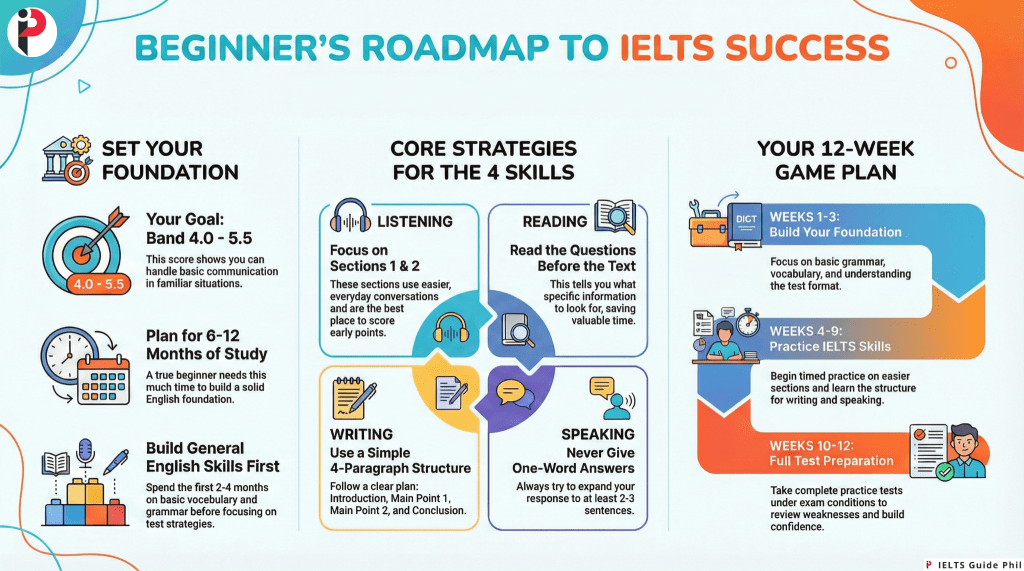
If this describes you, you’re likely aiming for band 4.0-5.5. Let’s understand what these scores mean:
Band 4.0 shows you have limited ability but can handle basic communication in familiar situations. You make frequent errors but can convey basic meaning.
Band 5.0 means you have partial command of English. You can handle basic communication and understand main ideas, though you make many mistakes.
Band 5.5 indicates modest command. You can communicate in familiar contexts reasonably well despite noticeable errors.
These are realistic and achievable goals for beginners with dedicated preparation.
How Much Time Do You Need?
This is the most important question for beginners. Here’s the honest truth: if you’re starting from a basic level, you need significant time to prepare properly.
Realistic Timeline:
- From true beginner (A1 level) to Band 4.0-5.0: 6-12 months
- From elementary (A2 level) to Band 5.0-5.5: 4-6 months
- With intensive study (15-20 hours/week): You can progress faster
- With casual study (5-7 hours/week): You’ll need more time
Don’t rush. Taking the test before you’re ready wastes money and can be discouraging. Build your English foundation first, then focus on test-specific strategies.
Should You Take IELTS Right Away?
Before registering for the IELTS, ask yourself:
- Can I understand the main idea when someone speaks slowly and clearly?
- Can I read and understand simple texts about familiar topics?
- Can I write a few sentences about myself and my daily life?
- Can I have a basic conversation about familiar topics?
If you answered “no” to several of these questions, consider building your general English skills for a few months before focusing specifically on IELTS preparation.
Alternative Path:
- Spend 2-4 months building basic English skills (grammar, vocabulary, listening, reading)
- Take a practice IELTS test to see your level
- If you score 4.0 or above, begin focused IELTS preparation
- If you score below 4.0, continue general English study for another 2-3 months
Listening Section: Understanding What You Hear
What to Expect
The Listening test has four sections with 40 questions total. You listen to recordings only once and write your answers. The recordings get progressively harder:
- Section 1: Two people having a conversation about everyday situations (easiest)
- Section 2: One person talking about everyday topics
- Section 3: Multiple people discussing education or training
- Section 4: One person giving a lecture or talk (hardest)
Essential Strategies for Beginners
Start with Section 1 and 2. These are more manageable for beginners. Don’t worry if Sections 3 and 4 are very difficult at first. Focus your practice energy where you can actually score points.
Learn to recognize question words. The questions use words like: What? Where? When? Who? How many? How much? Knowing these helps you understand what information you need.
Practice writing while listening. This is a skill that takes time to develop. Start with very short audio clips (1-2 minutes) and practice writing down key information you hear.
Use the example and preparation time. Before each section starts, you get time to read the questions. Use this time! Read the questions and try to guess what type of answer you need (a number? a name? a place?).
Write something for every answer. Even if you didn’t hear the answer clearly, write your best guess. There’s no penalty for wrong answers. Never leave a blank.
Learn basic spelling. You must spell answers correctly. Practice spelling common words:
- Numbers: thirty, forty, thirteen, fourteen, fifteen, eighteen
- Days: Monday, Tuesday, Wednesday, Thursday, Friday, Saturday, Sunday
- Months: January, February, March, April, May, June, July, August, September, October, November, December
- Common places: library, hospital, restaurant, university, airport, station
- Common words: address, appointment, accommodation, necessary, receive
Transfer answers carefully. At the end, you get 10 minutes to copy answers to the answer sheet. Use this time to:
- Check spelling
- Make sure writing is clear
- Add capital letters where needed (names, places, days, months)
- Check you haven’t skipped any questions
Simple Practice Activities
Week 1-2: Very Basic Listening
- Listen to simple English learning podcasts (BBC Learning English “Learning English” series)
- Watch children’s English cartoons or shows with English subtitles
- Listen to the same audio multiple times until you understand it
- Focus on understanding the main idea, not every word
Week 3-4: Active Listening
- Listen to short recordings (2-3 minutes) and write down numbers, names, and places you hear
- Use IELTS Listening Section 1 practice materials
- Check your answers and understand why you made mistakes
- Practice writing while you listen (don’t pause)
Week 5+: Test Practice
- Do complete Sections 1 and 2 from practice tests
- Time yourself and transfer answers in 10 minutes
- Gradually add Sections 3 and 4 as you improve
Common Beginner Mistakes
Mistake: Not reading the questions before the audio starts.
Fix: Always use preparation time to read questions. This helps you know what to listen for.
Mistake: Trying to understand every single word.
Fix: You don’t need to understand everything. Focus on catching the specific information the question asks for (the name, the number, the time, etc.).
Mistake: Writing too many words or too few words.
Fix: Read the instructions carefully. If it says “NO MORE THAN TWO WORDS,” you can write one word or two words, but not three. Count every word including “a,” “an,” “the.”
Mistake: Not writing anything when you miss an answer.
Fix: Never leave a blank. If you’re not sure, make your best guess based on what you heard.
Reading Section: Building Your Reading Skills
What to Expect
You get 60 minutes to read three texts and answer 40 questions. The texts are long (about 900 words each) and use academic or general interest topics. For beginners, this section is challenging because of difficult vocabulary and time pressure.
Essential Strategies for Beginners
Don’t try to understand every word. This is impossible and not necessary. Even native speakers don’t know every word. Focus on understanding the main ideas and finding specific information.
Read the questions first, then the text. This tells you what information to look for. You’re not reading for pleasure; you’re reading to answer questions.
Look for easy answers first. Some questions are easier than others. Answer the ones you can find quickly, then spend more time on harder questions.
Use the question words to guide you. If the question asks “Where did the meeting take place?” you’re looking for a place name. Scan the text for place names.
Learn to scan for specific information. Scanning means moving your eyes quickly over the text looking for specific words, names, numbers, or dates. Practice this skill daily.
Guess unknown words from context. If you see a new word, try to guess its meaning from the words around it. Is it something positive or negative? Is it a person, place, or thing?
Manage your time simply. Try to spend 20 minutes on each passage. If you can’t finish one passage in 20 minutes, move to the next one anyway. You can come back later if you have time.
Always answer every question. If you don’t know the answer, guess. Choose something based on what you did understand from the text.
Building Your Reading Foundation
Week 1-2: Reading Simple Texts
- Read English learning websites designed for beginners (Simple English Wikipedia, Breaking News English – Level 0 or 1)
- Focus on understanding the main idea of short articles (200-300 words)
- Look up only the most important new words (limit: 5 words per article)
- Re-read articles until you can understand them easily
Week 3-4: Increasing Difficulty
- Read longer articles (400-500 words) on familiar topics
- Practice scanning: Choose a word and find it quickly in the text
- After reading, try to summarize the main idea in one sentence
- Start learning to identify topic sentences (usually the first sentence of each paragraph)
Week 5+: Test Practice
- Begin with one IELTS passage at a time (not three at once)
- Don’t time yourself at first; focus on understanding and answering accurately
- Gradually add time limits as you improve
- Start with older IELTS books (Cambridge 1-5) which are slightly easier
Understanding Question Types (Simplified)
True/False/Not Given (or Yes/No/Not Given):
- True/Yes = The text says this
- False/No = The text says the opposite
- Not Given = The text doesn’t talk about this
Matching Headings:
- Read the headings first
- Read the first sentence of each paragraph (this often gives the main idea)
- Match the heading that best describes what the paragraph is about
Completion Questions (Fill in the Blanks):
- These answers come directly from the text
- Find the part of the text that talks about the question topic
- The answer is usually one, two, or three words from the text
- Copy the words exactly as they appear (same spelling, same form)
Multiple Choice:
- Read the question and all answer options
- Find the relevant part of the text
- Eliminate obviously wrong answers first
- Choose the answer that matches the meaning in the text
Common Beginner Mistakes
Mistake: Spending too much time on the first passage and having no time for the third passage.
Fix: Use a watch or clock. After 20 minutes, move to the next passage even if you haven’t finished. You can return to unanswered questions at the end if you have time.
Mistake: Choosing True/False/Not Given based on your own knowledge instead of what the text says.
Fix: Only use information from the text. Even if you know something is true in real life, if the text doesn’t say it, the answer is “Not Given.”
Mistake: Leaving difficult questions blank because you don’t understand the text well.
Fix: Make your best guess based on whatever you did understand. Look for any clues in the text.
Mistake: Copying more words than allowed for completion questions.
Fix: Read the instruction carefully. “NO MORE THAN TWO WORDS” means you can write one word or two words only. Count every word.
Writing Section: Expressing Your Ideas
What to Expect
You must complete two writing tasks in 60 minutes:
- Task 1 (20 minutes): Describe a graph, chart, table, or diagram in at least 150 words
- Task 2 (40 minutes): Write an essay giving your opinion on a topic in at least 250 words
For beginners, Writing is often the hardest section because you must create language, not just understand it.
Task 1: Describing Visual Information
What You Need to Do: Look at the graph, chart, table, or diagram and describe what it shows. You don’t give opinions—just describe the facts you see.
Basic Structure (4 Paragraphs):
Paragraph 1 – Introduction (2 sentences): Say what the graph shows in your own words (don’t copy the title exactly).
Example: “The bar chart shows information about how many people visited a museum in three different years.”
Paragraph 2 – Overview (2-3 sentences): Give the “big picture”—what is the main trend or most obvious information?
Example: “Overall, the number of visitors increased during this period. The biggest increase was between 2010 and 2015.”
Paragraph 3 – Details (3-4 sentences): Give specific numbers and details from the graph.
Example: “In 2010, 50,000 people visited the museum. This number rose to 75,000 in 2015. By 2020, visitor numbers reached 90,000.”
Paragraph 4 – More Details (2-3 sentences): Add more specific information or details.
Simple Language for Task 1:
When numbers go up:
- increase, rise, go up, grow
- “The number increased from 20 to 30.”
- “There was an increase from 20 to 30.”
When numbers go down:
- decrease, fall, go down, drop
- “The number decreased from 50 to 40.”
- “There was a decrease from 50 to 40.”
When numbers stay the same:
- remain the same, stay stable, do not change
- “The number remained at 100 throughout the period.”
Important Tips:
- Always include numbers and dates from the graph
- Always include units (%, million, thousand, etc.)
- Don’t give your opinion (don’t write “I think” or “in my opinion”)
- Write at least 150 words (aim for 160-180 to be safe)
Task 2: Writing an Essay
What You Need to Do: Give your opinion about a topic and explain why you think that way. You need to write at least 250 words.
Basic Structure (4-5 Paragraphs):
Paragraph 1 – Introduction (2-3 sentences):
- Say what the topic is (use different words from the question)
- Say what your opinion is
Example Question: “Some people think children should start learning English at a young age. Do you agree or disagree?”
Example Introduction: “Learning foreign languages is important in today’s world. I believe that children should begin studying English when they are young because it helps them learn more easily.”
Paragraph 2 – First Reason (4-5 sentences):
- Give your first main reason
- Explain why
- Give an example if possible
Example: “First, young children learn languages faster than adults. Their brains are still developing, so they can learn new words and grammar more easily. For example, children in my country who start English classes at age 6 usually speak much better than students who start at age 12.”
Paragraph 3 – Second Reason (4-5 sentences):
- Give your second main reason
- Explain why
- Give an example if possible
Paragraph 4 (Optional) – Other Side or Third Reason (3-4 sentences):
- You can mention the other perspective briefly
- Or give a third reason
Paragraph 5 – Conclusion (2-3 sentences):
- Repeat your main opinion in different words
- Summarize your main reasons
Example: “In conclusion, I strongly agree that children should learn English at a young age. It is easier for them to learn, and it gives them important advantages for their future.”
Important Essay-Writing Rules for Beginners:
- Answer the question directly. Make sure your essay talks about the topic in the question.
- Use formal language:
- Don’t use contractions: Write “do not” not “don’t”
- Don’t use informal words: Write “children” not “kids,” write “people” not “guys”
- Don’t use “I” too much: Once or twice in the introduction and conclusion is okay
- Use simple connecting words:
- First, Second, Third, Finally
- Also, In addition, Furthermore
- However, But, On the other hand
- For example, For instance
- Therefore, So, As a result
- In conclusion, To summarize
- Keep sentences relatively short. It’s better to write clear, simple sentences than long, complicated sentences with many mistakes.
- Count your words. Practice writing essays by hand and count your words. Learn how many words you write per line (usually 8-12 words). If you write 10 words per line, 250 words = 25 lines.
- Leave time to check. Save 2-3 minutes at the end to check for basic mistakes:
- Subject-verb agreement (He goes, not He go)
- Verb tenses
- Plural forms (child → children, person → people)
- Spelling
- Capital letters (at the start of sentences, names, countries, etc.)
Common Beginner Mistakes
Mistake: Writing too short (under 150 words for Task 1 or under 250 words for Task 2).
Fix: Practice counting your words. If you write too little, you will lose marks automatically. Write more than required to be safe.
Mistake: Copying sentences directly from the question.
Fix: Always paraphrase (use different words). If the question says “Some people believe that school uniforms are important,” you could write “There is an opinion that wearing the same clothes at school has benefits.”
Mistake: Using very informal language or text message language.
Fix: This is academic writing. Write “do not” instead of “don’t.” Write “because” not “coz.” Write “people” not “ppl.”
Mistake: Not organizing ideas into clear paragraphs.
Fix: Always use paragraphs. Start each new paragraph on a new line with an indent or space. Each paragraph should have one main idea.
Mistake: Making the same grammar mistakes repeatedly.
Fix: Learn your most common errors. If you always forget “s” on third person verbs (he go instead of he goes), practice this specifically. If you confuse “much” and “many,” study this rule.
Speaking Section: Communicating with Confidence
What to Expect
The Speaking test is a face-to-face conversation with an examiner. It lasts 11-14 minutes and has three parts. Many beginners feel very nervous, but remember: the examiner is trained to be friendly and wants you to do your best.
Part 1: Introduction and General Questions (4-5 minutes)
The examiner asks questions about familiar topics like your home, family, work, studies, or hobbies.
How to Answer: Don’t give just one or two words. Try to say at least 2-3 sentences for each answer.
Example: Question: “What do you do?” ❌ Weak answer: “I’m a student.” ✓ Better answer: “I’m a student at City University. I’m studying computer science. I’m in my second year.”
Question: “Do you like your hometown?” ❌ Weak answer: “Yes.” ✓ Better answer: “Yes, I like it very much. It’s a small city with friendly people. I especially like the parks and markets there.”
Formula for Giving Better Answers:
- Direct answer to the question
- Add one more detail about it
- Give a reason or example
Common Part 1 Topics to Practice:
- Your home and hometown
- Your family
- Your work or studies
- Your hobbies and interests
- Food you like
- Daily routines
- Sports
- Weather
- Transportation
Simple Language You Can Use:
- “I live in…” / “I come from…”
- “I study at…” / “I work at…”
- “I like… because…”
- “In my free time, I…”
- “I usually…”
- “My favorite… is…”
Part 2: Speaking for 1-2 Minutes (3-4 minutes)
You get a card with a topic. You have 1 minute to prepare, then you must speak for 1-2 minutes about the topic.
How to Use the 1 Minute:
- Read the card carefully
- Write notes (just key words, not full sentences)
- Think about what you will say first, second, third
How to Structure Your Answer:
- Start with a short introduction (5-10 seconds) “I’d like to talk about my best friend. His name is Ahmed.”
- Answer each point on the card (about 20-30 seconds each) The card has 3-4 bullet points. Talk about each one.
- Keep talking until the examiner stops you If you finish early, add more details. Describe feelings, add examples, explain why something was important.
If You Don’t Know What to Say:
- Describe details: colors, sizes, sounds, feelings
- Talk about why it’s important to you
- Compare it to something else
- Explain what you learned from the experience
Simple Connecting Words:
- First / To start with
- Then / After that / Next
- Finally / In the end
- Also / And
- Because / So
Part 3: Discussion Questions (4-5 minutes)
The examiner asks more general questions related to the Part 2 topic. These questions are more difficult than Part 1.
How to Answer: Give your opinion and explain why you think that way.
Formula:
- Give your opinion clearly “I think…” / “I believe…” / “In my opinion…”
- Give a reason “…because…”
- Give an example if possible “For example,…”
Example: Question: “Do you think social media is good for society?”
Answer: “I think social media has both good and bad points. On one hand, it helps people stay connected with family and friends who live far away. For example, I can video call my grandmother in another city every week. On the other hand, some people spend too much time on social media and don’t talk to people face-to-face anymore.”
Simple Phrases to Use:
- I think / I believe / In my opinion
- I agree / I disagree
- Yes, but…
- It depends on…
- On one hand… On the other hand…
- For example / For instance
- In my country / In my experience
Essential Speaking Tips for Beginners
1. Speak clearly, not fast. Speaking quickly doesn’t make you sound better. It’s more important that the examiner can understand you clearly.
2. It’s okay to pause briefly to think. If you need a moment, you can say:
- “Let me think about that…”
- “That’s a good question…”
- “Well…”
3. Don’t memorize full answers. Memorized answers sound unnatural. Instead, practice talking about topics naturally. Prepare ideas, not speeches.
4. If you don’t understand a question, ask politely:
- “Sorry, could you repeat that?”
- “I’m not sure I understand. Do you mean…?”
5. Don’t worry about accent. Your accent doesn’t matter. The examiner assesses whether you can be understood clearly, not whether you sound British or American.
6. Make eye contact and smile. This helps you feel more relaxed and makes a good impression.
7. If you make a mistake, don’t panic. Everyone makes mistakes, even native speakers. Keep talking. Don’t stop to say “sorry” or correct yourself multiple times.
8. Practice speaking English every day. Even 10 minutes daily helps. Talk to yourself about your day, describe objects you see, or answer practice questions.
Common Beginner Mistakes
Mistake: Giving very short answers (one or two words).
Fix: Always try to add at least one more sentence. Give a reason or add a detail.
Mistake: Staying completely silent when you don’t know what to say.
Fix: Say something, even if it’s simple. Talk about what you do know about the topic. It’s better to say something basic than nothing.
Mistake: Using the same simple words repeatedly (good, bad, nice).
Fix: Learn some alternatives:
- Instead of “good”: great, excellent, wonderful, positive, beneficial
- Instead of “bad”: terrible, negative, problematic, difficult
- Instead of “nice”: pleasant, enjoyable, lovely
Mistake: Apologizing constantly for your English.
Fix: Don’t say “Sorry, my English is bad” repeatedly. The examiner knows you’re learning. Just do your best.
Mistake: Stopping completely when you make a grammar mistake.
Fix: Don’t stop and correct yourself. Keep talking naturally. Small grammar mistakes are okay as long as your meaning is clear.
Essential Grammar for Beginners
You need to understand and use these grammar structures for IELTS:
Must Know (Critical):
- Present Simple: I work, he works, they work
- Present Continuous: I am working, she is working, we are working
- Past Simple: I worked, he went, they studied
- Future with “going to”: I am going to study, she is going to work
- Modal verbs: can, could, should, must, might
- Simple comparatives: bigger, more expensive, better, worse
- Superlatives: the biggest, the most expensive, the best, the worst
Important to Know:
- Present Perfect: I have worked, she has studied
- Prepositions: in, on, at, to, from, with, by
- Articles: a, an, the (or no article)
- Question forms: Do you…? Does he…? Did they…? Are you…?
- Countable/Uncountable: many books, much water
Focus on Accuracy:
- Subject-verb agreement: He works (not he work)
- Plural forms: children, people, women, men
- Correct verb forms: I go, I went, I have gone
Building Your Vocabulary: Start Here
As a beginner, focus on high-frequency words that appear often in IELTS.
Essential IELTS Topics and Basic Vocabulary:
Education:
- study, learn, teach, student, teacher, school, university, exam, homework, subject, class, course
Work:
- job, work, company, office, salary, colleague, manager, experience, career, employee, employer
Family:
- mother, father, sister, brother, parents, children, son, daughter, husband, wife, relatives, family
Home:
- house, apartment, room, kitchen, bedroom, bathroom, living room, furniture, rent, address
Free Time:
- hobby, interest, activity, sport, music, movie, game, friend, weekend, holiday, relax, enjoy
Health:
- healthy, exercise, diet, doctor, hospital, medicine, illness, pain, sick, tired, fitness
Environment:
- pollution, weather, climate, recycle, nature, plant, animal, clean, dirty, protect
Technology:
- computer, internet, phone, email, website, social media, app, online, message
Transportation:
- car, bus, train, bicycle, drive, ride, travel, ticket, station, airport
Common Verbs You Need: like, want, need, have, make, do, go, come, take, give, think, know, see, say, tell, use, work, live, study, learn, help, try
Common Adjectives: good, bad, big, small, new, old, easy, difficult, important, interesting, expensive, cheap, happy, sad, fast, slow
How to Learn Vocabulary:
- Learn words in context (in sentences), not alone
- Learn words by topic (all work-related words together)
- Use new words in your speaking and writing practice
- Review regularly (see the same word many times)
- Focus on the most common words first (not rare or very advanced words)
Your 12-Week Study Plan
Weeks 1-3: Building Foundation
Goals: Build basic English skills and understand test format
Daily Activities (1-2 hours):
- 20 minutes: Listen to beginner English learning podcasts
- 20 minutes: Read simple English texts (news, stories)
- 20 minutes: Study grammar (one grammar point per week)
- 20 minutes: Build vocabulary (10 new words per day)
- 20 minutes: Practice speaking (describe your day, answer simple questions)
Weekly:
- Take one simple practice test to see your level
- Write one short paragraph (100 words) about a familiar topic
Weeks 4-6: Introduction to IELTS
Goals: Learn test format and practice easy sections
Daily Activities (1.5-2 hours):
- 30 minutes: Listening practice (focus on Sections 1 and 2)
- 30 minutes: Reading practice (one passage, untimed)
- 20 minutes: Study grammar and vocabulary
- 30 minutes: Speaking practice (Part 1 topics)
Weekly:
- Write one Task 1 description (focus on structure, not time)
- Write one Task 2 essay (focus on structure, not time)
- Do Listening Sections 1 and 2 from one practice test
Weeks 7-9: Building Test Skills
Goals: Practice all sections and improve accuracy
Daily Activities (2-2.5 hours):
- 30 minutes: Complete Listening sections (timed)
- 40 minutes: Reading practice (one passage, timed to 20 minutes)
- 30 minutes: Writing practice (alternate Task 1 and Task 2)
- 30 minutes: Speaking practice (all three parts)
Weekly:
- Complete one full practice Listening test
- Complete one full practice Reading test
- Write one complete Writing test (both tasks, timed)
- Record yourself doing a complete Speaking test
Weeks 10-12: Test Preparation
Goals: Take practice tests and build confidence
Week 10:
- Take one complete practice test (all four sections)
- Review all mistakes carefully
- Focus on your weakest section
Week 11:
- Take another complete practice test
- Continue daily practice of all skills
- Review common mistakes
Week 12:
- Light practice only (don’t exhaust yourself)
- Review test strategies
- Rest the day before your test
- Prepare everything you need (ID, documents, pencils)
Useful Resources for Beginners
Free Learning Materials:
For General English:
- BBC Learning English (website and app)
- British Council LearnEnglish
- Duolingo (app for basic vocabulary and grammar)
- Simple English Wikipedia
For Listening:
- BBC Learning English – 6 Minute English
- ESL Podcast (slow speed)
- YouTube: IELTS Listening Practice Tests (start with older ones)
For Reading:
- Breaking News English (Level 0, 1, or 2)
- News in Levels (Level 1 or 2)
- Cambridge IELTS books (volumes 1-5 are easier)
For Writing:
- IELTS Liz (free website with examples)
- Write & Improve (Cambridge – free website that gives automatic feedback)
For Speaking:
- IELTS Speaking practice questions (YouTube)
- Find a language exchange partner (HelloTalk, Tandem apps)
- Practice with a teacher if possible
For Vocabulary:
- Quizlet (app with IELTS word lists)
- 500 most common English words list
- Picture dictionaries for visual learning
For Grammar:
- British Council grammar section
- Grammar practice apps (English Grammar in Use)
Frequently Asked Questions from Beginners
Q: Is IELTS too difficult for beginners?
A: IELTS is challenging, but band 4.0-5.5 is achievable for beginners who prepare properly. The key is setting realistic goals and giving yourself enough time (6-12 months of study). Don’t expect band 7 right away. Focus on steady improvement.
Q: Should I take Academic or General Training IELTS?
A: It depends on your purpose. Academic is for university admission. General Training is usually for immigration or work purposes. Check with the institution or country requiring your IELTS score. For beginners, General Training is slightly easier, especially the Reading and Writing sections.
Q: How much does IELTS cost, and how often can I take it?
A: IELTS costs between $200-250 (varies by country). You can take it as many times as you want, but it’s expensive. That’s why proper preparation before taking the test is important. Don’t waste money taking it before you’re ready.
Q: What if I fail IELTS?
A: There’s no “pass” or “fail” in IELTS. You receive a band score from 0-9. If your score is lower than you need, you can take the test again. Many people take IELTS multiple times to achieve their target score.
Q: Can I prepare for IELTS by myself, or do I need a teacher?
A: You can prepare by yourself using free resources, especially if you have good self-discipline. However, a teacher can help you:
- Identify your specific weaknesses
- Give feedback on your Speaking and Writing
- Keep you motivated
- Explain difficult grammar and vocabulary
If possible, work with a teacher for Speaking and Writing, and study Reading and Listening on your own.
Q: Which section is easiest for beginners?
A: This varies by person, but many beginners find Listening slightly more manageable than the others because:
- You only need to understand and write specific information, not produce language
- Sections 1 and 2 use everyday language and situations
- With practice, you can learn strategies to catch key information
Writing is usually the hardest for beginners because you must create language with correct grammar, vocabulary, and organization.
Q: How can I improve my English and IELTS score at the same time?
A: Focus on building general English skills first (vocabulary, grammar, listening, reading), then add IELTS-specific practice:
- Months 1-3: General English improvement
- Months 4-6: Mix general English with IELTS practice
- Months 7-9: Mostly IELTS practice with some general English
- Final month: Focused IELTS test preparation
Q: What score do I need to get into university?
A: This varies greatly by university and country. Common requirements:
- Foundation programs: 4.5-5.5
- Undergraduate programs: 6.0-6.5
- Graduate programs: 6.5-7.0
Check the specific requirements of your target university. Some universities accept lower IELTS scores if you take additional English classes.
Q: Is British or American English better for IELTS?
A: Both are completely acceptable. Use whichever you’re more comfortable with. Just be consistent in your Writing (don’t mix British and American spelling in the same essay). In Listening, you’ll hear various English accents, so practice with different accents.
Q: Can I use a dictionary during the test?
A: No. You cannot use a dictionary, phone, or any other materials during the test. You can only use the pencil and paper provided.
Q: What happens if I need to use the bathroom during the test?
A: You can ask to use the bathroom, but the clock doesn’t stop. You’ll lose time from your test. Try to use the bathroom before the test starts.
Q: How is the Speaking test scored if I’m very nervous?
A: Being nervous is normal and won’t lower your score. The examiner understands that test-takers feel nervous. They assess your English ability, not your confidence level. Take deep breaths, and remember the examiner wants you to do well.
Q: Should I guess if I don’t know an answer?
A: Yes, always! There’s no penalty for wrong answers. In Listening and Reading, if you don’t know the answer, make your best guess based on what you understood. Never leave a blank answer.
Q: Can I retake just one section if I do poorly?
A: No. If you want to improve your score, you must retake the entire test (all four sections). Your results are reported as one complete test.
Tips for Test Day Success
The Day Before:
- Don’t study intensively—light review only
- Prepare everything you need: ID, test confirmation, pencils, eraser, water
- Check the test center location and how to get there
- Go to bed early
- Relax—watching an English movie or TV show can help you feel comfortable with English
Test Day Morning:
- Eat a good breakfast (not too much, not too little)
- Arrive 30 minutes early (not too early or you’ll be nervous waiting)
- Bring your ID and test confirmation
- Bring pencils, eraser, and water (check what’s allowed at your test center)
- Go to the bathroom before the test starts
- Take deep breaths if you feel nervous
During the Test:
- Read all instructions carefully
- Manage your time (use a watch if allowed)
- Don’t panic if something seems difficult—do your best and move on
- Answer every question (guess if you’re not sure)
- In Writing, leave time to check your work
- In Speaking, stay calm and do your best to communicate
After Each Section:
- Don’t worry about sections you’ve completed—focus on the next one
- Use break time (if given) to relax, stretch, use the bathroom
- Stay positive even if you think you made mistakes
Understanding Your Scores
What Each Band Score Means:
Band 4.0 – Limited User: You can handle basic communication in familiar situations. You have problems with understanding and expression. You use only basic vocabulary and make frequent errors, but you can communicate basic meaning.
Band 4.5: Between band 4 and band 5—you’re making progress but still have significant limitations.
Band 5.0 – Modest User: You have partial command of English. You can handle basic communication in your field. You understand main ideas in familiar contexts but make many mistakes.
Band 5.5: Between band 5 and band 6—you can handle most communication in familiar contexts reasonably well despite errors.
Band 6.0 – Competent User: You have effective command despite inaccuracies and misunderstandings. You can use fairly complex language, particularly in familiar situations.
What Scores Mean for Your Goals:
Band 4.0-4.5: You can handle very basic English. You may need intensive English classes before starting academic programs.
Band 5.0-5.5: You can communicate in familiar contexts. Many universities offer conditional admission with English support classes. Some foundation or pathway programs accept these scores.
Band 6.0: This is a good achievement for beginners who have studied consistently. It opens doors to many opportunities, though you may need additional English support in academic settings.
Staying Motivated During Your IELTS Journey
Remember Why You’re Doing This:
Write down your goals: Why do you need IELTS? What will you do after achieving your target score? Look at this when you feel discouraged.
Celebrate Small Victories:
- Understood a full conversation in English? Celebrate!
- Finished writing 250 words for the first time? Great!
- Increased your practice test score by 0.5? Amazing progress!
Don’t Compare Yourself to Others:
Everyone learns at a different pace. Your only competition is yourself yesterday. Focus on your own progress.
Take Breaks:
Studying every single day for months is exhausting. Take one day off per week to rest and do something you enjoy in English (watch movies, listen to music, read for pleasure).
Join a Community:
Find other IELTS students online or in your area. Share experiences, practice together, encourage each other.
Be Patient with Yourself:
Learning a language takes time. You will make mistakes. You will have bad days. This is completely normal. Keep going!
Track Your Progress:
Keep a study journal or spreadsheet:
- Date
- What you studied
- Practice test scores
- What improved
- What needs more work
Seeing your progress over weeks and months is very motivating.
Common Questions About Scoring
Q: Can different sections have different band scores?
A: Yes! You receive a band score for each section (Listening, Reading, Writing, Speaking) and an Overall Band Score, which is the average of all four sections. For example:
- Listening: 5.5
- Reading: 5.0
- Writing: 4.5
- Speaking: 5.5
- Overall: 5.0 (average rounded to nearest 0.5)
Q: What if I need different scores for different sections?
A: Some universities or programs require minimum scores in each section. For example: “Overall 6.0 with no section below 5.5.” Make sure you know your requirements and prepare accordingly.
Q: How long are IELTS scores valid?
A: IELTS scores are valid for 2 years from the test date. After that, you need to take the test again if you need to prove your English level.
Final Encouragement: You Can Do This!
Starting your IELTS journey as a beginner takes courage. The test is challenging, but thousands of beginners successfully achieve their target scores every year. You can be one of them.
Remember These Key Points:
- Set realistic goals. Band 4.0-5.5 is appropriate for beginners. Don’t expect band 7-8 right away.
- Give yourself time. Plan for 6-12 months of preparation. Don’t rush.
- Build your foundation first. Focus on improving general English before intensive IELTS practice.
- Practice consistently. Daily practice (even 30 minutes) is better than occasional long sessions.
- Focus on communication. IELTS tests your ability to communicate in English, not perfection.
- Learn from mistakes. Every error teaches you something. Don’t be discouraged.
- Use free resources. You don’t need expensive courses. Many excellent free materials exist.
- Practice all four skills. Don’t neglect any section.
- Stay motivated. Remember your goals and why they matter to you.
- Believe in yourself. You are capable of achieving your IELTS goals with proper preparation and effort.
Your English will improve significantly during IELTS preparation. Even if you don’t achieve your target score on the first attempt, you’ll have much better English skills than when you started. These skills will benefit you throughout your life, far beyond the IELTS test itself.
Take it one day at a time. Study consistently. Be patient with yourself. Celebrate your progress. And remember: every expert was once a beginner.
Your IELTS success story starts today. Good luck on your journey!
#IELTSGuidePhil #IELTS #IELTSPreparation #IELTSForBeginners #LearnEnglish #IELTSBeginners #EnglishLearning #IELTSTips #StudyEnglish #Band5 #Band4 #IELTSJourney #BeginnerEnglish #IELTSStudy #ESL #EnglishTest #TestPrep #LanguageLearning #IELTSGoals #EnglishExam #StudyAbroad #IELTSHelp #BasicEnglish #IELTSGuide #LearnIELTS #EnglishForBeginners
 IELTS Guide Phil
Leave a comment