
If you’re an advanced English learner aiming for an IELTS score of 7.5 or above, you’re already past the basics. You understand grammar, you have a solid vocabulary, and you can communicate effectively. Yet achieving that coveted band 8 or 9 requires more than just language proficiency—it demands strategic preparation, nuanced understanding, and the ability to showcase your skills under exam conditions.
This comprehensive guide will help you refine your approach and maximize your performance across all four sections of the IELTS exam.
Understanding What “Advanced” Really Means in IELTS
Advanced learners often make the mistake of assuming their everyday English proficiency will automatically translate to high IELTS scores. The reality is more nuanced. The IELTS exam tests not just your English ability, but your ability to perform specific academic and communicative tasks under time pressure.
A band 7 indicates a “good user” with operational command, while band 8 represents a “very good user” with fully operational command and only occasional unsystematic inaccuracies. The jump from 7 to 8 isn’t about learning more vocabulary—it’s about precision, consistency, and sophistication in how you use what you already know.
Listening Section: From Comprehension to Perfection
The Advanced Challenge
At the advanced level, you likely understand most of what you hear. Your challenge is capturing precise details, spelling, and specific information under pressure while managing the exam’s unique format.
Actionable Strategies
Master the art of predictive listening. Before each section begins, use the preparation time to analyze the questions and predict what type of information you’ll need (a number, a name, a place, etc.). This mental preparation helps you filter information more effectively.
Develop shorthand notation. Create a personal system of abbreviations that allows you to capture information quickly without losing focus on the audio. For example, use “govt” for government, “b/c” for because, or symbols like “→” for leading to or resulting in.
Practice with authentic accents. The IELTS Listening test features speakers from various English-speaking countries. Expose yourself regularly to Australian, British, American, and other English accents through podcasts, news broadcasts, and documentaries.
Focus on paraphrasing recognition. The exam frequently paraphrases information between what you hear and what appears in the questions. Train yourself to recognize synonyms and rephrasings. For instance, if the question asks about “financial constraints,” the speaker might say “limited budget” or “money problems.”
Common Mistakes and Fixes
Mistake: Writing answers that exceed the word limit (e.g., writing four words when the instruction says “NO MORE THAN THREE WORDS”).
Fix: Count every word, including articles (a, an, the) and prepositions. If your answer seems too long, look for a more concise version that captures the essential meaning. “The local community center” can often be shortened to “local community center” or even “community center” depending on the question.
Mistake: Mishearing numbers, especially with similar sounds (thirteen vs. thirty, fifteen vs. fifty).
Fix: Pay attention to stress patterns. In numbers ending in -teen, the stress is on the second syllable (thirTEEN), while in multiples of ten, it’s on the first syllable (THIRty). Practice with financial news or statistics-heavy content.
Mistake: Losing concentration during longer monologues (particularly Section 4).
Fix: Active listening techniques like mentally summarizing each point as you hear it, or creating a quick mental outline of the speaker’s argument structure, help maintain focus.
Example Practice Approach
Listen to a 10-minute academic lecture or documentary segment. Afterwards, write a detailed summary including all key statistics, names, and technical terms mentioned. Check your accuracy against the transcript or by re-listening. This builds the stamina and precision needed for the exam.
Reading Section: Speed, Accuracy, and Strategic Thinking
The Advanced Challenge
You can understand complex texts, but the IELTS Reading section gives you only 60 minutes to read approximately 2,750 words and answer 40 questions. The challenge is managing time while maintaining accuracy across diverse question types.
Actionable Strategies
Implement a strict time management system. Allocate 20 minutes per passage, but be flexible. If a passage or question type is particularly challenging, move on and return to it if time permits. Aim to finish each passage with 2-3 minutes remaining to transfer answers.
Master skimming and scanning techniques. Skimming (reading quickly for main ideas) should take no more than 2-3 minutes per passage. Scanning (searching for specific information) should be targeted and efficient. Practice reading the first and last sentences of each paragraph to grasp structure quickly.
Understand question type strategies. Each question type (True/False/Not Given, matching headings, sentence completion, etc.) requires a different approach. For True/False/Not Given questions, distinguish carefully between “False” (the passage contradicts the statement) and “Not Given” (the passage doesn’t provide information either way).
Highlight strategically, not obsessively. If taking the paper-based test, underline key words in questions and mark relevant sections in the passage. Don’t over-highlight, as this can waste time and create visual clutter.
Read the questions before the passage. This controversial technique works well for advanced learners. Reading questions first gives you a mental framework of what to look for, making your initial skim more purposeful.
Common Mistakes and Fixes
Mistake: Bringing outside knowledge into True/False/Not Given questions.
Fix: Base your answers solely on what the passage states. Even if you know something to be true in reality, if it’s not in the passage, the answer is “Not Given.” The IELTS tests reading comprehension, not general knowledge.
Mistake: Spending too long on difficult questions, causing you to rush through easier ones later.
Fix: Use the “flag and return” method. Mark difficult questions and move forward. Often, information that helps with an earlier question appears later in your reading.
Mistake: Matching words in the questions directly to the passage without understanding paraphrasing.
Fix: The IELTS rarely uses exact words from questions in the passage. Train yourself to recognize synonyms: “children” becomes “youngsters,” “start” becomes “commence,” “help” becomes “assist” or “facilitate.”
Example Practice Approach
Take a passage from The Economist, Scientific American, or a similar publication. Set a 20-minute timer and create your own questions in various IELTS formats. This reverse-engineering helps you understand how the test is constructed and what examiners are looking for.
Writing Section: Precision, Coherence, and Sophistication
The Advanced Challenge
Advanced learners often write grammatically correct essays that still receive band 6.5 or 7. The issue isn’t usually grammar—it’s task achievement, organization, or the sophistication of ideas and language.
Task 1 (Academic): Actionable Strategies
Develop a flexible structure. A strong Task 1 response typically includes: an introduction (paraphrase the question), an overview (2-3 sentences highlighting main trends or most striking features), and 2-3 body paragraphs with specific details.
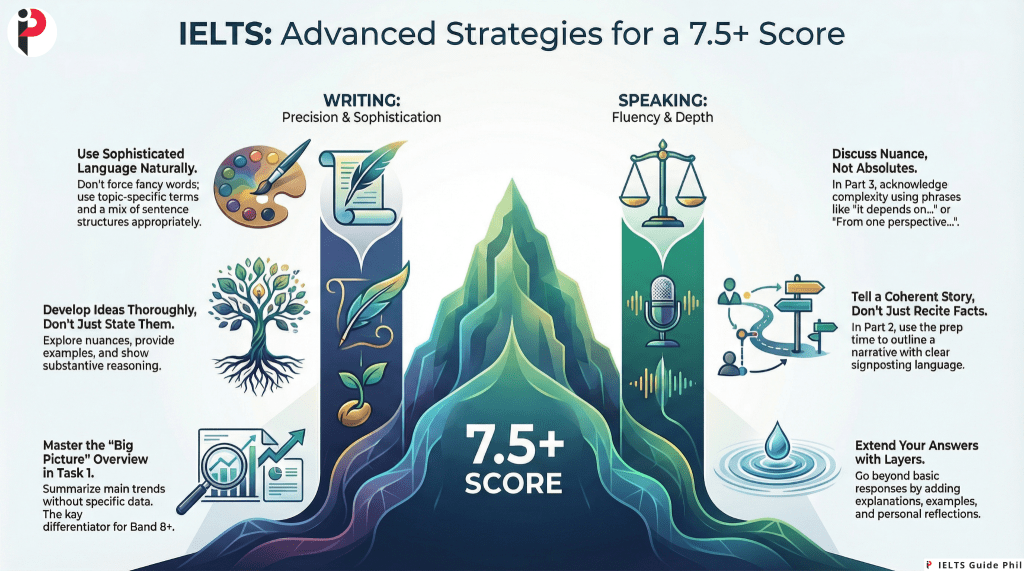
Master the overview. This is often the differentiator between band 7 and band 8. The overview should identify the big picture without including specific data. For a line graph showing multiple trends, you might write: “Overall, while consumption of renewable energy sources increased substantially throughout the period, fossil fuel usage remained dominant despite a gradual decline.”
Use data selectively and accurately. You don’t need to include every data point. Select the most significant figures and trends. When you do cite data, be precise: “approximately 75%” not “about 75%,” and always include units.
Vary your language for describing trends. Instead of repeatedly using “increase,” employ alternatives: rise, grow, climb, surge, soar (for dramatic increases), inch up (for slight increases). Similarly, for decreases: decline, drop, fall, plummet, dip.
Avoid redundancy. Phrases like “As can be seen from the graph” or “The graph shows that” waste words. Your reader knows they’re looking at a graph. Be direct: “Smartphone ownership increased from 30% to 85% between 2010 and 2020.”
Task 2: Actionable Strategies
Address the task fully. For “discuss both views and give your opinion” questions, spend roughly equal time on both perspectives before clearly stating your position. For “to what extent do you agree or disagree” questions, make your position clear from the introduction.
Use sophisticated paragraph structure. Each body paragraph should follow this pattern: topic sentence (main idea), explanation (develop the idea), example (specific illustration), and a concluding sentence that links back to the thesis.
Demonstrate lexical resource naturally. Don’t force fancy vocabulary. Use topic-specific terms appropriately: instead of “people who commit crimes,” use “offenders” or “perpetrators”; instead of “very big problem,” consider “pressing issue” or “significant challenge.”
Show grammatical range without showboating. Include a mix of sentence structures: simple sentences for clarity, compound sentences for connecting ideas, and complex sentences for sophistication. Use conditional structures, passive voice (when appropriate), and relative clauses naturally.
Develop ideas thoroughly. Band 8+ essays don’t just state opinions—they explore nuances, acknowledge counterarguments, and provide substantive reasoning. Instead of “Education is important for economic growth,” write “Investment in education generates long-term economic benefits by creating a skilled workforce capable of innovation and adapting to evolving market demands.”
Common Mistakes and Fixes
Mistake: Memorizing and regurgitating templates that result in an unnatural, robotic style.
Fix: Learn flexible frameworks, not rigid templates. Understand the principles of good essay structure and adapt your approach to each specific question. Your introduction should naturally flow from the question, not sound like it could be attached to any essay.
Mistake: Writing an off-topic or partially off-topic response.
Fix: Spend 2-3 minutes analyzing the question. Identify the topic, the specific aspect you’re asked to address, and the instruction words (discuss, evaluate, to what extent). Refer back to the question throughout your planning and writing.
Mistake: Poor time management leading to an incomplete Task 2 or rushed Task 1.
Fix: Allocate 20 minutes for Task 1 and 40 minutes for Task 2 (it’s worth twice the marks). Practice writing complete responses within these time limits repeatedly until it becomes automatic.
Mistake: Using informal language or contractions in academic writing.
Fix: Maintain an academic tone throughout. Instead of “don’t,” write “do not”; instead of “kids,” write “children”; instead of “a lot of,” use “many,” “numerous,” or “substantial.”
Example Practice Approach
For Task 1, practice writing overviews for various charts and graphs without writing the full report. This focuses your attention on the most challenging component. For Task 2, write essays on diverse topics and have them evaluated using the official IELTS writing assessment criteria, or use AI tools for preliminary feedback on coherence and vocabulary range.
Speaking Section: Fluency, Spontaneity, and Depth
The Advanced Challenge
Many advanced learners underperform in Speaking because they focus too much on accuracy at the expense of fluency, or they give shallow answers that don’t demonstrate the depth of their English ability.
Part 1: Actionable Strategies
Extend basic answers naturally. When asked about your hometown, don’t just say “It’s a large city.” Add layers: “It’s a large city in the north of the country, known for its historical architecture and vibrant food scene. What I particularly appreciate is how it blends modern infrastructure with traditional neighborhoods.”
Use Part 1 to warm up and build rapport. Smile, maintain eye contact, and speak with enthusiasm. Your energy and engagement affect your fluency rating.
Demonstrate range even in simple questions. Employ a variety of tenses naturally. If asked about your hobbies, you might say: “I’ve been really into photography lately. I started during the pandemic and I’ve found it’s become an important creative outlet for me.”
Part 2: Actionable Strategies
Use the one-minute preparation time strategically. Don’t write full sentences—jot down key words and a quick outline touching on all the bullet points on the cue card. Leave time to think about how you’ll connect these ideas smoothly.
Structure your response with signposting language. Begin with a brief introduction, then use phrases like “I’d like to start by describing…”, “Moving on to when/where…”, “What made this particularly memorable was…”, and “Looking back on it now…” This creates a coherent narrative.
Speak for the full two minutes. If you finish early, it suggests limited language or development of ideas. Expand on the most interesting aspects, add relevant details, or reflect on the broader significance of the topic.
Tell a story, don’t recite facts. Engage the examiner with vivid descriptions, your emotional responses, and specific details. Instead of “I went to a concert,” try “The moment the lights dimmed and the opening chords filled the arena, I was completely swept up in the atmosphere.”
Part 3: Actionable Strategies
Think of Part 3 as an intellectual discussion. This section assesses your ability to express and justify opinions, analyze issues, and speculate. Approach it like a conversation with a well-informed colleague, not an interrogation.
Acknowledge complexity and nuance. Band 8+ responses rarely give absolute answers. Use language like “It depends on…”, “While there are certainly benefits to…, we must also consider…”, “From one perspective… however, others might argue…”
Provide concrete examples and evidence. Support abstract ideas with specific instances. If discussing education policy, reference examples from specific countries or cite general trends you’re aware of.
Use sophisticated discourse markers. Employ advanced linking phrases: “Having said that…”, “By the same token…”, “To a certain extent…”, “Conversely…”, “That being said…” These demonstrate linguistic sophistication.
Don’t be afraid to briefly pause to think. Natural pauses while formulating complex thoughts are acceptable. Use thinking time phrases: “That’s an interesting question. Let me think…”, “Well, I suppose there are several factors to consider…”
Common Mistakes and Fixes
Mistake: Giving overly brief answers, especially in Part 1, which makes you seem unfriendly or limited.
Fix: Apply the “Three-Sentence Rule”: give a direct answer, elaborate with an explanation or example, and add a personal reflection or additional detail.
Mistake: Memorizing answers, which sounds unnatural and doesn’t address the actual questions asked.
Fix: Prepare ideas and vocabulary around common topics, but never memorize full responses. Practice speaking spontaneously about topics with the goal of sounding natural and conversational.
Mistake: Using advanced vocabulary incorrectly or inappropriately.
Fix: It’s better to use simpler words correctly than complex words incorrectly. Only use sophisticated vocabulary you’re completely confident with. Focus on using a range of common words precisely and naturally.
Mistake: Speaking too quickly or too slowly.
Fix: Aim for a natural, conversational pace. If you’re speaking too fast, you may stumble and make errors. If you’re too slow, you may sound hesitant. Record yourself and adjust your pace until it sounds like fluid, confident speech.
Example Practice Approach
Record yourself answering practice questions and listen critically. Are you speaking clearly? Using a range of grammatical structures? Providing developed answers? Consider working with a speaking partner or tutor who can simulate the exam experience and provide feedback on your performance.
Dos and Don’ts: Quick Reference Guide
Universal Dos
Do familiarize yourself with the exact format and timing of each section.
Do practice under test conditions regularly, including the pressure of time limits.
Do read the instructions carefully in the exam—they sometimes vary slightly.
Do keep track of time during each section without obsessing over the clock.
Do check your answers for careless errors if time permits.
Do stay calm if you encounter a difficult question—move on and return if possible.
Universal Don’ts
Don’t leave any answers blank (there’s no penalty for wrong answers).
Don’t waste time on questions you find extremely difficult—flag them and return later.
Don’t panic if you miss an answer in Listening—focus on the next question.
Don’t change answers unless you’re confident you made an error.
Don’t try to learn completely new grammar or vocabulary days before the exam.
Frequently Asked Questions
Q: How long should I prepare for the IELTS as an advanced learner?
A: Most advanced learners benefit from 4-8 weeks of focused, strategic preparation. This isn’t about learning English—it’s about familiarizing yourself with the test format, practicing under exam conditions, and identifying and addressing your specific weaknesses. If you’re scoring 7 or above in practice tests, a month of intensive preparation targeting weak areas is often sufficient.
Q: Should I take the Academic or General Training test?
A: Academic IELTS is typically required for university admission and professional registration. General Training is usually for immigration purposes. Check your specific requirements with the institution or body requesting your scores. The Listening and Speaking sections are identical; only Reading and Writing differ.
Q: Is British or American spelling and vocabulary acceptable?
A: Both are acceptable, but be consistent within your writing. Don’t switch between “colour” and “color” in the same essay. In Speaking, any native-speaker accent and vocabulary choices are fine.
Q: How is the Speaking test scored if I take it on a different day from the other sections?
A: Your Speaking test must occur within seven days (before or after) your other tests. It’s scored using the same criteria regardless of when it’s scheduled, and your scores are reported together.
Q: Can I retake individual sections if I’m unhappy with one score?
A: No, you must retake the entire test. However, you can take the IELTS as many times as you wish, and institutions typically accept your best overall score or best score in required sections.
Q: How can I improve if I’m stuck at band 7?
A: Band 7 represents good competency, and moving beyond requires precision and consistency. Focus on eliminating small errors, using a wider range of complex structures naturally, and providing more sophisticated, well-developed responses, particularly in Speaking Part 3 and Writing Task 2. Consider getting detailed feedback from an experienced IELTS instructor.
Q: Will idioms and phrasal verbs improve my score?
A: Used naturally and correctly, they demonstrate language flexibility, but they’re not required for high scores. Never force them. It’s better to use straightforward language accurately than to use idioms incorrectly. If you do use them, ensure they’re appropriate to the context (more natural in Speaking than in Academic Writing).
Q: How important is accent in the Speaking test?
A: Accent is not assessed. What matters is pronunciation—can the examiner understand you easily? Focus on clear articulation, appropriate word stress, and sentence-level intonation rather than trying to sound British or American.
Q: Should I aim for complex sentences in every writing response?
A: No. Effective writing uses a mix of sentence structures. Some ideas are best expressed simply. What matters is demonstrating range and using structures appropriately. A short, clear sentence can be just as impressive as a complex one if it serves the communication purpose.
Q: What if I don’t know much about the Speaking topics?
A: You’re not being tested on your knowledge of topics but on your ability to communicate in English. If asked about something unfamiliar, it’s acceptable to say so briefly and then redirect to related experiences or general perspectives you can discuss. The examiner wants to hear you speak English fluently, not deliver expert knowledge.
Your 4-Week Action Plan
Week 1: Diagnostic and Strategy
- Take a complete practice test under exam conditions
- Identify your weakest section and question types
- Study the scoring criteria for each section thoroughly
- Create a study schedule prioritizing weak areas
Week 2: Targeted Skill Building
- Focus 60% of study time on your weakest section
- Practice specific question types you struggle with
- Build topic-specific vocabulary for Writing and Speaking
- Work on time management strategies
Week 3: Integration and Practice
- Take another complete practice test
- Focus on consistency across all sections
- Practice maintaining performance under pressure
- Refine your approach based on second test results
Week 4: Fine-Tuning and Confidence Building
- Review common mistakes and errors from your practice
- Do lighter practice focusing on maintaining skills rather than cramming
- Take a final practice test 2-3 days before the exam
- Rest well the day before your test
Final Thoughts
Achieving a high IELTS score as an advanced learner is entirely within your reach. The difference between a band 7 and a band 8+ isn’t about native-level fluency—it’s about understanding what the test assesses and strategically demonstrating your skills.
Remember that the IELTS is a test of communicative competence, not perfection. Examiners expect minor errors even from band 9 candidates. What distinguishes top performers is their ability to communicate complex ideas clearly, use language flexibly and naturally, and maintain accuracy and coherence under the specific pressures of the exam format.
Approach your preparation strategically, practice consistently, and trust in the advanced English skills you’ve already developed. You’re not learning English for the IELTS—you’re learning how to showcase your English through the IELTS.
Good luck with your preparation and your exam!
#IELTS #IELTSPreparation #IELTSAdvanced #IELTSTips #EnglishTest #StudyAbroad #IELTSWriting #IELTSSpeaking #IELTSReading #IELTSListening #Band8 #Band9 #TestPrep #EnglishLearning #IELTSExam #AdvancedEnglish #LanguageLearning #IELTSStudy #ExamStrategy #AcademicEnglish #IELTSSuccess #EnglishProficiency #IELTSGoals #HigherEducation #StudyTips #IELTSGuidePhil
 IELTS Guide Phil
Leave a comment