
When most people hear “IELTS preparation,” they immediately think of test-takers frantically cramming vocabulary lists and practicing timed essays. But here’s something that might surprise you: IELTS prep lessons offer some of the most comprehensive and practical English language training available, regardless of whether you ever step foot in an exam center.
If you’re a general English learner looking to genuinely improve your communication skills, IELTS preparation materials and methodologies might be exactly what you need. Here’s why this test-focused approach can be transformative for anyone serious about mastering English.
The IELTS Framework: A Blueprint for Real Communication
The IELTS exam tests four fundamental language skills: listening, reading, writing, and speaking. This isn’t arbitrary. These four pillars represent how we actually use language in real life. Unlike many traditional English courses that might focus heavily on grammar rules or rote memorization, IELTS preparation takes a holistic approach that mirrors authentic communication situations.
When you engage with IELTS prep materials as a general learner, you’re essentially training yourself to function confidently in English across every major mode of communication. You’re not just learning the language; you’re learning to use it effectively in contexts that matter.
Building Academic and Professional Vocabulary Naturally
One of the most valuable aspects of IELTS preparation is its systematic approach to vocabulary building. IELTS materials expose learners to sophisticated, topic-specific vocabulary across subjects like education, technology, environment, health, and society. This isn’t obscure academic jargon—these are the very topics that come up in professional meetings, news articles, dinner conversations with educated speakers, and everyday life in English-speaking environments.
Through IELTS reading passages and listening materials, you encounter words and phrases in context, which is how vocabulary actually sticks. You learn not just what words mean, but how they’re used, what they collocate with, and when they’re appropriate. This contextual learning is far more effective than memorizing word lists in isolation.
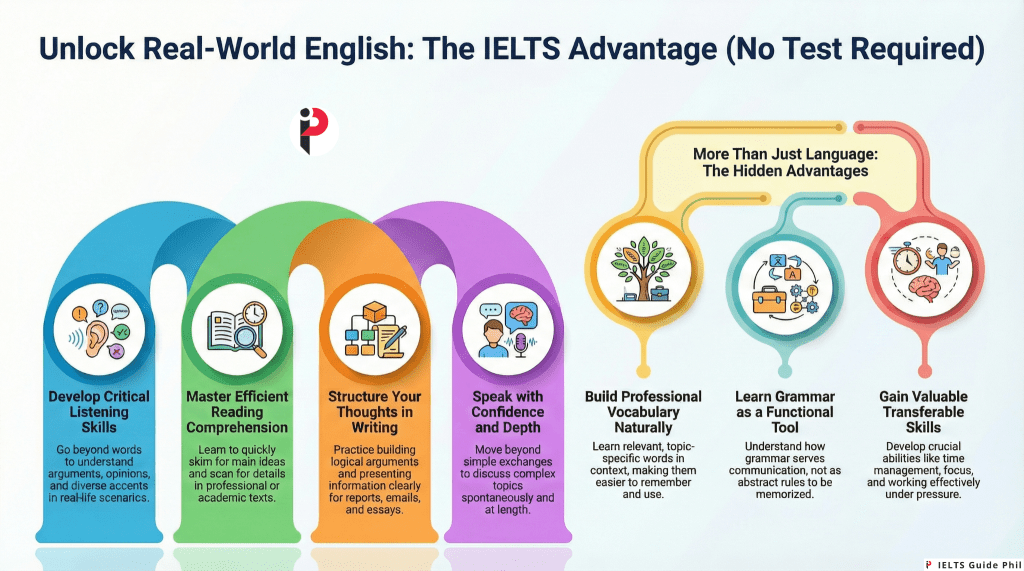
Developing Critical Listening Skills
IELTS listening practice goes beyond simply understanding words. It trains you to follow complex arguments, identify speakers’ attitudes and opinions, distinguish between main ideas and supporting details, and catch specific information even when it’s embedded in longer discussions.
These aren’t just test skills. They’re the exact abilities you need when attending university lectures, participating in business meetings, watching English-language films without subtitles, or following podcast discussions. IELTS listening materials feature various accents (British, American, Australian) and real-life scenarios, preparing you for the diversity of English you’ll encounter in the real world.
Mastering Reading Comprehension and Speed
IELTS reading preparation teaches you to read efficiently and purposefully. You learn skimming techniques to grasp overall meaning quickly, scanning methods to locate specific information, and close reading strategies to understand nuanced arguments. You practice identifying the writer’s purpose, recognizing implied meaning, and following complex logical structures.
These skills translate directly to reading work emails efficiently, understanding contracts and official documents, enjoying English literature, following news articles, and engaging with any written English content you encounter. The timed nature of IELTS practice also helps you become a faster, more confident reader—an invaluable skill in our information-saturated world.
Structuring Thoughts in Writing
Perhaps nowhere is IELTS preparation more beneficial than in writing development. IELTS Writing Task 2, which requires a clear argumentative essay, teaches you to organize your thoughts logically, present coherent arguments, use appropriate linking words and phrases, and express complex ideas clearly.
These are exactly the skills you need for professional emails, business reports, academic assignments, persuasive proposals, or even well-crafted social media posts. IELTS writing practice emphasizes clarity, coherence, and purposeful communication—qualities that elevate any piece of writing, whether you’re crafting a job application letter or explaining your ideas in a discussion forum.
The descriptive writing in Task 1 (describing charts, processes, or changes) trains you to present information objectively and accurately, another crucial professional skill.
Transforming Your Speaking Confidence
IELTS speaking preparation is particularly powerful for general learners. The speaking test format encourages you to discuss abstract topics, express and justify opinions, compare and contrast ideas, and speak at length on various subjects. This preparation builds several crucial communication skills.
First, it expands your ability to engage in extended discourse rather than just basic question-and-answer exchanges. You learn to develop your points with examples, elaborate on your ideas, and speak coherently for several minutes—essential for presentations, interviews, and thoughtful conversations.
Second, IELTS speaking practice helps you become comfortable discussing unfamiliar topics spontaneously. This adaptability is incredibly valuable in real-world situations where you can’t always predict what you’ll need to talk about.
Third, it trains you in appropriate register and formality, helping you understand when to use more formal or informal language depending on context and audience.
Grammar in Context, Not in Isolation
While IELTS preparation doesn’t ignore grammar, it approaches it functionally rather than theoretically. You learn grammatical structures because you need them to express specific meanings, not because they’re on a curriculum checklist. This functional approach means you’re more likely to remember and actually use the grammar you learn.
Complex sentences, conditional forms, passive voice, relative clauses—all these emerge naturally as you practice expressing sophisticated ideas in writing and speaking. You see how grammar serves communication rather than viewing it as an abstract system of rules.
Developing Cultural and Global Awareness
IELTS materials expose you to content about English-speaking cultures and global issues. This cultural knowledge is inseparable from language learning. Understanding cultural references, social norms, and common knowledge in English-speaking countries makes you a more effective communicator and helps you avoid misunderstandings.
Topics range from educational systems and workplace culture to environmental concerns and technological developments, giving you both language practice and knowledge about subjects that matter in international communication.
Building Exam-Independent Skills: Time Management and Focus
Even if you never take the IELTS exam, the discipline of timed practice develops valuable metacognitive skills. You learn to work efficiently under pressure, prioritize tasks, manage your time effectively, and maintain focus during demanding cognitive work. These transferable skills benefit you in countless situations beyond language learning.
Creating Measurable Progress
One often-overlooked benefit of using IELTS materials as a general learner is the clear framework for measuring progress. The IELTS band descriptors provide detailed criteria for what different levels of proficiency look like across all four skills. This gives you concrete goals to work toward and helps you identify specific areas for improvement.
You can track your development from expressing basic ideas to articulating complex arguments, from understanding simple conversations to following academic lectures, from writing simple paragraphs to crafting sophisticated essays. This sense of measurable progress is incredibly motivating for long-term language learning.
Practical Application: How to Use IELTS Prep as a General Learner
If you’re convinced that IELTS preparation can benefit your English learning journey, here’s how to approach it without the test pressure:
Focus on skills that align with your goals. If you need English for business, emphasize writing formal letters and discussing workplace topics. If you’re preparing for university, concentrate on academic vocabulary and lecture comprehension.
Use practice materials flexibly. Don’t obsess over timing initially; instead, focus on understanding the content deeply and using it as a springboard for further exploration.
Engage with topics that interest you. IELTS materials cover diverse subjects, so select passages and topics that genuinely engage you. Learning is always more effective when you’re intrinsically motivated.
Combine IELTS practice with authentic materials. Use IELTS listening practice alongside podcasts, IELTS reading alongside newspapers, and IELTS speaking topics as conversation starters with language exchange partners.
The Bottom Line
IELTS preparation, when approached with the right mindset, offers a structured, comprehensive, and highly practical pathway to English language proficiency. The skills you develop through IELTS materials—critical listening, efficient reading, coherent writing, and confident speaking—are exactly the skills you need to thrive in English, whether for professional advancement, academic pursuits, travel, or personal enrichment.
You don’t need to be an IELTS candidate to benefit from IELTS preparation. You just need to be serious about developing real, functional English communication skills that will serve you in countless situations throughout your life. The test itself may be optional, but the skills it develops are universally valuable for anyone committed to mastering English.
#IELTSPreparation #EnglishLearning #LearnEnglish #ESL #EnglishSkills #LanguageLearning #EnglishFluency #CommunicationSkills #EnglishTips #StudyEnglish #EnglishTeacher #LanguageEducation #EnglishPractice #SpeakEnglish #EnglishGrammar #IELTSGuidePhil
 IELTS Guide Phil
Leave a comment