
Most IELTS candidates focus on memorizing vocabulary lists and grammar rules, but the real difference between a Band 7 and Band 9 often lies in subtle linguistic features that native speakers use instinctively. These lesser-known skills can dramatically elevate your Writing and Speaking scores.
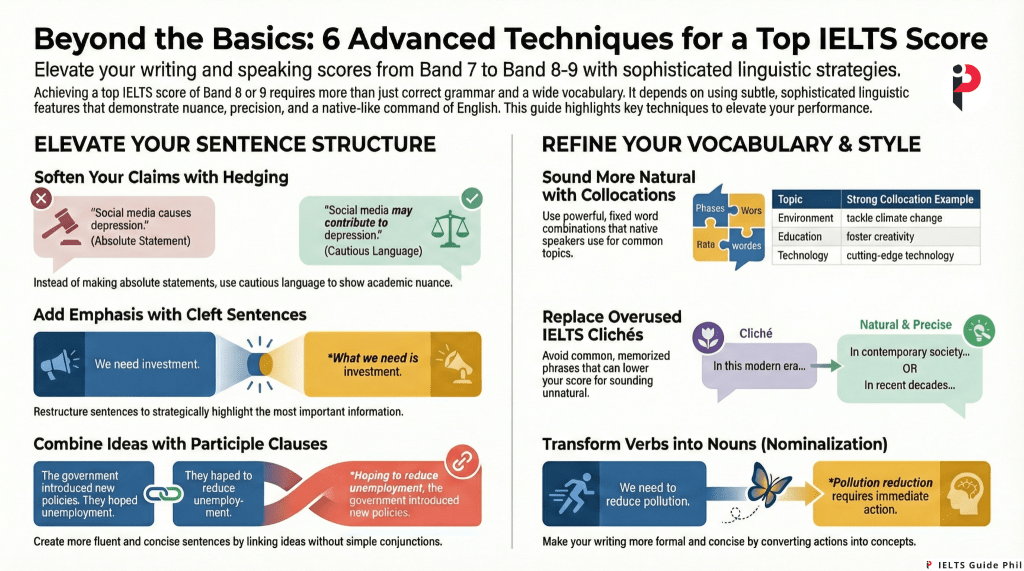
1. Hedging Language: The Art of Academic Caution
Examiners reward candidates who demonstrate nuance rather than making absolute statements. Hedging softens claims and shows sophisticated thinking.
Instead of absolute statements:
- “Social media causes depression in teenagers.”
- “This solution will solve the problem.”
Use hedging devices:
- “Social media may contribute to depression in teenagers.”
- “This solution could potentially address the problem.”
- “Research suggests that / indicates that / tends to show…”
- “It appears that / seems likely that…”
- “In many cases / To some extent / Generally speaking…”
Why it matters: Band 8-9 descriptors specifically mention “sophisticated use of qualification and precision.” Hedging demonstrates critical thinking and academic writing conventions.
2. Nominalization: Transforming Verbs into Abstract Nouns
This advanced technique makes your writing more formal and concise by converting verb phrases into noun phrases.
Basic level:
- “When the government develops the economy, people benefit.”
Advanced level:
- “Economic development benefits citizens.” (develop → development)
More examples:
- decide → decision
- arrive → arrival
- perform → performance
- analyze → analysis
- reduce → reduction
In context:
- “We need to reduce pollution” → “Pollution reduction requires immediate action”
- “People migrate to cities” → “Urban migration has accelerated”
Why it matters: Nominalization is a hallmark of academic English and allows you to discuss complex ideas more efficiently, which examiners associate with Band 8-9 writing.
3. Discourse Markers Beyond “Firstly, Secondly, Finally”
While basic linking words are essential, overusing the same ones sounds mechanical. Advanced candidates employ a wider range of cohesive devices.
For adding information:
- Furthermore / Moreover / Additionally
- What is more / On top of this
- Not to mention / Let alone
- Coupled with / Along with
For contrasting (beyond “however”):
- Nevertheless / Nonetheless
- That said / Having said that
- Conversely / By contrast
- On the contrary / Then again
For explaining/exemplifying:
- In other words / Put simply
- To illustrate this point / As a case in point
- Take, for example / Consider the case of
- This is exemplified by
For sequencing ideas (beyond “firstly”):
- To begin with / In the first instance
- Subsequently / In due course
- Ultimately / In the final analysis
Why it matters: Band 8 requires “skillful use of uncommon and/or idiomatic items” and these markers show lexical range while improving coherence.
4. Cleft Sentences: Emphasizing Key Information
Cleft sentences restructure statements to highlight specific elements, adding sophistication and rhetorical power.
Standard: “Technology has changed education the most.”
Cleft variations:
- “What has changed education the most is technology.”
- “It is technology that has changed education the most.”
- “The thing that has changed education the most is technology.”
More examples:
- “We need investment” → “What we need is investment”
- “I enjoy traveling for the cultural experiences” → “What I enjoy about traveling is the cultural experiences”
Why it matters: This demonstrates grammatical range and the ability to manipulate sentence structure for effect, which distinguishes Band 8-9 candidates.
5. Conditionals Beyond Type 1, 2, and 3
Most students learn basic conditionals, but advanced speakers use mixed and inverted forms.
Mixed conditionals:
- “If I had studied medicine (past), I would be a doctor now (present).”
- “If you were more careful (present), you wouldn’t have broken it (past).”
Inverted conditionals (formal writing):
- Instead of: “If I had known, I would have acted differently.”
- Write: “Had I known, I would have acted differently.”
- Instead of: “If the government should decide…”
- Write: “Should the government decide…”
- Instead of: “If there were better funding…”
- Write: “Were there better funding…”
Why it matters: These structures appear in the Band 9 descriptor: “full flexibility and precise use of a wide range of structures.”
6. Participle Clauses: Sophisticated Sentence Combining
Participle clauses make your writing more concise and flowing by combining ideas elegantly.
Basic: “The government introduced new policies. The government hoped to reduce unemployment.”
Advanced: “Hoping to reduce unemployment, the government introduced new policies.”
More patterns:
- “Having lived abroad for five years, I appreciate cultural diversity.”
- “Being a multilingual nation, Switzerland has unique challenges.”
- “The program, launched in 2020, has shown promising results.”
Why it matters: This demonstrates the ability to combine clauses smoothly, which contributes to coherence and shows grammatical sophistication.
7. The Subjunctive Mood: Formal Recommendations and Necessities
The subjunctive is rare in modern English but appears in formal contexts, making it perfect for IELTS Writing Task 2.
After verbs like suggest, recommend, propose, insist, demand:
- “I suggest that the government invest in education.” (not “invests”)
- “It is essential that every student have access to technology.” (not “has”)
- “Experts recommend that parents limit screen time.” (not “limits”)
Pattern: “It is + adjective + that + subject + base verb”
- It is crucial that society address this issue
- It is imperative that we take action
- It is vital that children learn critical thinking
Why it matters: Using the subjunctive correctly signals advanced grammatical knowledge and formal register awareness.
8. Appositives: Adding Information Elegantly
Appositives allow you to insert additional information smoothly without creating choppy sentences.
Basic: “Tokyo is the capital of Japan. It is one of the most populous cities in the world.”
Advanced: “Tokyo, the capital of Japan, is one of the most populous cities in the world.”
More examples:
- “This approach, a combination of traditional and modern methods, has proven effective.”
- “Dr. Smith, a leading expert in the field, argues that…”
- “The policy, an initiative launched in 2019, has reduced emissions by 30%.”
Why it matters: Appositives demonstrate the ability to vary sentence structure and incorporate information efficiently, both valued in Band 8-9 writing.
9. Collocations Over Individual Words
Native speakers use fixed word combinations. Using correct collocations sounds more natural than choosing random vocabulary.
Wrong collocations that sound unnatural:
- “make a decision” is correct, but “do a decision” is wrong
- “heavy rain” not “strong rain”
- “commit a crime” not “do a crime”
Advanced collocations for common IELTS topics:
Environment:
- tackle climate change
- curb emissions
- sustainable practices
- ecological footprint
- renewable energy sources
Education:
- foster creativity
- rote learning
- holistic education
- acquire knowledge
- cultivate critical thinking
Technology:
- rapid advancement
- unprecedented access
- digital divide
- cutting-edge technology
- embrace innovation
Society:
- social cohesion
- bridge the gap
- marginalized communities
- vested interests
- prevailing attitudes
Why it matters: Band 8 descriptors mention “collocation is used appropriately” and this separates memorized vocabulary from authentic usage.
10. Fronting and Inversion: Dramatic Emphasis
Moving elements to the front of sentences for emphasis is sophisticated but underused.
Standard order: “Environmental protection is rarely given priority in economic policy.”
Fronted: “Rarely is environmental protection given priority in economic policy.”
More examples:
- “Not only does this save time, but it also reduces costs.”
- “Only by working together can we solve this crisis.”
- “Never before have we faced such a challenge.”
- “Under no circumstances should we ignore this issue.”
- “Little did they know that this decision would change everything.”
Why it matters: This shows complete command of syntax and the ability to manipulate word order for rhetorical effect, hallmarks of Band 9.
11. Passive Voice Variations for Academic Tone
While overusing passive voice is problematic, strategic use in appropriate contexts demonstrates formal register.
When to use passive:
- When the action is more important than the doer: “The policy was implemented in 2020.”
- In formal, impersonal writing: “It is widely believed that…” / “It has been suggested that…”
- When you don’t know the agent: “The building was vandalized last night.”
Advanced passive structures:
- Get-passive (informal speaking): “I got invited to the conference”
- Passive gerund: “Being taught by experts enhances learning”
- Passive infinitive: “The issue needs to be addressed urgently”
Why it matters: Knowing when to use passive versus active voice shows register awareness, critical for Task Achievement in Writing.
12. Gradable and Limit Adjectives with Appropriate Modifiers
Native speakers instinctively know which adverbs work with which adjectives. This is a subtle but noticeable feature.
Gradable adjectives (can be more or less):
- very/extremely/really/incredibly/quite good, hot, interesting, difficult
Limit (ungradable) adjectives (absolute states):
- absolutely/completely/totally/utterly essential, perfect, impossible, unique
Common mistakes:
- ❌ “very unique” → ✓ “absolutely unique” or “nearly unique”
- ❌ “very perfect” → ✓ “absolutely perfect”
- ❌ “absolutely good” → ✓ “extremely good”
Why it matters: This demonstrates subtle vocabulary knowledge that native speakers use automatically, elevating naturalness in both speaking and writing.
13. Avoiding Overused IELTS Phrases
Some phrases are so common in IELTS responses that they actually hurt your score by sounding memorized.
Overused phrases to avoid:
- “In this modern era…”
- “In conclusion, to sum up…” (redundant)
- “There are many advantages and disadvantages…”
- “In my humble opinion…” (too informal/cliché)
- “It is a highly debatable issue…”
Fresh alternatives:
- “In contemporary society…” / “In recent decades…”
- “Ultimately…” / “In the final analysis…”
- “This issue presents both benefits and drawbacks…”
- “From my perspective…” / “I would contend that…”
- “This remains a contentious issue…”
Why it matters: Band 9 requires vocabulary to be “natural and sophisticated,” not memorized and formulaic.
14. Reformulation: Saying Things Multiple Ways
Advanced speakers can express the same idea using different structures, showing flexibility.
Same idea, different expressions:
“The government should invest more in education.”
- Educational investment deserves higher priority in government spending.
- It is imperative that authorities allocate additional resources to education.
- Greater governmental expenditure on education is warranted.
- The case for increased public spending on schools is compelling.
Why it matters: This demonstrates the “flexibility and precision” mentioned in Band 9 descriptors and helps you avoid repetition.
15. Discourse Fillers and Fluency Markers (Speaking)
In Speaking, natural pause fillers show you’re thinking in English rather than translating.
Natural fillers (use sparingly):
- “Well, the thing is…”
- “You know what I mean?”
- “Let me think…” / “How should I put it…”
- “That’s an interesting question…”
- “I’d say that…”
- “Off the top of my head…”
Avoid non-English sounds:
- ❌ “Um, er, ah” (shows translation happening)
- ✓ Brief pauses or “Well…”
Why it matters: Fluency and coherence in Speaking includes “speaks at length without noticeable effort” and natural fillers help maintain flow.
Practical Application Strategy
To incorporate these skills effectively:
- Choose 2-3 techniques per week to practice rather than trying to use everything at once
- Record yourself speaking and identify where you could use cleft sentences or participle clauses
- Rewrite practice essays replacing basic structures with advanced ones
- Read quality sources (The Economist, academic journals) and notice these features in context
- Create personal example banks for each technique using topics you’re comfortable with
Remember: These skills should enhance clarity, not obscure it. The goal is sophisticated simplicity, not complexity for its own sake. Use these techniques when they genuinely improve expression, and your writing and speaking will naturally move toward Band 8-9 territory.
#IELTSPreparation #IELTSWriting #IELTSSpeaking #Band9IELTS #IELTSTips #EnglishGrammar #AdvancedEnglish #IELTSVocabulary #AcademicEnglish #IELTSExam #EnglishFluency #IELTSBand8 #TestPreparation #LearnEnglish #IELTSSuccess #IELTSGuidePhil
 IELTS Guide Phil
Leave a comment