
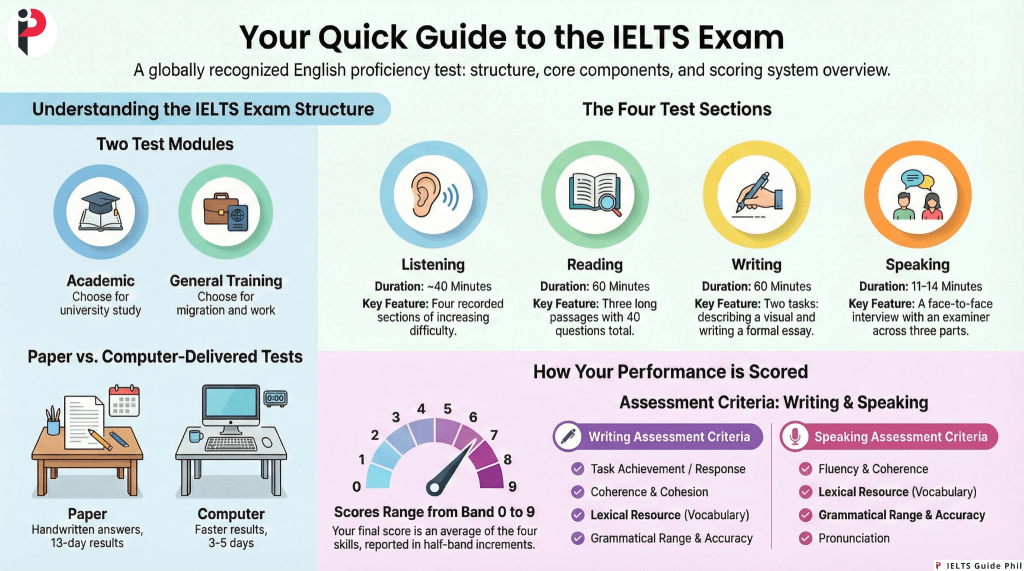
Preparing for the IELTS exam means understanding not only academic English but also the specific terminology used in the test itself. This comprehensive guide covers IELTS-specific terms, test components, scoring criteria, and essential vocabulary organized alphabetically. You can watch this YouTube video explainer by IELTS Guide Phil.
A – Academic Module and Assessment
Academic Module: One of two IELTS test formats, designed for students applying to universities or professional registration in English-speaking countries.
Academic Word List (AWL): A collection of 570 word families frequently used in academic texts across disciplines, essential for IELTS Academic test-takers.
Answer Sheet: The official paper where you transfer your answers during the test. In Listening, you get 10 minutes to transfer answers; in Reading, you must write directly on the answer sheet.
Assessment Criteria: The four marking standards used to evaluate Writing (Task Achievement/Response, Coherence and Cohesion, Lexical Resource, Grammatical Range and Accuracy) and Speaking (Fluency and Coherence, Lexical Resource, Grammatical Range and Accuracy, Pronunciation).
B – Band Scores and British Council
Band Score: The IELTS scoring system ranging from 0 (non-user) to 9 (expert user), measuring English language proficiency in half-band increments.
British Council: One of the three organizations that jointly own and administer IELTS worldwide, along with IDP and Cambridge Assessment English.
Band Descriptors: Detailed public criteria explaining the language abilities and performance expected at each band level for each skill.
Blank Answers: Leaving questions unanswered; there’s no penalty for wrong answers in IELTS, so always attempt every question.
C – Coherence and Cohesion
Coherence and Cohesion: One of four Writing assessment criteria, evaluating how well you organize information and link ideas logically using cohesive devices.
Cambridge Assessment English: One of the three official IELTS partners, responsible for research, test development, and validation.
Cue Card: The topic card given in Speaking Part 2 containing the topic and bullet-point prompts to guide your 1-2 minute monologue.
Computer-Delivered IELTS (CD IELTS): The digital version of the test taken on a computer, offering the same content as paper-based IELTS but with faster results (3-5 days).
Criteria: The specific standards used by examiners to assess your performance in Writing and Speaking tasks.
D – Detailed Reading and Descriptors
Detailed Reading: A reading skill tested in IELTS requiring careful attention to specific information, facts, and details in the passage.
Diagram Labelling: A question type in Listening or Academic Reading where you label parts of a diagram, map, plan, or process using words from the passage or recording.
Distractor: Incorrect answer options in multiple-choice questions designed to test whether you truly understand the passage or recording.
Discourse Markers: Words and phrases (however, moreover, in addition) that connect ideas and show relationships between sentences and paragraphs.
E – Examiner and Essay Types
Examiner: A certified professional who conducts Speaking tests and assesses Speaking and Writing performances according to official band descriptors.
Essay Types: Common Writing Task 2 formats including Opinion (Agree/Disagree), Discussion, Advantage/Disadvantage, Problem/Solution, and Two-Part Questions.
English UK: The organization that recognizes IELTS as proof of English language proficiency for UK visa and immigration purposes.
F – Fluency and Form Completion
Fluency and Coherence: One of four Speaking assessment criteria, evaluating your ability to speak at length without excessive hesitation and to organize ideas logically.
Form Completion: A question type in Listening where you fill in missing information on forms, notes, tables, or summaries.
Flexible Correction Policy: The rule allowing minor spelling variations (UK vs US English) and accepting answers that convey the correct meaning even with small errors.
G – General Training and Grammatical Range
General Training Module: The IELTS version for people migrating to English-speaking countries, seeking work experience, or undertaking training programs rather than university study.
Grammatical Range and Accuracy: An assessment criterion in both Writing and Speaking, evaluating the variety and correctness of grammatical structures you use.
Gist Reading: Reading to understand the main idea or general meaning without focusing on every detail, essential for skimming tasks.
Gap-Fill Questions: Question types requiring you to complete sentences or summaries by filling in missing words from the passage or recording.
H – Headings and Half-Bands
Heading Matching: An Academic Reading question type where you match headings to paragraphs or sections of the text based on their main ideas.
Half-Band Increments: IELTS scores are reported in whole and half bands (6.0, 6.5, 7.0, etc.), allowing for more precise assessment.
Headphones: Provided equipment for the Listening test in most test centers, though some use speakers.
I – IDP and IELTS Indicator
IDP: IDP Education, one of the three co-owners of IELTS, operating test centers globally and managing test registrations.
IELTS Indicator: An online English test similar to IELTS, created during COVID-19, accepted by some institutions when official testing wasn’t available.
Instructions: Specific directions given for each question type, including word limits (e.g., “NO MORE THAN TWO WORDS”) that must be followed precisely.
Introduction: The opening section of Writing Task 2 where you paraphrase the question and present your thesis statement.
J – Justification
Justification: In Speaking Part 3 and Writing Task 2, the requirement to support your opinions with reasons, examples, and explanations rather than simple statements.
K – Key Words
Key Words: Important words in questions and passages that help you locate answers and understand what information is being requested.
Knowledge Cutoff: IELTS doesn’t test specialized knowledge; all necessary information is provided in the test materials.
L – Listening and Lexical Resource
Listening: The first section of the IELTS test, consisting of four parts (40 questions) taking approximately 30 minutes plus 10 minutes to transfer answers.
Lexical Resource: An assessment criterion for Writing and Speaking, evaluating your vocabulary range, precision, and ability to use less common words and collocations.
Listening Sections: Four parts progressing from easier to harder – Section 1 (social conversation), Section 2 (monologue), Section 3 (academic discussion), Section 4 (academic lecture).
Line Graph: A common Task 1 Academic Writing visual showing changes over time that you must describe and analyze.
M – Matching and Monologue
Matching Questions: Question types where you match information, headings, features, or sentence endings based on the passage or recording.
Monologue: A single speaker presentation, found in Listening Section 2 and Section 4, and required in Speaking Part 2.
Multiple Choice: A question type offering several answer options (A, B, C, D) where you select the correct response based on the passage or recording.
Minimum Word Count: Writing Task 1 requires at least 150 words; Task 2 requires at least 250 words. Writing fewer results in lower Task Achievement scores.
N – Note Completion and Not Given
Note Completion: A Listening or Reading question type where you complete notes with missing information from the recording or passage.
Not Given: A possible answer in True/False/Not Given or Yes/No/Not Given questions when information isn’t mentioned in the passage.
Noun Phrases: Multi-word expressions functioning as nouns, important for achieving higher Lexical Resource scores in academic writing.
O – Overall Band Score and Opinion Essays
Overall Band Score: Your final IELTS score, calculated by averaging your four individual skill scores (Listening, Reading, Writing, Speaking) and rounding to the nearest half-band.
Opinion Essay: A Writing Task 2 type asking whether you agree or disagree with a statement, requiring a clear position with supporting arguments.
One-Idea Paragraphs: The recommended structure where each body paragraph in Writing Task 2 focuses on a single main idea with development.
P – Paraphrasing and Pronunciation
Paraphrasing: Expressing ideas using different words and structures, essential for Writing Task 1 introductions and demonstrating Lexical Resource.
Pronunciation: One of four Speaking assessment criteria, evaluating your ability to produce comprehensible speech with appropriate stress, rhythm, and intonation.
Paper-Based IELTS: The traditional test format where you write answers by hand on paper, with results available in 13 days.
Pie Chart: A circular graph showing proportions or percentages, commonly appearing in Academic Writing Task 1.
Preparation Time: The one-minute planning period given in Speaking Part 2 before you begin your monologue.
Q – Question Types
Question Types: The various formats used across IELTS including multiple choice, gap-fill, matching, True/False/Not Given, diagram labelling, short answer, and summary completion.
Question Paraphrasing: IELTS frequently rephrases information from passages in questions, requiring you to recognize synonyms and parallel expressions.
R – Reading and Remark (EOR)
Reading: The second section of IELTS, consisting of three passages (Academic) or three sections (General Training) with 40 questions in 60 minutes.
Remark (Enquiry on Results/EOR): A service allowing you to request re-marking of your Writing and/or Speaking tests if you believe there was an error.
Reading Passages: Three texts in Academic Reading from books, journals, magazines, and newspapers on academic topics, increasing in difficulty.
Reference Words: Pronouns and other words (it, this, these, such) that refer to previously mentioned ideas, important for understanding coherence.
S – Speaking and Skimming
Speaking: The final IELTS component, an 11-14 minute face-to-face interview with a certified examiner, consisting of three parts.
Skimming: Reading quickly to get the general idea or gist of a passage, an essential skill for Reading comprehension.
Scanning: Reading quickly to locate specific information like names, dates, or numbers within a passage.
Short Answer Questions: A question type requiring brief written responses (usually 1-3 words) based on the passage or recording.
Summary Completion: A question type where you complete a summary of part of the passage using words from a box or from the passage itself.
Synonyms: Words with similar meanings; IELTS heavily tests your ability to recognize synonyms between questions and passages.
T – Task Achievement and True/False/Not Given
Task Achievement (Task 1) / Task Response (Task 2): Writing assessment criteria evaluating how fully and appropriately you address all parts of the task.
True/False/Not Given: A Reading question type requiring you to determine if statements match information in the passage (True), contradict it (False), or aren’t mentioned (Not Given).
Table: A data presentation format showing information in rows and columns, common in Academic Writing Task 1.
Test Day: The scheduled date of your IELTS exam; arrive early with required identification documents.
Thesis Statement: The sentence in your Task 2 introduction that directly answers the question and outlines your position.
Topic Sentence: The first sentence of a body paragraph that introduces its main idea.
Transfer Time: The 10 minutes provided after Listening to transfer answers to the answer sheet (paper-based test only).
U – Underlength and UKVI
Underlength: Writing fewer than the required word count (150 for Task 1, 250 for Task 2), which reduces your Task Achievement/Response score.
UKVI (UK Visas and Immigration): A specific IELTS version required for UK visa applications, identical in format but with additional security measures.
Universities: Over 11,000 organizations worldwide accept IELTS scores for admission and professional registration.
V – Validity and Vocabulary
Validity Period: IELTS scores are typically valid for two years from the test date, though some institutions may have different requirements.
Vocabulary Range: The breadth of words and phrases you use, assessed under Lexical Resource in Writing and Speaking.
Visual Data: Charts, graphs, diagrams, and tables presented in Academic Writing Task 1 that you must describe objectively.
W – Writing and Word Limit
Writing: The third component of IELTS, consisting of two tasks completed in 60 minutes (Task 1: 20 minutes/150 words, Task 2: 40 minutes/250 words).
Word Limit Instructions: Specific requirements like “NO MORE THAN TWO WORDS AND/OR A NUMBER” that must be followed exactly in Listening and Reading.
Writing Task 1 (Academic): Describing visual information (graphs, charts, diagrams, processes) in at least 150 words.
Writing Task 1 (General Training): Writing a letter (formal, semi-formal, or informal) in response to a given situation.
Writing Task 2: An essay responding to a point of view, argument, or problem, requiring at least 250 words and worth twice the marks of Task 1.
Y – Yes/No/Not Given
Yes/No/Not Given: A Reading question type requiring you to determine if statements match the writer’s views/claims (Yes), contradict them (No), or aren’t mentioned (Not Given).
Your Opinion: Required in Opinion and Discussion essays for Task 2, where you must clearly state and support your perspective.
Z – Zero Score
Zero Score: Band 0 is assigned if you don’t attend the test, don’t attempt to answer, write completely off-topic, or copy from the question paper.
Zones (Time Zones): IELTS is administered globally with test dates coordinated across different time zones to maintain test security.
Final Tips for IELTS Success
Understanding these terms is crucial for navigating the IELTS examination successfully. Familiarize yourself with the test format, practice regularly with official materials, and ensure you comprehend what each assessment criterion requires. Remember that IELTS tests your ability to use English in academic and practical contexts, so focus on developing genuine language skills rather than memorizing templates.
Good luck with your IELTS preparation!
#IELTSGuidePhil #IELTS #IELTSPreparation #IELTSExam #IELTSVocabulary #IELTSTips #IELTSWriting #IELTSSpeaking #IELTSReading #IELTSListening #BandScore #IELTSAcademic #IELTSGeneralTraining #EnglishTest #StudyAbroad
 IELTS Guide Phil
Leave a comment