
Every year, millions of test-takers set the same goal: “I want to achieve a Band 7 in IELTS.” They circle a date on their calendar, perhaps book their test slot, and tell themselves this time will be different. Yet despite their determination, many find themselves stuck in a frustrating cycle—taking the test multiple times, getting similar scores, wondering why their goal remains just out of reach.
The problem isn’t their ambition. It’s their approach.
What if I told you that obsessing over your target band score might actually be holding you back? That the students who consistently achieve their desired results aren’t the ones constantly visualizing their score report, but rather those who’ve built something far more powerful: a system. You can watch this YouTube video explainer by IELTS Guide Phil.
The Goal vs. System Paradox
James Clear, author of Atomic Habits, makes a compelling observation: winners and losers often have the same goals. Every IELTS candidate wants a high score. Every runner in a race wants to win. The goal doesn’t differentiate the successful from the unsuccessful—the system does.
A goal is a destination: “I want Band 7.5.”
A system is the journey: “I read English news for 20 minutes every morning, practice writing task responses three times a week, record myself speaking daily, and review my mistakes every Sunday.”
Here’s the uncomfortable truth: you can achieve your IELTS goal and still end up in the same place six months later if you don’t have systems to maintain your English proficiency. Conversely, if you fall in love with the system—with the daily habits of improving your English—the scores become an inevitable byproduct.
Why Goals Alone Fail IELTS Students
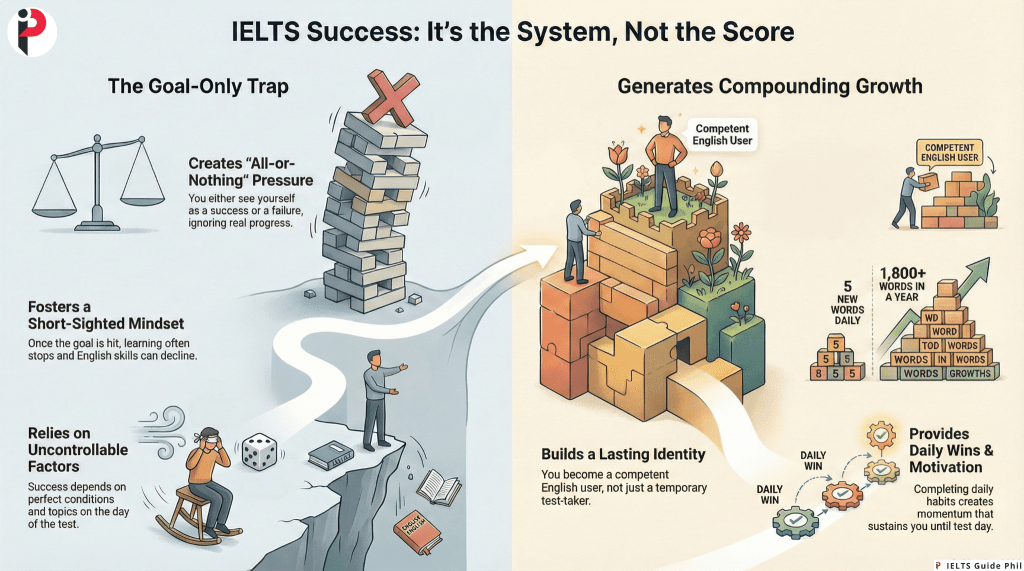
Goals create an “all or nothing” mentality. You’re either successful (Band 7) or you’re a failure (Band 6.5). This binary thinking ignores the substantial progress you’ve made and can be deeply demotivating. A student who improves from Band 5 to Band 6.5 has made remarkable progress, but if their goal was Band 7, they might only see failure.
Goals are temporary. What happens after you achieve your target score? Many students find their English actually deteriorates after passing IELTS because they had no system beyond test preparation. The goal was the finish line, so they stopped running.
Goals rely on factors you can’t always control. You might be asked to discuss a topic you know nothing about in Speaking Part 2. The reading passage might be unusually technical. Goals depend on external circumstances aligning perfectly on test day.
Goals defer happiness. When you’re goal-focused, you’re essentially saying, “Once I get Band 7, then I’ll be happy.” You’re trapped in a state of perpetual dissatisfaction until that future moment arrives—if it arrives at all.
The Power of Systems for IELTS Success
A system shifts your focus from outcomes to processes. Instead of asking “Did I get Band 7?” you ask “Did I follow my learning system today?” This subtle shift creates profound changes:
Systems Build Identity
When you commit to reading academic English for 30 minutes daily, you’re not just preparing for IELTS—you’re becoming someone who engages with complex English texts. When you practice writing coherent arguments several times a week, you’re not just training for Writing Task 2—you’re becoming a clearer thinker and communicator.
This identity shift is powerful. You stop being “someone trying to pass IELTS” and become “a competent English user.” The test simply measures what you already are.
Systems Compound
Goals are linear; systems are exponential. Every day you follow your system, you’re not just checking a box—you’re building on everything that came before. Your vocabulary expands. Your ear for English improves. Your confidence grows. Small improvements accumulate into remarkable transformations.
A student who learns just five new words daily, used correctly in context, will master over 1,800 words in a year. That’s not a goal—that’s a system that fundamentally changes their linguistic capability.
Systems Provide Daily Wins
With a goal-focused approach, you only “win” on test day. With a system, you win every single day you stick to your habits. This creates momentum and motivation that sustains you through the inevitable plateaus and setbacks.
Did you complete your listening practice today? Win. Did you write and self-correct a paragraph? Win. Did you have a 15-minute conversation in English? Win. These daily victories build the confidence and competence you need for test day.
Building Your IELTS Success System
So how do you create an effective IELTS system? Here’s a framework:
1. Design Keystone Habits
Identify 3-4 core habits that, if done consistently, would naturally improve your English across all four skills. These might include:
- Daily reading from varied sources (news, academic articles, opinion pieces)
- Regular writing practice with self-correction and feedback
- Active listening to podcasts, lectures, or interviews with note-taking
- Speaking practice through language exchange, recording yourself, or shadowing native speakers
The key is consistency over intensity. Thirty minutes daily beats a three-hour cramming session once a week.
2. Create Implementation Intentions
Don’t just commit to “practicing more.” Be specific about when, where, and how. Research shows that people who use implementation intentions are far more likely to follow through.
Instead of “I’ll practice writing more,” try: “After breakfast, I’ll sit at my desk and write one Task 2 essay outline, spending exactly 25 minutes on it.”
The specificity removes decision fatigue and makes the habit automatic.
3. Build Your Environment
Make good habits inevitable and bad habits difficult. If you want to read more in English, keep books and articles readily accessible on your phone. If you want to improve listening skills, subscribe to English podcasts and queue them up for your commute.
Remove friction from productive behaviors. One student I know changed their phone’s language to English, forcing themselves to navigate in English dozens of times daily—a simple environmental change with profound cumulative effects.
4. Track Processes, Not Just Outcomes
Instead of only tracking practice test scores, track whether you completed your system. Use a simple habit tracker or calendar where you mark off each day you followed your reading routine, writing practice, listening exercises, and speaking activities.
This shifts your definition of success from “Did I get the score?” to “Am I becoming the kind of person who achieves this score?” The latter is entirely within your control.
5. Build in Reflection and Adjustment
A good system isn’t static. Schedule weekly reviews where you assess what’s working and what isn’t. Are you actually improving your weak areas? Is your system sustainable? Are you enjoying the process?
This meta-awareness prevents you from mindlessly going through motions and ensures your system evolves with your needs.
A Sample IELTS System in Action
Let me illustrate with a real student’s system (details changed for privacy). Priya wanted Band 8 for immigration purposes. Instead of fixating on that number, she built this system:
Daily non-negotiables:
- 20 minutes of reading (alternating between news, academic journals, and opinion pieces)
- 10 minutes of vocabulary review using spaced repetition
- 15 minutes of listening to a podcast at natural speed, noting unknown phrases
Three times per week:
- Writing a full Task 2 essay, then analyzing model answers
- Recording herself answering random Speaking Part 2 topics, then listening critically
Weekly:
- One full practice test under timed conditions
- Review of all mistakes from the week with error pattern analysis
- One hour of conversation practice with a language partner
Monthly:
- Assessment of progress and system adjustment
- Deep dive into one particular skill area showing weakness
Notice what’s absent: obsessive score checking, comparison with others, anxiety about the test date. Priya’s focus was simple: follow the system. Trust the process.
She took the test once, six months after starting her system. She scored Band 8.5 overall. More importantly, her English continued improving afterward because the system wasn’t about IELTS—it was about becoming proficient in English. The test simply confirmed what the system had already built.
When Goals and Systems Work Together
I’m not suggesting you abandon goals entirely. Goals provide direction; systems provide the vehicle. You need both.
Set your IELTS target as a compass pointing the way, but invest 95% of your energy into the system that will get you there. The goal tells you what skills you need; the system determines how you’ll develop them.
Think of it this way: a goal is choosing a destination on a map. A system is developing the fitness, navigation skills, and daily walking habit that ensures you’ll not only reach that destination but be capable of going even further.
The Deeper Success
Here’s the beautiful irony: when you stop obsessing over your IELTS score and commit to a robust learning system, you often exceed your original goal. Why? Because you’re not studying for a test—you’re transforming your relationship with English.
Students with strong systems frequently report: “I went in hoping for Band 7 and got 7.5” or “I needed 6.5 but scored 8.” The system builds capability that exceeds the minimum requirement.
More importantly, these students don’t just pass IELTS and forget English. They continue engaging with the language because their system made it a natural part of their life. They’ve become English users, not just test-takers.
Your Next Step
If you’re currently preparing for IELTS, I challenge you to shift your focus today. Stop asking, “What score do I need?” Start asking, “What daily system will make me the kind of English user who naturally achieves that score?”
Design your keystone habits. Build your environment. Track your consistency. Trust the process.
The score you’re chasing will take care of itself. Your job is simply to fall in love with the system.
Because in the end, you don’t rise to the level of your goals. You fall to the level of your systems.
What systems have you built for IELTS success? What daily habits have made the biggest difference in your English proficiency? Share your thoughts and experiences—your system might inspire someone else’s breakthrough.
#IELTSGuidePhil #IELTSPreparation #IELTSSuccess #EnglishLearning #IELTSTips #LearnEnglish #StudyAbroad #IELTSExam #LanguageLearning #TestPreparation #EnglishFluency #IELTSStudy #StudyTips #AtomicHabits #SystemsOverGoals
 IELTS Guide Phil
Leave a comment