
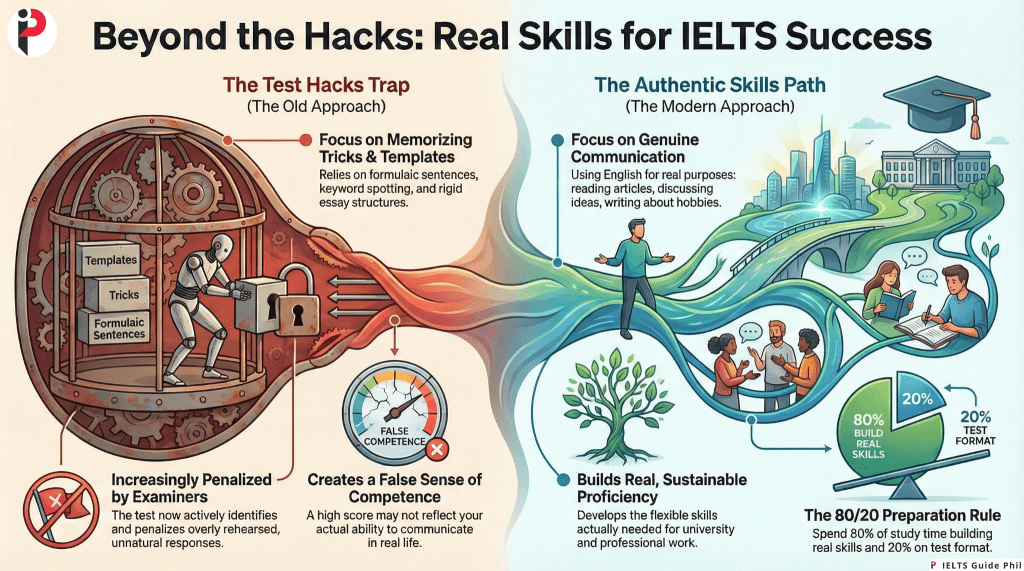
For years, IELTS preparation has been dominated by a formulaic approach: memorize template sentences, learn transition phrases, practice prediction techniques, and master the art of “sounding academic.” Walk into any IELTS coaching center, and you’ll likely hear instructors drilling students on phrases like “It is often argued that…” or teaching them to spot keywords in listening passages.
But here’s the uncomfortable truth: these shortcuts are becoming increasingly obsolete, and more importantly, they’re undermining the very purpose of learning English.
The Changing Face of IELTS
Recent updates to the IELTS examination reflect a significant shift in assessment philosophy. The test administrators at Cambridge Assessment English and IDP Education have recognized something crucial: real-world communication doesn’t follow templates, and genuine language proficiency can’t be faked with memorized chunks.
The Speaking test, in particular, has evolved to include more spontaneous, unpredictable questions that deliberately move away from commonly prepared topics. Examiners are now trained to identify and penalize overly rehearsed responses, template-based answers, and memorized content. They’re looking for natural conversation flow, genuine interaction, and the ability to develop ideas spontaneously—exactly what you’d need in an actual English-speaking environment.
In the Writing section, band descriptors now place even greater emphasis on task response authenticity and natural language use. Essays that rely heavily on learned phrases and rigid structures are increasingly being identified as lacking in genuine communicative competence. The assessment criteria reward candidates who can express complex ideas with flexibility and nuance, not those who can perfectly execute a five-paragraph formula.
Why Hacks Actually Hurt You
Let’s consider what happens when students focus primarily on test-taking strategies:
They develop a false sense of competence. You might score a 7.0 using templates and tricks, but then struggle to hold a basic conversation with a colleague or understand a university lecture. The test score becomes meaningless when it doesn’t reflect actual ability.
They create rigid mental frameworks. When you’ve memorized that “IELTS essays must have exactly four paragraphs” or “always use ‘Furthermore’ as your second transition word,” you lose the flexibility that real communication demands. Native speakers don’t think about paragraph counts—they organize ideas logically based on content.
They miss the point entirely. IELTS exists to assess whether you can function in an English-speaking academic or professional environment. If you’re moving to the UK for university, no one will care whether you can “describe a graph using appropriate lexical resources.” They’ll care whether you can participate in seminar discussions, understand your textbooks, and write coherent essays about your actual coursework.
What Real Language Skills Look Like
Genuine English proficiency isn’t about performing well on a test—it’s about communication that serves real purposes. Here’s what that actually means:
Reading isn’t about scanning for keywords. It’s about engaging with ideas, following complex arguments, understanding implied meaning, and integrating information from different sources. When you read a news article, you should be forming opinions about it, not just extracting answers to predetermined questions.
Writing isn’t about filling a structure. It’s about having something meaningful to say and knowing how to say it clearly. The difference between a band 6 and a band 8 writer isn’t that one knows more transition phrases—it’s that one can develop a coherent argument with supporting evidence while the other struggles to move beyond surface-level observations.
Listening isn’t a prediction game. Real listening comprehension means following a conversation’s natural flow, understanding context and tone, picking up on humor or sarcasm, and responding appropriately to what you’ve heard. You’re not “preparing for what’s coming next”—you’re genuinely engaged with the content.
Speaking isn’t recitation. It’s thinking on your feet, adjusting your message based on your listener’s reactions, using appropriate register for the situation, and expressing nuanced opinions about topics you haven’t prepared for. Authentic speech is messy, self-correcting, and full of personality.
Building Skills That Matter
So how do you develop real proficiency instead of test-taking ability?
Consume content voraciously. Read things you’re actually interested in—novels, long-form journalism, opinion essays, academic papers in your field. Watch documentaries, TED talks, interviews, and TV shows without subtitles. Listen to podcasts about topics you care about. The goal isn’t to “practice IELTS reading” or “expose yourself to British accents”—it’s to use English as a tool for learning and entertainment.
Engage in actual communication. Join online discussion forums, participate in language exchange programs, comment thoughtfully on blogs, write emails to friends learning your native language. Have conversations where the goal is connection and exchange of ideas, not error correction. Use English to do things, not to practice English.
Develop critical thinking in English. Don’t just passively absorb content—form opinions about it. After reading an article, ask yourself: Do I agree with this? What evidence supports or contradicts this argument? How does this connect to my own experience? When you think critically in English, you develop the cognitive flexibility that underpins advanced language use.
Write for real purposes. Start a blog about your hobbies, write reviews of books or films you’ve experienced, maintain a journal reflecting on your day, draft emails to pen pals. When writing serves a genuine communicative function, you naturally develop awareness of audience, purpose, and appropriate style—the exact skills IELTS writing aims to assess.
Focus on depth, not breadth. Instead of learning 50 “advanced vocabulary words for IELTS,” deeply understand 10 words: their connotations, collocations, appropriate contexts, and subtle differences from synonyms. Instead of memorizing 20 transition phrases, truly understand how ideas connect logically so you can signal those connections naturally.
Embrace mistakes as learning tools. In real communication, errors are normal and rarely catastrophic. When you mispronounce a word or use the wrong preposition, notice it, understand why it was wrong, and move on. Don’t let fear of mistakes prevent you from communicating. The goal is fluency and effectiveness, not perfection.
The Long-Term Perspective
Here’s what makes this approach ultimately more efficient: when you build genuine language skills, your IELTS score becomes a natural byproduct rather than a forced outcome. You’re not “preparing for IELTS”—you’re becoming proficient in English, and IELTS simply happens to be the tool measuring that proficiency.
Students who take this approach might progress more slowly in the first few months. They’re not seeing the quick gains that come from learning a template or memorizing predicted questions. But their growth is sustainable and real. By the time they sit the exam, they’re not performing test-taking tricks—they’re simply demonstrating abilities they’ve genuinely developed.
Moreover, they’re prepared for what comes after the test. The student who achieved band 7.5 through authentic language development will thrive in their English-speaking university, while the student who achieved the same score through hacks and formulas may struggle to keep up with actual coursework.
Practical Integration
This doesn’t mean you should ignore IELTS format entirely. Understanding the test structure, knowing what each section requires, and practicing under timed conditions all remain valuable. The key is perspective: these are finishing touches, not the foundation.
Think of it like training for a marathon. You need to run the actual race distance a few times before the event to understand pacing and logistics. But your real training is building cardiovascular fitness, strengthening muscles, and developing endurance. If all you did was practice “race day strategy,” you’d collapse before the finish line.
Similarly, spend 80% of your preparation time building genuine English proficiency through authentic engagement with the language, and 20% familiarizing yourself with test format and timing. This ratio produces better results than the reverse—and it produces results that matter beyond a test score.
The Bottom Line
The latest IELTS updates are making one thing clear: the test is evolving to better identify genuine communicative competence. Rote learning and formulaic approaches are becoming less effective not because the test is getting harder, but because it’s getting smarter at distinguishing real skills from performance tricks.
This is actually good news. It means that the most effective way to prepare for IELTS is also the most meaningful: develop real language skills that will serve you long after the test is over. Read widely, think critically, communicate authentically, and engage with English as a living language rather than a test subject.
Your IELTS score should reflect your actual ability to function in English. Anything less is selling yourself short—and in an era where the test increasingly rewards authenticity, the shortcut is actually the long way around.
#IELTSPreparation #EnglishLearning #IELTSTips #LanguageLearning #EnglishProficiency #IELTSExam #LearnEnglish #StudyAbroad #EnglishFluency #IELTSWriting #IELTSSpeaking #AuthenticLearning #LanguageSkills #TestPreparation #IELTSGuidePhil
 IELTS Guide Phil
Leave a comment