
Introduction: The Hidden Path in English Testing
Navigating UK visa applications can feel overwhelming, especially when it comes to the required English language test. Most people think of the traditional, lengthy IELTS exam, but there’s a lesser-known alternative designed specifically for immigration: the IELTS Life Skills test. It’s a surprisingly different assessment, and its features are not what most applicants expect. You can watch this YouTube video explainer by IELTS Guide Phil.
Four Surprising Takeaways About the IELTS Life Skills Test
1. It’s Not a Four-Skill Exam—It Only Tests Speaking and Listening
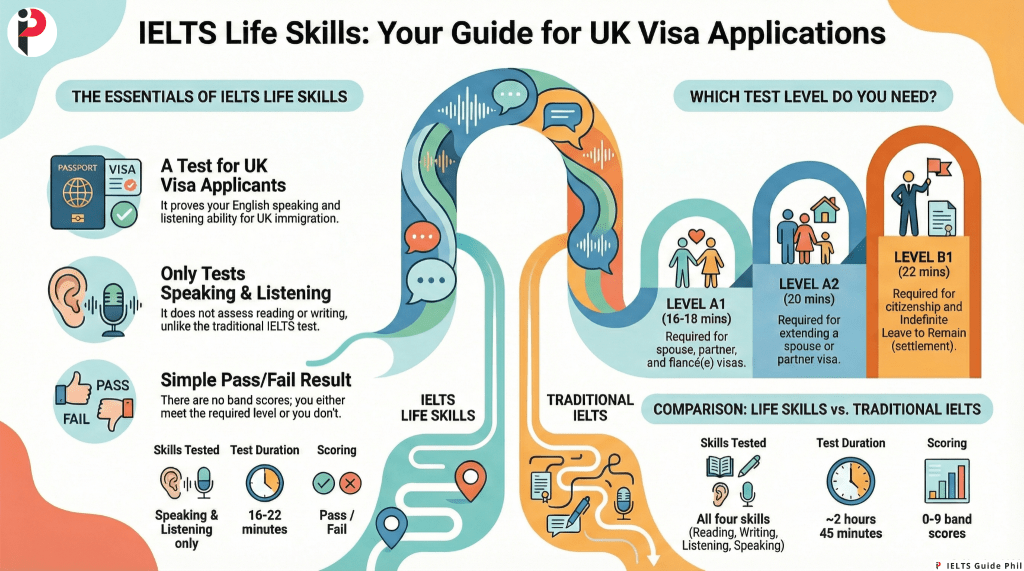
Unlike the traditional IELTS which is a comprehensive evaluation of Reading, Writing, Listening, and Speaking, the IELTS Life Skills test has a much tighter focus. It exclusively assesses your Speaking and Listening abilities.
This is a game-changer for applicants who need to prove they can handle everyday conversations. By removing the academic pressures of reading and writing, the test becomes a more accessible measure of practical communication. This sharp focus on conversation is also the reason the test employs such a unique format.
2. You Take the Test With a Partner, Not Alone
One of the most unusual aspects of the IELTS Life Skills test is its “paired format.” You won’t be in a room by yourself; instead, you’ll take the face-to-face test with an examiner and one other candidate.
This structure is intentionally designed to create a more natural, conversational environment that is “similar to real-life interactions you might have in the UK.” The interaction is collaborative, not competitive. This means you are assessed on your ability to engage in a conversation and make your meaning clear, not to outperform the person sitting beside you.
3. There Are No Band Scores—It’s Simply Pass or Fail
Forget the stress of aiming for a specific 7.0 or 8.5. The IELTS Life Skills test completely does away with the 0-9 band scoring system that the traditional IELTS is known for. The result is much simpler: you either Pass or Fail.
This binary outcome significantly reduces the pressure on test-takers. The goal isn’t to achieve a certain numerical score but to demonstrate that you have the necessary English skills for your required CEFR level—whether it’s A1 for a spouse or fiancé(e) visa, A2 for a visa extension, or B1 for citizenship and settlement applications. It simplifies the objective and makes the target crystal clear.
4. It’s Drastically Shorter and More Cost-Effective
Perhaps the most practical advantage is the test’s efficiency. While the traditional IELTS takes approximately 2 hours and 45 minutes to complete, the IELTS Life Skills test is over in just 16 to 22 minutes, with the exact time depending on the level you’re taking: A1 (16-18 mins), A2 (20 mins), or B1 (22 mins).
This remarkable difference in duration has a direct impact on the price. Because the test is shorter and more focused in its assessment, it is generally a more cost-effective option for visa applicants. This combination of time and money saved makes it a highly practical choice for those who meet the criteria.
Conclusion: A Test for Life, Not Just for Paper
The IELTS Life Skills test is a streamlined, practical tool built to assess the real-world communication skills needed for UK immigration. It moves beyond academic hurdles to offer a more accessible pathway for many applicants. This raises a crucial question: is a test centered on practical conversation a more realistic measure of a person’s readiness for life in a new country?
#IELTSGuidePhil #IELTSLifeSkills #UKVisa #UKImmigration #IELTSTest #IELTSPreparation #EnglishTest #VisaApplication #PassOrFail #SpeakingAndListening #IELTSFacts #StudyInUK #ImmigrationTips #IELTSForUKVI #LifeSkillsExam
 IELTS Guide Phil
Leave a comment