
The Truth About the “New” IELTS
If you’re planning to take the IELTS exam in 2026, you’ve likely encountered a wave of rumors and anxiety-inducing headlines about a “new” and “harder” test. Let’s cut through the noise with an expert analysis. As of today, there have been no official announcements about any changes to the test format, so any claims you see on social media are just speculation or clickbait. IELTS always announces significant changes through official channels months in advance to maintain the test’s validity and fairness.
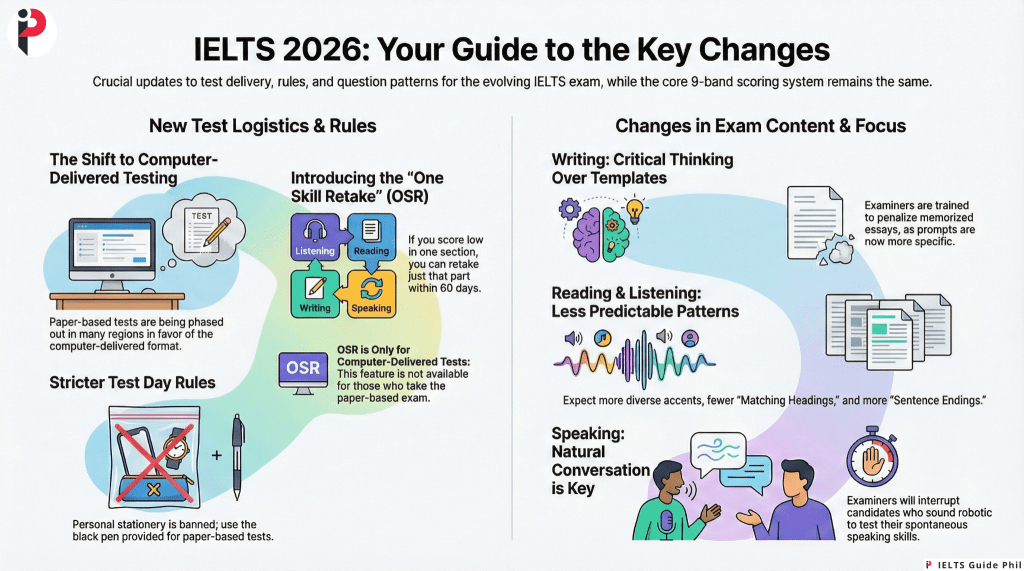
The core format of four skills—Listening, Reading, Writing, and Speaking—and the trusted 0-9 band scoring system remain the same. However, a series of significant administrative, logistical, and “hidden” pedagogical shifts are fundamentally transforming the test-taking experience. These changes are designed to favor genuine language ability over memorized tricks. This article will reveal the five most critical updates every 2026 test-taker must understand to succeed. You can watch this YouTube video explainer by IELTS Guide Phil.
Five Critical IELTS Updates for 2026
1. The Ultimate Second Chance: The “One Skill Retake” is a Game-Changer
Strategy: Leverage the Computer Test for a Second Chance.
The “One Skill Retake” (OSR) policy is a standard feature that allows a candidate to retake just one of the four sections (Listening, Reading, Writing, or Speaking) if they are unsatisfied with their score. This retake must be booked within 60 days of the original test date.
This impactful update is a direct benefit of the global shift to the computer-delivered test, offering a lifeline that the paper-based format cannot. OSR reduces the immense pressure of a single, all-or-nothing performance and saves candidates the time, cost, and stress of having to repeat the entire three-hour exam due to a slip-up in just one area.
“One Skill Retake is a game-changer”
2. The Digital Shift: Paper Tests and Pencils Are Disappearing
Strategy: Master Digital Tools and Know the New In-Person Rules.
The primary trend for 2026 is the massive global shift toward computer-delivered IELTS. This transition is so significant that the paper-based format is being completely phased out in some countries, like Bangladesh, from February 2026.
For the diminishing paper-based format, strict new regulations are being enforced to enhance fairness and security. Be aware of these two critical rules:
- Black Pen Only: Candidates are now required to use a black ballpoint pen only for the Listening, Reading, and Writing sections. Pencils are no longer permitted for these modules in many centers.
- No Personal Stationery: To further standardize the test environment, personal stationery (pens, pencils, erasers) is banned from test centers as of May 1, 2025. The test center will provide all necessary materials. Specifically, you will be given:
- For the paper test: One black ballpoint pen.
- For the computer test: One pencil and notepaper for taking notes.
The impact is clear: test-takers must be digitally prepared (practicing typing is now essential) and fully aware of these strict logistical rules to avoid confusion and stress on test day.
3. The War on Templates: The Exam is Getting Smarter
Strategy: Focus on Critical Thinking, Not Memorized Scripts.
The most significant pedagogical shift in 2026 is the crackdown on template-based or rehearsed answers. This is a deliberate move by IELTS to restore the test’s credibility against an industry of “test-taking tricks” and ensure that a high band score truly represents a candidate’s readiness for university-level discourse. Examiners are now specifically trained to identify and penalize scripted responses, with a new focus on rewarding “critical thinking” and “original thought.”
This change is most obvious in Writing Task 2, where prompts are evolving from broad topics to highly specific, nuanced questions.
- Old Style: “Is technology good for students?” (Easy to answer with a generic, memorized template).
- New Style: “To what extent does the reliance on AI tools in the classroom reduce a student’s ability to think independently?” (Requires a specific, thoughtful analysis that a template cannot provide).
In the Speaking test, if an examiner suspects you are reciting a script, they may interrupt you with unexpected follow-up questions to test your spontaneity. Success in 2026 depends on genuine communicative competence and the ability to think logically, not on memorizing phrases.
4. The Question Patterns Are Changing (But Not How You Think)
Strategy: Train for Deep Logic, Not Keyword Hunting.
The test is evolving to discourage simple “keyword hunting,” with subtle but important shifts in question types within the Reading and Listening sections that require a deeper level of comprehension.
- In Reading: The notoriously difficult “Matching Headings” questions are appearing less frequently. In their place is a sharp increase in “Matching Sentence Endings” and “Which paragraph contains this information?” tasks. This is a strategic change: “Matching Sentence Endings” forces you to understand grammar and the logical connection of ideas, whereas “Matching Headings” can sometimes be solved with simple keyword spotting.
- In Academic Writing Task 1: Expect to see more complex, “mixed charts.” Instead of a single line graph, you might get a pie chart combined with a table, requiring you to synthesize and compare data from multiple sources.
- In Listening: The order of question types is becoming more unpredictable. On a positive note, map questions often now include a “You Are Here” marker to help with orientation. Test-takers will also hear a wider variety of global accents beyond just British and Australian, including American and Indian.
5. Your Examiner Might Be on a Screen: The Rise of Video Call Speaking
Strategy: Adapt to the Digital Interview Environment.
The traditional face-to-face Speaking test is no longer the standard. In approximately 70-80% of test centers, the interview is now conducted as a Video Call Speaking (VCS) test.
You are still at an official test center, speaking with a live, trained human examiner in real-time. The only difference is that the interaction happens via a secure video link. The most significant change to the experience is that the Part 2 topic prompt appears on the monitor, not on a physical piece of paper. This requires you to be comfortable reading from a screen while simultaneously taking notes on the paper provided.
Conclusion: Prepare for the Skill, Not Just the Test
The message behind the 2026 IELTS updates is unmistakable: the exam is evolving to reward genuine, flexible communication skills over outdated test-taking tricks. The era of hacking the test with memorized templates and keyword-spotting shortcuts is over. The changes—from the One Skill Retake to the crackdown on scripts—are designed to create a fairer and more accurate assessment of your real-world English proficiency.
Knowing the exam now prioritizes authentic communication over shortcuts, which single biggest change will you make to your preparation strategy to ensure you’re building skills for your future, not just for the test?
#IELTS2026 #IELTSUpdates #IELTSPreparation #IELTSExamChanges #ComputerDeliveredIELTS #OneSkillRetake #IELTSWriting #IELTSSpeaking #IELTSReading #IELTSListening #IELTSTips #StudyAbroadEnglish #HighBandIELTS #IELTSStrategy #AcademicEnglish #IELTSGuidePhil
 IELTS Guide Phil
Leave a comment