
There’s a frustrating pattern that plays out in IELTS preparation centers worldwide. A candidate takes the test and scores Band 6 or 6.5. They study for another month, retake it, and get Band 6 again. They try once more with even more preparation and still land at Band 6 or perhaps 6.5. Despite genuine effort and noticeable improvements in their English, they seem stuck in an invisible ceiling that prevents them from reaching Band 7 or higher.
This isn’t coincidence, and it’s not about talent or language aptitude. The Band 6 plateau represents a specific threshold in the IELTS assessment framework where the nature of what’s being evaluated fundamentally changes. Understanding why this plateau exists and what it takes to break through it can save you months of frustration and wasted exam fees.
What Band 6 Actually Represents
To understand the plateau, you first need to understand what Band 6 means in the IELTS framework. According to the official descriptors, Band 6 is labeled as “Competent User” and indicates that you have “generally effective command of the language despite some inaccuracies, inappropriacies and misunderstandings.” You can use and understand fairly complex language, particularly in familiar situations.
Here’s the crucial insight: Band 6 is where most intermediate to upper-intermediate English learners naturally settle. It’s the band where you can communicate your ideas, where people generally understand you, and where you can function in English-speaking environments with some difficulty. In other words, it’s the comfortable zone where your English is “good enough” for basic communication.
This comfort zone is precisely what makes Band 6 so sticky. The skills that got you to Band 6 are fundamentally different from the skills required to reach Band 7 and beyond.
The Fundamental Shift Between Band 6 and Band 7
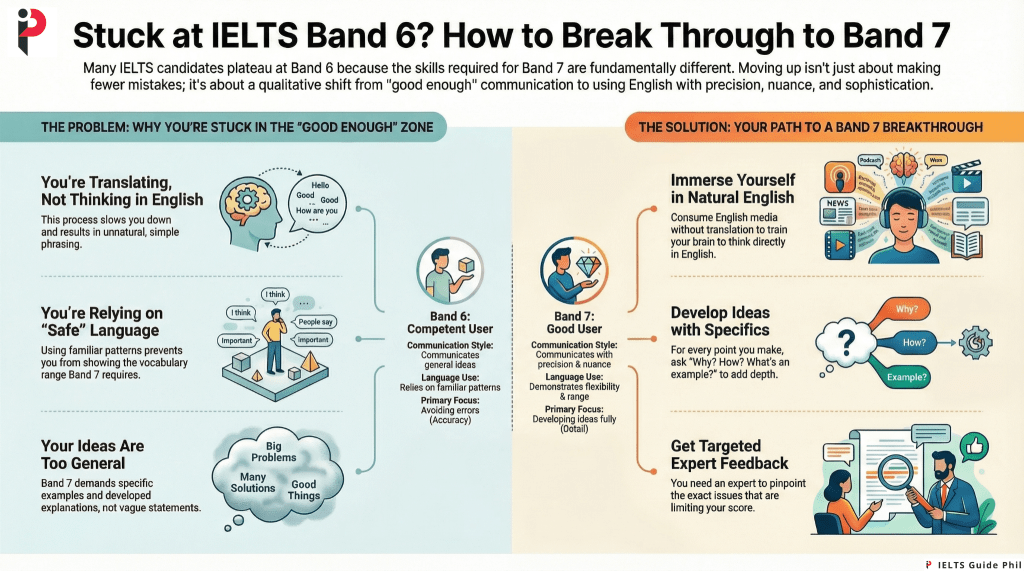
The jump from Band 6 to Band 7 isn’t just about knowing more words or making fewer mistakes. It represents a qualitative shift in how you use English. Band 6 users can communicate their ideas, while Band 7 users can communicate their ideas with precision, nuance, and sophistication.
Let’s examine what this means in practice across the different test sections.
The Writing Trap: Good Enough Isn’t Good Enough
In Writing, Band 6 candidates typically produce responses that are understandable and address the task, but with noticeable limitations. These limitations fall into predictable patterns that most candidates don’t recognize in their own work.
Task Response limitations at Band 6 include addressing the task only partially or in an unbalanced way. For example, if asked to discuss both views and give your opinion, a Band 6 response might spend 80% of the essay discussing the views and squeeze their opinion into a rushed final paragraph. The task is addressed, but not fully or evenly. Band 7 requires all parts of the task to be covered with appropriate depth and balance.
Coherence issues manifest as mechanical use of linking words without genuine logical flow. Band 6 writers often use “Firstly, secondly, finally” or “On the one hand, on the other hand” as structural markers, but the ideas within paragraphs don’t progress smoothly. Sentences might be individually clear but collectively disjointed. Band 7 requires ideas to flow naturally with clear progression throughout the response.
Vocabulary limitations show up not in using simple words, but in repetition and lack of precision. Band 6 writers might repeatedly use “important” throughout an essay because they can’t naturally access alternatives like “significant,” “crucial,” “vital,” or “paramount” at the right moments. They might write “good effect” instead of “beneficial impact” or “bad result” instead of “adverse outcome.” The words are correct but lack the precision and range that Band 7 demands.
Grammar at Band 6 typically features a mix of simple and complex sentences with noticeable errors that occasionally cause confusion. The critical difference is that Band 6 errors sometimes impede communication, while Band 7 allows for occasional errors that don’t affect meaning. Band 6 writers often make errors with articles, prepositions, and subject-verb agreement even in their best attempts at complex sentences.
The Speaking Challenge: Fluency Versus Accuracy
In Speaking, the Band 6 plateau is particularly pronounced because candidates often misunderstand what’s being assessed. They focus on not making mistakes, which actually damages their fluency and makes Band 7 harder to reach.
Band 6 speakers can generally maintain a conversation and express opinions, but with noticeable hesitation and repetition. They might pause frequently to search for words or self-correct mid-sentence. They can produce some complex language but not consistently. Most importantly, their responses, while understandable, lack the development and detail that Band 7 requires.
When asked “Do you prefer reading fiction or non-fiction?” a Band 6 speaker might say: “I prefer fiction because… it’s more interesting. When I read fiction, I can… relax. Non-fiction is sometimes boring for me. So I think fiction is better.”
A Band 7 speaker addressing the same question might say: “I tend to gravitate toward fiction, actually. There’s something about losing yourself in a story that non-fiction just can’t replicate. That said, I do enjoy the occasional biography or history book when I’m in the mood to learn something specific.”
Notice the difference isn’t just vocabulary. It’s the natural flow, the use of discourse markers, the qualification of statements, and the spontaneous extension of ideas.
Reading and Listening: The Speed and Accuracy Balance
While Reading and Listening are objectively scored based on correct answers, the Band 6 plateau appears here too. To score Band 7 or higher, you typically need to answer 30-32 questions correctly out of 40, which requires both speed and accuracy that Band 6 candidates haven’t fully developed.
Band 6 candidates often understand the texts or recordings but struggle with time management, causing them to rush through later questions and make careless mistakes. They might also struggle with questions that require inference or understanding writer’s attitude rather than just identifying stated information.
The Hidden Barriers That Keep You at Band 6
Several specific factors trap candidates at Band 6, and most aren’t aware these issues are limiting their scores.
Thinking in Your First Language
Band 6 candidates typically construct ideas in their native language and then translate them into English. This process creates several problems. It slows down your speaking and writing, making fluency difficult. It leads to unnatural phrasing because direct translation rarely produces idiomatic English. It limits your ability to express complex ideas because you’re constrained by your translation skills rather than your thinking capacity.
Band 7 and above requires increasingly thinking directly in English. The words and structures should arise naturally as you formulate ideas, not through a translation process.
Comfortable Pattern Reliance
By the time you reach Band 6, you’ve developed reliable patterns that work for basic communication. You have go-to phrases and sentence structures that you know are correct. The problem is that relying on these comfortable patterns prevents the range and flexibility that higher bands require.
You might always introduce opinions with “I think that…” or “In my opinion…” instead of varying with “I would argue that,” “It seems to me that,” “From my perspective,” or simply stating your position directly. You might always structure Writing Task 2 with “Introduction, advantages, disadvantages, conclusion” regardless of what the question actually asks for.
These patterns got you to Band 6, but they’re now holding you back because they prevent demonstration of the linguistic range necessary for Band 7.
Accuracy Obsession
Many Band 6 candidates focus intensely on avoiding mistakes. This creates a paradox: the fear of errors prevents the risk-taking necessary to demonstrate Band 7 language. You stick with sentence structures you’re confident about rather than attempting the complex sentences that could showcase your ability. You choose safe, simple vocabulary instead of the less common lexis that demonstrates range.
Band 7 explicitly permits occasional errors as long as they don’t impede communication. The descriptors prioritize range and flexibility over perfect accuracy. But Band 6 candidates often don’t take the necessary risks to show they can operate at that level.
Generic Content and Underdevelopment
In Writing and Speaking, Band 6 responses often feature broad, general statements without specific development. When discussing education, a Band 6 response might say “Technology is important in education because it helps students learn better.” This is true but vague.
A Band 7 response would develop the idea specifically: “Technology has transformed education by providing access to resources that were previously unavailable. For instance, students in remote areas can now attend virtual lectures from leading universities, something that would have been impossible a generation ago.”
The difference is specificity, concrete examples, and fuller development of ideas. Band 6 candidates often don’t realize their content is too generic to demonstrate Band 7 competency.
Insufficient Exposure to Natural English
Many Band 6 candidates have learned English primarily through textbooks and formal study rather than extensive exposure to how English is actually used by native and proficient speakers. This creates a formal, textbook quality to their language that sounds unnatural.
They might write “In conclusion, I am of the opinion that” instead of simply “Overall, I believe that.” They speak in full, careful sentences when natural speech includes fragments, fillers, and contractions. This formal register, while grammatically correct, lacks the natural flexibility that Band 7 requires.
Breaking Through the Band 6 Ceiling
Understanding why the plateau exists points toward how to overcome it. Breaking through to Band 7 requires specific shifts in approach rather than just more practice of the same activities.
Shift from Translation to Direct English Thinking
Start consuming English content extensively without translating it. Watch English shows and videos without subtitles in your language. Read English books and articles without stopping to look up every word. The goal is to build comfort with processing English directly.
In speaking and writing practice, catch yourself when you’re translating and consciously try to formulate ideas directly in English. This is uncomfortable initially but essential for reaching higher fluency levels.
Expand Beyond Comfort Zones
Deliberately vary your language choices. If you always use certain phrases or structures, consciously use alternatives. Keep a list of different ways to express common functions like giving opinions, making suggestions, or showing contrast. Force yourself to use these variations in practice until they become natural.
In Writing, practice different organizational approaches based on what each specific question requires. Don’t rely on a single memorized structure.
Balance Risk-Taking with Accuracy
Practice writing and speaking where you deliberately attempt complex language even if you make mistakes. Then review your performance to identify and correct errors. This two-stage process helps you expand range while maintaining accuracy.
The goal is reaching a point where you can produce complex language accurately, but you can’t get there without first producing complex language with errors and then refining it.
Develop Ideas Fully
Practice the “Why? How? Example” method for extending ideas. Whenever you make a point, ask yourself “Why is this true?”, “How does this work?”, and “What’s a specific example?” This forces you to move beyond generic statements to developed explanations.
In speaking practice, never accept a short answer. Always extend your response with additional detail, explanation, or examples. This develops the habit of full responses that Band 7 requires.
Immerse in Natural English
Supplement formal study with extensive exposure to how English is actually used. Listen to podcasts, watch interviews, read opinion articles. Pay attention not just to what is said but how it’s said. Notice the discourse markers, the sentence variety, the ways speakers extend and develop ideas naturally.
Try to incorporate these natural patterns into your own production. The goal is making your English sound less like a textbook and more like fluent communication.
Focus on Precision
Develop your ability to express ideas with precision rather than just clarity. This means building vocabulary not as random word lists but as networks of related terms with subtle differences. Understand the difference between “important,” “significant,” “crucial,” and “vital” and practice using each appropriately.
Work on expressing exact meaning with the exact words rather than approximately correct expressions.
Get Targeted Feedback
Perhaps most critically, you need feedback that specifically identifies why your performances sit at Band 6 rather than Band 7. Generic feedback like “good job” or “work on grammar” doesn’t help. You need someone who understands the band descriptors to point out precisely which criterion is limiting your score and what specific changes would move you up.
Without this targeted feedback, you might practice extensively without addressing the actual issues keeping you at Band 6.
The Timeline Reality
Breaking through the Band 6 plateau typically takes focused effort over several months, not weeks. This isn’t because Band 7 requires vastly more knowledge but because it requires changing ingrained habits and developing new patterns of language use. These changes happen gradually through consistent practice with the right focus.
Candidates who successfully break through usually report that it required not just more practice but practice with a fundamentally different approach. They shifted from trying to avoid mistakes to trying to demonstrate range. They moved from translating to thinking in English. They focused on developing ideas fully rather than just stating them clearly.
Moving Forward
If you’re stuck at Band 6, the solution isn’t simply to study harder or take more practice tests. It’s to honestly assess which specific aspects of your English are keeping you at this level and then target those areas with appropriate strategies. The plateau exists because Band 7 requires qualitatively different language use, not just quantitatively more knowledge.
Understanding this distinction and adjusting your preparation accordingly is what transforms frustrated Band 6 candidates into successful Band 7 achievers. The ceiling isn’t permanent, but breaking through it requires recognizing what kind of ceiling it is and bringing the right tools to dismantle it.
#IELTSBand6 #IELTSPlateau #IELTSBand7 #IELTSImprovement #IELTSPreparation #IELTSTips #IELTSWriting #IELTSSpeaking #BandScore #IELTSHelp #IELTSStudy #IELTSExam #EnglishLearning #IELTSStrategy #IELTSGoals #IELTSChallenge #LanguageTest #IELTSAdvice #TestTaking #IELTSSuccess #IELTSGuidePhil

 IELTS Guide Phil
Leave a comment