
If you’ve ever wondered what goes through an IELTS examiner’s mind as they assess your performance, you’re not alone. Many candidates imagine examiners as harsh critics looking for reasons to deduct points, or they assume subjective impressions determine scores. The reality is far more systematic and, once understood, far more empowering.
IELTS examiners work with detailed assessment criteria and undergo rigorous training to apply these criteria consistently. They’re not judging whether they personally like your essay or your speaking style. They’re methodically evaluating specific features of your language use against established descriptors. Understanding exactly what they’re trained to look for in each skill can transform your preparation from guesswork into targeted strategy.
Writing: Four Criteria, Four Opportunities
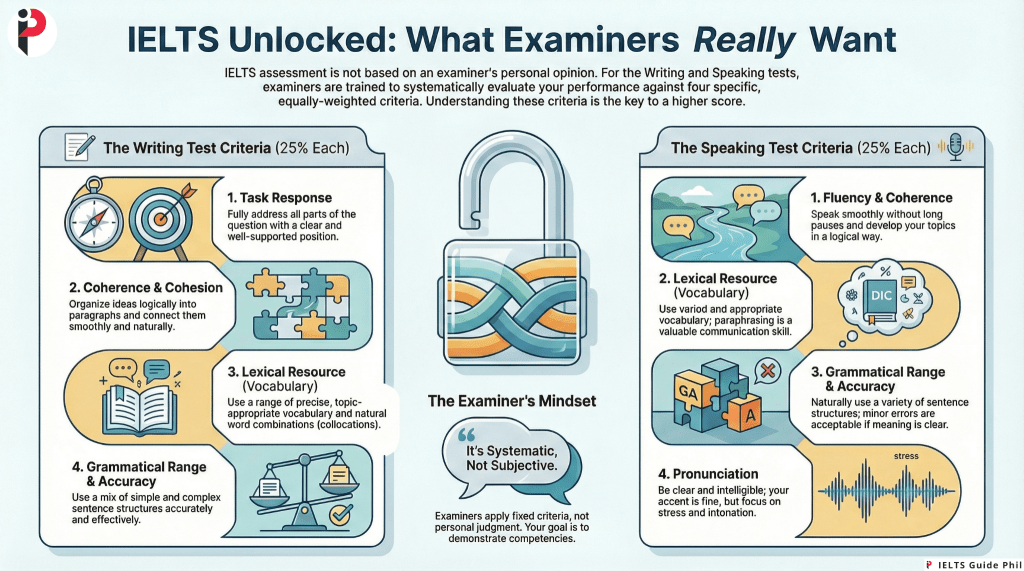
IELTS Writing examiners assess your essays using four equally weighted criteria. Your score for each criterion contributes 25% to your overall Writing band score, which means weakness in any single area significantly impacts your result.
Task Achievement (Task 1) and Task Response (Task 2)
This criterion evaluates whether you’ve done what the question asked you to do. It sounds simple, but it’s where many candidates lose significant marks without realizing it.
What examiners are looking for:
In Task 1, they check whether you’ve accurately identified and described the key features of the visual information. They want to see that you’ve made relevant comparisons and selected the most significant details rather than describing everything mechanically. They’re looking for an overview that summarizes the main trends or features, not just a data dump.
In Task 2, they examine whether you’ve addressed all parts of the question with appropriate depth. If the question asks “To what extent do you agree or disagree?” they expect a clear position. If it asks you to discuss both views and give your opinion, they need to see balanced discussion of both perspectives plus your own viewpoint. If you discuss advantages and disadvantages when the question asked about causes and solutions, you’ll score poorly on this criterion regardless of writing quality.
What examiners are not looking for:
They don’t care if your opinion is popular, politically correct, or something they personally agree with. They don’t reward longer essays if the additional length doesn’t address the task more fully. They don’t give credit for impressive knowledge that’s irrelevant to the specific question asked.
Red flags that lower your score:
Missing parts of the question entirely, taking a position when asked to discuss both views, providing an overview in Task 1 that doesn’t reflect the actual data, writing about a tangentially related topic rather than the specific issue in the question, under-developing your main ideas with insufficient explanation or examples.
Coherence and Cohesion
This criterion assesses how well your ideas connect and flow. Examiners are evaluating the logical organization of your response and the clarity of relationships between ideas.
What examiners are looking for:
They want to see clear overall progression from introduction through body paragraphs to conclusion. Each paragraph should have a clear central idea, and ideas within paragraphs should connect logically. They’re looking for appropriate use of reference words (it, this, these, such) and substitution to avoid repetition. They expect cohesive devices that genuinely connect ideas rather than being mechanically inserted.
Effective paragraphing is crucial. Examiners want to see that each paragraph serves a clear purpose and that the division of content into paragraphs makes logical sense. A new paragraph should signal a new aspect or stage of your response.
What examiners are not looking for:
They’re not counting how many linking words you use. In fact, overuse of cohesive devices like “moreover,” “furthermore,” and “in addition” often signals mechanical writing and can lower your score. They don’t want to see memorized essay structures that don’t fit the specific question. They’re not impressed by complex organizational schemes if the basic logic is unclear.
Red flags that lower your score:
Ideas that jump around without clear connection, paragraphs that blur together or don’t have distinct purposes, overuse or misuse of linking words, unclear referencing that makes the reader confused about what “it” or “this” refers to, memorized transitions that don’t actually relate the surrounding ideas.
Lexical Resource
This criterion evaluates your vocabulary range and your precision in word choice. It’s about appropriacy and accuracy as much as sophistication.
What examiners are looking for:
They want to see that you can use vocabulary appropriate to the topic and task. For academic topics, this means appropriate academic vocabulary. For general topics, it means natural everyday language. They’re looking for less common words and phrases used naturally and accurately, not forced into sentences where they don’t fit.
Examiners highly value collocations—words that naturally go together. Saying “commit a crime” rather than “do a crime,” or “pose a threat” rather than “make a threat” demonstrates control of natural word combinations. They also look for your ability to paraphrase effectively, using synonyms and different word forms appropriately.
They want to see awareness of style and register, meaning you write in a suitably formal academic style without being artificially pompous. Spelling matters, but only when errors cause confusion or there’s a pattern of consistent spelling problems.
What examiners are not looking for:
They’re not impressed by sophisticated vocabulary used incorrectly or unnaturally. Using “ameliorate” when “improve” would be more natural doesn’t help your score if “ameliorate” feels forced. They don’t want to see the same words repeated throughout your essay when alternatives exist. They don’t reward memorized phrases that don’t fit the context.
Red flags that lower your score:
Repetition of the same words throughout your response, incorrect word choice that changes meaning (“economic” vs “economical”), unnatural collocations (“make a crime” instead of “commit a crime”), inappropriate register (too informal or artificially formal), errors in word formation (“childrens” instead of “children,” “informations” instead of “information”).
Grammatical Range and Accuracy
This criterion assesses both the variety of structures you use and how accurately you use them. It’s a balance between demonstrating range and maintaining control.
What examiners are looking for:
They want to see a mix of simple and complex sentence structures used appropriately. Complex sentences should include a variety of subordinate clauses (relative clauses, conditional sentences, time clauses, etc.). They’re looking for accurate use of verb tenses and aspects, including more sophisticated forms like perfect and continuous tenses where appropriate.
Examiners value error-free sentences but understand that some errors are acceptable at higher bands as long as they don’t impede communication. They distinguish between slips (occasional errors in structures you generally control) and systematic errors (repeated mistakes showing you haven’t mastered certain structures).
They also look for accuracy in sentence-level grammar including articles, prepositions, subject-verb agreement, and plurals. At higher bands, these should be mostly accurate even in complex sentences.
What examiners are not looking for:
They’re not counting the number of complex sentences you produce. A simple sentence used appropriately is fine. They don’t expect every sentence to be grammatically perfect, especially at Band 7 and 8 where occasional errors are permitted. They’re not looking for specific advanced structures like the passive voice or conditional sentences unless they’re relevant to what you’re expressing.
Red flags that lower your score:
Using only simple sentences throughout, making frequent errors that impede understanding, attempting complex structures but making errors that show you don’t control them, consistent errors with basic grammar like articles or subject-verb agreement, run-on sentences or fragments that suggest you don’t understand sentence boundaries.
Speaking: Natural Communication Under Assessment
The Speaking test evaluates you on four criteria, each contributing 25% to your Speaking band score. Examiners are trained to assess you while maintaining a natural conversational flow.
Fluency and Coherence
This criterion evaluates how smoothly you speak and how well your ideas connect. It’s about the flow of your speech and the logic of your responses.
What examiners are looking for:
They want to see that you can speak at length without long pauses or hesitation. Some hesitation is natural and acceptable, but it shouldn’t disrupt communication. They’re looking for your ability to develop topics coherently, connecting ideas logically as you speak.
Examiners notice whether you can self-correct naturally without disrupting your flow. They observe whether you use discourse markers appropriately to signal transitions between ideas. They assess whether you can maintain coherent speech even when discussing abstract or unfamiliar topics.
What examiners are not looking for:
They’re not expecting you to speak as quickly as a native speaker. Natural pace with good content beats rapid speech with simple ideas. They don’t want to hear memorized answers that sound rehearsed or unnatural. They’re not looking for formal, lecture-style speech—conversational but clear communication is appropriate.
Red flags that lower your score:
Long, frequent pauses while searching for words, obvious memorization or rehearsed answers, very simple or repetitive responses, inability to expand on answers in Parts 1 and 3, losing track of your ideas mid-response, speaking in isolated words or very short phrases rather than connected speech.
Lexical Resource
In Speaking, this criterion assesses your vocabulary range and your ability to use words appropriately and naturally in conversation.
What examiners are looking for:
They want to see that you can discuss a range of topics using appropriate vocabulary for each. They’re looking for less common vocabulary and idiomatic language used naturally, not forced. The ability to paraphrase when you don’t know a specific word is valued highly—it shows communication strategies.
Examiners notice whether you can use collocations naturally in speech. They observe whether you self-correct word choice when you realize you’ve used an imprecise word. They value vocabulary that’s appropriate to the context and topic of discussion.
What examiners are not looking for:
They don’t want to hear you showing off vocabulary that doesn’t fit the conversation. They’re not impressed by complex words used incorrectly. They don’t expect you to know every word—paraphrasing ability matters more than having a huge vocabulary.
Red flags that lower your score:
Repeating the same basic words throughout the test, using words incorrectly in ways that confuse meaning, inability to discuss topics because you lack the vocabulary, using only very simple vocabulary even for abstract topics in Part 3, constant struggle to find any words to express your ideas.
Grammatical Range and Accuracy
This criterion evaluates the variety and accuracy of grammatical structures you produce spontaneously in speech.
What examiners are looking for:
They want to see that you can use a range of both simple and complex grammatical structures naturally. This includes using different verb tenses appropriately as you discuss past, present, and future topics. They’re looking for complex sentences with subordinate clauses produced without lengthy pauses.
Examiners value self-correction when you catch your own grammatical errors. They understand that some errors are natural in spontaneous speech, especially at higher bands. The key is whether errors interfere with understanding or are just minor slips.
What examiners are not looking for:
They’re not expecting perfect grammar in natural speech. Even native speakers make slips. They don’t want to see you speaking very slowly and carefully to avoid all errors—this damages your fluency score. They’re not looking for you to force in specific structures like the passive voice if they’re not relevant to what you’re saying.
Red flags that lower your score:
Using only very simple sentence structures throughout, making frequent errors that confuse meaning, consistent errors with basic structures like verb tenses or subject-verb agreement, inability to form complex sentences even when appropriate, producing grammatically broken speech that requires effort to understand.
Pronunciation
This often-misunderstood criterion evaluates how understandable your speech is, not whether you have a native accent.
What examiners are looking for:
They want to see clear articulation of individual sounds, even if influenced by your accent. They’re listening for appropriate word stress (STRESSing the right SYLLable) and sentence stress (emphasizing important words in sentences). They assess your intonation patterns—whether your voice rises and falls appropriately to signal questions, emphasis, and meaning.
Examiners notice whether you chunk your speech into meaningful units rather than speaking word-by-word. They observe whether your pronunciation ever causes misunderstanding or requires effort from the listener to decode.
What examiners are not looking for:
They’re absolutely not requiring a British or American accent. Accents are fine—intelligibility matters. They’re not focused on individual sound errors unless they’re frequent and impede understanding. They don’t expect perfect pronunciation of every word.
Red flags that lower your score:
Pronunciation errors that frequently cause misunderstanding, monotone delivery with no intonation variation, incorrect word stress that changes meaning or confuses the examiner, speaking with a pace so fast or unclear that understanding requires significant effort, consistent problems with specific sounds that appear in many words.
Listening and Reading: Precision in Comprehension
While Listening and Reading don’t involve examiner judgment—your answers are either correct or incorrect—understanding what these sections test helps you approach them strategically.
What Listening Tests
The Listening test assesses your ability to understand main ideas, specific information, speakers’ opinions and attitudes, purpose of what’s said, and ability to follow the development of ideas.
What’s being evaluated:
Can you identify key facts and details from conversations and monologues? Can you understand speakers’ feelings, opinions, and purposes even when not stated explicitly? Can you follow changes of topic or direction in what you hear? Can you understand both concrete information and more abstract ideas?
What’s not being tested:
Your prior knowledge of topics discussed, your ability to remember everything you hear, your opinion on what’s discussed, your ability to understand every single word.
Keys to success:
Pay attention to signposting language that indicates what’s coming. Listen for stress and intonation that emphasize important information. Be ready for synonyms and paraphrasing—answers often use different words than what you hear. Watch out for distractors where speakers mention information but then correct or contradict it.
What Reading Tests
The Reading test evaluates your ability to understand main ideas and details, identify writers’ views and attitudes, follow logical argument, and understand implied meaning and nuance.
What’s being evaluated:
Can you identify the main purpose and key points of texts? Can you find specific information efficiently? Can you understand writers’ opinions and attitudes even when not explicitly stated? Can you recognize how ideas in a text connect and develop? Can you understand nuanced meaning, including implied information?
What’s not being tested:
Your speed-reading ability on its own (accuracy matters more), your prior knowledge of the topics, your personal opinions on what you read, your ability to understand every word in the texts.
Keys to success:
Understand different question types require different reading approaches—skimming for gist, scanning for specific information, or close reading for detailed understanding. Read questions before passages to know what to look for. Pay attention to qualifying words like “some,” “most,” “may,” “often” that affect meaning. Watch for paraphrasing—answers use different words than the passage.
The Examiner Mindset: Systematic, Not Subjective
The most important insight about what examiners look for is that they’re applying criteria systematically, not making subjective judgments about whether they like your performance. They’re trained to identify specific features that correspond to band descriptors.
This means your goal isn’t to impress the examiner as a person but to demonstrate the specific competencies that the criteria measure. An examiner might personally find your essay topic boring but will still give you Band 8 if you demonstrate Band 8 competencies across the criteria. Conversely, they might find your speaking personality charming but can’t award higher than your performance merits.
Understanding this systematic approach should be liberating. You’re not trying to win over an examiner with your personality or impress them with your intelligence. You’re demonstrating specific, definable language competencies. When you know exactly what’s being evaluated, you can prepare strategically to show those competencies clearly.
Practical Application
Use this knowledge to approach each section strategically:
For Writing: Before you write, quickly review all parts of the question to ensure you’ll address everything. As you write, consciously vary your vocabulary and sentence structures. After writing, check that your essay has clear paragraph structure and logical progression.
For Speaking: Focus on extending your answers with explanations and examples rather than giving minimal responses. Don’t worry about occasional errors—fluent, developed responses with minor mistakes score higher than hesitant, perfect but simple responses. Listen to the questions carefully and address what’s actually asked.
For Listening and Reading: Read questions carefully before listening or reading. Focus on understanding what type of information you need rather than trying to understand everything. Remember that answers are often paraphrased, so listen and look for meaning, not exact words from questions.
When you understand what examiners are trained to look for, you can prepare with precision rather than hoping your general English improvement will somehow translate to higher scores. The assessment criteria are your roadmap to success—follow them systematically, and your scores will reflect your efforts.
#IELTSExaminers #IELTSScoring #IELTSTips #IELTSCriteria #IELTSWriting #IELTSSpeaking #IELTSReading #IELTSListening #BandDescriptors #IELTSPreparation #IELTSAdvice #IELTSExam #IELTSStrategy #TaskResponse #Coherence #LexicalResource #Grammar #IELTSHelp #EnglishTest #IELTSSuccess #IELTSGuidePhil
 IELTS Guide Phil
Leave a comment