
If you’ve ever walked out of an IELTS exam feeling confident, only to receive a score that left you confused and frustrated, you’re not alone. Many test-takers pour countless hours into preparation, memorize vocabulary lists, practice writing essays daily, and still don’t achieve the band score they need. The painful truth is that effort doesn’t automatically translate into higher scores. Understanding how IELTS is actually scored can be the difference between repeating the exam multiple times and achieving your target on the first attempt.
The Fundamental Misunderstanding
Most test-takers approach IELTS like a traditional exam where more studying equals better results. They believe that working harder, writing longer essays, or using more complex vocabulary will automatically boost their scores. This assumption is fundamentally flawed because IELTS doesn’t measure how hard you’ve worked or how much you know. Instead, it measures your ability to demonstrate specific language competencies in precise ways that align with detailed assessment criteria.
The IELTS scoring system operates on a framework that evaluates distinct aspects of language use across four skills: Listening, Reading, Writing, and Speaking. Each skill is assessed independently before being averaged to produce your overall band score. What confuses many candidates is that these assessments aren’t subjective impressions of your English ability but rather systematic evaluations against explicit descriptors.
How Each Section Is Actually Scored
Listening and Reading: The Objective Sections
The Listening and Reading sections are the most straightforward because they use objective marking. Each correct answer equals one raw mark, and your total raw score is converted to a band score using a conversion table. For example, in the Academic Reading test, getting 30 out of 40 questions correct typically translates to Band 6.5, while 35 correct answers usually means Band 7.5.
Here’s what catches people off guard: there’s no partial credit. Your answer must match the marking scheme exactly. If the answer is “television” and you write “the television” or “televisions,” you get zero marks, even though your understanding was essentially correct. This is why careful attention to instructions about word limits and plurals matters far more than your overall English proficiency in these sections.
Writing: Where Effort Diverges Most from Scores
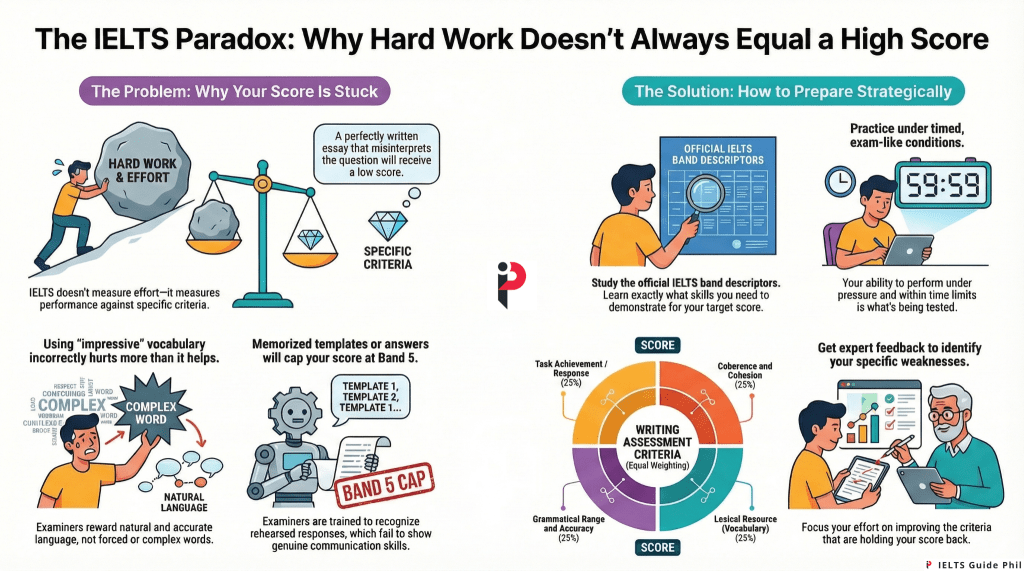
The Writing section is where the disconnect between effort and results becomes most pronounced. Your essays are evaluated on four equally weighted criteria, each worth 25% of your Writing score:
Task Achievement (Task 1) / Task Response (Task 2) measures whether you fully address all parts of the question. Many candidates lose significant marks here not because their English is poor, but because they misinterpret the question or neglect certain aspects. For instance, a Task 2 question asking “To what extent do you agree or disagree?” requires you to state a clear position. Simply discussing both sides without taking a stance will limit you to Band 5, regardless of how well-written your essay is.
Coherence and Cohesion evaluates how well your ideas flow and connect. Using linking words like “however,” “moreover,” and “furthermore” isn’t enough—in fact, overusing them mechanically can lower your score. Examiners are looking for logical progression of ideas, clear paragraphing, and natural connections between sentences. A simple, clearly structured essay often scores higher than a complex one with forced transitions.
Lexical Resource assesses your vocabulary range and accuracy. Here’s where many candidates sabotage themselves by using sophisticated words incorrectly or unnaturally. Using “utilize” instead of “use” doesn’t impress examiners if it sounds forced. They’re looking for appropriate word choice, collocations, and the ability to paraphrase effectively. A Band 7 response uses less common vocabulary naturally and accurately, not ostentatiously.
Grammatical Range and Accuracy examines sentence structure variety and error frequency. Writing only simple sentences limits you to Band 5, but making frequent errors while attempting complex structures can also cap your score at Band 5 or 6. The key is demonstrating control over both simple and complex forms while minimizing errors that impede communication.
The critical insight is that these criteria are weighted equally. An essay with advanced vocabulary but weak task response cannot score above Band 5 overall because scores across criteria are averaged. You cannot compensate for weakness in one area by excelling in another.
Speaking: Assessing Natural Communication
The Speaking test evaluates you on four criteria similar to Writing: Fluency and Coherence, Lexical Resource, Grammatical Range and Accuracy, and Pronunciation. Many candidates believe they need to speak in a formal, academic manner or use impressive vocabulary to score well. This approach often backfires.
Examiners are trained to assess your ability to communicate naturally and effectively. Speaking too slowly while searching for complex words damages your Fluency score. Using idioms incorrectly hurts your Lexical Resource score. Delivering rehearsed answers that don’t directly address the questions reduces your scores across multiple criteria.
What’s particularly misunderstood is that Band 7 doesn’t require perfection. The descriptors explicitly state that Band 7 candidates may make occasional errors but can still communicate effectively. A candidate who speaks naturally with minor grammatical slips often outscores someone who speaks stiffly while focusing on avoiding all mistakes.
Why Smart Students Sometimes Get Lower Scores
This phenomenon puzzles many test-takers: highly educated individuals, including university professors and successful professionals, sometimes score Band 6 or 6.5 when they need Band 7 or 7.5. The explanation lies in understanding what IELTS measures versus what academic or professional success requires.
IELTS assesses your ability to perform specific language tasks within specific constraints. An accomplished academic might write brilliant, nuanced arguments in their field but struggle to write a clear, direct Task 2 essay within 40 minutes that fully addresses all parts of a general question. Their sophisticated thinking actually becomes a liability when the task requires straightforward analysis and clear positioning.
Similarly, professionals accustomed to jargon-heavy communication in their field might struggle with the range of everyday vocabulary and the ability to paraphrase that IELTS demands. Their specialized English is strong, but their general English might have gaps that become apparent in the exam context.
The Role of Training and Strategy
This brings us to why targeted IELTS preparation is essential, even for proficient English users. Success requires understanding the specific task types, timing constraints, and assessment criteria, then training to perform optimally within those parameters.
For Writing, this means learning to analyze questions systematically, plan efficiently, structure responses to match criteria expectations, and edit strategically in limited time. For Speaking, it involves practicing extending answers naturally, developing ideas spontaneously, and self-correcting effectively. For Listening and Reading, it requires familiarizing yourself with question formats, learning to predict answers, and managing time across sections.
Test-takers who achieve high scores quickly typically do so not just because of strong English ability but because they understand exactly what examiners are looking for and have practiced demonstrating those specific competencies under exam conditions.
Common Pitfalls That Cap Scores
Several specific behaviors consistently prevent candidates from reaching higher bands:
Over-complicating responses by using unnecessarily complex vocabulary or sentence structures that you can’t control accurately. Band descriptors reward appropriate and natural language use over showing off.
Under-developing ideas in Writing Task 2 by making points without adequate explanation or examples. A well-developed argument with clear reasoning scores higher than listing multiple superficial points.
Ignoring timing by spending too long on early questions in Reading or Writing, leaving insufficient time for later ones. Your performance across the entire test determines your score, not your best individual answer.
Memorizing and reproducing templates or model answers in Writing and Speaking. Examiners are trained to recognize these, and using them limits your score to Band 5 regardless of accuracy because they don’t demonstrate genuine language ability.
Misreading questions in Writing by responding to what you expected rather than what was actually asked. A perfectly written essay on the wrong topic cannot score above Band 5 for Task Response.
What Actually Improves Scores
Given these insights, what should you focus on to genuinely improve your band scores?
First, study the public band descriptors available on the official IELTS website. These documents explicitly state what examiners look for at each band level. Understanding the difference between Band 6 and Band 7 descriptors for each criterion gives you concrete targets.
Second, practice under realistic exam conditions with timing constraints. Your ability to perform a skill in untimed conditions is irrelevant if you can’t execute it within the exam’s time limits.
Third, get feedback from qualified IELTS instructors or use official practice materials with scoring guides to understand where your responses currently sit on the band scale. Many test-takers practice extensively without knowing whether they’re improving in ways that matter for scoring.
Fourth, focus on exam strategy as much as language improvement. Learning when to skim versus read carefully, how to allocate time across Writing tasks, and how to structure Speaking responses takes you directly toward higher scores.
Fifth, work on the specific criteria where you’re weakest. If your Task Response is capping your Writing score, improving vocabulary won’t help until you address the fundamental issue.
The Bottom Line
IELTS is ultimately a standardized test with explicit criteria and systematic scoring. The examiners aren’t judging your intelligence, effort, or overall English ability in the abstract. They’re assessing specific performances against detailed descriptors. Success comes from understanding exactly what’s being measured, recognizing where your current performances fall short, and training strategically to demonstrate the competencies that align with your target band level.
Your effort matters, but only when it’s directed toward the right targets. Hours of study that don’t address what IELTS actually measures won’t move your scores. Understanding the gap between genuine English ability and IELTS performance ability is the first step toward the scores you need.
If you’re preparing for IELTS, shift your mindset from “I need to improve my English” to “I need to demonstrate specific competencies in specific ways within specific constraints.” That reframing, combined with strategic practice, makes the difference between effort that frustrates and effort that succeeds.
#IELTS #IELTSPreparation #IELTSScoring #IELTSTips #BandScore #IELTSWriting #IELTSSpeaking #IELTSReading #IELTSListening #IELTSExam #EnglishTest #StudyAbroad #IELTSTest #LanguageLearning #TestPreparation #IELTSAdvice #EnglishProficiency #IELTSStrategy #IELTSHelp #IELTSGoals #IELTSGuidePhil
 IELTS Guide Phil
Leave a comment