
Introduction
You’ve been studying vocabulary flashcards for months. You’ve memorized linking words. You practice writing exactly 250 words for Task 2. You’re doing everything the IELTS prep books tell you to do.
So why isn’t your score improving?
Here’s an uncomfortable truth: some of the most popular IELTS advice is actually working against you. Well-meaning teachers, outdated prep materials, and viral study tips are leading thousands of test-takers down the wrong path every single day.
After analyzing feedback from IELTS examiners and reviewing score reports from hundreds of candidates, I’ve identified the most common pieces of advice that sound helpful but quietly damage your performance. If you’ve been following any of these strategies, it might explain why your scores have plateaued despite hours of preparation.
Let’s uncover what you need to stop doing today.
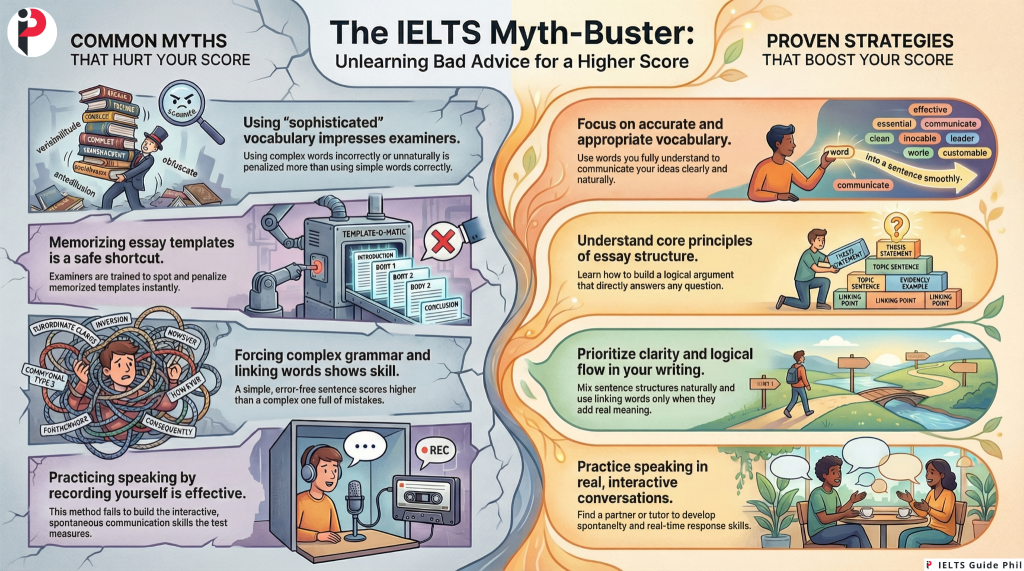
1. “Use Sophisticated Vocabulary to Impress the Examiner”
The Advice: Many prep courses emphasize learning advanced vocabulary lists and using impressive words to demonstrate your lexical range. You’re told that words like “plethora,” “myriad,” and “ubiquitous” will boost your score.
Why It Hurts Your Score: Using vocabulary you don’t fully understand creates three critical problems. First, you’ll likely use words incorrectly or in unnatural contexts, which examiners immediately notice. Second, sophisticated words used inappropriately are worse than simple words used correctly. Third, this approach makes your writing sound forced and artificial rather than natural and fluent.
IELTS examiners are specifically trained to identify “memorized language” and “learned vocabulary used inappropriately.” When a candidate writes “There is a plethora of individuals who utilize ubiquitous technology,” it’s obvious they’ve swapped out simple words for complex ones without considering natural usage.
What To Do Instead: Focus on using vocabulary appropriately, accurately, and naturally. A Band 7 candidate who writes “Many people use technology every day” with perfect grammar and natural flow will score better than a Band 5 candidate who writes “A myriad of populace perpetuate technological implementation.” Learn words in context, understand their connotations and collocations, and only use vocabulary you’ve encountered multiple times in authentic materials.
2. “Memorize Templates and Fill in the Blanks”
The Advice: Countless websites and tutors provide writing templates with sentences like “This essay will discuss both views and give my opinion” or “There are several reasons why this is the case.” You’re told to memorize these frameworks and simply insert your ideas.
Why It Hurts Your Score: Examiners can spot templates instantly, and using them directly violates the assessment criteria for “Task Achievement” and “Coherence and Cohesion.” The IELTS assessment explicitly penalizes “memorized responses” and templates are specifically mentioned in examiner training as red flags.
More importantly, templates make your writing generic and rigid. You’ll struggle to adapt them to questions that don’t fit the formula perfectly, leading to awkward or irrelevant responses. Templates also prevent you from developing the flexible writing skills you actually need for a high score.
What To Do Instead: Understand essay structure principles rather than memorizing phrases. Learn how to write an effective thesis statement for any question, how to develop paragraphs logically, and how to introduce examples naturally. Your opening should respond directly to the specific question asked, not rely on a one-size-fits-all formula. Practice writing diverse responses to different question types so you can adapt your approach flexibly.
3. “Count Your Words and Write Exactly 150/250”
The Advice: You’re told to write exactly the minimum word count, not a word more or less, and to practice counting words quickly during the exam.
Why It Hurts Your Score: This advice creates two problems. First, focusing on word count distracts you from what actually matters: answering the question fully and developing your ideas effectively. Second, writing exactly 150 or 250 words often means you’re either padding your response with unnecessary information or cutting off your conclusion prematurely.
Candidates who write “The government should solve this problem because there are many reasons and examples that show why this is important and necessary and beneficial for society” are adding empty words to hit a count rather than developing meaningful content.
What To Do Instead: Aim for slightly above the minimum (170-180 for Task 1, 270-290 for Task 2) and focus on fully developing your response. Write until you’ve completely answered the question and supported your points adequately. A well-developed 280-word essay will always outscore a padding-filled 250-word essay. Practice estimating word count by learning what your handwriting looks like at different lengths, but don’t obsess over exact numbers during the exam.
4. “Learn Linking Words and Use Them Frequently”
The Advice: Study lists of linking words (furthermore, moreover, nonetheless, hence) and use them throughout your writing to show coherence and cohesion.
Why It Hurts Your Score: Overusing linking words or using them incorrectly actually damages your Coherence and Cohesion score. Examiners specifically look for “mechanical cohesive devices” as evidence of lower-band writing. When every sentence starts with “Furthermore,” “Moreover,” or “In addition,” it signals that you’re trying to force connections rather than creating natural flow.
Consider this example: “Many students struggle with exams. Furthermore, they find homework difficult. Moreover, they experience stress. In addition, they lack sleep.” These linking words add nothing to coherence and make the writing choppy and unnatural.
What To Do Instead: Focus on logical development of ideas first, then add cohesive devices where they genuinely help clarity. Learn to use pronoun references, synonyms, and idea progression to create flow. Many high-scoring essays use relatively few explicit linking words because the ideas themselves flow logically. When you do use linking words, ensure they reflect the actual relationship between ideas (cause-effect, contrast, addition) and vary your choices naturally.
5. “Give Both Sides Equal Treatment in Discussion Essays”
The Advice: For “discuss both views” questions, you should spend equal time on both perspectives to show balance and objectivity.
Why It Hurts Your Score: This advice misunderstands what the question is actually asking. The instruction “discuss both views and give your opinion” requires you to explain both perspectives, but the real focus should be on developing your own position with clear reasoning. Spending equal time on views you disagree with often means underdeveloping your actual argument.
Candidates who write two body paragraphs with identical structure and length, then add a two-sentence conclusion saying “In my opinion, the first view is better,” have prioritized artificial balance over meaningful analysis.
What To Do Instead: Demonstrate that you understand both perspectives (which might take just 2-3 sentences each), then spend the majority of your essay developing your own position with specific reasons, examples, and explanation. The examiner wants to see your critical thinking and ability to build an argument, not just summarize opposing viewpoints. Your opinion should be clear throughout the essay, not just mentioned briefly at the end.
6. “Aim for Complex Grammar Structures”
The Advice: Use complex sentences with multiple clauses, passive voice, and advanced structures to demonstrate grammatical range and show you deserve a higher band.
Why It Hurts Your Score: Forcing complex grammar when you’re not comfortable with it leads to errors, which directly impacts your Grammatical Range and Accuracy score. A sentence full of grammatical mistakes doesn’t earn points just because it attempted complexity. In fact, multiple errors in an attempted complex structure score lower than a simple sentence with perfect grammar.
“Despite the fact that which technology has been developed continuously, there are still having many problems that remained unsolved by scientists” attempts complexity but contains several errors that damage the score.
What To Do Instead: Mix simple, compound, and complex sentences naturally based on what you’re trying to say. Use complex structures when they genuinely help express your meaning more precisely, not just to show off. Ensure that every structure you use is grammatically accurate. A Band 7 essay might have mostly simple and compound sentences with occasional complex structures, all error-free, and score better than a Band 5 essay filled with error-ridden complexity.
7. “Always Disagree or Take a Strong Position”
The Advice: Examiners prefer strong opinions and definitive stances. Never sit on the fence or present a balanced view in opinion essays.
Why It Hurts Your Score: This advice confuses “having a clear position” with “having an extreme position.” IELTS actually rewards nuanced thinking and the ability to acknowledge complexity while still maintaining a clear viewpoint. You can recognize merit in multiple perspectives while explaining why you favor one approach overall.
The problem isn’t being balanced; it’s being unclear. An essay that says “Some people think X, others think Y, both have good points, it’s hard to say” lacks a clear position. But an essay that says “While X has certain advantages in specific contexts, Y is ultimately more beneficial because…” demonstrates sophisticated thinking.
What To Do Instead: Take a clear position, but allow for nuance and conditions. Use language like “largely agree,” “in most cases,” or “generally more effective” when appropriate. Acknowledge limitations or exceptions to your position, then explain why your viewpoint still holds. This demonstrates critical thinking and language flexibility, both of which contribute to higher scores.
8. “Practice Speaking by Recording Yourself”
The Advice: Improve your speaking by recording yourself answering practice questions, then listening back and correcting mistakes.
Why It Hurts Your Score: While self-recording can help with some aspects of pronunciation, it doesn’t replicate the interactive nature of the IELTS Speaking test. The exam tests your ability to communicate spontaneously, respond to follow-up questions, and develop ideas in real-time with an examiner. Recording yourself encourages over-rehearsed, scripted responses that examiners instantly recognize.
Additionally, you can’t accurately assess your own fluency, coherence, or naturalness. You’ll likely miss the same mistakes repeatedly because you don’t know what to listen for, and you can’t improve interactive skills like turn-taking or responding to unexpected questions.
What To Do Instead: Practice speaking with real people as much as possible. Find a language exchange partner, hire a tutor for mock interviews, or join IELTS speaking practice groups online. Focus on thinking in English and responding naturally rather than memorizing perfect answers. Record these conversations if you want, but the value is in the live interaction, not the playback. If you must practice alone, speak about random topics with a timer to simulate the spontaneity required in the exam.
9. “Paraphrase Everything in Task 1”
The Advice: Never use words from the question or the chart/graph. Always paraphrase to show vocabulary range.
Why It Hurts Your Score: Forcing yourself to paraphrase specific terms, labels, or technical vocabulary often leads to inaccuracy or awkward expression. If the graph shows “renewable energy sources,” changing it to “sustainable power origins” or “eco-friendly electricity types” can actually make your description less clear or less accurate.
IELTS examiners expect you to use some of the same terminology, especially for specific categories, technical terms, or precise data labels. What matters is that you don’t copy entire phrases or the question structure wholesale.
What To Do Instead: Paraphrase the overall task and general descriptions, but keep specific labels and categories when they’re the clearest, most accurate option. For example, if the graph shows “coal, oil, and natural gas,” these terms are fine to use. But you might paraphrase “the chart shows” to “the graph illustrates” or “energy consumption increased” to “energy usage rose.” Focus your paraphrasing on the question stem and your overview statements, not on distorting clear, specific terminology.
10. “Read Extensively to Improve Your Reading Score”
The Advice: Read English newspapers, novels, and articles every day to build your reading skills for IELTS.
Why It Hurts Your Score: While reading is generally beneficial, unfocused extensive reading doesn’t directly improve your IELTS Reading performance. The exam tests specific skills like identifying paraphrase, scanning for details, understanding implicit meaning, and matching information across a text under strict time pressure. These are test-taking skills that require targeted practice, not just general reading comprehension.
Many candidates who read extensively still struggle with the IELTS Reading section because they haven’t practiced the specific techniques needed: dealing with unfamiliar vocabulary without panicking, managing time across three passages, or understanding how answers are distributed throughout the text.
What To Do Instead: Practice with IELTS-style passages and questions, analyzing why answers are correct and why distractors are designed to trap you. Learn to identify paraphrasing patterns between questions and text. Develop strategies for different question types (matching headings, True/False/Not Given, sentence completion). Time yourself strictly and analyze your mistakes. Supplement this with some general reading for vocabulary and background knowledge, but prioritize targeted IELTS practice for score improvement.
11. “Focus on Your Weak Skills”
The Advice: Identify your weakest skill (usually Writing or Speaking) and spend most of your study time improving it.
Why It Hurts Your Score: This approach has diminishing returns and can actually let your stronger skills deteriorate. If you need an overall Band 7 and you currently have Reading 7.5, Listening 7.0, Speaking 6.0, Writing 6.0, spending 90% of your time on Speaking and Writing might drop your Reading to 7.0 and Listening to 6.5 while only raising Speaking to 6.5 and Writing to 6.5. Your overall score stays the same or even decreases.
Additionally, skills reinforce each other. Your reading comprehension helps your writing. Your listening skills support your speaking. Neglecting stronger skills means missing opportunities for integrated improvement.
What To Do Instead: Allocate study time proportionally to all skills with extra emphasis on weaker areas. If you need overall Band 7, maintain your Band 7+ skills with regular practice (maybe 20-30% of your time) while focusing more intensively on skills below your target (50-60% of your time). This balanced approach prevents backsliding while accelerating improvement where you need it most. Remember that your overall score is an average, so all four skills matter.
12. “Learn British Spelling and Pronunciation”
The Advice: IELTS is a British test, so you must use British English spelling, vocabulary, and pronunciation to score well.
Why It Hurts Your Score: This advice is simply false. IELTS explicitly accepts all major varieties of English (British, American, Australian, etc.). You can write “color” or “colour,” “analyze” or “analyse,” “apartment” or “flat.” Examiners are trained to accept all standard varieties.
The problem occurs when candidates who naturally use American English try to force British conventions they’re not comfortable with, leading to inconsistency and errors. Writing “colour” in one paragraph and “color” in another, or mixing “lift” and “elevator” randomly, shows lack of control rather than range.
What To Do Instead: Choose the variety of English you’re most comfortable with and be consistent. If you’ve learned American English, stick with it throughout. If you’ve learned British English, maintain that. The only requirement is internal consistency within each response (don’t mix varieties within a single essay) and accuracy within your chosen variety. Your pronunciation should be clear and intelligible regardless of accent.
Conclusion
The advice that hurts your score most is the advice that prioritizes surface features over genuine communication. IELTS isn’t testing whether you can memorize sophisticated words, count to exactly 250, or force complex grammar. It’s testing whether you can communicate effectively in English across academic and everyday contexts.
High-scoring candidates don’t sound like they’re taking a test. Their writing flows naturally, their speaking sounds spontaneous and genuine, their reading strategies are efficient, and their listening captures meaning rather than just words. They’ve moved beyond test tricks and developed real English proficiency.
Review the advice you’ve been following. If any of it appears on this list, it’s time to adjust your approach. Focus on authentic communication, accurate language use, and genuine skill development rather than gaming the test. The examiners have seen every trick and template, and they’re specifically trained to identify and penalize artificial test-taking strategies.
Your IELTS score should reflect your actual English ability. By avoiding these counterproductive strategies and focusing on real communication skills, you’ll not only improve your score but also develop English proficiency that serves you well beyond the test.
What matters isn’t impressing the examiner with vocabulary acrobatics or grammatical gymnastics. What matters is showing that you can understand, respond to, and communicate about a range of topics clearly, accurately, and naturally. That’s the skill IELTS measures, and that’s the skill that will actually help you in your academic or professional future.
Stop trying to sound like a textbook. Start trying to sound like yourself, in English.
#IELTSGuidePhil #IELTS #IELTSPreparation #IELTSExam #IELTSTips #IELTSWriting #IELTSSpeaking #IELTSReading #IELTSListening #IELTSTest #EnglishTest #StudyAbroad #EnglishLearning #LearnEnglish #IELTSStudy #IELTSBand7 #TestPrep #EnglishExam #IELTSHelp #IELTSAdvice #AcademicEnglish
 IELTS Guide Phil
Leave a comment