
You’re working full-time or studying for other qualifications. You have family responsibilities or a long commute. You’re already stressed about the IELTS score you need for university admission or immigration, and every article you read seems to assume you can dedicate six hours a day to preparation. The advice telling you to “immerse yourself completely in English” or “practice writing five essays daily” feels impossible given your reality.
Then there’s the anxiety. You lie awake thinking about the Speaking test. You imagine freezing when the examiner asks you a question. You worry that no matter how much you prepare, it won’t be enough. The pressure to achieve a specific band score by a specific deadline makes every practice session feel high-stakes, which paradoxically makes it harder to focus and learn effectively.
If this sounds familiar, you need a study strategy designed for real life—not for an imaginary candidate with unlimited time and no stress. Here’s how to prepare effectively when you’re busy, anxious, and dealing with competing demands on your time and energy.
Reframe Your Relationship with IELTS Preparation
Before diving into study tactics, address the psychological barriers that often sabotage preparation more than any lack of knowledge.
Accept That Perfect Preparation Is Impossible
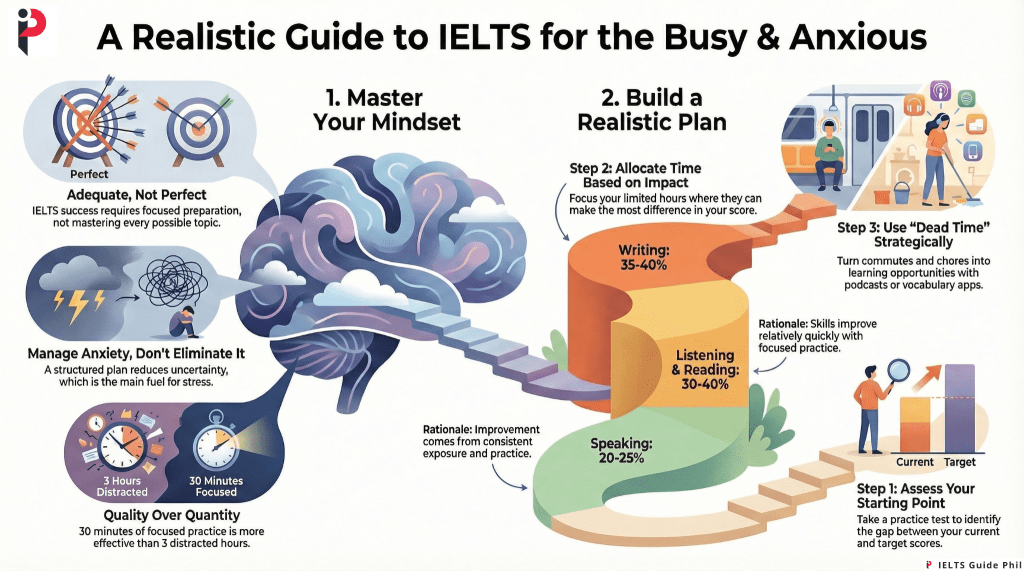
You will not have time to do everything you read about online. You won’t complete every practice test available. You won’t master every possible vocabulary topic. And that’s completely fine. IELTS success doesn’t require perfect preparation—it requires adequate preparation focused on the right areas.
Releasing yourself from the expectation of comprehensive preparation reduces anxiety and allows you to focus your limited time effectively. Instead of worrying about everything you haven’t done, concentrate on doing what you can do well.
Understand That Anxiety Is Normal—And Manageable
Feeling nervous about IELTS doesn’t mean you’re unprepared or going to fail. Test anxiety is a normal response to high-stakes situations. The goal isn’t to eliminate anxiety but to prevent it from interfering with your preparation and performance.
What amplifies anxiety is uncertainty. Not knowing what to expect, doubting whether you’re improving, or worrying that your preparation approach is wrong creates a spiral of stress. A structured plan reduces this uncertainty and gives you something concrete to focus on rather than abstract worries.
Recognize That Time Quality Beats Time Quantity
Thirty focused minutes of targeted practice will serve you better than three distracted hours of unfocused study. When you’re busy, you can’t afford to waste time on ineffective preparation. Every study session needs clear purpose and full attention.
This means when you sit down to prepare, eliminate distractions completely. Phone away, notifications off, door closed. Better to do less with full focus than more with divided attention.
Building Your Realistic Study Plan
Your study strategy needs to fit your life, not require you to reorganize your life around studying. Here’s how to structure preparation around real constraints.
Assess Your Starting Point and Timeline
Before planning how to study, honestly assess where you are and where you need to be.
Take one official IELTS practice test under realistic conditions. This isn’t optional—you can’t plan effective preparation without knowing your starting point. Score it honestly using the marking schemes and band descriptors. This gives you baseline scores for each section.
Calculate how much time you realistically have before your test date. If you have three months and can genuinely commit to one hour daily on weekdays and two hours on weekends, that’s approximately 100 hours. If you have six weeks with more limited time, you might have 40 hours. Be honest about your available time—planning to study three hours daily when you know you can’t sustain this just creates guilt and stress when you inevitably fall short.
Identify the gap between your current scores and target scores. If you’re at Band 6 and need Band 7, you’re looking at significant but achievable improvement. If you’re at Band 5 and need Band 8, you need to either extend your timeline or adjust expectations. Understanding the gap helps you set realistic goals.
Allocate Time Based on Impact
Not all sections require equal time investment, and not all improvements come at the same speed. Prioritize based on where you can make the most difference.
Listening and Reading improve more quickly with practice because they test comprehension skills and test-taking strategies. If you’re scoring Band 5.5 or 6 in these sections, focused practice can move you to Band 7 or 7.5 within weeks. Allocate 30-40% of your study time here if these are limiting your overall score.
Writing typically requires the most time to improve significantly because it involves producing language, not just recognizing it. If you need substantial Writing improvement, allocate 35-40% of your study time here. However, realize that realistic improvement from Band 6 to Band 7 usually requires at least 2-3 months of consistent practice.
Speaking can improve relatively quickly once you understand what’s expected and practice sufficiently. If speaking anxiety is your main issue, you need exposure and practice more than study. Allocate 20-25% of study time here, focusing on structured practice rather than passive learning.
Adjust these percentages based on your specific situation. If your Writing and Speaking are already Band 7 but Listening is Band 5.5, obviously prioritize Listening.
Create a Weekly Structure You Can Actually Follow
Design a realistic weekly schedule that accommodates your actual life, not an idealized version of it.
For someone with 1 hour available on weekdays and 2-3 hours on weekends (approximately 10 hours weekly):
- Monday: 30 minutes Listening practice, 30 minutes vocabulary review
- Tuesday: 1 hour Writing (one complete Task 2 essay)
- Wednesday: 30 minutes Reading practice, 30 minutes analyzing errors
- Thursday: 1 hour Speaking practice (recording yourself and reviewing)
- Friday: 30 minutes Listening, 30 minutes light review or catch-up
- Saturday: 2-3 hours (full Writing practice including both tasks, or full Reading test with analysis)
- Sunday: 2 hours (Speaking practice, plus one complete Listening test)
For someone with only 30-45 minutes on weekdays and limited weekend time (5-6 hours weekly):
- Focus on the sections that most need improvement
- Alternate days between productive skills (Writing/Speaking) and receptive skills (Listening/Reading)
- Use weekends for longer timed practice under test conditions
- Accept that improvement will be slower and adjust timeline accordingly
Build in flexibility. Life happens. If you miss a day, don’t try to double up the next day—that’s unsustainable. Just continue with your schedule. Consistency over weeks matters more than perfection every single day.
Use Your “Dead Time” Strategically
When you’re busy, maximize moments that would otherwise be wasted.
During your commute, listen to English podcasts or audiobooks. This doesn’t replace focused Listening practice but builds your comfort with natural English. Even 20 minutes daily adds up to over two hours weekly of English exposure.
While cooking or doing chores, play IELTS Listening practice tests. You won’t be able to answer questions, but you’re training your ear to process English in the background of other activities.
Keep a vocabulary notebook on your phone. Any spare moment—waiting in line, between meetings—review a few new words or collocations. These micro-sessions add up without requiring dedicated study time blocks.
Section-Specific Strategies for Limited Time
When time is scarce, preparation must be strategic. Here’s how to make maximum impact in minimum time for each section.
Listening: Pattern Recognition and Prediction
With limited time, don’t just do practice test after practice test. Work smarter.
Week 1-2: Focus on understanding question types and what they test. Do practice sections slowly, pausing to predict what kind of information you’ll hear. Review scripts after to see how answers were signaled.
Week 3-4: Practice under timed conditions but focus on one section type per session. Monday might be form completion, Wednesday is multiple choice, Friday is matching. This builds specific skills systematically.
Ongoing: After each practice, don’t just check answers. Analyze why you missed questions. Was it because you didn’t hear the word? Because you heard it but didn’t recognize it was the answer? Because the information was paraphrased? Different problems need different solutions.
Time-saving tip: One well-analyzed Listening test teaches more than three tests you just score and forget. Spend 30 minutes on the test, 30 minutes analyzing errors and reviewing scripts for missed answers.
Reading: Strategic Skimming and Scanning
Reading improvement for busy candidates focuses on time management and targeted question strategies.
Week 1-2: Practice with untimed conditions first. Focus on accurately answering questions without pressure. Learn to identify question types and which require skimming versus careful reading.
Week 3-4: Add time pressure gradually. If you need 25 minutes per passage now, aim for 22 minutes, then 20. Build speed without sacrificing accuracy.
Ongoing: Focus on question types you struggle with most. If True/False/Not Given questions trip you up, do extra practice on just those. If you’re fine with those but struggle with matching headings, focus there.
Time-saving tip: Don’t read entire passages casually before looking at questions. Read the questions first so you know what to look for, then read strategically. This is how you’ll work under test conditions anyway.
Writing: Focused Practice with Self-Assessment
Writing takes time to improve, so efficiency is crucial when time is limited.
Task 2 Priority: If you only have time for one, prioritize Task 2—it’s worth twice as much as Task 1. You can get Band 7 overall in Writing with Band 6.5 in Task 1 and Band 7.5 in Task 2, but not the reverse.
Quality over quantity: Writing one essay that you then analyze thoroughly and rewrite is more valuable than writing five essays and just checking if you addressed the task. After writing, wait a day, then review your own essay using the band descriptors. Identify which criterion is weakest and focus on improving that aspect.
Learn from models, don’t memorize them: Read Band 7-8 sample essays, but analyze why they achieved those scores. What makes the task response complete? How do ideas connect coherently? Then apply those principles to your own writing rather than memorizing structures.
Get feedback strategically: If you can afford it, have a qualified instructor review one essay every 1-2 weeks. Their feedback on that essay should guide your practice for the intervening period. If you can’t afford professional feedback, use online IELTS forums where experienced users provide comments, or trade feedback with other test-takers at a similar level.
Time-saving tip: Practice planning essays in 5 minutes, then don’t write the full essay. Just write the introduction and topic sentences for body paragraphs. This lets you practice the high-value skill of task analysis and planning without the time investment of full essays. Do this for questions where you’re unsure how to approach the task.
Speaking: Overcoming Anxiety Through Exposure
Speaking preparation for anxious, busy candidates needs to address both skills and psychological comfort.
Record yourself regularly: This is uncomfortable but essential. Use the official IELTS Speaking question sets and record yourself answering. Listen back objectively. Are you answering the actual questions asked? Are you extending answers or giving one-sentence responses? This shows you what an examiner hears.
Practice Part 2 systematically: The 2-minute long turn causes the most anxiety because you can’t rely on the examiner to keep the conversation going. Practice one Part 2 topic every other day. Force yourself to speak for the full 2 minutes even if you run out of things to say—learning to extend ideas is the skill you’re building.
Simulate test pressure: Once a week, do a full mock Speaking test with someone else, even via video call with a friend or language exchange partner. You need practice speaking under the pressure of another person listening and evaluating. The anxiety this creates is valuable—it lets you practice functioning despite nervousness.
Address anxiety directly: Before practicing, do a brief breathing exercise. During practice, when you feel panic rising, pause, take a breath, and continue. You’re training yourself that feeling anxious doesn’t mean you can’t perform. The Speaking test is only 11-14 minutes. You can handle feeling uncomfortable for that duration.
Time-saving tip: Listening to yourself for 5 minutes after recording is more valuable than speaking for 30 minutes without review. Always build in review time.
Managing Test Anxiety Throughout Preparation
Anxiety management isn’t separate from preparation—it’s integral to effective preparation.
Build Confidence Through Evidence
Anxiety thrives on uncertainty. Combat it with evidence of progress. Keep a simple log of practice test scores. When you see scores improving, even incrementally, it provides concrete evidence that preparation is working. This evidence counters the anxious voice telling you nothing you do matters.
After each practice session, note one thing you did well and one thing to improve. This balanced perspective prevents the all-or-nothing thinking that fuels anxiety.
Practice Realistic Test Conditions
Anxiety on test day is amplified when conditions feel unfamiliar. Reduce this by practicing under realistic conditions regularly.
Do at least 2-3 full practice tests under actual test conditions: same time of day, time limits, no pausing, minimal breaks. This familiarizes you with the endurance required and reduces the strangeness of test day.
For Speaking, practice in an unfamiliar room or with an unfamiliar person occasionally. The more the practice conditions vary, the more adaptable you become.
Develop a Pre-Test Routine
In the week before your test, establish a routine for test day. What will you eat for breakfast? What time will you wake up? What will you do in the hour before leaving? Having these decisions made in advance reduces decision fatigue and gives you a sense of control.
Practice this routine during your final mock tests so it feels familiar on actual test day.
Accept Imperfection
Remind yourself regularly that you don’t need perfect performance—you need adequate performance. Band 7 explicitly allows for occasional errors. Even Band 8 permits some mistakes. Your goal isn’t flawlessness; it’s demonstrating sufficient competence across the criteria.
This perspective helps you continue functioning even when you make mistakes during practice or the actual test. One wrong answer in Listening doesn’t ruin your score. One grammatical error in Speaking doesn’t sink your band. Keep going.
The Final Weeks: Refinement Over Revolution
In the 2-3 weeks before your test, shift your focus from learning new things to refining what you know.
Stop learning new vocabulary: Focus on using the vocabulary you already know accurately and naturally. New words now are likely to be forced and unnatural.
Do full practice tests: At this stage, practice under complete test conditions. You’re building stamina and familiarizing yourself with the experience, not developing new skills.
Review your errors systematically: Look at mistakes from all your practice over the preparation period. Are there patterns? Do you consistently miss similar question types in Listening? Do you repeatedly make the same grammatical errors in Writing? Focus your final days on these specific recurring issues.
Prioritize rest: Being well-rested on test day matters more than cramming one more practice test the night before. In the final 2-3 days, reduce study intensity. Do light review but prioritize sleep, stress management, and arriving at the test center calm and alert.
When You’re Running Out of Time
If your test is in 1-2 weeks and you haven’t prepared as much as you wanted, don’t panic. Focus ruthlessly on what matters most.
Take one full practice test immediately: You need to know exactly where you stand. This tells you which sections need urgent attention.
Focus only on your weakest area: You don’t have time to improve everything. If Writing is far below your other scores, spend 80% of your limited time on Writing. Get the low-hanging fruit.
Learn test strategy over content: At this point, understanding how questions work and how to manage time is more valuable than trying to improve your overall English. Focus on technique.
Manage expectations realistically: If you’re at Band 5 and need Band 7 with one week left, that’s likely not achievable. Consider postponing if possible, or accept that this might be a learning attempt to experience the test before a more serious attempt.
After the Test: Whatever Happens, You Have Options
If you achieve your target score, celebrate. Your focused, realistic approach worked.
If you fall short, remember that IELTS can be retaken. Many successful candidates needed more than one attempt. Use your test experience to understand what you need to focus on for next time. The score report shows your band for each section—this tells you exactly where to target improvement.
If anxiety significantly affected your performance, now you know what test day feels like. Your next attempt will be more familiar, and you can specifically prepare for managing that anxiety based on what you experienced.
The Bottom Line
Effective IELTS preparation when you’re busy and anxious isn’t about doing everything—it’s about doing the right things consistently. It’s about working with your constraints rather than against them, and addressing psychological barriers as seriously as language barriers.
You don’t need unlimited time or perfect calm to succeed at IELTS. You need a realistic plan, focused effort, and the understanding that adequate preparation strategically applied beats comprehensive preparation that burns you out or never happens because the ideal conditions never materialize.
#IELTSStudyPlan #IELTSPreparation #BusyStudents #TestAnxiety #IELTSTips #IELTSStrategy #StudySchedule #IELTSExam #TimeManagement #IELTSHelp #RealisticGoals #IELTSAdvice #StressManagement #IELTSStudy #EffectiveLearning #IELTSGoals #WorkingProfessionals #IELTSMotivation #TestPrep #IELTSSuccess #IELTSGuidePhil
 IELTS Guide Phil
Leave a comment