
When you hear “computer-delivered IELTS test,” it’s easy to assume it’s simply the familiar paper exam ported onto a screen. Many candidates prepare with this idea in mind, focusing on typing practice and getting comfortable with a digital interface. While those skills are useful, this assumption overlooks several fundamental changes to the test day experience that can catch even tech-savvy students by surprise.
The reality is that the computer-delivered test isn’t just a format change; it’s an entirely different environment with its own unique rules, tools, and timings. Some of the most critical aspects are counter-intuitive and can significantly impact your performance if you aren’t prepared for them. This article reveals six of the most impactful and surprising truths about the computer-delivered IELTS, helping you walk into the test center with confidence.
1. The ‘Computer’ Test Still Involves a Face-to-Face Interview
Despite the name “computer-delivered,” the Speaking section of the test remains a distinctly human experience. This portion is conducted by a live, certified IELTS examiner, identical to the paper-based version. The interview will take place either face-to-face in a private room or through a live video call, but you will always be interacting with a person, not an algorithm. For quality assurance purposes, the entire session is recorded.
This is a crucial detail because it means your preparation for the Speaking test shouldn’t change. You still need to practice engaging in a natural, real-time conversation, using appropriate body language and responding to a human interviewer’s cues. The test assesses your ability to communicate with a person, and to that end, you are still provided with paper and a pen to plan your answer for Part 2 of the test.
2. The Listening Test’s Biggest Safety Net is Gone
One of the most significant changes in the computer-delivered Listening test is the elimination of the 10-minute transfer time. In the paper-based test, candidates are given this extra time at the end of the section to carefully copy their answers onto the official answer sheet. In the computer-delivered test, this time does not exist.
The impact of this change is profound. You must type your answers directly into the computer as you listen, and all responses are saved automatically. However, while this safety net is removed, the digital format adds powerful new tools like an on-screen highlighter and a digital notes panel to help you track information as you listen. This requires a completely different time management strategy. You can review and change answers freely within a section, but once you move on, those answers are locked in.
3. The Spell Checker Hides More Errors Than It Reveals
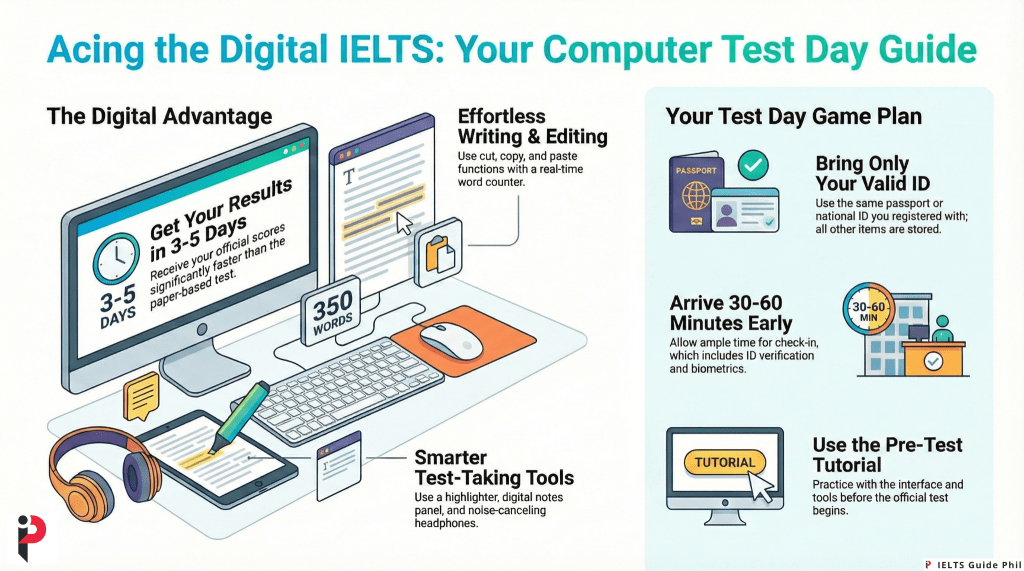
The digital Writing section offers several helpful tools, including an automatic word counter and the ability to cut, copy, and paste text, which makes editing much easier than on paper. It also includes a feature that looks like a spell checker, but its limitations can create a dangerous false sense of security.
The built-in tool will underline misspelled words in red, but that is all it does. It does not provide corrections or suggestions. Crucially, it will not identify grammatical errors or instances where you’ve used the wrong word (e.g., “there” instead of “their”). Over-relying on the red underline can cause you to miss these other, more serious errors that impact your score. Meticulous proofreading for spelling, grammar, and correct word choice remains an essential skill you must perform yourself.
4. Accuracy Trumps Speed in the Writing Test
A common source of anxiety for the computer-delivered test is typing speed. Many candidates worry that if they aren’t a fast typist, they will be at a significant disadvantage in the Writing section. However, the test is designed to assess your English language skills, not your words-per-minute.
You do not need to be a fast typist to achieve a high score. Accuracy is far more important than speed. Taking the time to compose thoughtful, well-structured sentences with correct grammar and vocabulary will serve you better than rushing to produce a high volume of text filled with errors.
Many successful candidates type slowly but thoughtfully.
5. You Bring Almost Nothing But Your ID
For a high-stakes exam, you might expect to bring a small arsenal of supplies. The opposite is true for the computer-delivered IELTS. Your packing list is shockingly short: you only need your valid passport or national ID (the same one used for registration) and your test confirmation email. That’s it.
By contrast, the list of prohibited items is long. You must leave behind all personal belongings, including phones, smartwatches, notes, pens, paper, food, and drinks, which are stored in provided lockers. This minimalist approach is directly tied to test security. It ensures a standardized, controlled environment for every candidate, eliminating distractions and guaranteeing that the only tools you use are the ones provided on the computer.
6. You Can Navigate the Reading Test Like a Pro
Perhaps the most underrated advantage of the computer format is the suite of powerful tools available in the Reading section, which can transform your entire test-taking strategy. Unlike on paper, where you must constantly flip pages, the digital interface is designed for efficiency.
The test uses a split-screen view, allowing you to see the reading passage and the questions simultaneously, eliminating the need to look back and forth. You also have a search function to quickly locate specific keywords in the text. Furthermore, you can flag questions for review, creating a simple way to skip difficult items and return to them later without losing your place. Mastering these features can save you precious time and help you approach the Reading section with much greater control.
The Computer is a Tool, Not the Test
Ultimately, the computer-delivered IELTS is more than just a new way to take an old test. It has a unique set of rules, features, and strategic considerations that, when understood, can be leveraged to your advantage. By preparing for the test as it truly is—not as you assume it to be—you can walk in ready to perform your best.
The key advantage of the computer test is that it allows you to focus more on your English and less on mechanical aspects like handwriting and transferring answers. Embrace the technology as a tool to showcase your language skills.
#IELTSComputerTest #IELTSPrep #IELTSTips #ComputerBasedIELTS #IELTSStrategy #IELTSListening #IELTSWriting #IELTSSpeaking #IELTSReading #IELTSMindset #IELTSPreparation #TestDayReady #BeyondTheBooks #BandScoreGoals #IELTSAdvice #DigitalIELTS #IELTS #IELTSGuidePhil
 IELTS Guide Phil
Leave a comment