
Introduction: The Hidden Rules of a Simple Letter
The anxiety of a formal writing test is universal, especially when the task seems deceptively simple, like writing a letter. You know the basics, but you can’t shake the feeling that you’re missing something crucial. The key is to stop thinking of it as a test of your English brilliance and start thinking of it as what it actually is: a simulation. As the experts at IELTS Guide Phil put it, “Think of it as writing a real-life letter you might need in English-speaking countries.”
Success in the IELTS General Training Writing Task 1 isn’t about using complex vocabulary, but about understanding a few surprising, strategic rules that most people miss. Here are five of the most impactful rules that can transform your approach and boost your score.
The 5 Rules That Matter Most
1. The Most Important Part of the Writing Test… Isn’t This Letter
The single most important strategic insight for the IELTS Writing section is this: Task 1 is only worth approximately 33% of your total Writing score. The essay in Task 2 is worth roughly 67%.
This is a game-changer for time management. It means you absolutely must not spend more than the recommended 20 minutes on your letter. Every extra minute you spend polishing your letter is a minute stolen from the higher-value Task 2. From an examiner’s perspective, a candidate who writes a perfect letter but runs out of time on their essay has made a major strategic error. Disciplined time allocation is a critical, non-negotiable strategy for success.
2. Your Goal Isn’t to Be Creative—It’s to Be Correct
Many test-takers waste precious time trying to invent a fascinating story or demonstrate deep knowledge of the letter’s topic. This is a fundamental misunderstanding of what’s being tested.
You’re being tested on your ability to communicate appropriately in written English for everyday situations, not on your creativity or knowledge.
This should feel incredibly liberating. It frees you from the pressure of being original and allows you to focus on what directly impacts your Task Achievement score: following instructions. When an examiner sees a letter focused on clear communication rather than a complex, made-up story, they see a candidate who understands the real-world purpose of the task. Pour your energy into a clear, direct opening, such as, “I am writing to express my dissatisfaction with a product I recently purchased,” and methodically addressing every bullet point.
3. The Critical Contraction Rule
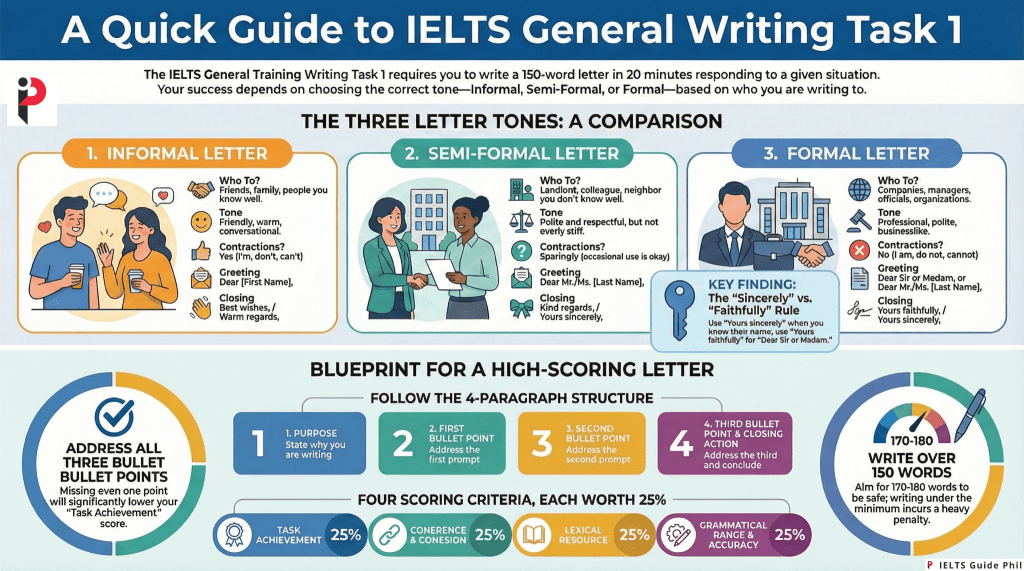
A tiny detail like an apostrophe can reveal a massive amount about your understanding of tone. The rules for using contractions (like “I’m,” “don’t,” or “can’t”) are strict, and your application of them is a direct signal of your mastery.
- Formal Letters: Contractions are forbidden. You must write the full forms: “I am,” “do not,” “cannot.”
- Semi-Formal Letters: Some contractions are acceptable, but they should be used sparingly to maintain a respectful tone.
- Informal Letters: Contractions are perfectly acceptable and help create a natural, friendly tone.
This isn’t just a style tip; it’s fundamental to your Task Achievement score, which assesses whether your tone is “appropriate” for the situation. For an examiner, your use of contractions is one of the fastest indicators of whether you’ve correctly identified the letter’s required tone.
4. The Closing Salutation Mystery, Solved Forever
Few things cause more confusion than choosing the right closing. Guessing between “Yours faithfully” and “Yours sincerely” can cost you easy points. Here is the complete, unbreakable guide for all three letter types.
For Formal Letters:
- Use “Yours faithfully” when your letter starts with “Dear Sir or Madam” (name unknown).
- Use “Yours sincerely” when your letter starts with a specific name, like “Dear Mr. Peterson.”
To make this unforgettable, use this memory trick:
- Use FAITHfully when you don’t know their name (you have faith you’re reaching the right person).
- Use SINCErely when you know their name (since you know them).
For Semi-Formal Letters:
- The most common and safest options are “Kind regards,” or “Best regards,”. If you’ve used their name in the opening, “Yours sincerely,” is also acceptable.
For Informal Letters:
- You have more flexibility here. Excellent choices include “Best wishes,”, “Warm regards,”, or “Take care,”.
An examiner sees the correct pairing of opening and closing not as a minor detail, but as a sign of a writer’s control over Lexical Resource—your awareness of style and the formulaic language of letter-writing.
5. Meet the ‘Semi-Formal’: The Tone You Never Knew You Needed
Most people think of communication as either formal (businesslike) or informal (friendly). However, IELTS specifically assesses a third, “in-between” category: the semi-formal tone. This is the tone you use for someone you don’t know personally but where the situation isn’t strictly official—think a landlord, a colleague, or a neighbor you’re not close with.
To master this tone, you need the right tools. A semi-formal letter should start with “Dear Mr./Ms. [Last Name],” and end with “Kind regards,” or “Best regards,”. It requires choosing polite but direct phrases like “I am writing to inform you about…” or “I would appreciate it if you could…” instead of overly casual or stiff alternatives.
This category is a common trap. Nailing this delicate balance of respect and approachability is a direct hit for your Task Achievement score. Examiners know the semi-formal tone is challenging; acing it demonstrates a nuanced command of English that separates a good candidate from a great one.
Conclusion: Writing Smarter, Not Harder
Mastering the IELTS letter isn’t about having the largest vocabulary or writing the most dramatic story. It’s about strategic thinking. By understanding how the test is weighted, what examiners actually look for, and the non-negotiable rules of tone and format, you can focus your energy where it truly counts.
Knowing these hidden rules, which small change to your writing practice will you make first?
#IELTS #IELTSGuidePhil #IELTSLetter #IELTSPreparation #IELTSTips #IELTSStrategy #IELTSExam #WritingSkills #GeneralTrainingIELTS #StudyAbroad #ExamSuccess #BandScoreGoals #SmartStudy #TestStrategy #FormalWriting #SemiFormalTone #InformalWriting #ClosingSalutations #ContractionRules #FocusAndLearn #IELTS2025 #LanguageLearning
 IELTS Guide Phil
Leave a comment