
What is IELTS Writing Task 2? (Start Here If You Know Nothing!)
IELTS Writing Task 2 is an essay-writing task where you respond to a point of view, argument, or problem. You’ll receive a question about a topic (education, technology, environment, society, etc.) and must write a formal academic essay presenting your ideas, arguments, and opinions. You can watch this YouTube video explainer by IELTS Guide Phil.
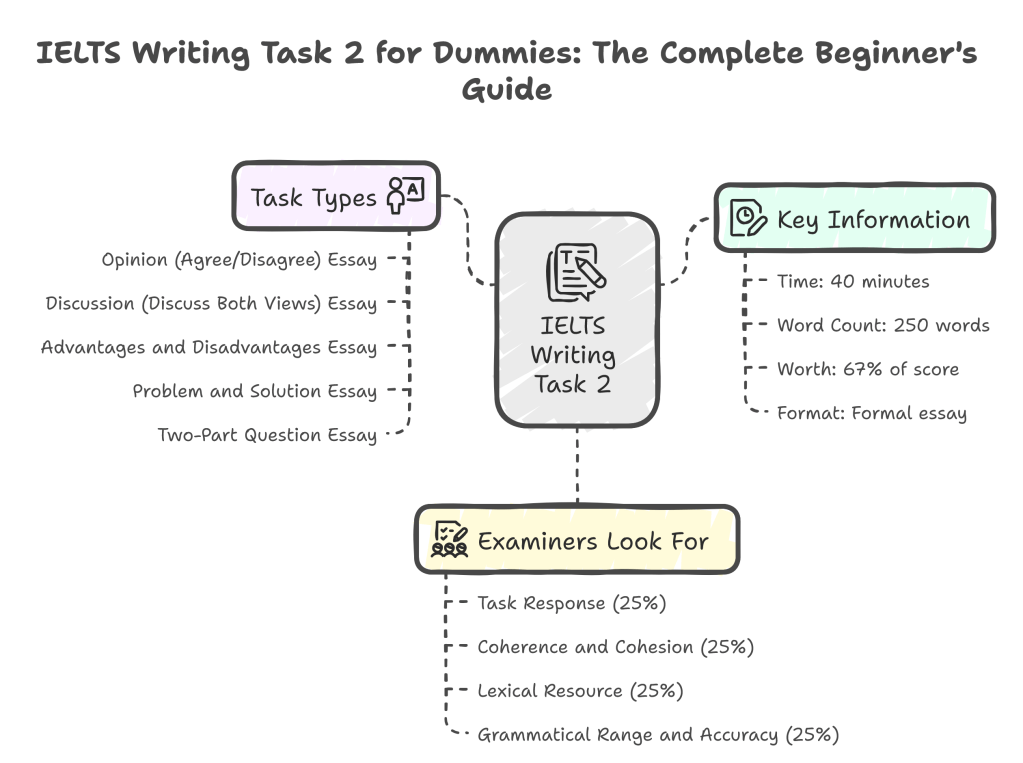
Here’s what you need to know:
- Time: 40 minutes (recommended)
- Minimum word count: 250 words
- Worth: Approximately 67% of your total Writing score (Task 1 is only 33%)
- Format: Formal academic essay
- Task types: Both Academic and General Training students write the SAME Task 2
Think of it as a school essay exam, but you’re being tested on your English writing ability, not your knowledge of the topic. The examiners want to see that you can:
- Present and develop ideas clearly
- Support your opinions with reasons and examples
- Organize your writing logically
- Use a range of vocabulary and grammar accurately
Key principle: There are no “right” or “wrong” opinions. You can agree, disagree, or present a balanced view. What matters is HOW WELL you express and support your position.
The 5 Types of Task 2 Questions
Understanding the question type is crucial because each requires a different approach.
1. Opinion (Agree/Disagree) Essay
Question format: “Some people believe that [statement]. To what extent do you agree or disagree?”
Example: “Some people think that university students should only study subjects that are useful for future jobs. To what extent do you agree or disagree?”
What you must do:
- State your opinion clearly (agree, disagree, or partially agree)
- Explain and support your position with reasons and examples
- Stay consistent throughout the essay
Possible approaches:
- Fully agree: Present 2-3 reasons why you completely agree
- Fully disagree: Present 2-3 reasons why you completely disagree
- Partially agree: Acknowledge both sides but lean toward one position
2. Discussion (Discuss Both Views) Essay
Question format: “Some people think [view A]. Other people believe [view B]. Discuss both views and give your own opinion.”
Example: “Some people think that the best way to reduce crime is to give longer prison sentences. Others believe that there are better alternative ways to reduce crime. Discuss both views and give your opinion.”
What you must do:
- Discuss BOTH views fairly (don’t ignore one side)
- Give YOUR opinion (this is required!)
- Support all views with reasons and examples
Structure:
- Body paragraph 1: Discuss the first view
- Body paragraph 2: Discuss the second view
- Include your opinion (either in the introduction, in a separate paragraph, or woven throughout)
3. Advantages and Disadvantages Essay
Question format: “[Situation/trend] has both advantages and disadvantages. Do the advantages outweigh the disadvantages?” OR “Discuss the advantages and disadvantages of [situation].”
Example: “In some countries, young people are encouraged to work or travel for a year between finishing high school and starting university. Discuss the advantages and disadvantages for young people who decide to do this.”
What you must do:
- Discuss advantages clearly
- Discuss disadvantages clearly
- If asked whether advantages outweigh disadvantages, state your conclusion
Structure:
- Body paragraph 1: Advantages
- Body paragraph 2: Disadvantages
- Conclusion: Your judgment (if asked)
4. Problem and Solution Essay
Question format: “[Problem description]. What problems does this cause? What can be done to solve these problems?”
Example: “In many countries, children are becoming overweight and unhealthy. What are the causes of this? What solutions can be implemented?”
What you must do:
- Identify problems/causes clearly
- Propose realistic solutions
- Explain how solutions address the problems
Structure:
- Body paragraph 1: Problems/Causes
- Body paragraph 2: Solutions
- OR: Problem 1 + Solution 1 (Body 1), Problem 2 + Solution 2 (Body 2)
5. Two-Part Question Essay
Question format: Two separate questions that must both be answered.
Example: “More and more people are using computers and electronic devices to access information. Therefore, there is no longer any need for printed books, magazines, or newspapers. To what extent do you agree or disagree? What are the advantages of using electronic devices?”
What you must do:
- Answer BOTH questions separately and clearly
- Give equal attention to both
- Structure your essay to address each question
Structure:
- Body paragraph 1: Answer to Question 1
- Body paragraph 2: Answer to Question 2
The Essay Structure (Your Blueprint)
Every Task 2 essay follows this four-paragraph structure:
Paragraph 1: Introduction (1-3 sentences, ~40 words)
Purpose: Introduce the topic and state your position/thesis.
Formula:
- Hook/Background sentence: General statement about the topic
- Paraphrase the question: Show you understand what’s being asked
- Thesis statement: Your position/main idea
Example:
Question: “Some people believe that children should start learning a foreign language at primary school rather than secondary school. To what extent do you agree or disagree?”
Introduction: “In today’s globalized world, foreign language proficiency has become increasingly valuable. While some argue that language learning should begin in primary school, others believe secondary school is more appropriate. I strongly agree that an early start to language education offers significant advantages for children’s cognitive and linguistic development.”
What this introduction does:
✓ Introduces the topic (language learning)
✓ Paraphrases the question without copying
✓ States a clear position (I strongly agree)
Paragraph 2: Body Paragraph 1 (5-7 sentences, ~100 words)
Purpose: Present your first main idea with explanation and examples.
Formula:
- Topic sentence: State your main idea
- Explanation: Develop the idea
- Example: Provide a specific example or evidence
- Link: Connect back to your thesis
Example (continuing the language learning essay):
“Firstly, young children have a natural aptitude for acquiring languages that diminishes with age. Research has shown that children’s brains are more adaptable and can absorb new linguistic patterns more easily than adult brains. For instance, children who learn a second language before age seven typically achieve native-like pronunciation, whereas older learners often retain a noticeable accent. This biological advantage makes primary school the ideal time to introduce foreign language instruction, maximizing children’s natural learning capacity.”
What this paragraph does:
✓ Presents one clear main idea (children’s natural aptitude)
✓ Explains WHY this matters (brain adaptability)
✓ Provides a concrete example (pronunciation before age 7)
✓ Links back to the position (ideal time for introduction)
Paragraph 3: Body Paragraph 2 (5-7 sentences, ~100 words)
Purpose: Present your second main idea with explanation and examples.
Formula: Same as Body Paragraph 1
Example:
“Additionally, early language learning provides cognitive benefits that extend beyond linguistic skills. Studies have demonstrated that bilingual children develop enhanced problem-solving abilities and improved executive function compared to their monolingual peers. For example, research from Cambridge University found that children who studied a foreign language from age five showed significantly better performance in mathematics and logical reasoning tasks. These cognitive advantages suggest that introducing languages at primary level not only teaches communication skills but also strengthens overall intellectual development.”
Paragraph 4: Conclusion (1-2 sentences, ~30 words)
Purpose: Summarize your main points and restate your position.
Formula:
- Restate thesis: Reaffirm your position (using different words)
- Summary of main points: Briefly mention your key arguments
- Final thought: (Optional) A forward-looking statement or recommendation
Example:
“In conclusion, I firmly believe that primary school represents the optimal stage for introducing foreign language education. The combination of children’s natural learning abilities and the significant cognitive benefits makes early language instruction a valuable investment in children’s futures. Schools should therefore prioritize foreign language programs from the earliest grades possible.”
What NOT to include in conclusions:
✗ New ideas or arguments
✗ Examples
✗ “In my opinion” (you’ve already stated your opinion throughout)
Complete Essay Example
Question: “Some people believe that social media has a negative impact on society. To what extent do you agree or disagree?”
Model Answer (Band 7-8):
In the modern digital age, social media platforms have become an integral part of daily life for billions of people worldwide. While these platforms offer unprecedented connectivity, there is growing concern about their societal effects. I largely agree that social media has predominantly negative impacts on society, particularly regarding mental health and the spread of misinformation.
Firstly, social media significantly contributes to mental health problems, especially among young people. The constant exposure to curated, idealized versions of others’ lives creates unrealistic expectations and feelings of inadequacy. For instance, a 2021 study by the Royal Society for Public Health found that Instagram was associated with high levels of anxiety, depression, and body image concerns among teenagers. Furthermore, the addictive nature of these platforms, engineered through features like infinite scrolling and notification alerts, leads to excessive screen time that disrupts sleep patterns and reduces face-to-face social interaction. This psychological harm represents a serious societal cost that outweighs many of social media’s benefits.
Additionally, social media facilitates the rapid spread of misinformation and conspiracy theories, undermining informed public discourse. Unlike traditional media with editorial standards, anyone can publish unverified information that reaches millions within hours. During the COVID-19 pandemic, for example, false claims about vaccines and treatments proliferated across Facebook and Twitter, directly contributing to vaccine hesitancy and potentially preventable deaths. The algorithmic amplification of divisive content further polarizes communities and erodes trust in legitimate institutions. This threat to democratic discourse and public health decision-making demonstrates social media’s capacity for significant societal harm.
In conclusion, while social media offers valuable communication tools, I believe its negative impacts on mental wellbeing and information integrity substantially outweigh its advantages. Society must address these harms through stronger platform regulation, improved digital literacy education, and individual mindfulness about social media consumption. Only through such measures can we mitigate the damaging effects of these increasingly influential technologies.
(Word count: 318 words)
Why this is a Band 7-8 essay:
✓ Clear position stated and maintained throughout
✓ Well-organized four-paragraph structure
✓ Two well-developed main ideas with explanations and specific examples
✓ Strong cohesion with linking words (Firstly, Additionally, Furthermore, For instance)
✓ Range of vocabulary (curated, proliferated, erodes, mitigate)
✓ Variety of grammar structures (complex sentences, passive voice, relative clauses)
✓ Formal academic tone throughout
✓ Addresses the question directly
The Scoring Criteria (What Examiners Look For)
Your Task 2 essay is marked on four criteria, each worth 25%:
1. Task Response (25%)
What it means: Did you answer the question fully and appropriately?
Band 7 requirements:
- Addresses all parts of the task
- Presents a clear position throughout
- Presents, extends, and supports main ideas
- May sometimes be overgeneralized or lack focus
How to achieve this:
✓ Answer the exact question asked (don’t go off-topic)
✓ State your position clearly in the introduction
✓ Develop each main idea fully with explanation and examples
✓ Stay consistent with your position throughout
Common mistakes:
✗ Not answering all parts of the question
✗ Unclear or inconsistent position
✗ Ideas mentioned but not developed
✗ Writing about the general topic instead of the specific question
2. Coherence and Cohesion (25%)
What it means: Is your essay logically organized and easy to follow?
Band 7 requirements:
- Logically organizes information and ideas
- Clear progression throughout
- Uses a range of cohesive devices appropriately
- Clear central topic within each paragraph
Cohesive devices you should use:
- Sequencing: Firstly, Secondly, Finally, To begin with
- Addition: Furthermore, Moreover, Additionally, In addition
- Contrast: However, Nevertheless, On the other hand, In contrast
- Example: For instance, For example, Such as, Particularly
- Result: Therefore, Consequently, As a result, Thus
- Emphasis: Indeed, In fact, Clearly, Undoubtedly
How to achieve this:
✓ Use clear paragraphing (4 paragraphs)
✓ Start each body paragraph with a topic sentence
✓ Use linking words appropriately (don’t overuse)
✓ Ensure smooth transitions between ideas
✓ Use pronouns and reference words (this, these, such) to connect sentences
Common mistakes:
✗ Overusing linking words (making writing sound mechanical)
✗ Using linking words incorrectly
✗ Poor paragraphing (one long paragraph or too many short ones)
✗ Ideas don’t connect logically
3. Lexical Resource (25%)
What it means: Do you use a good range of vocabulary accurately?
Band 7 requirements:
- Uses sufficient range of vocabulary to allow flexibility and precision
- Uses less common lexical items with awareness of style and collocation
- May produce occasional errors in word choice, spelling, or word formation
Vocabulary strategies:
✓ Use topic-specific vocabulary naturally
✓ Use synonyms to avoid repetition
✓ Use collocations correctly (combinations of words that naturally go together)
✓ Use some less common words accurately
✓ Paraphrase effectively
Example of good vocabulary use: Instead of: “Technology is important for education.” Better: “Technology plays a crucial role in modern education.” Even better: “Technological innovations have revolutionized contemporary educational practices.”
Common mistakes:
✗ Repeating the same words (important, important, important)
✗ Using overly simple vocabulary throughout
✗ Using words incorrectly (wrong collocation: “make a damage” instead of “cause damage”)
✗ Attempting very advanced words you don’t understand
✗ Spelling errors
4. Grammatical Range and Accuracy (25%)
What it means: Do you use a variety of sentence structures correctly?
Band 7 requirements:
- Uses a variety of complex structures
- Produces frequent error-free sentences
- Has good control of grammar and punctuation
- May make a few errors
Grammar structures you should use:
✓ Complex sentences: “While social media offers connectivity, it also poses risks.”
✓ Relative clauses: “Students who study abroad often develop valuable skills.”
✓ Conditional sentences: “If governments invested more in education, literacy rates would improve.”
✓ Passive voice: “The research was conducted over five years.”
✓ Modal verbs: “Governments should/must/could implement policies.”
✓ Participle clauses: “Having considered both views, I believe…”
Sentence variety example:
Poor (only simple sentences): “Technology is important. It helps education. Students use computers. This improves learning.”
Better (varied structures): “Technology plays a crucial role in modern education. As students increasingly use computers and digital devices, learning outcomes have improved significantly. This technological integration, while beneficial, also presents challenges that educators must address.”
Common mistakes:
✗ Only using simple sentences
✗ Subject-verb agreement errors (“The government are”)
✗ Tense errors (mixing past and present randomly)
✗ Article errors (the/a/an or no article)
✗ Run-on sentences (sentences that are too long without proper punctuation)
Essential Dos and Don’ts
DO:
✓ Write at least 250 words (aim for 270-290 to be safe)
✓ Spend 40 minutes on Task 2 (it’s worth more than Task 1)
✓ Plan your essay (5 minutes planning saves time and improves quality)
✓ Answer the exact question asked (don’t just write about the general topic) ✓ State your position clearly in the introduction
✓ Use formal academic language throughout
✓ Develop each main idea fully with explanation and examples
✓ Use paragraphs (4 paragraphs: intro, body 1, body 2, conclusion)
✓ Use linking words to connect ideas (but don’t overuse them)
✓ Give specific examples to support your points
✓ Check your work (save 2-3 minutes for proofreading)
✓ Stay consistent with your position throughout
✓ Use a variety of sentence structures
✓ Write legibly (if handwriting)
DON’T:
✗ Don’t write less than 250 words (significant penalty)
✗ Don’t spend too long on Task 2 (leave time for checking)
✗ Don’t copy the question word-for-word
✗ Don’t use informal language (don’t write “gonna,” “wanna,” “lots of,” “kids”)
✗ Don’t use contractions (don’t, can’t, won’t—write do not, cannot, will not)
✗ Don’t use personal anecdotes as your only examples (“My friend Bob…”)
✗ Don’t go off-topic (stay focused on the question)
✗ Don’t list ideas without developing them
✗ Don’t use bullet points (write in paragraph form)
✗ Don’t be too emotional or biased (stay balanced and academic)
✗ Don’t memorize entire essays (examiners recognize this and will lower your score)
✗ Don’t use overly complex vocabulary you don’t understand
✗ Don’t write a separate opinion paragraph unless it’s a discussion essay
✗ Don’t introduce new ideas in the conclusion
✗ Don’t use “I” excessively (once or twice is fine, but don’t start every sentence with “I think”)
Common Mistakes and How to Fix Them
Mistake 1: Not Answering the Question
The problem: Writing generally about the topic instead of answering the specific question.
Example: Question: “Some people think that the government should provide financial support for artists. To what extent do you agree or disagree?”
Off-topic response: Writing an essay about “the importance of art in society” without discussing government funding.
Why it happens: Not reading the question carefully, or misunderstanding what’s being asked.
The fix:
- Underline the key words in the question
- Identify exactly what’s being asked
- Check that every paragraph relates back to the question
On-topic response: Discuss whether government funding for artists is justified, presenting arguments for or against government financial support specifically.
Mistake 2: Writing Under 250 Words
The problem: Stopping at 230-240 words thinking it’s “close enough.”
Why it’s a problem: Under-length essays are heavily penalized. You lose marks in Task Response.
The fix:
- Practice counting words during preparation
- Aim for 270-290 words to build a safety buffer
- If you’re short, develop your examples more fully
- Add an additional supporting point if needed
How to add words without waffle:
- Explain your points in more detail
- Provide more specific examples
- Add a second example to support your argument
- Expand on the implications of your points
Mistake 3: Unclear or Missing Position
The problem: Not stating your opinion clearly, or changing your opinion throughout the essay.
Example (unclear): “There are advantages and disadvantages to social media. Some people like it and some don’t. It depends on the person.”
Why it’s a problem: Task Response requires a clear position. Sitting on the fence loses marks.
The fix: State your position clearly in the introduction and maintain it consistently.
Clear position examples:
- “I strongly agree that…” (Opinion essay)
- “While both views have merit, I believe that…” (Discussion essay)
- “In my view, the advantages significantly outweigh the disadvantages…” (Advantages/Disadvantages essay)
Mistake 4: Poor Time Management
The problem: Spending 50+ minutes on Task 2, leaving no time for checking, or rushing Task 1.
Why it’s a problem: Errors multiply when you rush. Plus, Task 1 still matters.
The fix:
- Task 1: 20 minutes (strict)
- Task 2: 40 minutes (35 writing + 5 checking)
- Practice with a timer until this becomes automatic
40-minute breakdown for Task 2:
- 5 minutes: Read question, plan essay
- 30 minutes: Write (aim for 8-9 words per minute)
- 5 minutes: Check grammar, spelling, word count
Mistake 5: Memorized Essays
The problem: Memorizing complete essays and trying to reproduce them in the exam.
Example: Writing a memorized essay about “technology” for a question about “social media and mental health.”
Why it’s a problem: Examiners recognize memorized responses. Your essay won’t answer the specific question. This can result in a very low score or even disqualification.
The fix:
- Learn flexible structures and useful phrases, not entire essays
- Practice adapting your ideas to different questions
- Understand that every question requires a unique response
- Focus on developing your English skills, not memorization
What you CAN memorize:
✓ Essay structure (4 paragraphs)
✓ Linking phrases
✓ Topic vocabulary
✓ Useful phrases (“One significant advantage is…”, “A primary concern is…”)
What you CANNOT memorize:
✗ Entire essays
✗ Whole paragraphs
✗ Detailed examples that don’t fit the question
Mistake 6: Using Overly Informal Language
The problem: Writing as if you’re texting a friend or posting on social media.
Examples:
✗ “Lots of kids these days use smartphones.”
✗ “It’s gonna be really hard to fix this problem.”
✗ “People don’t wanna work hard anymore.”
✗ “That’s why this stuff is super important.”
Why it’s a problem: Task 2 requires formal academic English. Informal language lowers your Lexical Resource score.
The fix: Use formal alternatives.
✓ “Many children currently use smartphones.”
✓ “It will be extremely challenging to address this issue.”
✓ “People are increasingly reluctant to engage in demanding work.”
✓ “This is why these matters are particularly significant.”
Informal words to avoid:
- kids → children, young people
- lots of → many, numerous, a significant number of
- gonna → going to
- wanna → want to
- stuff/things → issues, matters, aspects
- big → significant, substantial, considerable
- really/very → extremely, particularly, notably
- get → obtain, receive, acquire
Mistake 7: No Examples or Vague Examples
The problem: Making claims without supporting them, or using very general examples.
Vague example: “Social media causes problems. For example, people have issues.”
Why it’s a problem: Band 7+ requires well-developed ideas with relevant examples.
The fix: Provide specific, detailed examples.
Specific example: “Social media significantly impacts mental health. For instance, a 2021 study by the Royal Society for Public Health found that Instagram was associated with increased anxiety and depression among teenagers, with 70% of young users reporting that the platform made them feel worse about their body image.”
Types of examples you can use:
- Statistics/research: “According to a 2022 UNESCO report…”
- Real-world cases: “In countries like Finland and Singapore, which have implemented…”
- Historical examples: “The industrial revolution demonstrated that…”
- Hypothetical but realistic scenarios: “If a student spends excessive time on social media, their academic performance may decline…”
Note: You don’t need to cite real studies perfectly. Examiners don’t fact-check. “Research has shown…” or “Studies indicate…” is acceptable if you can’t remember exact sources.
Mistake 8: One Long Paragraph
The problem: Writing the entire essay as a single block of text.
Why it’s a problem: Poor organization severely affects Coherence and Cohesion score. Makes your essay difficult to follow.
The fix: Always use clear paragraphing.
Correct format:
- Paragraph 1: Introduction
- Paragraph 2: Body paragraph 1
- Paragraph 3: Body paragraph 2
- Paragraph 4: Conclusion
Visual tip: Leave a line between paragraphs or indent the first line of each new paragraph.
Mistake 9: Repeating the Same Words
The problem: Using “important” ten times, “children” eight times, “increase” repeatedly.
Why it’s a problem: Shows limited vocabulary range. Reduces Lexical Resource score.
The fix: Use synonyms and vary your language.
Synonym groups:
Important:
- significant, crucial, vital, essential, critical, key, fundamental, major
Children:
- young people, youngsters, juveniles, minors, adolescents (for teenagers), the younger generation
Increase (verb):
- rise, grow, expand, escalate, surge, climb, mount, intensify
Increase (noun):
- rise, growth, expansion, surge, upward trend, escalation
Problem:
- issue, challenge, difficulty, concern, obstacle, complication, dilemma
Good:
- beneficial, advantageous, positive, favorable, constructive, valuable
Bad:
- negative, detrimental, harmful, adverse, damaging, problematic
Mistake 10: Grammar Errors That Lower Your Score
Common errors:
Subject-verb agreement:
✗ “The government are implementing policies.”
✓ “The government is implementing policies.” (government is singular)
✗ “People is affected by this.”
✓ “People are affected by this.” (people is plural)
Article errors:
✗ “Education is important for society.” (usually correct – abstract noun)
✗ “The education is important.” (wrong – don’t use “the” with abstract nouns in general statements)
✓ “Education is crucial for societal development.”
Tense consistency:
✗ “In 2020, pollution increases. Now it decreased.”
✓ “In 2020, pollution increased. Since then, it has decreased.”
Run-on sentences:
✗ “Technology is important it helps people it makes life easier everyone should use it.”
✓ “Technology is important because it helps people. It makes life easier, and therefore, everyone should use it.”
The fix:
- Learn common grammar patterns
- Practice writing with correct grammar
- Always proofread for these specific errors
- If unsure about a complex structure, use a simpler correct one
Mistake 11: Irrelevant or Overly Personal Examples
The problem: Using personal stories that don’t support your argument.
✗ “My uncle Bob started a business and became rich. This shows that education is not important.”
Why it’s a problem: Personal anecdotes (especially about people the examiner doesn’t know) are weak evidence in academic writing.
The fix: Use broader, more relevant examples.
✓ “Many successful entrepreneurs, such as Bill Gates and Mark Zuckerberg, achieved success without completing university degrees. However, these exceptional cases do not represent the average person’s experience, as statistics show that university graduates earn significantly more over their lifetimes.”
When personal examples work:
- If they’re brief and support a point
- If combined with broader evidence
- If they represent a common experience
Mistake 12: No Clear Topic Sentences
The problem: Body paragraphs don’t have a clear opening sentence stating the main idea.
Why it’s a problem: Makes your essay harder to follow. Affects Coherence and Cohesion.
Example of unclear paragraph: “Technology is everywhere now. People use phones. The internet is popular. This affects society in many ways. Young people especially are affected.”
The fix: Start each body paragraph with a clear topic sentence.
Example with clear topic sentence: “Firstly, technology has fundamentally transformed how young people communicate and build relationships. [Topic sentence] While previous generations primarily interacted face-to-face or through phone calls, today’s youth predominantly use digital platforms such as social media, messaging apps, and video calls. This shift has created both opportunities for global connection and concerns about the quality of interpersonal relationships…”
Advanced Tips for High Scores (Band 7+)
1. Master the Art of Paraphrasing
Band 7+ essays demonstrate flexibility with language. Practice restating ideas in multiple ways.
Original: “Climate change is a serious problem.”
Paraphrased versions:
- “Global warming represents a significant challenge.”
- “Environmental degradation poses a critical threat.”
- “The changing climate constitutes a major concern.”
- “Rising temperatures present a substantial issue.”
2. Use Concession for Balance
Even if you have a strong opinion, acknowledge the opposing view briefly. This shows sophisticated thinking.
Structure: “While [opposing view], I believe that [your view] because [reason].”
Example: “While social media does offer valuable networking opportunities, I believe its negative impacts on mental health significantly outweigh these benefits because the psychological harm affects millions of users daily.”
Useful concession phrases:
- While it is true that…
- Although some people argue that…
- Despite the fact that…
- Admittedly…
- It must be acknowledged that…
- Notwithstanding…
3. Develop “Idea Banks” for Common Topics
Create mental frameworks for frequently tested topics:
Education:
- Access and equality
- Teaching methods
- Technology in education
- Academic vs vocational training
- Student debt
Technology:
- Social media impacts
- Privacy concerns
- Automation and employment
- Digital divide
- Online vs offline interaction
Environment:
- Climate change solutions
- Individual vs government responsibility
- Economic growth vs environmental protection
- Renewable energy
- Plastic pollution
Society:
- Work-life balance
- Gender equality
- Generation gaps
- Urbanization
- Cultural preservation
For each topic, prepare:
- Key vocabulary
- Typical arguments for and against
- Relevant examples (real or hypothetical)
4. Use Conditional Sentences
Conditionals demonstrate grammatical range and help you discuss hypothetical situations.
Types:
First conditional (likely future): “If governments invest more in renewable energy, carbon emissions will decrease significantly.”
Second conditional (hypothetical present): “If everyone stopped using private cars, traffic congestion would be greatly reduced.”
Third conditional (hypothetical past): “If stricter regulations had been implemented earlier, the environmental damage could have been prevented.”
Mixed conditionals: “If people had been more environmentally conscious in the past, we would not be facing such severe climate challenges today.”
5. Strengthen Your Conclusions
Go beyond simply restating your thesis. Add a forward-looking statement or recommendation.
Weak conclusion: “In conclusion, I agree that technology is important for education.”
Strong conclusion: “In conclusion, technology has become an indispensable tool in modern education, offering unprecedented access to information and interactive learning experiences. As digital literacy becomes increasingly essential in the 21st-century workforce, educational institutions must continue integrating technological innovations while ensuring equitable access for all students. Only through such balanced approaches can society fully realize the benefits of educational technology.”
Techniques:
- Recommendation: “Governments should therefore…”
- Prediction: “In the coming decades, it is likely that…”
- Call to action: “Society must address these challenges through…”
- Broader implication: “The resolution of this issue will determine…”
6. Create Variety in Sentence Openings
Avoid starting every sentence with “The…” or the subject.
Varied openings:
- Adverb: “Increasingly, people are…”
- Prepositional phrase: “In many countries, …”
- Participle phrase: “Having considered both views, …”
- Conditional clause: “If governments take action, …”
- Despite + noun: “Despite these challenges, …”
- It clause: “It is evident that…”
7. Use Academic Hedging
Academic writing often avoids absolute statements. Use hedging language to sound more sophisticated.
Too absolute:
✗ “Technology will solve all environmental problems.”
✗ “Everyone agrees that education is important.”
Better (hedged):
✓ “Technology may contribute significantly to addressing environmental challenges.”
✓ “There is widespread consensus that education plays a crucial role in societal development.”
Hedging words:
- might, may, could, can (instead of will)
- tend to, seem to, appear to (instead of direct statements)
- many, most, some (instead of all, everyone)
- often, frequently, generally (instead of always)
- suggest, indicate, imply (instead of prove, show definitively)
Frequently Asked Questions
Q: How long should my essay be? A: Minimum 250 words. Aim for 270-290 words. Going over 300 is fine if you have time, but don’t sacrifice Task 1 or checking time.
Q: Can I disagree with the question? A: Absolutely! There are no “right” or “wrong” opinions in IELTS. You can agree, disagree, or take a balanced position. What matters is how well you support your view.
Q: Should I give my opinion or stay neutral? A: It depends on the question type. Opinion essays REQUIRE your opinion. Discussion essays also require your opinion (read carefully—most say “give your opinion”). Advantages/Disadvantages essays may or may not require a judgment depending on the wording.
Q: Can I use “I” in my essay? A: Yes, it’s acceptable in IELTS Task 2, especially in phrases like “I believe,” “I agree,” “In my view.” However, don’t overuse it. Once or twice in the introduction and conclusion is enough.
Q: Is it better to fully agree or partially agree? A: Both are acceptable. Choose the approach that’s easier for you to develop. Fully agreeing or disagreeing is often clearer and easier to structure. Partial agreement requires balancing both sides, which can be trickier.
Q: Can I make up examples and statistics? A: Yes! Examiners don’t fact-check. You can say “According to recent research…” or “Studies have shown…” even if you don’t remember the exact source. However, keep examples realistic and plausible. Don’t write obvious nonsense like “99% of people are millionaires.”
Q: What if I don’t know anything about the topic? A: Use common sense and general knowledge. You don’t need to be an expert. If the question is about space exploration and you know nothing about it, you can still discuss costs, benefits to humanity, priority compared to Earth problems, etc.
Q: How many examples should I include? A: Aim for at least one developed example per body paragraph (2 total). More is fine if you have time and they’re relevant.
Q: Should I write a plan? A: Yes! Spend 5 minutes planning. It helps you organize ideas, avoid going off-topic, and write more efficiently. A simple plan:
- Position/Thesis
- Main Idea 1 + example
- Main Idea 2 + example
- Conclusion
Q: What if I make a spelling mistake? A: A few minor spelling errors won’t significantly hurt your score if the rest of your essay is strong. However, frequent errors or misspelling key words will reduce your Lexical Resource score. Always proofread.
Q: Can I cross out words? A: Yes. If you make a mistake, simply draw one neat line through it and continue. Don’t waste time erasing or using correction fluid.
Q: Is American or British spelling acceptable? A: Both are acceptable. However, be consistent within your essay. Don’t write “colour” in one paragraph and “color” in another.
Q: What if I can’t think of a second main idea? A: If you’re truly stuck:
- Develop your first idea more thoroughly with multiple examples
- Think about the issue from different angles (economic, social, environmental, individual, governmental)
- Consider different stakeholders (students, parents, teachers, government)
- Write about short-term vs long-term effects
However, with practice, this shouldn’t happen. Build your “idea banks” for common topics.
Q: Should I write a title? A: No. IELTS Task 2 essays don’t need titles. Start directly with your introduction.
Q: How important is handwriting? A: Very important if you’re doing paper-based IELTS. If the examiner can’t read your writing, they can’t score it properly. Practice writing neatly under time pressure.
Q: Can I change my opinion in the middle of the essay? A: No. Maintain a consistent position throughout. Changing your mind makes your essay confusing and hurts your Task Response and Coherence scores.
Q: What’s more important: ideas or language? A: Both matter, but they’re assessed separately. Brilliant ideas expressed in poor English won’t score highly. Similarly, perfect English saying nothing substantial won’t either. Aim for a balance: clear ideas expressed in good English.
Q: How can I expand my essay if it’s too short? A:
- Develop explanations more fully (explain WHY and HOW)
- Add more specific examples
- Explain the implications of your points
- Add a second example
- Expand on the significance of your arguments
Q: How long should each paragraph be? A: Approximate word counts:
- Introduction: 40-50 words
- Body Paragraph 1: 90-110 words
- Body Paragraph 2: 90-110 words
- Conclusion: 30-40 words
- Total: 250-310 words
Q: What’s the difference between “Discuss both views” and “Advantages and Disadvantages”? A:
- Discuss both views: Two different OPINIONS about a topic. You must discuss both opinions AND give YOUR opinion.
- Advantages and Disadvantages: The positive and negative aspects of a SITUATION. May or may not require your judgment (check the question).
Q: Can I use rhetorical questions? A: It’s better to avoid them in IELTS Task 2. Academic essays typically make statements rather than ask questions. If you must use one, make it brief and follow with a clear answer.
Your IELTS Writing Task 2 Preparation Plan
Week 1-2: Foundation Building
Days 1-3: Learn the Structure
- Study the four-paragraph essay structure
- Analyze 5 Band 7-8 model essays
- Identify introduction, thesis, topic sentences, examples, conclusions
- Learn the 5 question types
Days 4-7: Vocabulary Building
- Create vocabulary lists for common topics (education, technology, environment, health, society)
- Learn linking words and phrases
- Practice paraphrasing the same ideas in 3-4 different ways
- Study collocations (words that go together)
Days 8-10: Grammar Review
- Review complex sentence structures
- Practice conditional sentences
- Study relative clauses
- Learn passive voice usage
Days 11-14: Write Your First Essays
- Write 3-4 untimed practice essays
- Focus on structure, not perfection
- Get feedback if possible
- Don’t worry about time yet
Week 3-4: Question Type Mastery
Days 1-3: Opinion Essays
- Write 3 opinion essays (untimed)
- Practice stating and supporting your position
- Learn phrases for agreement/disagreement
Days 4-6: Discussion Essays
- Write 3 discussion essays (untimed)
- Practice presenting both views fairly
- Learn to integrate your opinion
Days 7-9: Advantages/Disadvantages
- Write 2-3 essays on advantages and disadvantages
- Practice balanced discussion
- Learn to make judgments
Days 10-12: Problem/Solution Essays
- Write 2 problem-solution essays
- Practice identifying causes and proposing solutions
- Learn cause-effect language
Days 13-14: Two-Part Questions
- Write 2 two-part question essays
- Practice addressing both questions equally
Week 5-6: Timed Practice and Improvement
Days 1-7: Begin Timed Writing
- Write 5-7 essays in 40 minutes each
- Use a timer strictly
- Focus on completing within time
- Self-assess using the scoring criteria
Days 8-14: Intensive Feedback
- Get feedback on at least 5 essays (from a teacher, tutor, or correction service)
- Identify your recurring mistakes
- Create a personal “error checklist”
- Rewrite corrected essays
Week 7-8: Refinement and Exam Simulation
Days 1-5: Address Weak Areas
- Focus on your weakest question types
- Work on your most common errors
- Practice specific skills (paraphrasing, examples, linking)
- Write 5 more timed essays
Days 6-10: Full Exam Simulations
- Do 5 complete Writing tests (Task 1 + Task 2, 60 minutes total)
- Strict exam conditions: no dictionary, no pausing
- Practice transferring answers if doing paper-based
- Time yourself precisely
Days 11-14: Final Review
- Review all your corrected essays
- Memorize useful phrases and vocabulary
- Practice your weakest areas
- Do 2 more full practice tests
- Rest well the day before the exam
Test Day Strategy
Before the test: ✓ Sleep well the night before ✓ Eat a proper meal ✓ Arrive early to avoid stress ✓ Bring required ID and materials
During the test:
Task 1 (20 minutes):
- 3 min: Analyze and plan
- 15 min: Write
- 2 min: Check
Task 2 (40 minutes):
- 5 min: Read question carefully, identify type, plan essay
- 30 min: Write (aim for 8-9 words per minute)
- 5 min: Proofread and correct
What to check in the final 5 minutes:
- Word count (at least 250)
- Grammar errors (especially subject-verb agreement, tenses, articles)
- Spelling mistakes
- Have you answered all parts of the question?
- Is your position clear?
Recommended Resources
Official Materials (Essential)
- Cambridge IELTS books (1-18): Official past papers with sample answers and examiner comments
- IELTS.org: Official website with free resources and band descriptors
- IELTS Progress Check: Official scored practice tests (paid service)
Websites for Practice and Learning
- IELTS Liz (ieltsliz.com): Free video lessons, model essays, common topics
- IELTS Simon (ielts-simon.com): Model essays with detailed explanations
- IELTS Advantage (ieltsadvantage.com): Question bank and strategies
- IELTS Buddy (ieltsbuddy.com): Practice questions and sample responses
- IELTS-Blog.com: Task 2 topics and recent exam questions
YouTube Channels
- IELTS Liz: Comprehensive Task 2 strategy videos
- E2 IELTS with Jay: Method-based approach to writing
- IELTS Advantage: Topic-by-topic analysis and tips
- Write to Top: Essay reviews and improvement strategies
Books
- “IELTS Writing Task 2 by Rachel Mitchell”
- “Target Band 7” by Simone Braverman
- “Get Ready for IELTS Writing” by Collins
- “The Complete Guide to IELTS Writing” by Phil Biggerton
Vocabulary and Grammar
- Academic Word List (AWL): Essential academic vocabulary
- English Collocations in Use (Cambridge): Learn natural word combinations
- English Grammar in Use by Raymond Murphy: Grammar reference and practice
- Quizlet: Search for “IELTS Writing Task 2 vocabulary” sets
- Grammarly (free version): Basic grammar checking
Getting Feedback (Crucial!)
- IELTS teachers/tutors: Hire a qualified teacher for at least 5-10 feedback sessions
- WriteToScore.com: Essay correction service
- IELTS Advantage Correction Service
- Magoosh IELTS: Essay evaluation service
- Language exchange partners: Find IELTS study partners online
- Reddit r/IELTS: Community feedback (free but quality varies)
Common IELTS Topics to Prepare
Education:
- University vs vocational training
- Online vs traditional education
- Education funding
- Homework and exams
- Early childhood education
Technology:
- Social media impacts
- Privacy and surveillance
- Artificial intelligence
- Online shopping
- Remote work
Environment:
- Climate change solutions
- Individual vs government responsibility
- Pollution reduction
- Renewable energy
- Wildlife conservation
Work:
- Work-life balance
- Job satisfaction vs salary
- Remote work
- Retirement age
- Gender equality in the workplace
Health:
- Healthcare funding
- Preventive vs treatment approaches
- Mental health awareness
- Obesity and diet
- Exercise and lifestyle
Society:
- Urbanization
- Cultural preservation
- Generation gaps
- Crime and punishment
- Immigration
Media:
- News reliability
- Celebrity culture
- Advertising
- Entertainment vs education
- Internet censorship
For each topic, prepare:
- Key vocabulary
- Common arguments (for and against)
- Relevant examples
- Personal position (what do you think?)
Final Thoughts
IELTS Writing Task 2 is challenging, but it’s also the most improvable section with focused practice. Unlike Speaking (which requires years of fluency development) or Reading (which demands extensive vocabulary), Writing can significantly improve in 6-8 weeks with the right approach.
Key Principles to Remember:
1. Structure is your foundation. Master the four-paragraph format. A well-structured essay with average vocabulary will score better than brilliant ideas presented chaotically.
2. Answer the question. This seems obvious, but it’s the most common mistake. Always read the question twice, underline key words, and check throughout your essay that you’re staying on topic.
3. Develop your ideas fully. Don’t just list points. Explain WHY, provide examples, explore implications. Band 7+ requires fully extended ideas.
4. Balance all four criteria. You need strong performance in Task Response, Coherence and Cohesion, Lexical Resource, AND Grammatical Range and Accuracy. Focusing only on vocabulary while ignoring grammar won’t work.
5. Practice with feedback. Writing 50 essays without feedback won’t help as much as writing 15 essays with detailed corrections. Learn from your mistakes.
6. Time management is critical. Task 2 is worth more than Task 1, but you still need to complete both. Practice until 40 minutes becomes automatic.
7. Read widely in English. The best writers are good readers. Read articles from The Guardian, BBC, The Economist, and academic sources. Notice how arguments are constructed, how ideas connect, what vocabulary is used.
8. Be realistic about memorization. Memorize phrases, structures, and vocabulary—not entire essays. Examiners recognize memorized content and will penalize it.
Mindset Shifts:
From: “I need perfect English to pass.” To: “I need clear, accurate English with some variety.”
From: “I must use very advanced vocabulary.” To: “I must use appropriate vocabulary accurately.”
From: “My ideas need to be brilliant.” To: “My ideas need to be clear, relevant, and well-supported.”
From: “I should write as much as possible.” To: “I should write enough (270-290 words) with quality content.”
Final Encouragement:
Band 7 in Writing Task 2 is achievable for most dedicated students. It doesn’t require native-level English—it requires good structure, clear ideas, adequate vocabulary, reasonable grammar, and consistent practice with feedback.
Thousands of students achieve their target scores every month. The formula works:
- Learn the structure
- Build your vocabulary
- Practice regularly
- Get feedback
- Learn from mistakes
- Improve systematically
You’re not trying to become a professional writer. You’re demonstrating that you can communicate complex ideas clearly in written English at an academic level. With 6-8 weeks of focused preparation, this is absolutely within your reach.
Remember: Every Band 9 candidate was once a beginner. Every successful IELTS essay starts with the first word. Your journey to your target score begins with one practice essay, one corrected mistake, one new vocabulary word learned.
Start today. Practice consistently. Learn from feedback. Trust the process.
You’ve got this!
#IELTSGuidePhil #IELTSWriting #IELTSTask2 #IELTS #IELTSPreparation #IELTSTips #IELTSExam #LearnEnglish #IELTSEssay #WritingSkills #IELTSPractice #StudyAbroad #IELTSBandScore #EnglishWriting #IELTSTest #AcademicWriting #IELTSHelp #IELTSStrategy #EssayWriting #IELTSSuccess #EnglishLearning #IELTSGuide #TestPrep #IELTSStudy #EnglishTest #IELTSAcademic #IELTSGeneralTraining
 IELTS Guide Phil
Leave a comment