
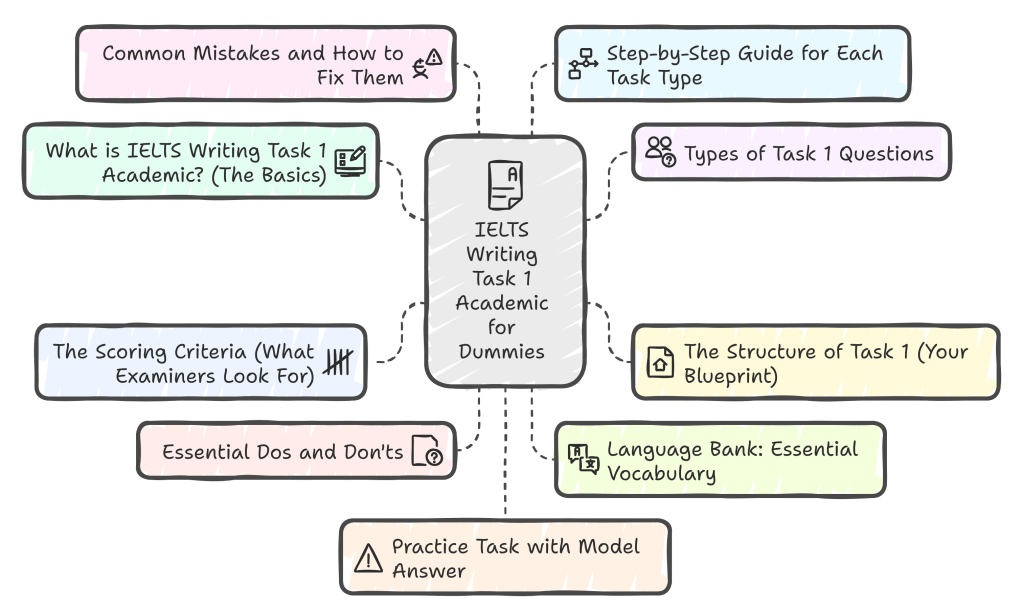
What is IELTS Writing Task 1 Academic? (The Basics)
IELTS Writing Task 1 Academic is the first writing task you’ll complete on test day. You’ll be given a visual representation of information—a graph, chart, table, diagram, or map—and you must describe what you see in your own words.
The mission: Summarize and report the main features of the visual information, make comparisons where relevant, and present the data accurately and clearly. You can watch this YouTube video explainer by IELTS Guide Phil.
Here’s what you need to know:
- Time: 20 minutes (recommended—not strictly enforced)
- Minimum word count: 150 words
- Maximum word count: No limit, but aim for 170-190 words
- Worth: Approximately 33% of your Writing score (Task 2 is worth 67%)
Think of it as being a news reporter describing data to someone who can’t see it. Your job isn’t to give your opinion or explain WHY the data looks this way—just describe WHAT you see objectively.
Key principle: You’re not being tested on your data analysis skills or your knowledge of the topic. You’re being tested on your ability to describe visual information clearly in English.
Types of Task 1 Questions
You’ll encounter one of these seven types on test day:
1. Line Graph
Shows changes over time with one or more lines.
Example: “The graph below shows the number of tourists visiting three different cities between 2010 and 2020.”
What to describe: Trends (increase, decrease, fluctuation), comparisons between lines, starting and ending points, highest/lowest points.
2. Bar Chart
Uses bars to compare data across categories.
Example: “The chart shows the amount of money spent on different types of entertainment in Country X in 2020.”
What to describe: Comparisons between bars, highest and lowest values, significant differences or similarities.
3. Pie Chart
Shows proportions as slices of a circle (often percentages).
Example: “The pie charts compare the percentage of household expenses in two different countries.”
What to describe: Largest and smallest segments, comparisons between charts (if there are multiple), noticeable differences.
4. Table
Presents data in rows and columns.
Example: “The table below shows the population and GDP of five different countries in 2021.”
What to describe: Key patterns, comparisons between rows/columns, highest and lowest values, any trends.
5. Process Diagram
Shows how something is made or how something works (step-by-step).
Example: “The diagram illustrates the process of producing chocolate from cocoa beans.”
What to describe: Each stage in order, how stages connect, any materials or equipment used.
6. Map
Shows changes to a location over time or compares two places.
Example: “The maps show a town as it is now and plans for its future development.”
What to describe: Main changes, new additions, removals, relocations, what stayed the same.
7. Mixed Charts
Combines two types (e.g., bar chart + line graph, two pie charts).
Example: “The bar chart shows cinema attendance by age group, and the line graph shows total annual cinema revenue from 2000 to 2020.”
What to describe: Key features of each chart, any relationships between them, comparisons.
The Structure of Task 1 (Your Blueprint)
Every Task 1 response should follow this four-paragraph structure:
Paragraph 1: Introduction (1-2 sentences)
Purpose: Paraphrase the question to show what the visual information presents.
Formula: The [type of visual] illustrates/compares/shows [main topic] [time period/location if given].
Example: Question: “The graph below shows the number of books sold by a bookstore from January to June 2023.”
Your introduction: “The line graph illustrates book sales figures for a bookstore over a six-month period in 2023.”
Key skill: Paraphrasing. Don’t copy the question word-for-word.
Paragraph 2: Overview (2-3 sentences)
Purpose: Summarize the main trends or features—the “big picture.”
This is THE MOST IMPORTANT paragraph. Examiners specifically look for an overview. Missing it can lower your score significantly.
What to include:
- The most obvious trend or pattern
- The highest/lowest/biggest/smallest values
- Any striking features
What NOT to include:
- Specific numbers or details (save those for body paragraphs)
- Your opinion or explanation of WHY
Example (continuing the bookstore example): “Overall, book sales showed considerable fluctuation throughout the period. Fiction books consistently outsold non-fiction, and sales peaked in March before declining sharply in April.”
Signal phrases for overview:
- “Overall, …”
- “In general, …”
- “It is clear that…”
- “As can be seen from the [graph/chart/diagram], …”
Paragraph 3: Body Paragraph 1 (3-4 sentences)
Purpose: Describe the first main feature in detail with specific data.
What to include:
- Specific numbers, percentages, or figures
- Comparisons
- Starting values
Example: “In January, fiction book sales stood at approximately 2,000 units, while non-fiction sales were significantly lower at 800 units. By March, fiction sales had surged to a peak of 3,500 units, representing a substantial increase of 75%. In contrast, non-fiction sales rose more modestly to 1,200 units.”
Paragraph 4: Body Paragraph 2 (3-4 sentences)
Purpose: Describe the second main feature or continue with remaining details.
What to include:
- Remaining data points
- Further comparisons
- Ending values
Example: “From April onwards, fiction sales experienced a dramatic decline, falling to 1,500 units by June. Non-fiction sales also decreased but remained relatively stable, ending the period at 900 units. The gap between the two categories, which had widened considerably by March, narrowed again by the end of June.”
Total structure:
- Introduction (paraphrase the question)
- Overview (main trends/features)
- Body 1 (detailed description with data)
- Body 2 (detailed description with data)
Word count breakdown:
- Introduction: 20-30 words
- Overview: 30-40 words
- Body 1: 50-60 words
- Body 2: 50-60 words
- Total: 150-190 words
The Scoring Criteria (What Examiners Look For)
Your Task 1 is marked on four criteria, each worth 25% of your Task 1 score:
1. Task Achievement (25%)
What it means: Did you complete the task properly?
Band 7 requirements:
- Covers the requirements of the task
- Presents a clear overview of main trends
- Clearly presents and highlights key features
- Could be more fully extended
Common mistakes that lower scores:
- No overview paragraph
- Including irrelevant information
- Writing less than 150 words
- Copying the question without paraphrasing
- Adding personal opinions or explanations
2. Coherence and Cohesion (25%)
What it means: Is your writing organized logically and easy to follow?
Band 7 requirements:
- Logically organizes information
- Clear progression throughout
- Uses a range of cohesive devices appropriately
- Good paragraphing
Cohesive devices (linking words):
- Contrast: whereas, while, however, in contrast, on the other hand
- Comparison: similarly, likewise, in comparison
- Addition: furthermore, moreover, additionally, also
- Time: initially, subsequently, finally, between X and Y
- Result: therefore, consequently, as a result
Common mistakes:
- Overusing linking words (sounds unnatural)
- Poor paragraphing (one long paragraph)
- Ideas don’t flow logically
3. Lexical Resource (25%)
What it means: Do you use a good range of vocabulary accurately?
Band 7 requirements:
- Uses sufficient range of vocabulary
- Shows awareness of style and collocation
- Occasional errors in word choice
- Rare errors in spelling/word formation
Essential vocabulary categories:
- Verbs of change: increase, decrease, rise, fall, decline, drop, surge, plunge, fluctuate, remain stable
- Adverbs: dramatically, significantly, considerably, slightly, gradually, steadily, sharply
- Prepositions: from…to, between…and, at (for specific points), by (for differences)
- Comparison: higher than, lower than, more than, the most, the least
Common mistakes:
- Repeating the same words (increase, increase, increase…)
- Using informal language (“went up a lot” → “increased significantly”)
- Incorrect word choice (“The data showed obesity” → “The data showed obesity rates”)
4. Grammatical Range and Accuracy (25%)
What it means: Do you use a variety of sentence structures correctly?
Band 7 requirements:
- Uses a variety of complex structures
- Produces frequent error-free sentences
- Good control of grammar and punctuation
- Few errors
Grammar you need:
- Past tense (if data is in the past): “Sales increased in 2020”
- Present perfect (for periods up to now): “Sales have increased since 2020”
- Comparatives: bigger than, more expensive than, the highest
- Passive voice: “The building was constructed in 2015”
- While/whereas clauses: “While X increased, Y decreased”
- Complex sentences: “Despite fluctuating slightly, overall sales remained stable”
Common mistakes:
- Tense errors (“Sales increases in 2020”)
- Subject-verb agreement (“The data show” vs “The data shows”)
- Article errors (“The sales” vs “Sales”)
- Run-on sentences
Essential Dos and Don’ts
DO:
✓ Write at least 150 words—under 150 loses marks significantly
✓ Include an overview paragraph—this is crucial for Band 7+
✓ Paraphrase the question in your introduction
✓ Use specific data—include numbers, percentages, dates
✓ Make comparisons where relevant
✓ Use a variety of vocabulary and grammar structures
✓ Organize clearly into 4 paragraphs
✓ Stay objective—just describe what you see
✓ Check grammar, spelling, and punctuation
✓ Spend exactly 20 minutes (leave 40 minutes for Task 2)
✓ Use formal academic language
✓ Group similar information logically
DON’T:
✗ Don’t write less than 150 words—you’ll lose marks
✗ Don’t spend more than 20 minutes—Task 2 is worth more
✗ Don’t copy the question word-for-word in your introduction
✗ Don’t give your opinion (“I think sales increased because…”)
✗ Don’t explain reasons unless it’s a cause-and-effect diagram
✗ Don’t include information not shown in the visual
✗ Don’t describe every single detail—focus on main features
✗ Don’t use informal language (“loads of,” “went up loads”)
✗ Don’t use bullet points—write in paragraphs
✗ Don’t forget to make comparisons when there are multiple data sets
✗ Don’t write a conclusion with your opinion
✗ Don’t use contractions (don’t, can’t)—use full forms (do not, cannot)
Language Bank: Essential Vocabulary
Describing Increases
| Strength | Verb | Noun | Adverb |
|---|---|---|---|
| Big increase | surge, soar, rocket, jump, shoot up | a surge, a jump | dramatically, sharply, considerably, significantly, substantially |
| Moderate increase | rise, increase, grow, go up, climb | a rise, an increase, growth | moderately, steadily |
| Small increase | edge up, creep up, inch up | a slight increase | slightly, marginally, fractionally |
Example sentences:
- “Sales surged dramatically from 100 to 500 units.”
- “There was a significant rise in temperature.”
- “The population increased steadily throughout the period.”
Describing Decreases
| Strength | Verb | Noun | Adverb |
|---|---|---|---|
| Big decrease | plunge, plummet, slump, drop sharply, decline dramatically, fall steeply | a plunge, a slump, a sharp drop | dramatically, sharply, considerably, significantly, substantially |
| Moderate decrease | fall, decrease, decline, drop, go down | a fall, a decrease, a decline | moderately, steadily |
| Small decrease | dip, edge down | a slight decrease, a dip | slightly, marginally, fractionally |
Example sentences:
- “Profits plummeted dramatically in 2020.”
- “There was a steep decline in sales.”
- “Unemployment decreased slightly over the period.”
Describing Stability/No Change
Verbs: remain stable, remain constant, stay the same, plateau, level off, maintain
Example sentences:
- “Sales remained stable at 200 units.”
- “After increasing rapidly, growth leveled off in 2019.”
- “The figure maintained a constant level throughout.”
Describing Fluctuations
Verbs: fluctuate, vary, oscillate
Nouns: fluctuations, variations
Example sentences:
- “Sales fluctuated considerably between 2010 and 2020.”
- “There were significant fluctuations in temperature.”
- “Prices varied throughout the year.”
Describing Peaks and Troughs
Peak (highest point):
- “Sales peaked at 500 units in March.”
- “The figure reached a peak of 75%.”
- “There was a peak in sales.”
Trough (lowest point):
- “Sales hit a low of 100 units.”
- “The figure reached its lowest point in June.”
- “Sales bottomed out at 50 units.”
Making Comparisons
Comparative structures:
- “X was higher than Y.”
- “Sales in Country A were significantly greater than those in Country B.”
- “The proportion of X exceeded that of Y.”
- “Y was lower than X by 20%.”
- “There was twice as much X as Y.”
- “X accounted for 50%, while Y represented only 10%.”
Superlatives:
- “Country A had the highest sales.”
- “June recorded the lowest figure.”
- “X was the most popular category.”
- “Y was the least significant contributor.”
Starting and Ending Points
Starting:
- “Sales stood at 100 units in January.”
- “The figure was 25% in 2010.”
- “X began at 50%.”
Ending:
- “By the end of the period, sales had reached 200 units.”
- “The figure finished at 40%.”
- “Sales ended the period at 150 units.”
Describing Changes Over Time
Time prepositions:
- Between X and Y: “Between 2010 and 2020, sales doubled.”
- From X to Y: “From January to June, prices fell.”
- Over the period: “Over the 10-year period, there was a steady increase.”
- During X: “During the 1990s, population grew.”
- By Y: “By 2020, sales had reached 500 units.” (shows completion)
- In Y: “In 2020, sales reached 500 units.” (shows specific time)
Example sentence: “Between 2000 and 2010, sales rose dramatically from 100 to 500 units.”
Useful Phrases for Overview
- “Overall, it is clear that…”
- “In general, …”
- “As can be seen from the [chart/graph], …”
- “The most noticeable feature is…”
- “The main trend is…”
- “It is evident that…”
- “What stands out from the [chart/graph] is…”
Common Mistakes and How to Fix Them
Mistake 1: No Overview
The problem: Jumping straight into details without giving a general summary.
Why it’s a problem: The overview is specifically assessed in Task Achievement. Without it, you cannot score above Band 5.
Example of missing overview:
❌ [Introduction] “The graph shows sales from 2010 to 2020.”
❌ [Body immediately] “In 2010, sales were 100 units…”
The fix: Always include an overview paragraph after your introduction.
✓ [Introduction] “The graph shows sales from 2010 to 2020.”
✓ [Overview] “Overall, sales increased significantly throughout the period, with the most dramatic rise occurring between 2015 and 2018.”
✓ [Body] “In 2010, sales stood at 100 units…”
Mistake 2: Writing Less Than 150 Words
The problem: Stopping at 120-140 words because you think you’ve said enough.
Why it’s a problem: Under-length responses are penalized. You lose marks in Task Achievement.
The fix:
- Count your words during practice
- Aim for 170-190 words to be safe
- Add more specific details, comparisons, or data points
- Expand your overview with more observations
How to add words without waffle:
- Include more specific figures
- Make additional comparisons
- Describe intermediate points, not just start and end
- Use more complex sentences
Mistake 3: Copying the Question
The problem: Your introduction is identical to the question.
Question: “The graph below shows the number of books sold by a bookstore from January to June.”
❌ Your introduction: “The graph below shows the number of books sold by a bookstore from January to June.”
Why it’s a problem: Demonstrates lack of paraphrasing ability. Affects Lexical Resource score.
The fix: Paraphrase using synonyms and different sentence structures.
✓ “The line graph illustrates book sales figures for a bookstore over a six-month period.”
Paraphrasing techniques:
- “shows” → “illustrates, depicts, compares, presents, provides information about”
- “number of” → “figure for, quantity of, amount of”
- “January to June” → “a six-month period, the first half of the year”
Mistake 4: Including Your Opinion or Explanation
The problem: Adding analysis or opinions about WHY the data looks this way.
❌ “Sales increased because the company launched a new product.”
❌ “I think this happened because people had more money.”
❌ “This is good for the economy.”
Why it’s a problem: Task 1 requires objective description only. Adding opinions shows you don’t understand the task.
The fix: Just describe WHAT you see, not WHY.
✓ “Sales increased significantly from 100 to 500 units.”
Exception: Cause-and-effect diagrams (e.g., “The diagram shows how global warming affects sea levels”) may require some explanation of process steps.
Mistake 5: Describing Every Single Detail
The problem: Trying to mention every data point.
❌ “In January it was 100, then in February it was 120, then in March it was 125, then in April…”
Why it’s a problem: Task 1 asks you to “summarize and select main features.” Listing every detail shows poor selection.
The fix: Focus on significant changes, trends, and comparisons. Group similar data.
✓ “Sales increased gradually from 100 units in January to 150 units by May, before dropping slightly to 140 units in June.”
What to select:
- Highest and lowest points
- Biggest changes
- Overall trends
- Striking differences or similarities
Mistake 6: Poor Time Management
The problem: Spending 30-35 minutes on Task 1, leaving only 25-30 minutes for Task 2.
Why it’s a problem: Task 2 is worth twice as much (67% vs 33%). Spending too long on Task 1 sacrifices your Task 2 performance.
The fix:
- Set a timer for 20 minutes
- If you reach 20 minutes and haven’t finished, write one final sentence and move on
- Practice timed tasks until 20 minutes becomes automatic
Time breakdown:
- 3 minutes: Analyze the visual, plan your response
- 15 minutes: Write (aim for 12-15 words per minute)
- 2 minutes: Check and correct errors
Mistake 7: Using Informal Language
The problem: Using casual, spoken English instead of formal academic language.
❌ “Sales went up loads.”
❌ “There were tons of people.”
❌ “Stuff got way more expensive.”
❌ “It’s obvious that…”
Why it’s a problem: Task 1 requires formal, academic writing. Informal language lowers your Lexical Resource score.
The fix: Use formal academic vocabulary.
✓ “Sales increased significantly.”
✓ “There was a substantial rise in population.”
✓ “Costs rose considerably.”
✓ “It is clear that…”
Other informal words to avoid:
- a lot of → a significant amount of, considerably
- big → large, substantial, considerable
- small → slight, minor, marginal
- go up → increase, rise, grow
- go down → decrease, decline, fall
- get → become
Mistake 8: Repeating the Same Words
The problem: Using “increase” ten times in your response.
❌ “Sales increased in 2010. Then they increased more in 2015. The increase was big. There was an increase of 50%.”
Why it’s a problem: Shows limited vocabulary range. Reduces Lexical Resource score.
The fix: Use synonyms and vary your language.
✓ “Sales rose in 2010. Subsequently, they grew more substantially in 2015. The surge was significant, representing an increase of 50%.”
Create a synonym list:
- Increase: rise, grow, climb, surge, soar, jump
- Decrease: fall, decline, drop, plunge, slump, dip
- Show: illustrate, depict, present, display, indicate
- Big: significant, substantial, considerable, marked
Mistake 9: Grammar and Tense Errors
The problem: Using wrong tenses or making grammar mistakes.
❌ “In 2020, sales increases dramatically.” (wrong tense)
❌ “Between 2010 to 2020, sales rise.” (wrong preposition + tense)
❌ “The data shows that sales was high.” (subject-verb disagreement)
The fix: Learn and practice correct structures.
✓ “In 2020, sales increased dramatically.” (past simple)
✓ “Between 2010 and 2020, sales rose.” (between…and, past simple)
✓ “The data show that sales were high.” (data is plural, past tense)
Tense guide:
- Past dates (2010, last year): past simple
- Predictions/future (2030, next year): future simple or is predicted to/is projected to
- No date given: often present simple or past
- Period continuing to now: present perfect
Example: “In 2020, sales increased. Since then, they have remained stable. By 2030, they are expected to rise again.”
Mistake 10: No Comparisons
The problem: Describing each data set separately without comparing them.
❌ “Country A had 50% in 2010. Country B had 30% in 2010.”
Why it’s a problem: The task often asks you to “make comparisons where relevant.” Failing to compare loses Task Achievement marks.
The fix: Use comparative structures to directly compare data.
✓ “Country A had 50% in 2010, which was significantly higher than Country B’s figure of 30%.”
✓ “While Country A had 50%, Country B had only 30%.”
✓ “Country A exceeded Country B by 20 percentage points.”
Mistake 11: Incorrect Data
The problem: Misreading the graph and reporting wrong numbers.
❌ Graph shows 250, you write 25.
❌ Graph shows 15%, you write 50%.
Why it’s a problem: Inaccurate data reporting significantly reduces Task Achievement score.
The fix:
- Read scales carefully (check if it’s thousands, millions, percentages, etc.)
- Double-check numbers before writing them
- Use approximations if exact figures are unclear: “approximately 250,” “around 15%,” “roughly 60”
Useful approximation words:
- approximately, roughly, about, around, nearly, just over, just under, close to
Mistake 12: Poor Organization
The problem: One long paragraph with no clear structure.
Why it’s a problem: Poor organization affects Coherence and Cohesion score. Makes your response hard to follow.
The fix: Always use clear paragraphing:
- Paragraph 1: Introduction
- Paragraph 2: Overview
- Paragraph 3: Body 1
- Paragraph 4: Body 2
Leave a line or indent between paragraphs to make structure visually clear.
Step-by-Step Guide for Each Task Type
How to Describe a Line Graph
Step 1: Identify main trends
- Is the line going up, down, or fluctuating?
- Are there multiple lines? How do they compare?
Step 2: Write your overview Focus on the overall trend and most striking features.
Step 3: Select key data
- Starting and ending points
- Highest and lowest points
- Points where lines cross
- Steepest increases/decreases
Step 4: Organize body paragraphs
- Option A: First half of time period (Body 1), second half (Body 2)
- Option B: Line 1 (Body 1), Line 2 (Body 2)
- Option C: Increases/peaks (Body 1), decreases/troughs (Body 2)
Example structure: “The line graph illustrates changes in X from 2010 to 2020. Overall, X increased significantly throughout the period, while Y declined gradually. In 2010, X stood at 100… By 2020, X had reached 300…”
How to Describe a Bar Chart
Step 1: Identify what’s being compared
- Different categories? Different time periods? Different groups?
Step 2: Write your overview
- Which bar is highest? Lowest?
- Any striking patterns or differences?
Step 3: Make comparisons This is crucial for bar charts—compare bars directly.
Step 4: Organize body paragraphs
- Option A: Highest values (Body 1), lowest values (Body 2)
- Option B: First few categories (Body 1), remaining categories (Body 2)
- Option C: One group (Body 1), another group (Body 2)
Useful phrases:
- “X was the highest at…, followed by Y at…”
- “In contrast, Z was the lowest at…”
- “X significantly exceeded Y by…”
How to Describe a Pie Chart
Step 1: Understand what the pie represents
- Usually percentages adding up to 100%
- Sometimes multiple pie charts for comparison
Step 2: Write your overview
- Largest and smallest segments
- Main differences if comparing two pies
Step 3: Group similar data
- Don’t list every single segment
- Group smaller ones: “Other categories accounted for 15%…”
Step 4: Make comparisons If there are two pie charts, compare equivalent segments.
Useful phrases:
- “X accounted for the largest proportion at 45%.”
- “Y represented only 5% of the total.”
- “The majority of… was comprised of…”
- “In contrast to 2010, when X was 30%, by 2020 it had fallen to 15%.”
How to Describe a Table
Step 1: Identify rows and columns
- What’s being compared?
- Are there trends over time or comparisons between categories?
Step 2: Write your overview
- Highest and lowest values
- Most obvious patterns
Step 3: Select key data carefully Tables can be overwhelming with data. Don’t describe every cell.
Step 4: Organize logically
- Option A: By rows (Body 1: rows 1-2, Body 2: rows 3-4)
- Option B: By columns
- Option C: By comparing specific categories
Tip: Look for patterns diagonally, horizontally, and vertically.
How to Describe a Process Diagram
Step 1: Count the stages How many steps are in the process?
Step 2: Write your overview “Overall, the process consists of X stages, beginning with… and ending with…”
Step 3: Describe each stage in order Use sequencing language.
Step 4: Use passive voice (if it’s a manufacturing process) “The beans are harvested, then they are dried…”
Sequencing words:
- First, Initially, To begin with, The first stage involves…
- Next, Subsequently, Following this, After that, Then…
- Finally, Lastly, The final stage involves…
Example: “The process begins when cocoa beans are harvested. Following this, they are dried in the sun for several days. Subsequently, the dried beans are roasted at high temperatures. Finally, the roasted beans are ground into a paste to produce chocolate.”
Tense: Usually present simple (describes a general process).
How to Describe a Map
Step 1: Identify what’s being shown
- Changes over time? (1990 vs 2020)
- Plans for development? (now vs future)
- Comparison of two places?
Step 2: Write your overview
- What are the main changes?
- What’s been added, removed, or relocated?
Step 3: Use directional language
Useful phrases:
- “To the north/south/east/west of…”
- “In the northern/southern part of…”
- “Adjacent to, next to, beside…”
- “Opposite, facing…”
- “The road was extended from X to Y.”
- “A new building was constructed in the southwest corner.”
- “The forest was replaced by residential housing.”
- “The park remained unchanged.”
Step 4: Organize by location
- Body 1: North/West changes
- Body 2: South/East changes
Tense:
- Past changes: past simple (“was built, were demolished”)
- Future plans: future simple or passive (“will be constructed, is planned to be…”)
Practice Task with Model Answer
Practice Question:
The graph below shows the number of overseas visitors to three different areas in a European country between 1987 and 2007.
Summarise the information by selecting and reporting the main features, and make comparisons where relevant.
(Imagine a line graph with three lines: “The coast” starts at 40,000 and rises to 75,000; “The mountains” starts at 20,000, peaks at 30,000, then falls to 25,000; “The lakes” remains stable around 10,000-15,000)
Model Answer (Band 7-8):
The line graph illustrates the number of tourists visiting three distinct regions of a European country over a 20-year period from 1987 to 2007.
Overall, the coast was by far the most popular destination throughout the entire period, experiencing substantial growth. In contrast, the mountains showed considerable fluctuation, while the lakes remained the least visited area with relatively stable visitor numbers.
In 1987, the coast attracted approximately 40,000 visitors, which was twice as many as the mountains at 20,000 and four times more than the lakes at around 10,000. Over the following two decades, coastal tourism grew significantly, reaching 75,000 visitors by 2007, representing an increase of almost 90%.
The mountains experienced more variable patterns. After rising steadily to peak at 30,000 visitors in 1997, the figure subsequently declined to approximately 25,000 by the end of the period. Meanwhile, the lakes saw minimal change, with visitor numbers fluctuating slightly between 10,000 and 15,000 throughout the two decades, finishing at roughly 15,000 in 2007.
(Word count: 178 words)
Why this is a good answer:
✓ Clear four-paragraph structure (intro, overview, 2 body paragraphs)
✓ Strong overview identifying main trends
✓ Specific data with comparisons
✓ Varied vocabulary (attracted, experienced, grew, peaked, declined, fluctuating)
✓ Range of grammatical structures
✓ Appropriate length (178 words)
✓ Formal academic tone
✓ Accurate paraphrasing of the question
Frequently Asked Questions
Q: How many words should I write? A: Minimum 150 words. Aim for 170-190 words. Writing significantly more (220+) wastes time you need for Task 2.
Q: Should I include a conclusion? A: No separate conclusion is needed. Your overview serves this purpose. If you write a conclusion, don’t add new information or opinions—just briefly restate the overview.
Q: What if I don’t understand the topic? A: You don’t need to understand the topic deeply—just describe what you see. If it’s a graph about “quantum computing market share,” you don’t need to know what quantum computing is. Just describe the numbers.
Q: Can I use bullet points? A: No. Task 1 must be written in paragraph form. Bullet points will lower your score.
Q: What tense should I use? A:
- Past dates (2020, last year): past simple
- Future dates (2030, next year): future forms or “is expected to/projected to”
- No specific date: present simple or past simple
- Process diagrams: usually present simple
Q: Should I write about data that’s not in the visual? A: No. Only describe what you can see. Don’t add external knowledge or make up information.
Q: What if I can’t see the exact number on the graph? A: Use approximations: “approximately 250,” “around 15%,” “roughly 60,” “just over 100,” “just under 50.”
Q: Do I need to write the title in my introduction? A: No. Paraphrase the question description, but don’t copy the title word-for-word.
Q: Can I describe data in a different order than it appears? A: Yes. You can organize your description logically—you don’t have to follow the exact visual order. However, for process diagrams, you must follow the sequence.
Q: What if there are two different visuals (e.g., a bar chart AND a table)? A: Describe both, making comparisons between them if relevant. You still need one overview covering both visuals.
Q: How important is handwriting? A: It must be legible. If the examiner can’t read your writing, they can’t score it. Practice writing neatly under time pressure.
Q: Should I use a pen or pencil? A: Check your test center’s requirements. Generally, pen is preferred for Writing, but both are usually accepted.
Q: What if I make a mistake? A: Cross it out neatly with one line and continue. Don’t waste time erasing or using correction fluid (usually not allowed).
Q: Can I write in capital letters? A: It’s better to use normal sentence case (capital at the start of sentences and for proper nouns). Writing entirely in capitals is harder to read and may affect your score.
Q: How can I improve my Task 1 score quickly? A:
- Master the four-paragraph structure
- Always include an overview
- Learn vocabulary for describing trends
- Practice paraphrasing the question
- Do 10-15 practice tasks with feedback
Q: Is Task 1 easier than Task 2? A: Task 1 is more formulaic (follows a pattern), so many students find it easier once they learn the structure. However, Task 2 allows more creativity.
Q: What’s the most common mistake in Task 1? A: Missing the overview. Many students go straight from introduction to details, losing valuable marks.
Your IELTS Writing Task 1 Preparation Plan
Week 1-2: Foundation
- Learn the structure: Introduction, overview, 2 body paragraphs
- Study all 7 task types: Line graph, bar chart, pie chart, table, process, map, mixed
- Build vocabulary: Create flashcards for describing trends
- Analyze model answers: Read Band 7-9 samples, identify structure
- Practice paraphrasing: Take 10 Task 1 questions and rewrite them
Week 3-4: Practice Individual Task Types
- Days 1-2: Practice line graphs (do 3-4)
- Days 3-4: Practice bar charts (do 3-4)
- Days 5-6: Practice pie charts and tables (do 2-3 of each)
- Day 7: Practice process diagrams (do 2)
- Days 8-9: Practice maps (do 2-3)
- Day 10-14: Mixed practice (rotate task types)
- Get feedback on at least 5 of these
Week 5-6: Timed Practice
- Do 10-12 timed tasks (20 minutes each)
- Focus on time management
- Self-assess using the scoring criteria
- Keep a mistake log: What errors do you repeat?
- Memorize vocabulary: Review your flashcards daily
Week 7-8: Refinement
- Do 8-10 more timed tasks
- Focus on your weak task types
- Practice under exam conditions: No dictionary, strict timing
- Review all model answers you’ve studied
- Polish your overview writing: This is crucial
- Final week: Do 1 task per day, but spend time perfecting it
Test Day Checklist
✓ Read the task carefully: What type is it? What’s being compared? ✓ Plan for 3 minutes: Identify trends, decide on organization ✓ Write for 15 minutes: Follow your four-paragraph structure ✓ Check for 2 minutes: Grammar, spelling, word count ✓ Move to Task 2 after 20 minutes: Even if not perfect
Recommended Resources
Official Materials
- Cambridge IELTS books (1-18): Authentic Task 1 questions with sample answers
- IELTS.org: Free sample tasks and band descriptors
- IELTS Progress Check: Official scored practice (paid)
Websites for Practice
- IELTS Liz (ieltsliz.com): Free lessons, model answers, vocabulary lists
- IELTS Advantage (ieltsadvantage.com): Task 1 strategies and samples
- IELTS Simon (ielts-simon.com): Model answers with explanations
- IELTS Buddy (ieltsbuddy.com): Practice tasks with sample responses
YouTube Channels
- IELTS Liz: Comprehensive Task 1 video lessons
- E2 IELTS: Strategy videos and method demonstrations
- IELTS Advantage: Task-specific tutorials
Vocabulary Building
- Create your own vocabulary notebook with:
- Verbs of change (increase, decrease, fluctuate, etc.)
- Adverbs (dramatically, steadily, slightly, etc.)
- Comparison phrases
- Time expressions
- Quizlet: Search for “IELTS Task 1 vocabulary” sets
- Memrise: IELTS Writing courses
Getting Feedback
- IELTS teachers: Hire a tutor for at least 5 feedback sessions
- Writing correction services: Websites like WriteToScore, IELTS Advantage Correction Service
- Language exchange partners: Find someone preparing for IELTS
- Online forums: Reddit’s r/IELTS, IELTS-Blog.com forums
Final Thoughts
IELTS Writing Task 1 Academic is highly formulaic. Unlike Task 2, which requires original ideas and arguments, Task 1 follows a predictable pattern. This is good news—it means you can master it through practice and memorization of structures.
Remember these key principles:
- Structure is everything: Introduction → Overview → Body 1 → Body 2
- The overview is crucial: Never skip it
- Accuracy matters: Report data correctly
- Comparisons are essential: Don’t just list—compare
- Time management is critical: Stick to 20 minutes
- Practice makes perfect: Do at least 15-20 practice tasks before the exam
Most importantly: Task 1 is worth only 33% of your Writing score. Don’t sacrifice Task 2 (worth 67%) by spending too long on Task 1. Get comfortable writing a solid Task 1 response in 20 minutes, then move on.
Mindset shift: You don’t need a perfect Task 1. A Band 7 Task 1 is very achievable with the right structure, adequate vocabulary, and accurate data reporting. Focus on consistency and avoid major errors rather than trying to write a masterpiece.
Final encouragement: Thousands of students master IELTS Task 1 every year. The formula works. Learn the structure, build your vocabulary, practice regularly with feedback, and you’ll see improvement. Trust the process, stay consistent, and you’ll achieve your target score.
You’ve got this! Now go practice.
#IELTSGuidePhil #IELTSWriting #IELTSTask1 #IELTS #IELTSPreparation #IELTSTips #IELTSAcademic #LearnEnglish #IELTSExam #WritingSkills #IELTSPractice #StudyAbroad #IELTSBandScore #EnglishWriting #IELTSTest #AcademicWriting #IELTSHelp #IELTSStrategy #GraphDescription #DataDescription #IELTSSuccess #EnglishLearning #IELTSGuide #TestPrep #IELTSStudy #EnglishTest
 IELTS Guide Phil
Leave a comment