
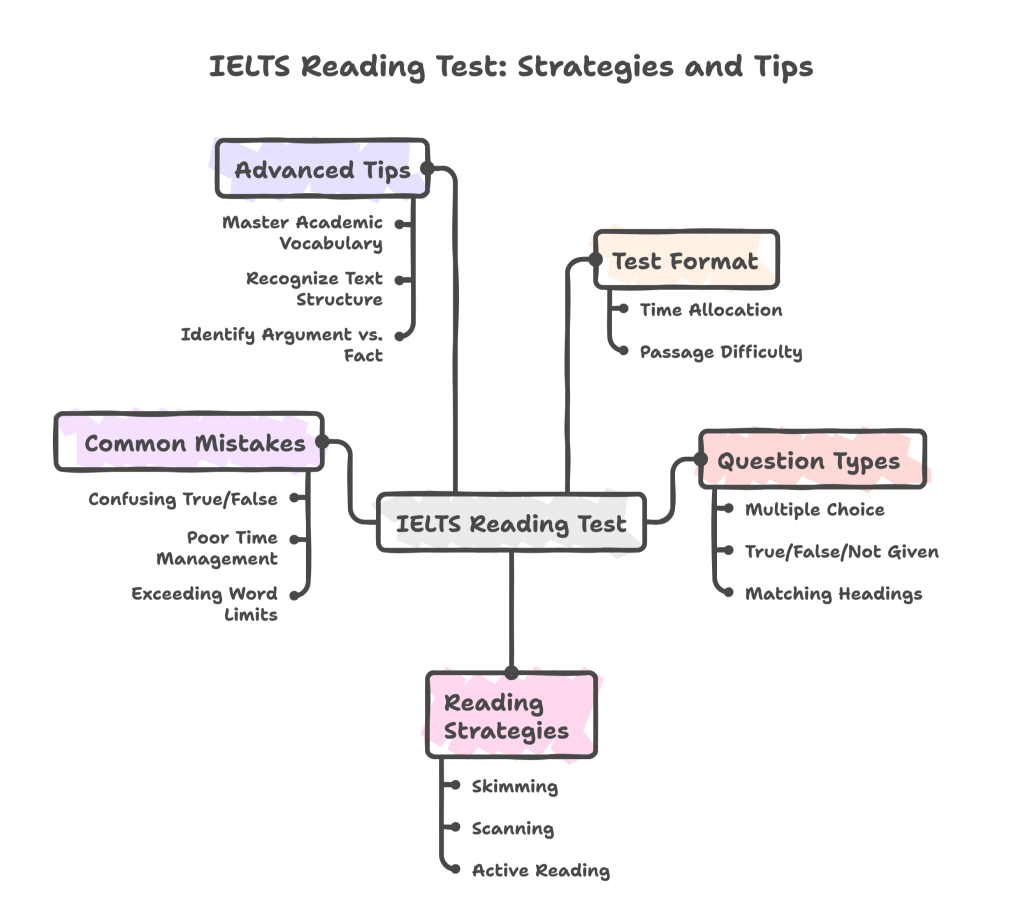
What is IELTS Reading? (The Basics)
The IELTS Reading test is a 60-minute marathon that tests your ability to understand, analyze, and find specific information in written English. You’ll read three long passages and answer 40 questions based on what you’ve read. You can watch this YouTube video explainer by IELTS Guide Phil.
Here’s what makes it challenging: you get exactly 60 minutes for everything—reading three lengthy texts, answering 40 questions, and transferring your answers to the answer sheet. There’s no extra time for transfers like in Listening. Time management is absolutely critical.
Think of it as a treasure hunt through dense texts. You’re searching for specific information, understanding main ideas, recognizing writer’s opinions, and following complex arguments—all while racing against the clock.
Important distinction: The Reading test is DIFFERENT for Academic and General Training test-takers.
Academic vs. General Training Reading
IELTS Academic Reading
Who takes it: Students applying to universities or professional registration
Passage sources:
- Books
- Academic journals
- Magazines
- Newspapers
Content type:
- Topics of general academic interest
- Appropriate for undergraduate or postgraduate students
- Does NOT require specialist knowledge (but uses academic language)
Example topics:
- Climate change and environmental policies
- Archaeological discoveries
- The history of technology
- Psychological research findings
- Animal behavior studies
- Urban planning developments
Structure: Three long passages of increasing difficulty
IELTS General Training Reading
Who takes it: People migrating to English-speaking countries or applying for work/training programs
Passage sources:
- Advertisements
- Official documents
- Books
- Magazines
- Newspapers
- Company handbooks
- Guidelines
Content type:
- Everyday practical materials
- Work-related texts
- General interest reading
Structure:
- Section 1: Two or three short factual texts (e.g., advertisements, notices, timetables, information leaflets)
- Section 2: Two short work-related texts (e.g., job descriptions, contracts, staff training materials)
- Section 3: One long, complex text on a general topic (similar to Academic but more accessible)
Example topics:
- Hotel booking policies
- Safety instructions at a workplace
- Community event announcements
- An article about healthy eating
- Company employee benefits guide
This guide focuses primarily on Academic Reading, but most strategies apply to both.
The Test Format
Time Allocation
- Total time: 60 minutes (no extra transfer time)
- Recommended per passage: 20 minutes
- Number of passages: 3
- Total questions: 40
- Word count per passage: 700-900 words
The Three Passages
Passage 1: Easiest
- More accessible language
- Clearer structure
- Straightforward ideas
- Target time: 15-18 minutes
Passage 2: Moderate
- More complex vocabulary
- Longer sentences
- More abstract ideas
- Target time: 18-20 minutes
Passage 3: Hardest
- Advanced academic vocabulary
- Complex sentence structures
- Abstract concepts and arguments
- Target time: 20-22 minutes
Reality check: You might not follow this timing perfectly, and that’s okay. Some people prefer to spend less time on Passage 1 to save time for Passage 3.
The Scoring System
- 40 questions = 40 marks
- Each correct answer = 1 mark
- Your raw score converts to a band score (1-9)
Approximate conversion (Academic):
- 39-40 correct = Band 9
- 37-38 correct = Band 8.5
- 35-36 correct = Band 8
- 33-34 correct = Band 7.5
- 30-32 correct = Band 7
- 27-29 correct = Band 6.5
- 23-26 correct = Band 6
- 19-22 correct = Band 5.5
- 15-18 correct = Band 5
Note: General Training has a slightly stricter conversion. Band 6.5 typically requires 30 correct answers instead of 27.
Key point: No penalty for wrong answers—always guess if you run out of time!
The 14 Question Types (Yes, Really!)
IELTS Reading has 14 different question types. Let’s break them down:
1. Multiple Choice
Choose the correct answer from options A, B, C, or D.
Example: According to the passage, the main reason for urban migration is: A) Better job opportunities B) Educational facilities C) Healthcare access D) Climate preferences
2. Identifying Information (True/False/Not Given)
Decide if statements agree with information in the passage.
True: The statement matches the information False: The statement contradicts the information Not Given: The information is not mentioned
Example: Statement: “The research was conducted over a five-year period.”
- If the passage says “The study lasted five years” → True
- If the passage says “The study lasted three years” → False
- If the passage doesn’t mention the duration → Not Given
Critical difference: This is about FACTS, not opinions.
3. Identifying Writer’s Views/Claims (Yes/No/Not Given)
Similar to True/False/Not Given, but focuses on the writer’s OPINION.
Yes: The statement agrees with the writer’s views No: The statement contradicts the writer’s views Not Given: It’s impossible to know what the writer thinks about this
Example: Statement: “Online education is superior to traditional classroom learning.”
- If the writer argues this → Yes
- If the writer argues the opposite → No
- If the writer doesn’t express an opinion on this → Not Given
4. Matching Information
Match statements or information to the correct paragraph.
Example: Which paragraph contains the following information?
- A description of the research methodology: Paragraph C
- The historical background of the issue: Paragraph A
5. Matching Headings
Choose the correct heading for each paragraph or section from a list.
Example: List of headings: i. Economic impacts
ii. Environmental concerns
iii. Future predictions
iv. Historical development
Paragraph A discusses how the issue began in the 1950s → Heading: iv
6. Matching Features
Match items (names, dates, events) to features or characteristics.
Example: Match each researcher to their finding:
- Dr. Smith
- Professor Lee
- Dr. Johnson
A) Discovered a new species
B) Developed a new theory
C) Conducted field research
7. Matching Sentence Endings
Complete sentences by choosing the correct ending from a list.
Example: The primary cause of the problem…
A) …was identified in 2010.
B) …remains unclear.
C) …has been resolved.
8. Sentence Completion
Complete sentences using words from the passage (with a word limit).
Example: The research indicates that _____ is the most significant factor. (NO MORE THAN TWO WORDS)
Answer from passage: “Climate change is the most significant factor.”
Your answer: climate change
9. Summary/Note/Table/Flow-chart Completion
Fill in gaps in a summary, notes, table, or flow-chart using words from the passage or from a word bank.
Example: Complete the summary below using words from the passage. (NO MORE THAN TWO WORDS)
The study examined the effects of _____ on marine life.
10. Diagram Label Completion
Label a diagram using words from the passage.
Example: Label the parts of the water filtration system described in the passage.
11. Short Answer Questions
Answer questions using words from the passage (with a word limit).
Example: What method did the researchers use to collect data? (NO MORE THAN THREE WORDS)
Answer: interviews and surveys
12. Multiple Matching (List Selection)
Choose multiple correct answers from a longer list (often 5-7 options, choose 2-3).
Example: Which TWO of the following are mentioned as benefits of the new policy?
A) Reduced costs
B) Improved efficiency
C) Better quality
D) Faster delivery
E) Increased safety
13. Classification
Classify information according to categories (often using letters A, B, C).
Example: Classify the following as:
A) Advantages
B) Disadvantages
C) Not mentioned
- Increased productivity: A
- Higher costs: B
14. Table Completion
Complete a table using information from the passage.
Example:
| Year | Event | Location |
|---|---|---|
| 1990 | First conference | _____ |
| 1995 | _____ | Geneva |
Essential Reading Strategies
Before You Start Reading
1. Skim the Passage (2 minutes)
Don’t read every word. Get the general idea:
- Read the title and any subheadings
- Look at any diagrams, graphs, or illustrations
- Read the first sentence of each paragraph (topic sentences)
- Read the conclusion
This gives you a mental map of what the passage is about.
2. Read the Questions First (2-3 minutes)
Before diving into detailed reading, understand what you’re looking for:
- Read ALL questions for that passage
- Underline keywords in the questions
- Note what type of information you need (dates, names, reasons, etc.)
Why this matters: You’ll recognize the answers when you see them during detailed reading.
3. Identify Question Types Different question types require different strategies. Note which types you’re dealing with.
During Reading
1. Use the Scanning Technique
For specific information (names, dates, numbers):
- Move your eyes quickly across the text
- Look for the specific word or phrase
- Ignore everything else
Example: Looking for a date? Scan for numbers. Looking for a person’s name? Scan for capital letters.
2. Use the Skimming Technique
For main ideas and general understanding:
- Read quickly without focusing on every word
- Focus on topic sentences (usually the first sentence of paragraphs)
- Notice transition words (however, therefore, moreover)
3. Read Actively
- Underline keywords as you read
- Make brief notes in margins (if allowed on question paper)
- Circle names, dates, and key terms
4. Follow the Order
Questions usually (but not always) follow the order of information in the passage. If you’re answering question 5, the answer to question 6 is likely to come AFTER it in the text.
Exception: Matching headings and some matching questions don’t follow order.
5. Use Context Clues
Don’t know a word? Use context:
- Look at surrounding sentences
- Look for synonyms or definitions nearby
- Make an educated guess based on the topic
Example: “The scientist was meticulous in her research, carefully checking every detail.” Even if you don’t know “meticulous,” the context tells you it means careful/thorough.
Time Management Strategies
The 20-Minute Rule
Aim for 20 minutes per passage:
- 2-3 minutes: Skim passage and read questions
- 12-15 minutes: Answer questions
- 2-3 minutes: Check answers and transfer to answer sheet
What to Do When You’re Running Out of Time:
- Skip to easier question types (multiple choice, matching)
- Guess answers for difficult questions
- NEVER leave answers blank
- Focus on questions worth the same marks—don’t spend 5 minutes on one question when you could answer three easier ones
Priority System:
- Answer questions you’re confident about first
- Make educated guesses on uncertain questions
- Random guess on questions you have no idea about
Specific Strategies by Question Type
True/False/Not Given & Yes/No/Not Given:
- Read the statement carefully
- Find the relevant section in the passage
- Compare the statement to the passage EXACTLY
- Don’t use your own knowledge—only use what the passage says
- If you can’t find the information after 1-2 minutes, mark “Not Given”
Common trap: The statement uses similar words to the passage but changes the meaning. Read carefully!
Example: Passage: “Most scientists believe that climate change is accelerating.” Statement: “All scientists agree that climate change is accelerating.” Answer: False (Most ≠ All)
Matching Headings:
- Do this question type first—it helps you understand the passage structure
- Cross off headings as you use them (if each heading is used once)
- Focus on the main idea of each paragraph, not details
- Watch for “distractor” headings that use words from the paragraph but don’t capture the main idea
Tip: Read the first and last sentences of each paragraph—these often contain the main idea.
Multiple Choice:
- Eliminate obviously wrong answers first
- Be careful of “extreme” words (always, never, all, none)—these are often incorrect
- The correct answer is usually a paraphrase, not an exact quote
- Watch for distractors that use words from the passage but don’t answer the question
Sentence/Summary Completion:
- Check the word limit (NO MORE THAN TWO WORDS means 1 or 2, not 3!)
- Use EXACTLY the words from the passage—don’t change them
- Check grammar—your answer should fit grammatically into the sentence
- Check spelling—must be perfect
Matching Information to Paragraphs:
- Underline keywords in the statement
- Scan paragraphs for those keywords or synonyms
- One paragraph may be used more than once (check instructions)
- Some paragraphs may not be used at all
Essential Dos and Don’ts
DO:
✓ Practice time management—take full practice tests with a timer
✓ Read the instructions carefully—each question type has specific requirements
✓ Answer all 40 questions—no penalty for wrong answers, so guess if needed
✓ Transfer answers as you go or leave 3-5 minutes at the end for transfer
✓ Use exactly the words from the passage for completion questions
✓ Check spelling—misspelled words are marked wrong
✓ Stick to word limits—if it says “NO MORE THAN TWO WORDS,” don’t write three
✓ Use process of elimination for multiple choice
✓ Read the whole sentence before and after the gap in completion questions ✓ Stay calm if a passage is difficult—move to the next one and come back if time permits
✓ Develop your vocabulary—the more words you know, the easier reading becomes
✓ Practice different text types—news articles, academic journals, magazines
DON’T:
✗ Don’t read every word in detail on first read—you’ll run out of time
✗ Don’t rely on your general knowledge—answer based only on the passage
✗ Don’t leave answers blank—always guess if you’re unsure
✗ Don’t spend too long on one question—move on and come back later
✗ Don’t ignore unfamiliar words—use context to understand meaning
✗ Don’t write more than the word limit—you’ll get zero marks
✗ Don’t change words from the passage when completing sentences
✗ Don’t panic if the topic is unfamiliar—all information needed is in the text ✗ Don’t spend 25 minutes on one passage—you’ll sacrifice the others
✗ Don’t forget to check grammar when completing sentences
✗ Don’t copy phrases longer than needed from the passage
✗ Don’t assume “Not Given” means the information wasn’t there—you might have missed it
Common Mistakes and How to Fix Them
Mistake 1: Confusing True/False/Not Given
The problem: Students struggle to distinguish between “False” and “Not Given.”
Why it happens:
- False: Information contradicts the passage
- Not Given: Information is not mentioned at all
Example: Passage: “The experiment was conducted in 2015.”
Statement 1: “The experiment was conducted in 2010.” → False (contradicts) Statement 2: “The experiment was expensive.” → Not Given (no information about cost)
The fix:
- False: You find information that directly contradicts the statement
- Not Given: After searching the relevant section, you find NO information about this topic
Practice tip: Do 10 True/False/Not Given exercises focusing only on distinguishing False from Not Given.
Mistake 2: Poor Time Management
The problem: Spending 35 minutes on Passage 1 and rushing through Passages 2 and 3.
Why it happens: Perfectionism, getting stuck on difficult questions, reading too carefully.
The fix:
- Set strict time limits: 20 minutes per passage (or 17/20/23 if you prefer)
- Use a watch or timer
- If you’re stuck on a question after 1-2 minutes, guess and move on
- Mark difficult questions and return if time permits
Practice tip: Take timed practice tests regularly. Train yourself to move on when time is up.
Mistake 3: Exceeding Word Limits
The problem: Question says “NO MORE THAN TWO WORDS” and you write “extremely difficult task” (3 words).
Why it happens: Not counting carefully, including unnecessary words like “a,” “the,” “very.”
The fix:
- Count every word, including articles and prepositions
- Use only essential words: “difficult task” (2 words) ✓
- Check if articles are necessary for meaning
- If the passage says “the difficult task” and you need two words, write “difficult task” (drop “the”)
Practice tip: After completing practice questions, specifically review word count compliance.
Mistake 4: Paraphrasing Instead of Using Exact Words
The problem: In completion questions, you write your own words instead of copying from the passage.
Why it happens: Trying to sound more sophisticated or misunderstanding instructions.
Example: Passage: “The research indicated significant climate variations.” Question: The research showed _____ climate changes. (NO MORE THAN TWO WORDS)
Wrong answer: major (paraphrased)
Correct answer: significant variations (exact words from passage)
The fix: For completion questions, copy EXACTLY from the passage. Don’t paraphrase.
Mistake 5: Using Outside Knowledge
The problem: Answering based on what you know instead of what the passage says.
Example: Passage: “Some researchers believe social media has negative effects on mental health.”
Question: Does the writer think social media harms mental health? Yes/No/Not Given
Answer based on passage: Not Given (the writer reports what researchers think, but doesn’t state their own opinion)
Wrong answer: Yes (based on your own belief)
The fix: Base every answer ONLY on information in the passage. Ignore your personal knowledge.
Mistake 6: Misreading the Question
The problem: The question asks for “disadvantages” but you provide “advantages.”
Why it happens: Reading too quickly under time pressure.
The fix:
- Underline the question keyword (advantages, disadvantages, causes, effects)
- Re-read the question before selecting your answer
- Double-check: “Does this answer what was asked?”
Mistake 7: Falling for “Word Matching” Traps
The problem: Choosing an answer because it contains the same words as the passage, not because it’s correct.
Example: Passage: “Despite initial concerns about safety, the new technology proved reliable.”
Question: What was the main concern about the new technology? A) Cost B) Safety C) Reliability
Wrong reasoning: “B has ‘safety’ which appears in the passage!” → B
Correct answer: B (but for the right reason—the passage says safety was a concern)
Be careful: Sometimes the correct answer uses SYNONYMS, not exact words.
Another example: Passage: “The research was conducted rapidly.”
Question: How was the research done? A) Carefully B) Quickly ← Correct (synonym for “rapidly”) C) Rapidly ← This doesn’t appear as an option
The fix: Focus on meaning, not just word matching. Look for paraphrases and synonyms.
Mistake 8: Ignoring Keywords in Questions
The problem: Missing important qualifiers like “main reason,” “initial,” “currently.”
Example: Question: What is the MAIN reason for climate change? The passage lists five reasons, but only one is described as “primary” or “most significant.”
The fix:
- Underline qualifiers: main, initial, current, primary, final, most important
- These words change what you’re looking for
Mistake 9: Not Checking Grammar in Completion Questions
The problem: Your answer doesn’t fit grammatically into the sentence.
Example: Sentence: The researchers were interested in _____.
Your answer: “study climate”
Problem: “were interested in study climate” is grammatically wrong
Correct answer: “studying climate” or “climate studies”
The fix: Read the complete sentence with your answer inserted. Does it sound right?
Mistake 10: Leaving Answers Blank
The problem: Running out of time and leaving 5 questions unanswered.
Why it’s a mistake: No penalty for wrong answers! A guess has a chance of being correct.
The fix:
- With 5 minutes left, if you have unanswered questions, start guessing
- For multiple choice, choose “C” if you have no idea (statistically no better, but having a rule saves time)
- For True/False/Not Given, guess “Not Given” if you truly can’t find information
- For completion questions, make your best guess based on grammar and context
Advanced Tips for High Scores (Band 7+)
1. Master Academic Vocabulary
High-scoring test-takers have strong vocabulary. Focus on:
- Academic Word List (AWL): 570 word families common in academic texts
- Synonyms: Learn multiple ways to express the same idea
- Context guessing: Practice inferring meaning from context
Example word families to know:
- analyze, analysis, analytical, analytically
- significant, significance, significantly
- evident, evidence, evidently
2. Recognize Text Structure
Academic texts follow patterns:
- Introduction: Presents topic and thesis
- Body paragraphs: Each has one main idea (usually in the first sentence)
- Conclusion: Summarizes main points
Use this structure to your advantage when matching headings or finding main ideas.
3. Identify Argument vs. Fact
Writers present:
- Facts: Objective information
- Opinions: The writer’s or others’ views
- Arguments: Claims supported by evidence
Distinguishing these is crucial for Yes/No/Not Given questions.
Signal words for opinions:
- “I believe…”
- “It seems…”
- “arguably…”
- “Some experts claim…”
4. Spot Synonyms and Paraphrasing Patterns
IELTS loves paraphrasing. The question and answer use different words for the same concept.
Common paraphrase patterns:
- Passage: “increased rapidly” → Question: “rose quickly”
- Passage: “detrimental effects” → Question: “harmful impacts”
- Passage: “children” → Question: “young people”
Practice tip: Create a list of synonyms for common academic words.
5. Use the “Elimination + Evidence” Strategy
For difficult True/False/Not Given questions:
- Find the relevant section
- Eliminate one option (usually easiest to eliminate)
- Find evidence for the remaining two
- Choose the one with clear textual support
6. Develop Speed Reading
The faster you read (with comprehension), the more time for questions.
Techniques:
- Chunking: Read groups of words together, not word-by-word
- Reduce subvocalization: Don’t “speak” words in your head
- Use a pointer: Guide your eyes with a finger or pen for faster scanning
Practice tip: Read English articles daily. Time yourself. Gradually increase speed while maintaining comprehension.
7. Practice Active Reading
Don’t just read passively. Engage with the text:
- Predict what comes next
- Question the author’s claims
- Summarize each paragraph mentally
- Connect ideas between paragraphs
This deeper engagement improves comprehension and retention.
Frequently Asked Questions
Q: Should I read the passage first or the questions first? A: Read the questions first (or at least skim them). This way, you know what to look for when reading the passage. However, some people prefer reading the passage first. Try both methods in practice tests and see what works for you.
Q: What if I don’t understand the topic?
A: Don’t panic! You don’t need specialist knowledge. All information needed to answer questions is in the passage. Focus on finding the answers, not understanding every detail.
Q: Can I write on the question paper? A: Yes! Underline, circle, make notes. The question paper is yours. However, only answers on the answer sheet are marked.
Q: How important is spelling? A: Extremely important. Misspelled words are marked wrong, even if the meaning is clear. Common misspellings that lose marks: “goverment” (government), “enviroment” (environment), “occured” (occurred).
Q: Are answers case-sensitive? A: Generally no. You can write “Government” or “government”—both are acceptable. However, proper nouns should be capitalized (Paris, not paris).
Q: What if the answer is a hyphenated word? Does it count as one or two words? A: Hyphenated words count as ONE word (e.g., “well-being” = 1 word).
Q: Can I write numbers as digits or words? A: Both are usually acceptable. “5” and “five” are both correct. However, be consistent with the passage. If the passage uses digits, use digits.
Q: What happens if I write “TRUE” instead of “YES” (or vice versa)? A: You’ll lose the mark. True/False/Not Given is different from Yes/No/Not Given. Check which one the question asks for.
Q: How can I improve my reading speed? A:
- Read English materials daily (news articles, magazines, academic texts)
- Practice skimming and scanning techniques
- Expand your vocabulary to reduce time spent on unfamiliar words
- Take timed practice tests regularly
Q: Should I read all three passages before answering questions? A: No! Work on one passage at a time. Read it, answer its questions, then move to the next passage.
Q: What if I finish early? A: Use remaining time to:
- Check answers you weren’t sure about
- Ensure all answers are transferred correctly
- Double-check spelling and word limits
- Review any questions you skipped
However, finishing early is rare—most people use the full 60 minutes.
Q: Is the General Training Reading easier than Academic? A: Section 1 and 2 of General Training are easier than Academic passages. However, Section 3 is similar in difficulty. The scoring is also stricter for General Training.
Q: How many questions can I get wrong and still score Band 7? A: For Academic Reading, you can typically get 8-10 questions wrong and still achieve Band 7 (30-32 correct out of 40). For General Training, you need about 34 correct for Band 7.
Q: Should I guess “Not Given” if I can’t find the answer? A: Only if you’ve genuinely searched the relevant section and found no information. Don’t default to “Not Given” without checking. However, if you’re running out of time, it’s better to guess than leave it blank.
Q: Can I use a highlighter during the test? A: Check with your test center. Generally, pencils are provided, but highlighters may not be allowed. Underlining with a pencil works just as well.
Q: How can I practice if I don’t have Cambridge IELTS books? A:
- Read The Guardian, BBC News, or National Geographic online
- Read academic articles on topics like science, environment, technology
- Practice with free materials on IELTS.org
- Use library resources
However, official Cambridge IELTS books are the best practice materials.
Your IELTS Reading Preparation Plan
Week 1-2: Assessment and Foundation
- Take a diagnostic test: Identify your current band score
- Analyze mistakes: Which question types are hardest for you?
- Learn question types: Understand all 14 types
- Build vocabulary: Start learning Academic Word List
- Practice basic skills: Skimming and scanning
Week 3-4: Strategy Development
- Learn strategies for each question type
- Practice time management: 20 minutes per passage
- Focus on weak question types
- Daily reading: 30 minutes of academic texts
- Take 2 practice passages per week
Week 5-6: Intensive Practice
- Take 3 full practice tests (all 3 passages, 60 minutes)
- Review every mistake thoroughly
- Practice speed reading techniques
- Expand vocabulary: Learn 20-30 new words per week
- Focus on True/False/Not Given (often the trickiest)
Week 7-8: Fine-Tuning and Simulation
- Take tests under strict exam conditions
- Practice with different topic areas (science, history, social issues)
- Review all strategies
- Take 4-5 full tests in final 2 weeks
- Rest well before test day
Test Day Strategy
- Bring: ID, pencils, eraser, watch (analog watches usually allowed)
- Stay calm: Take deep breaths if you feel anxious
- Read instructions carefully: Check word limits for each question
- Manage time strictly: Move on after 20 minutes per passage
- Trust your preparation: You’ve practiced for this!
Recommended Resources
Official Materials (Essential)
- Cambridge IELTS books (1-18): Official past papers
- IELTS.org: Free practice materials and sample tests
- IELTS Progress Check: Official scored practice tests (paid)
Websites for Practice Reading
- The Guardian (www.theguardian.com): High-quality journalism, academic style
- BBC News (www.bbc.com/news): Clear, well-written articles
- National Geographic (www.nationalgeographic.com): Science and nature topics
- Scientific American (www.scientificamerican.com): Scientific articles for general readers
- The Economist (www.economist.com): Business, politics, current affairs
Vocabulary Building
- Academic Word List (AWL): Search online for free lists
- Quizlet: Flashcard app with IELTS vocabulary sets
- Memrise: Spaced repetition for vocabulary learning
- Anki: Customizable flashcard system
YouTube Channels
- IELTS Liz: Excellent strategy videos
- E2 IELTS: Comprehensive test strategies
- IELTS Advantage: Tips and techniques
Books
- “Collins English for IELTS – Reading”
- “Barron’s IELTS”
- “Target Band 7” by Simone Braverman
Apps
- IELTS Prep App (British Council)
- IELTS Reading (various developers)
- BBC Learning English: Free daily lessons
Final Thoughts
IELTS Reading is challenging, but it’s also completely conquerable with the right approach. Unlike Speaking (which requires years of fluency development), Reading skills can improve dramatically with focused practice and strategy.
Remember:
- Time management is crucial: Practice with a timer until pacing becomes automatic
- Strategy matters: Knowing how to approach each question type saves time and improves accuracy
- Vocabulary is power: The more words you know, the easier and faster reading becomes
- Practice is non-negotiable: Do at least 10-15 full practice tests before your exam
- Stay calm: Panic wastes time and clouds judgment
You don’t need a perfect score. Band 7 means getting 30-32 out of 40 correct. That’s 8-10 questions wrong—and you still get an excellent score!
Final mindset shift: You’re not reading for pleasure or to learn everything in the passage. You’re treasure hunting—finding specific information to answer questions. Stay focused on that goal, and you’ll succeed.
You’ve got this! Now get out there and practice.
#IELTSGuidePhil #IELTSReading #IELTS #IELTSPreparation #IELTSTips #LearnEnglish #IELTSTest #ReadingSkills #IELTSPractice #IELTSAcademic #IELTSGeneralTraining #TestPrep #EnglishProficiency #IELTSGuide #IELTSHelp #StudyOverseas #IELTSSuccess #EnglishForStudy #IELTSPractice #IELTSStrategy #LanguageTest
 IELTS Guide Phil
Leave a comment