
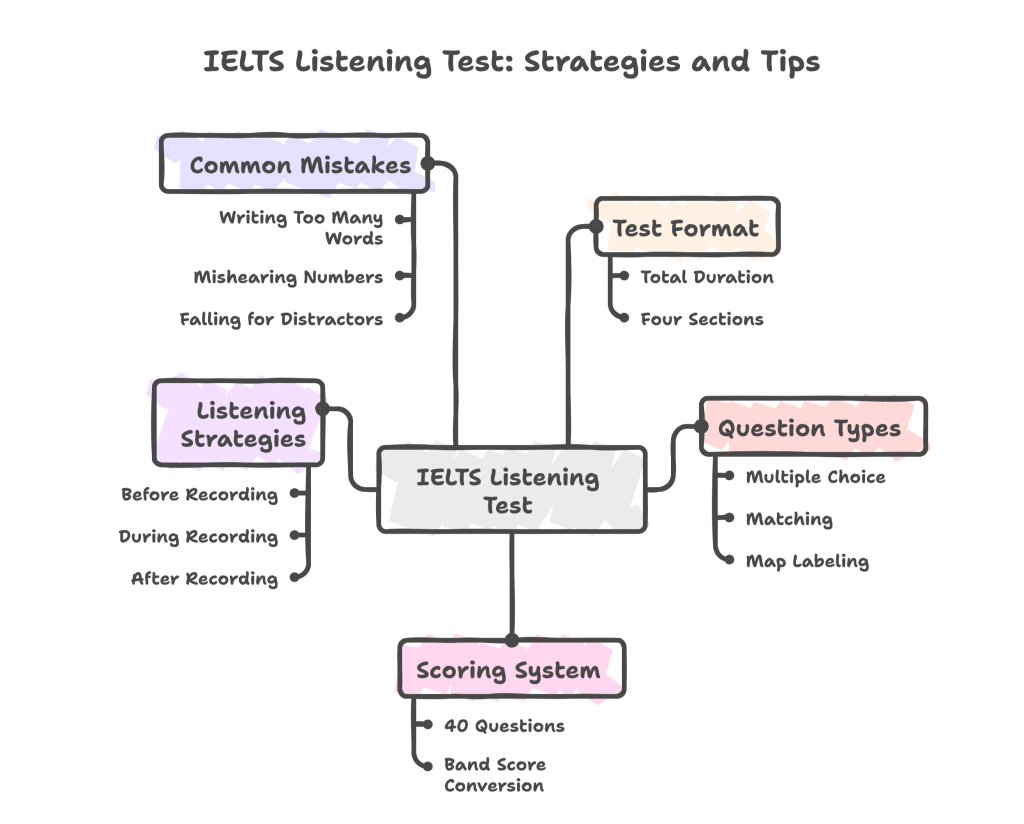
What is IELTS Listening? (The Basics)
The IELTS Listening test is the first section you’ll tackle on exam day. It lasts 30 minutes (plus 10 extra minutes to transfer your answers) and is identical for both Academic and General Training test-takers. You’ll listen to four recordings of native English speakers and answer 40 questions based on what you hear. You can watch this YouTube video explainer by IELTS Guide Phil.
Here’s the catch: you only hear each recording once. No rewind button. No second chances. This makes it one of the most challenging sections for many test-takers, but with the right strategies, it’s also one of the most predictable and scoreable sections.
Think of it like this: you’re eavesdropping on four different conversations and lectures, taking notes as you go, and proving you understood what was said.
The Test Format (What Actually Happens)
Total Duration
- 30 minutes: Listening to recordings and answering questions
- 10 minutes: Transferring your answers to the answer sheet (paper test only)
- Total: 40 minutes
The Four Sections
Each section gets progressively harder and represents different real-life situations:
Section 1: Social Conversation (2 people)
- Difficulty: Easiest
- Context: Everyday social situation
- Format: Dialogue between two people
- Example: Someone calling to book a hotel room, inquire about a gym membership, or report a lost item
- Typical questions: Forms to fill out, capturing names, dates, addresses, phone numbers
Section 2: Social Monologue (1 person)
- Difficulty: Easy to Moderate
- Context: Everyday social context
- Format: One person speaking
- Example: A tour guide describing a museum, a radio announcement about local facilities, or someone explaining how to use a library
- Typical questions: Multiple choice, map labeling, matching
Section 3: Educational Conversation (2-4 people)
- Difficulty: Moderate to Challenging
- Context: Educational or training setting
- Format: Conversation between students, or between students and a tutor
- Example: Students discussing a research project, planning a presentation, or reviewing an assignment with a professor
- Typical questions: Multiple choice, matching, sentence completion
Section 4: Academic Monologue (1 person)
- Difficulty: Most Challenging
- Context: Academic lecture or talk
- Format: One person presenting on an academic topic
- Example: A university lecture on environmental science, a talk about historical events, or a presentation on business strategies
- Typical questions: Note completion, sentence completion, flow chart
Question Types You’ll Encounter
There are several question types that appear across all four sections:
- Multiple Choice: Choose the correct answer from three or four options
- Matching: Match items from a list to information in the recording
- Plan/Map/Diagram Labeling: Label a visual representation
- Form/Note/Table/Flow-chart/Summary Completion: Fill in missing information
- Sentence Completion: Complete sentences with words from the recording
- Short-answer Questions: Answer questions in three words or fewer
The Scoring System
- 40 questions = 40 marks
- Each correct answer = 1 mark
- Your raw score (out of 40) converts to a band score (1-9)
Approximate conversion:
- 39-40 correct = Band 9
- 37-38 correct = Band 8.5
- 35-36 correct = Band 8
- 32-34 correct = Band 7.5
- 30-31 correct = Band 7
- 26-29 correct = Band 6.5
- 23-25 correct = Band 6
- 18-22 correct = Band 5.5
- 16-17 correct = Band 5
Important: There’s no penalty for wrong answers, so always guess if you’re unsure!
Understanding the Test Flow
Here’s what happens during the actual test:
- Before each section: You get 30 seconds to read the questions
- During the recording: You listen and write your answers
- After each section: You get 30 seconds to check your answers
- After Section 4: In the paper test, you get 10 minutes to transfer all answers to the official answer sheet
Pro tip: Use the answer sheet transfer time wisely. Check spelling, capitalization, and make sure you’ve answered everything.
Step-by-Step Listening Strategies
Before the Recording Starts
1. Read the Instructions Carefully
Check the word limit: “Write NO MORE THAN TWO WORDS” means you can write one or two words, but not three.
2. Predict the Answers
Look at the questions and think about what kind of information you need (a number? a name? a date?). This primes your brain to catch the right information.
Example: If you see “The library opens at _____,” you know you’re listening for a time.
3. Underline Keywords
Circle or underline important words in the questions. These help you follow along and know when the answer is coming.
4. Look for Clues in the Context
Questions usually follow the order of the recording. If Question 5 is about opening hours and Question 6 is about membership fees, you’ll hear them in that order.
During the Recording
1. Don’t Panic If You Miss Something
Missing one answer is not the end. Move to the next question immediately. Dwelling on a missed answer means you’ll miss the next one too.
2. Listen for Signpost Words
Speakers use words to signal important information:
- “The most important thing is…”
- “However…” (introduces a contrast or correction)
- “To summarize…”
- “First… second… finally…”
3. Watch Out for Distractors
IELTS loves to trick you! Someone might say, “Let’s meet at 3 PM… actually, let’s make it 4 PM instead.” The answer is 4 PM, not 3 PM. Always listen for corrections, changes of mind, and contradictions.
4. Write As You Listen
Don’t wait until the end of a section. Jot down answers immediately, even if they’re messy. You can clean them up later.
5. Use the Pauses
During the 30-second pauses between sections, quickly scan the next set of questions to prepare yourself.
After the Recording
1. Check Your Spelling
Misspelled words are marked wrong. Common misspellings: “Wednesday,” “accommodation,” “advertisement,” “business.”
2. Verify Word Limits
If it says “NO MORE THAN THREE WORDS,” count your words.
“Very expensive car” = 3 words ✓.
“A very expensive car” = 4 words ✗.
3. Check Grammar
If the sentence reads, “The meeting is on _____,” and you write “Tuesday,” that’s correct. If you write “on Tuesday,” that’s four words for a three-word limit.
4. Use the 10-Minute Transfer Time
Don’t rush. Transfer carefully. Double-check you’ve put each answer in the correct numbered space on the answer sheet.
Essential Dos and Don’ts
DO:
✓ Use the reading time strategically to preview questions and predict answers
✓ Follow the order of questions—they match the order of information in the recording
✓ Write your answers on the question paper first, then transfer them neatly during the 10-minute transfer time
✓ Keep writing even if you’re unsure—guess intelligently based on context ✓ Pay attention to plurals—if you hear “books” but write “book,” it may be marked wrong depending on context
✓ Use correct capitalization for proper nouns (names, places, days, months) ✓ Listen for specific details like numbers, dates, times, prices
✓ Answer all questions—there’s no penalty for wrong answers
✓ Practice with different English accents (British, American, Australian, Canadian)—IELTS uses all of them
✓ Stay calm and focused—concentration is your biggest asset
DON’T:
✗ Don’t leave answers blank—always write something, even if it’s a guess
✗ Don’t write more than the word limit—you’ll get zero marks
✗ Don’t worry about perfect handwriting on the question paper—as long as you can read it for transfer time
✗ Don’t try to catch every single word—focus on answering the questions, not understanding everything
✗ Don’t panic if you miss a question—move on immediately to avoid missing more
✗ Don’t overthink—your first instinct is usually correct
✗ Don’t use abbreviations unless the recording uses them (e.g., write “Monday,” not “Mon”)
✗ Don’t add extra words that weren’t in the recording (e.g., if you hear “expensive,” don’t write “very expensive”)
✗ Don’t rely on memorization—you need to understand and process information, not memorize vocabulary
✗ Don’t forget to transfer your answers—answers left only on the question paper score zero
Common Mistakes and How to Fix Them
Mistake 1: Writing Too Many Words
The problem: The question says “NO MORE THAN TWO WORDS” and you write “really good restaurant.”
Why it happens: You want to be thorough and provide context.
The fix: Count your words strictly. Use only the exact words from the recording. “Good restaurant” = 2 words ✓.
Practice tip: During practice, circle the word limit for each question to keep it front of mind.
Mistake 2: Mishearing Numbers
The problem: Confusing “fifteen” with “fifty,” “13” with “30,” or “eighteen” with “eighty.”
Why it happens: Similar sounds, fast speech, or distractions.
The fix:
- Learn the stress patterns: “thirTEEN” vs “THIRty”
- When you hear a number, repeat it in your head
- Write it down immediately in numerical form (write “15,” not “fifteen”)
Practice tip: Listen to phone numbers, addresses, and prices in English podcasts or videos. Pause and write them down.
Mistake 3: Falling for Distractors
The problem: Speaker says, “The meeting is on Tuesday… oh wait, I meant Thursday.” You write “Tuesday.”
Why it happens: You hear the first option and stop listening for changes.
The fix: Stay alert for correction phrases:
- “Actually…”
- “I mean…”
- “Sorry, I made a mistake…”
- “Let me correct that…”
- “On second thought…”
Practice tip: Create a list of “trap phrases” and train yourself to pause and listen for the final answer.
Mistake 4: Poor Spelling
The problem: You spell “Wednesday” as “Wensday” or “business” as “buisness.”
Why it happens: English spelling is notoriously difficult.
The fix: Create a spelling list of commonly tested words:
- Days: Monday, Tuesday, Wednesday, Thursday, Friday, Saturday, Sunday
- Months: January, February, etc.
- Common words: accommodation, restaurant, environment, government, approximately, necessary
Practice tip: Write these words 10 times each until they’re automatic.
Mistake 5: Missing Plural Forms
The problem: You write “student” but the speaker said “students.”
Why it happens: The plural “s” is subtle and easy to miss.
The fix: Listen carefully for plural markers. Check if the context requires singular or plural (e.g., “There are three _____” clearly needs a plural).
Practice tip: When practicing, specifically focus on identifying singular vs. plural in recordings.
Mistake 6: Getting Stuck on One Question
The problem: You miss question 8, panic, and then miss questions 9, 10, and 11 trying to figure out what you missed.
Why it happens: Anxiety and perfectionism.
The fix: Accept that you might miss 1-2 questions. Immediately move to the next question. Circle the one you missed and guess at the end.
Mindset shift: Getting 38/40 correct still gives you Band 8.5. Missing a few is totally fine!
Mistake 7: Not Using the Example
The problem: Ignoring the example question at the start of Section 1.
Why it happens: Nervousness or rushing.
The fix: The example helps you tune into the speakers’ accents and speaking speed. Listen carefully—it’s a warm-up for your brain.
Mistake 8: Poor Time Management During Transfer
The problem: Rushing through the transfer and making careless mistakes, or running out of time.
Why it happens: Not practicing the transfer process.
The fix: During practice tests, always include the 10-minute transfer. Time yourself. Practice neat, accurate writing.
Mistake 9: Ignoring Context
The problem: Writing an answer that doesn’t make grammatical or logical sense.
Example: “The library is open _____.” You write “accommodation.” That doesn’t fit grammatically.
The fix: Always read the complete sentence with your answer. Does it make sense? Is the grammar correct?
Mistake 10: Not Preparing for Different Accents
The problem: You practice only with British accents, then get American or Australian speakers on test day.
Why it happens: Limited exposure to accent variety.
The fix: Practice with all four accents: British, American, Australian, and Canadian. Watch TV shows, podcasts, and news from these regions.
Resource tip: BBC (British), NPR (American), ABC Australia (Australian), CBC (Canadian).
Question Type Strategies
Multiple Choice Questions
Strategy:
- Read all options before the recording starts
- Eliminate obviously wrong answers
- Listen for paraphrasing—the correct answer often uses different words than what’s said
- Be careful of distractors that mention words from the recording but don’t answer the question
Example: Question: What is the main reason for the delay? A) Bad weather B) Staff shortage C) Equipment failure
Recording: “While the weather hasn’t been great, and we’re a bit short-staffed, the real problem is that our main equipment broke down.”
Answer: C (the speaker identifies “real problem” as the key phrase)
Form/Table Completion
Strategy:
- Look at the headings to understand what information is needed
- Pay attention to word limits
- Information follows the order of the form/table
- Note format requirements (e.g., dates, prices, times)
Example:
| Name | Date | Time |
|---|---|---|
| Susan Brown | 15th March | _____ |
Recording: “Yes, Susan Brown. That’s March 15th at 2:30 PM.”
Answer: 2:30 PM (or 14:30, depending on instructions)
Map/Plan/Diagram Labeling
Strategy:
- Study the map during reading time—note landmarks and orientation
- Listen for directional language: “opposite,” “next to,” “between,” “on the corner”
- Follow the speaker’s “journey” through the map
- Mark your position as you go
Example Map Task: Label the library on the campus map.
Recording: “The library is located on the north side of campus, directly across from the cafeteria, next to the science building.”
Answer: Find the cafeteria, look opposite (across from it), and label that spot as the library.
Matching Questions
Strategy:
- Scan both lists before the recording
- Information may come in any order
- Listen for synonyms and paraphrasing
- Check off options as you use them (if they can only be used once)
Example: Match each person to their opinion:
- Dr. Smith
- Professor Lee
- Ms. Johnson
A) Supports the proposal B) Opposes the proposal C) Undecided
Sentence/Note Completion
Strategy:
- Read the incomplete sentence for context
- Predict the type of word needed (noun, verb, adjective)
- Write exactly what you hear—don’t paraphrase
- Check grammar agreement
Example: Sentence: The most popular course is _____.
Recording: “Our business management program is the most popular course.”
Answer: business management (or “business management program” if word limit allows)
Short Answer Questions
Strategy:
- Check the word limit carefully (usually 1-3 words)
- Answer with words from the recording
- Don’t add extra words like “a,” “the,” “is” unless necessary for meaning
- Make sure your answer actually answers the question
Example: Question: Where did Emma leave her bag? (Write NO MORE THAN TWO WORDS)
Recording: “I think I left my bag in the cafeteria.”
Answer: cafeteria (or “the cafeteria”)
Accent Awareness
IELTS uses speakers with British, American, Australian, and Canadian accents. Here are key differences to know:
Pronunciation Differences
British vs American:
- “Can’t”: British = “cahnt,” American = “cant” (rhymes with “ant”)
- “Schedule”: British = “shed-yool,” American = “sked-yool”
- “Water”: British = “waw-tuh,” American = “wah-der”
Australian:
- “Day” sounds like “die”
- “No” sounds like “naw”
- Rising intonation at the end of statements
Canadian:
- “About” sounds like “aboot” (slight difference)
- Very similar to American but with subtle British influences
Practice tip: Watch content from each region:
- British: BBC News, The Great British Bake Off
- American: NPR podcasts, American TV shows
- Australian: ABC News Australia
- Canadian: CBC Radio
Advanced Tips for High Scores (Band 7+)
1. Develop Predictive Listening
Before you hear the answer, predict what type of information it will be. This primes your brain to catch it.
Example: If you see “The library opens at _____,” you’re listening for a time. You won’t confuse it with an address or a name.
2. Master the Art of Noting Key Words
Don’t try to write everything. Listen for the answer, not every word.
Recording: “The assignment is due next Friday, but if you need more time, you can request an extension until the following Wednesday.”
Key information: Due date: Friday (or Wednesday with extension)
3. Recognize Paraphrasing Patterns
IELTS rarely repeats the exact words from the question in the recording.
Question word → Recording word
- “cheap” → “affordable,” “inexpensive,” “won’t cost much”
- “difficult” → “challenging,” “not easy,” “requires effort”
- “popular” → “well-liked,” “in demand,” “favored”
4. Train Your Focus
Concentration is a skill. Practice listening to 30-minute recordings without breaks to build stamina.
5. Learn Common Collocations
Certain words naturally go together in English:
- “Heavy rain” (not “strong rain”)
- “Missed opportunity” (not “lost opportunity”)
- “Crucial role” (not “critical role,” though both are correct, one is more common)
Familiarity with these helps you predict and catch answers faster.
6. Practice Active Listening Daily
Don’t just practice IELTS materials. Listen actively to:
- Podcasts (BBC, NPR, This American Life)
- TED Talks
- University lectures on YouTube
- News broadcasts
Take notes as you listen, summarizing main points.
Frequently Asked Questions
Q: Can I write my answers in capital letters?
A: Yes, capital letters are acceptable for the entire answer sheet. In fact, many test-takers prefer this because it’s clearer and avoids capitalization errors. However, you can also use normal capitalization (capital letters for proper nouns only).
Q: What if I can’t hear the recording clearly?
A: Raise your hand immediately and inform the invigilator. Technical issues can be addressed, but you must report them during the test, not after.
Q: Can I use contractions (like “can’t” instead of “cannot”)?
A: Yes, contractions are acceptable if they appear in the recording. However, if you have space in the word limit, writing the full form is safer.
Q: What happens if I spell a word wrong?
A: It will be marked incorrect. Spelling must be accurate. Common words, proper nouns, and days/months must be spelled correctly.
Q: Are British and American spellings both accepted?
A: Yes, but be consistent. “Organisation” (British) and “organization” (American) are both correct. Just don’t mix them.
Q: What if I write “5” instead of “five”?
A: Both are usually acceptable unless the instructions specify. If you write a number for a word limit (e.g., “5 PM”), it counts as one word/number.
Q: Can I change my answer during the paper test transfer time?
A: Yes, the 10-minute transfer time is yours to use as you wish. You can change answers, but make sure you don’t spend too long on second-guessing—your first answer is often correct.
Q: Do I need to write the question number on the answer sheet?
A: No, the answer sheet is already numbered 1-40. Just write your answer next to the corresponding number.
Q: What if I miss the beginning of Section 1?
A: Stay calm and focus on the questions you can still answer. Don’t let one section ruin the entire test. You can still score well by answering the remaining questions correctly.
Q: Can I ask for the recording to be repeated?
A: No, unfortunately not. Each recording is played only once. This is why practice and preparation are so important.
Q: How can I improve if I’m scoring below Band 5?
A: Focus on building foundational English listening skills first:
- Listen to beginner-level English content
- Practice with subtitles, then without
- Work on vocabulary building
- Take an English course if possible
Then gradually introduce IELTS-specific practice.
Q: Is Section 4 always the hardest?
A: Generally, yes, because it’s an academic lecture with complex vocabulary. However, the difficulty can vary depending on your familiarity with the topic.
Q: Can I practice too much?
A: Quality over quantity. It’s better to do three practice tests and thoroughly analyze your mistakes than to do ten tests without reflection. Always review what you got wrong and why.
Q: What score do I need?
A: It depends on your goal. Most universities require Band 6.5-7.5. Immigration programs typically require Band 6.0-7.0. Check your specific requirements.
Q: How long should I prepare?
A: It varies by current level:
- Band 4 → Band 6: 3-6 months
- Band 5 → Band 7: 2-4 months
- Band 6 → Band 7.5: 1-3 months
Practice consistently—30 minutes daily is better than 3 hours once a week.
Your IELTS Listening Preparation Plan
Week 1: Diagnostic and Familiarization
- Take a full IELTS Listening practice test
- Identify your current band score
- Note which question types you struggle with most
- Familiarize yourself with all question types
Week 2-3: Skill Building
- Practice each question type individually
- Work on spelling common IELTS words
- Listen to podcasts and take notes
- Practice with different accents (British, American, Australian, Canadian)
Week 4-5: Strategy Development
- Learn and apply specific strategies for each question type
- Practice predicting answers before listening
- Work on recognizing paraphrasing
- Practice the transfer process (10 minutes)
Week 6-7: Intensive Practice
- Take 2-3 full practice tests per week
- Review every mistake—understand why you got it wrong
- Focus on your weakest areas
- Build stamina with longer listening sessions
Week 8: Simulation and Fine-Tuning
- Take tests under strict exam conditions (no pauses, full transfer time)
- Practice staying calm under pressure
- Review all strategies one final time
- Rest well the day before the test
Test Day Checklist
✓ Arrive 30 minutes early
✓ Bring your ID and test confirmation
✓ Use the bathroom before the test starts
✓ Stay hydrated but don’t drink too much water
✓ Take deep breaths to stay calm
✓ Trust your preparation
Recommended Resources
Official Practice Materials:
- IELTS Official Practice Materials (from IELTS.org)
- Cambridge IELTS books (1-20)
Listening Practice:
- BBC Radio 4
- NPR podcasts
- TED Talks
- ABC News Australia
- CBC Radio Canada
Apps:
- IELTS Prep App by British Council
- IELTS Listening (various apps available)
YouTube Channels:
- IELTS Liz
- E2 IELTS
- IELTS Advantage
Websites:
- IELTS.org (official site)
- IELTSbuddy.com
- IELTS-Simon.com
Final Thoughts
IELTS Listening is challenging, but it’s also one of the most improvable sections with consistent practice. Unlike Speaking (which requires fluency built over years), Listening skills can improve dramatically in weeks with the right approach.
Remember these key principles:
- Practice consistently (daily is ideal)
- Analyze your mistakes (don’t just take test after test)
- Build stamina (30+ minutes of focused listening)
- Stay calm (panic is your biggest enemy)
- Trust the process (improvement takes time, but it happens)
You don’t need to be perfect. You need to be strategic, prepared, and confident. Every question you answer correctly brings you closer to your target band score.
You’ve got this!
#IELTSGuidePhil #IELTSListening #IELTSPreparation #IELTSTips #IELTS #LearnEnglish #IELTSTest #EnglishListening #IELTSPractice #StudyAbroad #IELTSBandScore #EnglishLearning #IELTSExam #ListeningPractice #IELTSHelp #IELTSStrategy #EnglishTest #IELTSStudy #TestPrep #IELTSSuccess #EnglishSkills #IELTSGuide #ListeningSkills #IELTSAcademic #IELTSGeneralTraining #EnglishProficiency
 IELTS Guide Phil
Leave a comment