
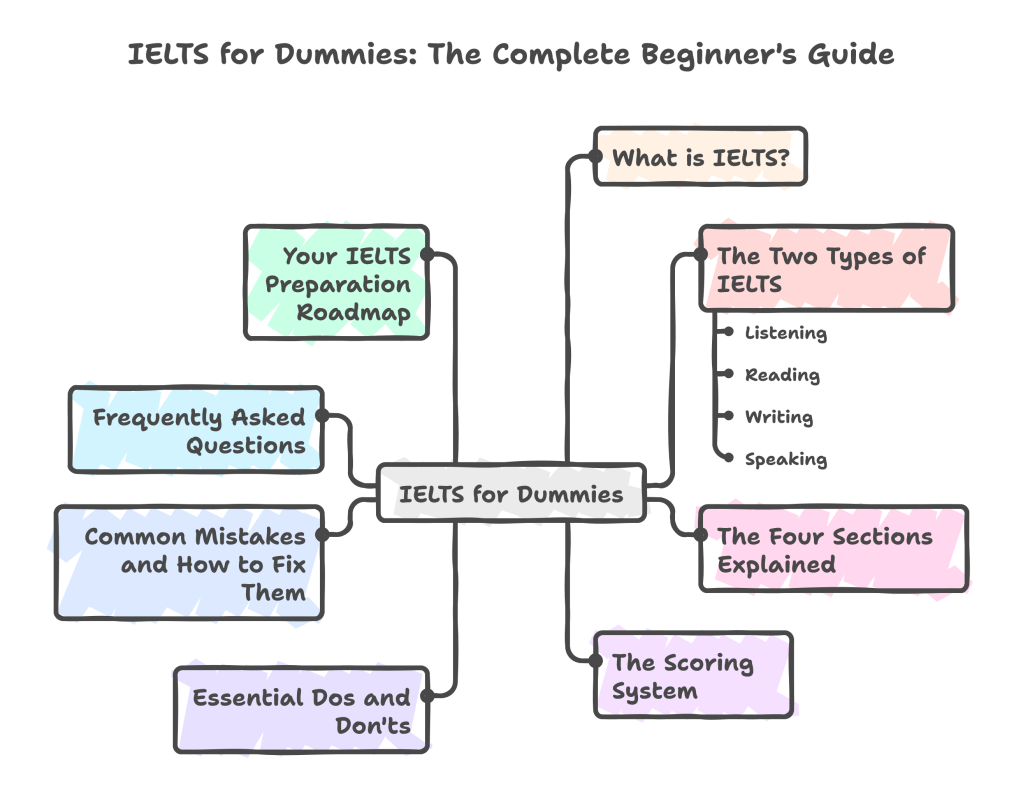
What is IELTS? (Start Here If You Know Nothing!)
IELTS stands for International English Language Testing System. Think of it as your English proficiency passport. It’s a standardized test that measures how well you can use English in academic and everyday situations. Universities, employers, and immigration authorities around the world use IELTS scores to determine if your English is good enough for their requirements.
Imagine you want to study in the UK, work in Canada, or migrate to Australia. These countries need proof that you can communicate effectively in English. That’s where IELTS comes in—it’s your ticket to proving you’ve got the language skills. You can watch this YouTube video explainer by IELTS Guide Phil.
The Two Types of IELTS (Which One Do You Need?)
IELTS Academic
Who needs it: Students applying to universities or professional registration programs.
What it tests: Academic English—the kind you’d use in lectures, textbooks, and research papers.
Example scenario: You’re applying to study engineering at a university in Melbourne. You’ll need IELTS Academic because the university wants to know you can understand complex academic texts and write essays.
IELTS General Training
Who needs it: People migrating to English-speaking countries, applying for work experience, or pursuing training programs below degree level.
What it tests: Everyday practical English in social and workplace contexts.
Example scenario: You’re applying for permanent residency in Canada. Immigration authorities want to see you can handle daily life situations like understanding workplace memos or writing emails.
The Four Sections Explained (What You’ll Actually Do)
IELTS tests four language skills. Here’s what happens in each section:
1. Listening (30 minutes)
What you do: Listen to four recordings of native English speakers and answer questions.
Recordings include:
- A conversation between two people in an everyday social context (like booking a hotel room)
- A monologue in an everyday social context (like a speech about local facilities)
- A conversation between up to four people in an educational or training context (like a university tutor discussing an assignment with students)
- A monologue on an academic subject (like a university lecture)
Real example question: You hear someone booking a doctor’s appointment. You need to write down the appointment time, the doctor’s name, and the reason for the visit.
Duration: You hear each recording only once, so stay focused!
2. Reading (60 minutes)
What you do: Read three long passages and answer 40 questions.
Academic IELTS: Passages come from books, journals, magazines, and newspapers. Topics are academic but accessible to non-specialists.
General Training IELTS: Section 1 has short texts (like advertisements or notices), Section 2 has two texts related to work (like company policies), and Section 3 has one long, complex text on a general topic.
Real example question (Academic): Read a passage about climate change research, then answer questions like “According to the passage, what was the primary cause of temperature increase between 2000-2010?”
Real example question (General Training): Read a hotel policy document and answer “What is the latest check-out time?”
3. Writing (60 minutes)
What you do: Complete two writing tasks.
Academic Writing:
- Task 1 (20 minutes, 150 words minimum): Describe a graph, table, chart, or diagram in your own words. Example: “The graph below shows the percentage of people in different age groups who used smartphones in 2020. Summarize the information by selecting and reporting the main features.”
- Task 2 (40 minutes, 250 words minimum): Write an essay responding to a point of view, argument, or problem. Example: “Some people believe that universities should only offer courses that are useful for future jobs. To what extent do you agree or disagree?”
General Training Writing:
- Task 1 (20 minutes, 150 words minimum): Write a letter (personal, semi-formal, or formal). Example: “You recently bought a product online but it arrived damaged. Write a letter to the company explaining the problem and requesting a replacement.”
- Task 2 (40 minutes, 250 words minimum): Same as Academic—write an essay on a given topic.
4. Speaking (11-14 minutes)
What you do: Have a face-to-face conversation with a certified examiner. This can be done in person or via video call.
Three parts:
- Part 1 (4-5 minutes): Introduction and general questions about yourself, your home, your family, your interests. Example: “Do you enjoy cooking? Why or why not?”
- Part 2 (3-4 minutes): You receive a task card with a topic. You have one minute to prepare, then speak for 1-2 minutes. Example: “Describe a memorable trip you took. You should say: where you went, who you went with, what you did, and explain why it was memorable.”
- Part 3 (4-5 minutes): Discussion of more abstract ideas related to Part 2. Example: If you spoke about travel, the examiner might ask, “How has tourism changed in your country over the last decade?”
The Scoring System (Understanding Your Band Score)
IELTS uses a 9-band scoring system:
- Band 9: Expert user—full operational command of English
- Band 8: Very good user—fully operational with only occasional inaccuracies
- Band 7: Good user—operational command with occasional inaccuracies
- Band 6: Competent user—effective command despite inaccuracies
- Band 5: Modest user—partial command, copes with overall meaning
- Band 4: Limited user—basic competence in familiar situations
- Band 3: Extremely limited user
- Band 2: Intermittent user
- Band 1: Non-user
- Band 0: Did not attempt the test
You’ll receive individual scores for Listening, Reading, Writing, and Speaking, plus an overall band score (the average of the four).
What scores do you need? Most universities require 6.0-7.5 overall, with minimum scores in each section (often 6.0 or 6.5). Immigration programs typically require 6.0-7.0 depending on the visa category.
Essential Dos and Don’ts
DO:
✓ Practice with authentic IELTS materials from the official IELTS website or Cambridge IELTS practice books
✓ Time yourself during practice to build exam stamina
✓ Read the instructions carefully—each question type has specific requirements
✓ Answer every question—there’s no penalty for wrong answers
✓ Use the 10 minutes at the end of Listening (paper test, not computer test) to transfer your answers to the answer sheet
✓ Check spelling and grammar in Writing—errors reduce your score
✓ Speak clearly and at a natural pace during the Speaking test
✓ Stay within word limits in Writing (150 words for Task 1, 250 for Task 2)
✓ Paraphrase instead of copying words directly from the question in Writing
✓ Register early—test dates fill up quickly, especially during peak application seasons
DON’T:
✗ Don’t leave any answers blank—guess if you’re unsure
✗ Don’t write less than the minimum word count in Writing—you’ll lose marks
✗ Don’t memorize and regurgitate prepared answers in Speaking—examiners can tell
✗ Don’t use informal language in Academic Writing (avoid contractions like “don’t,” “can’t”)
✗ Don’t panic if you don’t understand one question—move on and come back if time permits
✗ Don’t waste time on difficult questions in Reading—answer the easy ones first
✗ Don’t write in pencil on the Listening/Reading answer sheet unless instructed—use a pen
✗ Don’t exceed the word limit for short-answer questions (if it says “NO MORE THAN THREE WORDS,” don’t write four)
✗ Don’t get fixated on achieving a perfect score—focus on meeting your required band
✗ Don’t try to impress with overly complex vocabulary you’re not comfortable with—clarity beats complexity
Common Mistakes and How to Fix Them
Mistake 1: Not Understanding the Question Type
The problem: In Reading, there are 14 different question types (True/False/Not Given, matching headings, sentence completion, etc.). Students often answer the wrong way.
The fix: Learn what each question type requires. For example, “True/False/Not Given” is different from “Yes/No/Not Given”—the first deals with factual information, the second with opinions or claims.
Mistake 2: Poor Time Management
The problem: Spending 30 minutes on Reading passage 1 and rushing through passages 2 and 3.
The fix: Allocate 20 minutes per passage in Reading. Set mental checkpoints: “By minute 20, I should be starting passage 2.” Practice with a timer until pacing becomes automatic.
Mistake 3: Copying Words in Writing Task 1
The problem: “The graph shows the percentage of people who used smartphones. The percentage of people who used smartphones increased.”
The fix: Paraphrase: “The graph illustrates smartphone usage rates. The proportion of users rose significantly.”
Mistake 4: Going Off-Topic in Writing Task 2
The problem: Question asks about the benefits of online learning, but you write three paragraphs about traditional classroom advantages.
The fix: Spend 5 minutes planning. Underline keywords in the question. Constantly refer back to ensure you’re addressing what’s actually asked.
Mistake 5: Speaking in One-Word Answers
The problem: Examiner: “Do you like reading?” You: “Yes.”
The fix: Extend your answers. “Yes, I really enjoy reading, especially science fiction novels. I find they help me relax after a long day at work, and I usually read for about an hour before bed.”
Mistake 6: Mishearing Numbers in Listening
The problem: Hearing “fifteen” but writing “fifty.”
The fix: When you hear numbers, quickly repeat them in your head. Pay extra attention to teens versus tens (13 vs 30, 14 vs 40). The stress patterns differ: “thirTEEN” versus “THIRty.”
Mistake 7: Using Memorized Templates
The problem: “It is often said that… Some people believe… In my opinion… To conclude…” used word-for-word in every essay.
The fix: Develop flexible structures, not rigid templates. Examiners recognize memorized phrases and may lower your score for lack of originality.
Mistake 8: Ignoring Word Limits
The problem: Question says “Write NO MORE THAN TWO WORDS” and you write “very expensive car.”
The fix: Count carefully. “Expensive car” would be correct. Practice this skill—it’s tested repeatedly.
Frequently Asked Questions
Q: How long are IELTS scores valid?
A: Two years from the test date. After that, you’ll need to retake the test if required.
Q: Can I take IELTS on paper or computer?
A: Both options are available at most test centers. The content is identical; it’s just the delivery format that differs. Computer-based results come faster (3-5 days versus 13 days).
Q: How much does IELTS cost?
A: Fees vary by country but typically range from $215-$245 USD. Check your local test center for exact pricing.
Q: How many times can I take IELTS?
A: As many times as you want, with no waiting period between tests. However, it’s expensive, so prepare thoroughly before your first attempt.
Q: What if I need to cancel or reschedule?
A: You can usually get a refund or reschedule if you notify the test center at least 5 weeks before the test date. Less than 5 weeks, and you may lose your fee.
Q: Is British or American spelling acceptable?
A: Both are fine, but be consistent. Don’t mix “colour” and “color” in the same essay.
Q: Can I use a pen or pencil?
A: For paper-based tests, use a pen for Listening, Reading, and Writing. Check your test center’s specific requirements.
Q: What happens if I arrive late?
A: You may not be allowed to take the test and will forfeit your fee. Arrive at least 30 minutes early.
Q: How soon will I get my results?
A: Paper-based: 13 days. Computer-based: 3-5 days. You’ll receive a Test Report Form with your scores.
Q: Can I request a re-mark?
A: Yes, this is called “Enquiry on Results” (EOR). You can request a re-mark within 6 weeks of your test date. There’s a fee, which is refunded if your score increases.
Q: Do I need to prepare differently for Academic vs General Training?
A: The Listening and Speaking sections are identical. Reading and Writing differ, so use practice materials specific to your test type.
Q: What’s a good score?
A: It depends on your goals. Check the requirements of the institution or immigration program you’re applying to. Generally, 6.5-7.0 is considered competitive for university admission.
Q: Can I improve my score quickly?
A: Improvement depends on your current level. If you’re already at Band 5-6, reaching Band 7 typically requires 200-300 hours of focused study. Set realistic timelines.
Your IELTS Preparation Roadmap
Week 1-2: Assessment Take a full practice test to establish your baseline score. Identify your weakest section.
Week 3-6: Skill Building Focus on fundamentals—expand vocabulary, practice grammar, improve pronunciation. Use authentic materials like BBC News, TED Talks, and academic journals.
Week 7-10: Practice and Strategy Complete timed practice tests weekly. Learn specific strategies for each section (skimming for Reading, note-taking for Listening, essay structures for Writing).
Week 11-12: Intensive Review Take three full practice tests under exam conditions. Review mistakes thoroughly. Fine-tune weak areas.
Test Week: Confidence and Rest Do light review only. Get adequate sleep. Prepare your ID and test materials. Stay calm and confident.
Final Thoughts
IELTS isn’t about being a perfect English speaker—it’s about proving you can function effectively in English-speaking environments. Native speakers make mistakes too. Your goal is to communicate clearly, accurately, and confidently within the test’s framework.
Remember: preparation is everything. The test format is predictable, strategies can be learned, and improvement is absolutely achievable with consistent effort. Thousands of test-takers succeed every day, and with the right approach, you can too.
Good luck on your IELTS journey!
#IELTSGuidePhil #IELTS #IELTSPreparation #IELTSTips #IELTSExam #LearnEnglish #EnglishTest #StudyAbroad #IELTSWriting #IELTSSpeaking #IELTSReading #IELTSListening #EnglishLearning #IELTSBandScore #IELTSAcademic #IELTSGeneralTraining #TestPrep #EnglishProficiency #IELTSGuide #IELTSHelp #StudyOverseas #IELTSSuccess #EnglishForStudy #IELTSPractice #IELTSStrategy #LanguageTest
 IELTS Guide Phil
Leave a comment