
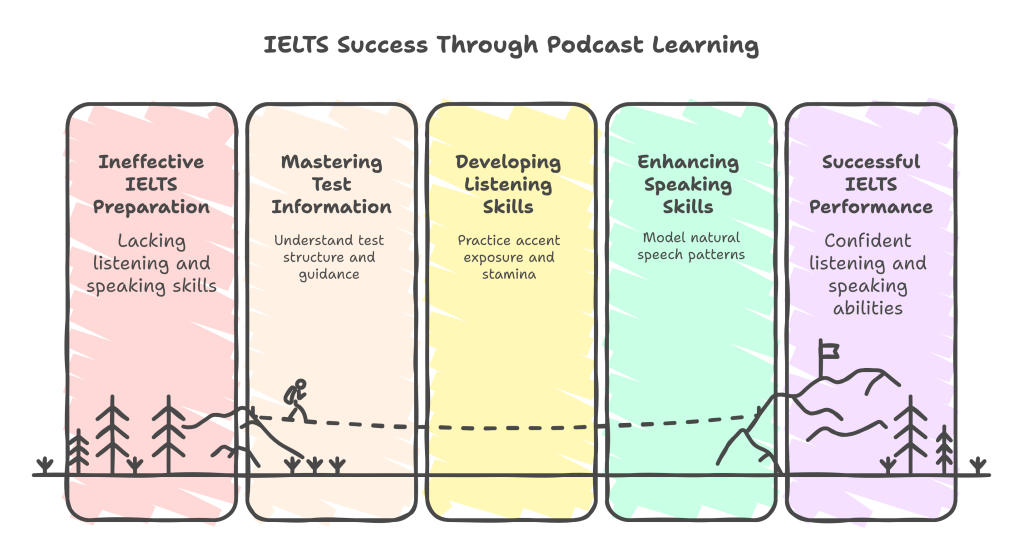
In today’s fast-paced world, maximizing your study time is crucial. The IELTS Guide Phil podcast on Spotify transforms your commute, workout, or downtime into productive IELTS preparation sessions. This comprehensive guide reveals how podcast-based learning accelerates your journey to test success through enhanced listening skills, authentic English exposure, and flexible, on-the-go education.
Why Podcast Learning Is Revolutionary for IELTS
Unlike traditional study methods that require your full attention and a desk, podcasts offer:
- Multitasking capability – Learn while commuting, exercising, or doing chores
- Authentic listening practice – Real conversations and natural speech patterns
- Repetition made easy – Replay episodes to reinforce learning
- Native speaker exposure – Accent familiarization and pronunciation models
- Free, accessible content – No expensive courses required
- Flexible pacing – Listen at your own speed, pause, and replay
The Neuroscience of Audio Learning
Research shows that audio learning activates different neural pathways than reading. When you listen to podcasts:
- Your auditory processing strengthens
- You develop better pronunciation through unconscious mimicry
- Information retention improves through repetition
- Multisensory engagement enhances memory formation
1. Mastering Essential Test Information Through Audio
Understanding Test Structure Through Listening
Podcast episodes break down complex IELTS information into digestible audio segments:
What You Learn:
- Comprehensive test format explanations
- Section-by-section breakdowns (Listening, Reading, Writing, Speaking)
- Timing strategies for each component
- Band score descriptors explained clearly
- Registration processes and requirements
- Computer-delivered vs. paper-based differences
Example Episode Topic: “Complete IELTS Listening Test Breakdown” might explain that the Listening test progressively increases in difficulty from Section 1 (everyday conversation) to Section 4 (academic lecture), with specific question types appearing in each section.
Practical Test Day Guidance
Podcasts provide:
- What to bring on test day
- Arrival time and check-in procedures
- Test center rules and regulations
- Break policies and bathroom procedures
- How to handle technical issues
- Post-test result timelines
Advantage of Audio Format: You can listen to test-day preparation episodes the night before your exam while relaxing, reducing anxiety through familiarization without the stress of reading dense material.
Dos:
✅ Listen to foundational episodes first for comprehensive understanding
✅ Take quick notes of important numbers and dates
✅ Replay sections you find confusing
✅ Listen to test format episodes multiple times for retention
Don’ts:
❌ Skip episodes about test logistics—they prevent costly mistakes
❌ Listen only once and assume you’ve absorbed everything
❌ Ignore updates about test policy changes
❌ Forget to bookmark essential episodes for review
2. Developing Superior Listening Skills
How Podcasts Mirror the IELTS Listening Test
The IELTS Listening test requires you to understand various accents, follow conversations, extract specific information, and comprehend academic content. Podcasts provide authentic practice:
Direct Benefits:
- Accent Exposure
- Filipino-English accents in explanations
- International English varieties in examples
- Neutral accents for clarity
- Accent switching builds adaptability
- Listening Stamina
- 20-40 minute episodes train sustained focus
- Similar duration to actual IELTS Listening test
- Builds concentration endurance naturally
- Information Extraction
- Training to identify main ideas while listening
- Catching specific details (dates, numbers, names)
- Understanding speaker opinions and attitudes
- Following complex arguments
Example Training Scenario:
Episode: “How to Tackle Section 3 Conversations”
Skills Practiced:
- Following a discussion between multiple speakers
- Identifying different viewpoints
- Noting specific academic vocabulary
- Understanding context through tone and stress
Listening Strategy Development:
Podcasts teach you to:
- Predict content from introductions and context
- Identify signpost language (firstly, however, in conclusion)
- Recognize paraphrasing when speakers rephrase ideas
- Concentrate despite distractions through consistent practice
- Manage note-taking while listening continuously
Common Mistake: Trying to understand every single word.
Fix: Podcasts train you to grasp overall meaning even when you miss individual words—exactly what IELTS requires. Focus on content, not perfection.
Active Listening Techniques
Beginner Level (First 2 weeks):
- Listen without distractions
- Replay difficult sections immediately
- Note unfamiliar vocabulary
- Summarize each episode in 2-3 sentences
Intermediate Level (Weeks 3-6):
- Listen during activities (walking, commuting)
- Pause to predict what comes next
- Shadow speak (repeat what you hear)
- Take structured notes
Advanced Level (Weeks 7+):
- Listen at 1.25x speed for challenge
- Answer practice questions while listening
- Transcribe short segments
- Analyze speaker strategies and techniques
3. Enhancing Speaking Skills Through Audio Modeling
Learning Natural Speech Patterns
One of the most significant advantages of podcasts is exposure to authentic, fluent English:
What You Absorb:
- Conversation Flow
- How native speakers transition between ideas
- Natural hesitations and fillers (appropriate ones)
- Turn-taking in discussions
- Interrupting and agreeing politely
- Intonation and Stress
- Emphasis patterns that convey meaning
- Rising and falling intonation for questions
- Stress on important words
- Emotional expression through tone
- Connected Speech
- Linking words smoothly
- Contractions in natural speech
- Reduced forms (going to → gonna in casual contexts)
- Rhythm and pace of fluent speakers
Example Learning:
Podcast Speaker Says: “If you WANT to improve your SCORE, you NEED to practice CONsistently.”
What You Learn:
- Content words are stressed (want, improve, score, need, practice, consistently)
- Function words are reduced (to, your, you)
- This pattern makes speech clear and natural
Shadowing Technique for Speaking Improvement
The Shadowing Process:
- Listen to a podcast segment (30-60 seconds)
- Replay and repeat simultaneously, mimicking:
- Pronunciation
- Intonation
- Rhythm
- Pace
- Record yourself speaking
- Compare with the original
- Repeat until you match closely
Benefits of Shadowing:
- Improves pronunciation dramatically
- Develops muscle memory for English sounds
- Enhances fluency and flow
- Builds confidence in speaking
- Reduces foreign accent interference
Example Practice:
Podcast Phrase: “The most effective strategy involves consistent practice combined with strategic preparation.”
Shadowing Focus:
- /ˈstrætədʒi/ (strategy) pronunciation
- Smooth linking: “effective_effective” becomes “effec-tiv_strategy”
- Stress pattern: MOST efFECtive STRATegy
- Natural pace without rushing
Dos:
✅ Practice shadowing for 10-15 minutes daily
✅ Focus on short segments initially
✅ Record and review your pronunciation
✅ Pay attention to intonation, not just words
✅ Imitate the speaker’s rhythm and pace
Don’ts:
❌ Shadow entire episodes without breaks
❌ Ignore pronunciation errors in your speech
❌ Rush through words to keep up
❌ Practice only with fast-paced content
❌ Forget to review and compare with original
Building Speaking Confidence
Podcasts Help You:
- Feel comfortable hearing English regularly
- Develop mental templates for expressing ideas
- Learn how to elaborate on points effectively
- Understand appropriate formality levels
- Gain topic-specific speaking vocabulary
Speaking Part 2 Preparation:
Listen to how podcast hosts structure explanations:
- Clear introduction of topic
- Main points with elaboration
- Specific examples or personal experiences
- Natural conclusion or summary
Mirror this structure in your 2-minute IELTS speeches.
4. Expanding Vocabulary Contextually
Natural Vocabulary Acquisition
Unlike memorizing word lists, podcast learning embeds vocabulary in meaningful context:
How Vocabulary Sticks:
- Contextual Understanding
- Hear words used in authentic situations
- Understand connotations and register
- Learn collocations naturally
- See words in multiple contexts
- Repetition Without Tedium
- Key IELTS terms appear across episodes
- Spaced repetition through different topics
- Reinforcement without boring drills
- Active Vocabulary Development
- Hearing words helps recognition (Listening/Reading)
- Mimicking speakers moves words to active use (Speaking/Writing)
Topic-Based Vocabulary Clusters:
Episode Theme: Education Vocabulary Learned:
- tertiary education, curriculum reform, pedagogical approaches
- literacy rates, academic achievement, vocational training
- distance learning, educational equity, assessment methods
Episode Theme: Environment Vocabulary Learned:
- sustainable development, carbon emissions, biodiversity loss
- renewable energy, conservation efforts, ecological footprint
- climate mitigation, environmental degradation, green technology
Episode Theme: Technology Vocabulary Learned:
- digital transformation, artificial intelligence, cybersecurity
- automation, technological advancement, innovation
- online platforms, virtual reality, data privacy
Academic Word List (AWL) Through Audio
Podcasts naturally incorporate high-frequency academic words essential for IELTS:
Tier 1 (Most Common): analyze, approach, area, assess, assume, benefit, concept, consist, constitute, context
Tier 2 (Very Important): achieve, acquire, adapt, adequate, component, comprehensive, compute, conduct, consequent
Audio Advantage:
- Correct pronunciation learned automatically
- Word stress patterns absorbed naturally
- Usage in sentences provides grammar context
Example from Podcast:
“Research indicates that candidates who utilize a comprehensive preparation strategy tend to achieve higher band scores. This approach involves consistent practice across all four components of the test.”
Words Learned: indicates, utilize, comprehensive, strategy, achieve, approach, consistent, components
Collocations and Phrases
What Are Collocations? Words that naturally go together in English.
Podcast Examples:
Correct Collocations:
- “take an exam” (not “give an exam”)
- “make progress” (not “do progress”)
- “strong accent” (not “heavy accent” in positive context)
- “fluent speaker” (not “fluid speaker”)
- “achieve a goal” (not “reach a goal” in formal writing)
Advanced Phrases:
- “In light of this information…”
- “It stands to reason that…”
- “Taking everything into consideration…”
- “From a practical standpoint…”
Dos:
✅ Keep a vocabulary journal organized by topic
✅ Note down collocations, not just individual words
✅ Review new vocabulary within 24 hours
✅ Use new words in practice speaking/writing
✅ Pay attention to word forms (noun, verb, adjective)
Don’ts:
❌ Try to write down every word while listening
❌ Learn words in isolation without context
❌ Ignore pronunciation when noting vocabulary
❌ Forget to review previously learned words
❌ Use words without understanding connotations
5. Mastering Grammar Through Exposure
Implicit Grammar Learning
Podcasts provide thousands of correct grammar examples, helping you internalize patterns:
Grammar Structures You’ll Absorb:
- Complex Sentence Structures
- “While some candidates focus on vocabulary, others prioritize grammar practice.”
- “Although the Listening test appears straightforward, it requires significant concentration.”
- Conditional Forms
- “If you practice regularly, you will see improvement.”
- “Had I known this strategy earlier, I would have scored higher.”
- “Should you encounter difficulty, don’t hesitate to move on.”
- Passive Voice (Common in IELTS Academic)
- “Band scores are calculated based on performance.”
- “The test is administered by trained examiners.”
- “Results are released within 13 days.”
- Relative Clauses
- “Students who practice daily tend to achieve better results.”
- “The strategies that work best vary by individual.”
- “This is the approach which most experts recommend.”
- Reported Speech
- “Examiners have stated that fluency matters more than accuracy.”
- “Research suggests that consistent practice is essential.”
Sentence Pattern Recognition
Podcast hosts naturally use structures you need for IELTS Writing:
Concession: “Despite the challenges, many candidates succeed.” “Although difficult, the IELTS test is certainly achievable.”
Comparison: “The Listening test is as important as the Reading test.” “Speaking requires more spontaneity than Writing.”
Cause and Effect: “Poor preparation leads to lower scores.” “Due to consistent practice, candidates improve rapidly.” “The result was that confidence increased significantly.”
Emphasis: “What really matters is your overall preparation.” “It is essential that you practice all four skills.”
Common Mistake: Thinking grammar is separate from listening practice.
Fix: Recognize that every podcast episode is a grammar lesson. Pay attention to how ideas are structured and connected.
6. Perfecting Pronunciation and Accent
Understanding Different English Accents
IELTS includes various English accents (British, American, Australian, others). Podcasts help you:
Accent Familiarization:
- Filipino-English Accent
- Common among Filipino speakers
- Helps you understand local context
- Builds confidence through familiarity
- International English Varieties
- British English pronunciation
- American English variations
- Australian English patterns
- Canadian English features
- Neutral/Standard English
- Clear, widely understood pronunciation
- Ideal model for your own speaking
- Suitable for international contexts
Key Pronunciation Features to Notice:
British vs. American:
- “schedule” – /ˈʃedjuːl/ (British) vs. /ˈskedʒuːl/ (American)
- “advertisement” – stress on 2nd syllable (British) vs. 3rd (American)
- “been” – /biːn/ (British) vs. /bɪn/ (American)
The Goal: Not to sound British or American, but to be clearly understood by international listeners.
Individual Sound Practice
Challenging Sounds for Filipino Speakers:
- /f/ and /p/ sounds
- “fast” vs. “past”
- “feel” vs. “peel”
- Listen carefully to podcast speakers
- /v/ and /b/ sounds
- “very” vs. “berry”
- “vote” vs. “boat”
- Th sounds /θ/ and /ð/
- “think” /θɪŋk/
- “this” /ðɪs/
- Not /t/ or /d/
- Final consonant clusters
- “asked” /æskt/ (not “ask”)
- “texts” /teksts/ (not “teks”)
- “months” /mʌnθs/ (not “mons”)
Practice Method:
- Identify problem sounds in podcast episodes
- Isolate those segments
- Slow down playback to 0.75x speed
- Practice the sound repeatedly
- Return to normal speed
- Shadow the speaker
Word Stress and Sentence Stress
Word Stress Patterns:
Podcasts teach you correct stress through repetition:
- photoGRAPH, phoTOgraphy, photoGRAPHic (stress shifts)
- REcord (noun) vs. reCORD (verb)
- PREsent (noun) vs. preSENT (verb)
Sentence Stress for Meaning:
Example from Podcast:
“I didn’t say YOU failed the test.” (Someone else said it)
“I didn’t say you FAILED the test.” (Maybe you did poorly but didn’t fail)
“I didn’t say you failed THE test.” (Maybe you failed something else)
IELTS Speaking Application: Proper stress makes your meaning clear and sounds natural.
Dos:
✅ Listen specifically for pronunciation patterns
✅ Slow down podcast playback for difficult sounds
✅ Record yourself and compare to speakers
✅ Focus on clarity over perfect accent
✅ Practice individual sounds causing difficulty
Don’ts:
❌ Try to fake a British or American accent
❌ Ignore your pronunciation weaknesses
❌ Speak too fast, causing unclear pronunciation
❌ Forget that comprehensibility matters most
❌ Be discouraged by accent differences
7. Learning Natural Spoken English Expression
Discourse Markers and Fillers
Appropriate Fillers for IELTS Speaking:
Podcasts demonstrate natural hesitation strategies:
Good Fillers (Use Sparingly):
- “Well, in my opinion…”
- “Let me think about that…”
- “That’s an interesting question…”
- “I would say that…”
Avoid Overusing:
- “Um,” “uh,” “like,” “you know”
- Long silences
- Repetitive fillers
Discourse Markers for Fluency:
Adding Information:
- Furthermore, Moreover, In addition, Additionally
- “What’s more, the benefits extend beyond…”
Contrasting:
- However, Nevertheless, On the other hand, Conversely
- “Having said that, there are drawbacks…”
Sequencing:
- Firstly, Secondly, Finally, To begin with
- “Moving on to the next point…”
Exemplifying:
- For instance, For example, Such as, Namely
- “To illustrate this point…”
Concluding:
- In conclusion, To sum up, Overall, All things considered
- “Taking everything into account…”
Expressing Opinions and Ideas
Podcast Models Show You How To:
- State Opinions Clearly
- “I firmly believe that…”
- “In my view…”
- “From my perspective…”
- “I would argue that…”
- Qualify Statements
- “To some extent…”
- “Generally speaking…”
- “In most cases…”
- “More often than not…”
- Express Uncertainty Appropriately
- “I’m not entirely sure, but…”
- “It seems to me that…”
- “I would imagine that…”
- “As far as I know…”
- Agree and Disagree Diplomatically
- “I see your point, but…”
- “That’s partly true, however…”
- “I agree to a certain extent…”
- “While that may be the case…”
Elaboration Techniques
IELTS Speaking requires extended responses. Podcasts teach you to elaborate:
Basic Answer: “Yes, I like reading.”
Elaborated Answer (Podcast Model): “Yes, I definitely enjoy reading. It’s something I try to do daily, especially before bed. I particularly like fiction because it helps me relax after a busy day. Recently, I’ve been reading more contemporary novels rather than classics. I find that reading not only improves my English but also helps me understand different perspectives and cultures.”
Elaboration Strategies:
- Answer directly
- Explain why/how
- Give specific examples
- Add personal experience
- Discuss impact or consequences
Common Mistake: Giving one-sentence answers in Speaking test.
Fix: Listen to how podcast speakers naturally extend their points. Practice elaborating your own answers using similar patterns.
8. Gathering Ideas for Writing and Speaking
Topic Familiarization
IELTS tests common topics repeatedly. Podcast episodes covering these topics arm you with ideas:
Common IELTS Topics Covered:
1. Education Ideas from Podcasts:
- Online learning advantages and limitations
- University education vs. vocational training
- Lifelong learning importance
- Educational technology impact
- Student loan and financial issues
- International education trends
2. Environment and Climate Ideas from Podcasts:
- Individual vs. government responsibility
- Renewable energy solutions
- Plastic pollution and alternatives
- Climate change impacts
- Sustainable lifestyle choices
- Conservation strategies
3. Technology Ideas from Podcasts:
- Social media effects on society
- Privacy concerns in digital age
- Automation and employment
- Technology in education
- Generational technology gaps
- Digital wellness and screen time
4. Work and Employment Ideas from Podcasts:
- Work-life balance challenges
- Remote work trends
- Career development strategies
- Unemployment and economic factors
- Gig economy pros and cons
- Workplace diversity
5. Health and Lifestyle Ideas from Podcasts:
- Mental health awareness
- Exercise and physical fitness
- Healthcare systems
- Preventive vs. reactive medicine
- Stress management
- Diet and nutrition trends
Developing Arguments
Podcast Discussions Show You:
How to Build Arguments:
Structure:
- Main claim
- Supporting reason
- Evidence or example
- Explanation of significance
Example from Podcast:
Topic: Should governments invest more in public transportation?
Argument Structure:
- Claim: “Governments should prioritize public transportation investment.”
- Reason: “This reduces urban congestion and environmental pollution.”
- Evidence: “Cities like Singapore have shown that efficient public transport systems decrease private vehicle usage by up to 40%.”
- Significance: “This not only improves air quality but also enhances citizens’ quality of life.”
Counterargument Skills:
Podcasts teach balanced discussion:
- Acknowledging opposing views
- Presenting alternative perspectives
- Refuting counterarguments politely
- Finding middle ground
Example: “While some argue that technology isolates people, I believe it actually facilitates connection in ways previously impossible. For instance, families separated by distance can now communicate daily through video calls.”
Dos:
✅ Take notes on interesting ideas and examples
✅ Organize ideas by IELTS topic categories
✅ Listen to diverse viewpoints on issues
✅ Notice how speakers structure arguments
✅ Practice expressing ideas in your own words
Don’ts:
❌ Try to memorize entire arguments
❌ Use ideas without understanding them
❌ Ignore counterarguments in discussions
❌ Present only one-sided views
❌ Forget to adapt ideas to your own context
9. Creating an Effective Podcast Study Routine
Daily Listening Schedule
Beginner Schedule (Weeks 1-4):
Morning (15-20 minutes):
- Listen during morning routine
- Focus on one complete episode
- Take 3-5 key notes
Evening (10-15 minutes):
- Replay challenging segments
- Practice shadowing 2-3 minutes
- Review vocabulary noted
Total: 25-35 minutes daily
Intermediate Schedule (Weeks 5-8):
Morning Commute (20-30 minutes):
- Full episode listening
- Mental note-taking
- Predict content before episodes
Lunch Break (10 minutes):
- Quick vocabulary review
- Write summary of morning episode
Evening (15-20 minutes):
- Focused shadowing practice
- Record speaking using podcast ideas
- Answer practice questions
Total: 45-60 minutes daily
Advanced Schedule (Weeks 9+):
Throughout Day:
- 1-2 episodes during various activities
- Active listening practice
- Speed variation (1.25x for challenge)
Focused Study (30 minutes):
- Transcription practice
- Detailed pronunciation work
- Speaking practice using podcast topics
Total: 60-90 minutes daily
Active Listening Strategies
Before Listening:
- Check episode title and description
- Predict content and vocabulary
- Prepare note-taking materials
- Set learning objectives
During Listening:
- Note unfamiliar words and phrases
- Mark time stamps for difficult sections
- Mentally answer questions posed
- Identify useful expressions
After Listening:
- Summarize main points orally
- Look up noted vocabulary
- Practice key phrases
- Apply one learned strategy
Integration with Other IELTS Practice
Podcasts + Practice Tests:
- Listen to strategy episodes before practice
- Apply techniques immediately
- Review relevant episodes after reviewing answers
Podcasts + Writing Practice:
- Use podcast ideas in essays
- Apply vocabulary heard
- Structure arguments as modeled
Podcasts + Speaking Practice:
- Shadow speakers for pronunciation
- Use phrases in practice responses
- Discuss podcast topics with study partners
Podcasts + Reading:
- Compare written and spoken explanations
- Reinforce vocabulary through different modes
- Cross-reference strategies
10. Maximizing Podcast Benefits
Technology Tips
Spotify Features to Use:
- Playback Speed
- 0.75x for difficult pronunciation
- 1.0x for normal learning
- 1.25x for challenge and review
- Sleep Timer
- Listen before bed without worry
- Set timer for relaxation listening
- Download Episodes
- Listen offline during commute
- Save data while learning
- Access anywhere, anytime
- Create Playlists
- Organize by skill (Listening, Speaking, etc.)
- Group by proficiency level
- Mark favorites for review
- Share Episodes
- Send to study partners
- Discuss with study groups
- Recommend to fellow test-takers
Note-Taking System
Effective Podcast Notes:
Template:
- Episode Title:
- Date Listened:
- Main Topics:
- Key Strategies: (3-5 points)
- New Vocabulary: (5-10 words)
- Practice Actions: (What to do next)
- Questions/Unclear Points:
Digital vs. Paper:
Digital (Phone/Tablet):
- Quick typing during listening
- Easy to search later
- Can add timestamps
- Organize by category
Paper:
- Better for memory retention
- Draw diagrams and mind maps
- Less distraction
- Physical review process
Tracking Progress
Weekly Review:
- Number of episodes completed
- Vocabulary words learned
- Speaking practice hours
- Improvements noticed
Monthly Assessment:
- Re-listen to early episodes (easier now?)
- Take practice test and compare scores
- Evaluate listening speed comprehension
- Assess speaking fluency improvements
Progress Indicators:
You’re improving when:
- Understanding episodes on first listen
- Automatically using learned vocabulary
- Speaking with better pronunciation
- Needing fewer replays
- Feeling confident with various accents
- Thinking in English more naturally
Common Mistakes and How to Fix Them
Mistake 1: Passive Listening Only
Problem: Treating podcasts like background music without active engagement.
Fix: Set specific learning goals for each episode. Take notes, pause to reflect, and practice applying what you learn.
Mistake 2: Not Replaying Difficult Sections
Problem: Moving on when you don’t understand something.
Fix: Use the 15-second rewind feature. Listen to challenging parts 3-5 times. Understanding comes through repetition.
Mistake 3: Ignoring Pronunciation Practice
Problem: Only listening without speaking practice.
Fix: Dedicate 10-15 minutes daily to shadowing. Record yourself and compare with podcast speakers.
Mistake 4: Overwhelming Vocabulary Lists
Problem: Trying to note every unfamiliar word, leading to disrupted listening.
Fix: Note only 5-10 key words per episode. Focus on high-frequency and topic-relevant vocabulary.
Mistake 5: Inconsistent Listening
Problem: Binge-listening one day, then nothing for a week.
Fix: Listen to at least one episode daily, even if just 15 minutes. Consistency beats intensity.
Mistake 6: Not Applying What You Learn
Problem: Collecting knowledge without practicing.
Fix: After each episode, practice one strategy or use three new words in speaking/writing.
Mistake 7: Listening at Wrong Times
Problem: Trying to actively learn while doing complex tasks.
Fix: Match listening intensity to activity level:
- Active learning → Full attention (sitting, commuting)
- Review → Moderate attention (walking, exercising)
- Exposure → Light attention (household chores)
Mistake 8: Skipping Episodes That Seem “Too Easy”
Problem: Only listening to advanced content, missing foundational concepts. Fix: Review basics periodically. Even “easy” episodes reinforce knowledge and boost confidence.
Mistake 9: No Review System
Problem: Listening once and forgetting content.
Fix: Create a review schedule:
- Day 1: Listen to new episode
- Day 3: Review notes
- Week 1: Re-listen to key episodes
- Month 1: Comprehensive review of all episodes
Mistake 10: Expecting Immediate Results
Problem: Getting discouraged after one week without dramatic improvement.
Fix: Understand that language learning is cumulative. Track small wins weekly. Major improvements appear after 6-8 weeks of consistent practice.
Frequently Asked Questions
Q1: How many podcast episodes should I listen to daily?
A: Quality over quantity. One episode (15-30 minutes) with active engagement is better than passively hearing three. Aim for 30-45 minutes of focused listening daily.
Q2: Should I listen to episodes in order?
A: Start with foundational episodes about test format and general strategies. Then explore topics based on your weak areas. Review frequently asked question episodes regularly.
Q3: Can I prepare for IELTS using only podcasts?
A: Podcasts are excellent for Listening and Speaking development, plus vocabulary and ideas. However, combine them with Reading practice, Writing exercises, and mock tests for comprehensive preparation.
Q4: What if I don’t understand the podcast?
A: Start with slower playback (0.75x speed). Replay sections multiple times. Note time stamps of difficult parts and review later. Understanding improves with exposure.
Q5: Should I take notes while listening?
A: Yes, but strategically. Note key strategies, unfamiliar words, and important points. Don’t write everything—this disrupts listening. Review and expand notes after the episode.
Q6: How do podcasts help with the IELTS Listening test specifically?
A: They train your ear for different accents, improve concentration stamina, teach information extraction, and familiarize you with various speaking speeds and contexts.
Q7: Can podcasts improve my Speaking score?
A: Absolutely. Through shadowing practice, you improve pronunciation, fluency, and intonation. You also learn natural phrases, discourse markers, and elaboration techniques.
Q8: Is it better to listen with or without transcripts?
A: Start without transcripts to train your ear. After listening, check transcripts (if available) for unfamiliar words. Then re-listen with new understanding.
Q9: How long before my test should I start listening to podcasts?
A: Ideally, 2-3 months for comprehensive preparation. However, even 2-4 weeks of intensive podcast listening can significantly improve listening comprehension and speaking fluency.
Q10: What’s the best time of day to listen to IELTS podcasts?
A: Morning listening sharpens your mind for the day. Evening listening consolidates learning. Choose times when you’re alert and can focus. Consistency matters more than timing.
Q11: Should I listen at normal or increased speed?
A: Start at 1.0x (normal) speed. Once comfortable, try 1.25x for challenge and to train faster processing. Use 0.75x for difficult pronunciation sections.
Q12: How do I know if I’m making progress?
A: Track these indicators:
- Understanding more on first listen
- Needing fewer replays
- Recognizing vocabulary in different contexts
- Speaking more fluently
- Better performance on practice tests
Q13: Can podcasts help me understand different English accents?
A: Yes! Regular exposure to various accents (British, American, Australian, Filipino-English) builds familiarity and reduces comprehension anxiety during the actual test.
Q14: What should I do if I miss a day of listening?
A: Don’t stress. Resume the next day without trying to “catch up” by binge-listening. Consistency matters more than perfection. Focus on maintaining the habit.
Q15: Are podcasts useful for high-band score goals (7.5-9.0)?
A: Definitely. Advanced learners benefit from nuanced explanations, sophisticated vocabulary, complex grammar structures, and subtle pronunciation features that distinguish higher band scores.
Essential Dos and Don’ts Summary
DO:
✅ Listen consistently—make it a daily habit
✅ Practice active listening with focused attention
✅ Shadow speakers for pronunciation improvement
✅ Take organized notes during and after episodes
✅ Replay difficult sections multiple times
✅ Apply learned strategies in practice immediately
✅ Use multiple playback speeds for different purposes
✅ Download episodes for offline listening
✅ Track your progress weekly and monthly
✅ Combine podcast learning with other practice
✅ Focus on understanding over perfection
✅ Review favorite episodes periodically
DON’T:
❌ Listen passively without engagement
❌ Try to understand every single word
❌ Skip pronunciation and shadowing practice
❌ Take excessive notes that disrupt listening
❌ Listen only once and never review
❌ Expect instant results after a few days
❌ Only listen to “advanced” episodes
❌ Ignore your weak areas
❌ Forget to practice what you’ve learned
❌ Compare your progress to others
❌ Give up when episodes seem challenging
❌ Listen while doing complex tasks requiring full attention
Bonus: Advanced Podcast Learning Techniques
1. The Triple-Pass Method
First Pass (Comprehension):
- Listen without stopping
- Understand general content
- Note overall topic and structure
Second Pass (Analysis):
- Pause for difficult sections
- Note vocabulary and phrases
- Identify useful expressions
- Mark pronunciation points
Third Pass (Application):
- Shadow speak selected segments
- Practice using new vocabulary
- Transcribe challenging parts
- Apply strategies discussed
2. Topic Clustering Strategy
Organize Episodes by Theme:
Create themed learning weeks:
- Week 1: All episodes about Listening strategies
- Week 2: Speaking Part 1 and 2 techniques
- Week 3: Writing Task 2 approaches
- Week 4: Vocabulary building episodes
- Week 5: Test day preparation
Benefits:
- Deep dive into specific skills
- Comprehensive understanding of topics
- Multiple perspectives on same subject
- Better retention through repetition
3. Speaking Journal Method
After Each Episode:
Record a 2-3 minute audio journal:
- Summarize the main points
- Share your opinion on the topic
- Use vocabulary you just learned
- Practice pronunciation you heard
Why This Works:
- Immediate application reinforces learning
- Speaking practice integrated naturally
- Progress tracking through recordings
- Confidence building over time
4. Study Partner Podcast Discussion
Weekly Podcast Club:
With study partners:
- All listen to the same episode
- Meet (in person or online) to discuss
- Share different takeaways
- Quiz each other on content
- Practice speaking about the topic
- Compare notes and vocabulary
Benefits:
- Accountability for consistent listening
- Multiple interpretations deepen understanding
- Speaking practice in safe environment
- Shared learning experiences
5. Transcription Practice
For Advanced Learners:
Select 2-3 minute segments and:
- Listen and type exactly what you hear
- Check accuracy by replaying
- Identify errors and patterns
- Study vocabulary/grammar mistakes
- Practice those elements specifically
Skills Developed:
- Acute listening accuracy
- Spelling improvement
- Grammar pattern recognition
- Detail-oriented attention
Integration with IELTS Guide Phil’s Other Resources
The Complete Learning Ecosystem
Podcasts + Blog Posts:
- Read blog for detailed strategies
- Listen to podcast for audio reinforcement
- Different learning modes for same content
- Visual + auditory = better retention
Podcasts + Practice Tests:
- Learn strategies via podcast
- Apply in timed practice
- Identify weak areas
- Return to relevant podcast episodes
Podcasts + Study Communities:
- Discuss episodes with other learners
- Share insights and discoveries
- Create accountability partnerships
- Motivate each other
Creating Your Perfect Study Mix
Sample Weekly Schedule:
Monday:
- Morning: Podcast episode (30 min)
- Evening: Blog post reading (20 min)
- Practice: Vocabulary exercises (15 min)
Tuesday:
- Morning: Review Monday’s notes (15 min)
- Afternoon: Podcast shadowing practice (20 min)
- Evening: Writing practice using podcast ideas (30 min)
Wednesday:
- Morning: New podcast episode (30 min)
- Evening: Practice Listening test (40 min)
Thursday:
- Morning: Podcast review and notes (20 min)
- Evening: Speaking practice with podcast topics (30 min)
Friday:
- Morning: Podcast episode (30 min)
- Evening: Reading practice (40 min)
Weekend:
- Saturday: Full practice test (3 hours)
- Sunday: Review mistakes, re-listen to relevant podcasts (2 hours)
Total Weekly Investment: 10-12 hours Podcast Component: 3-4 hours (manageable and effective)
Staying Motivated Throughout Your Journey
Setting Milestone Goals
Short-term (Weekly):
- Complete 5-7 podcast episodes
- Master 25-30 new vocabulary words
- Practice shadowing 30 minutes total
- Record one speaking response
Medium-term (Monthly):
- Listen to entire topic series
- Improve practice test score by 0.5 band
- Maintain 100% note review rate
- Share one helpful episode with study group
Long-term (3 months):
- Cover all podcast topics
- Achieve target band score in practice
- Build 500+ word active vocabulary
- Speak confidently on all common topics
Celebrating Progress
Recognize Small Wins:
- Understanding a complete episode without replay
- Using a learned phrase naturally
- Improving pronunciation of difficult sound
- Feeling excited about podcast release
- Helping another learner with podcast tip
Reward System:
- After 1 week consistent listening: Favorite treat
- After 1 month: Small celebration or outing
- After achieving practice test goal: Something special
- After actual test: Major celebration regardless of score
Overcoming Plateaus
When Progress Seems Slow:
- Change your routine
- Try different listening times
- Vary playback speeds
- Explore new episode topics
- Review fundamentals
- Re-listen to early episodes
- Consolidate existing knowledge
- Appreciate how much you’ve learned
- Increase application
- More shadowing practice
- More speaking with study partners
- More writing using podcast vocabulary
- Seek support
- Discuss challenges with study group
- Share struggles in online communities
- Remember everyone experiences plateaus
- Trust the process
- Language learning isn’t linear
- Comprehension improves before production
- Breakthrough often follows plateau
Final Tips for Maximum Podcast Impact
The 10 Commandments of IELTS Podcast Learning
- Consistency Over Intensity
- 30 minutes daily beats 3 hours weekly
- Active Engagement Beats Passive Listening
- Think, note, practice while listening
- Repetition Is Your Friend
- Great episodes deserve multiple listens
- Application Cements Learning
- Use what you learn immediately
- Patience Produces Results
- Trust the accumulation effect
- Quality Attention Matters
- 15 focused minutes beat 60 distracted
- Balance Is Essential
- Combine podcasts with other practice
- Progress Tracking Motivates
- Document your journey
- Community Enhances Learning
- Share and discuss with others
- Enjoyment Sustains Effort
- If it’s not somewhat enjoyable, adjust your approach
Your Podcast Success Formula
Success = (Consistency × Active Engagement × Application) + Time
Where:
- Consistency = Daily listening habit
- Active Engagement = Notes + shadowing + vocabulary work
- Application = Using learned material in practice
- Time = 6-12 weeks minimum
Making Podcasts Part of Your Lifestyle
Beyond IELTS:
The habit you build now lasts forever:
- Continue listening after your test
- Explore other English podcasts
- Maintain language skills effortlessly
- Enjoy content while improving
- Make English part of daily life
Life-Long Learning:
Podcast listening skills transfer to:
- Professional development
- Academic listening (university lectures)
- Cultural understanding
- Personal growth
- Entertainment with benefits
Conclusion: Your Audio Path to IELTS Success
The IELTS Guide Phil podcast on Spotify is more than just test preparation—it’s your portable English teacher, pronunciation coach, vocabulary builder, and confidence booster all in one. Through consistent listening, active engagement, and strategic application, you transform commute time, workout sessions, and daily routines into powerful learning experiences.
Remember These Core Principles:
- Listen daily – Even 15 minutes makes a difference
- Engage actively – Notes, shadowing, and practice
- Apply immediately – Use what you learn right away
- Track progress – Celebrate improvements
- Stay patient – Results accumulate over time
- Enjoy the process – Learning should be rewarding
Your Next Steps:
- Subscribe to IELTS Guide Phil on Spotify
- Download episodes for offline listening
- Start today with foundational episodes
- Create your listening schedule
- Track your progress weekly
- Practice what you learn daily
- Share helpful episodes with study partners
- Celebrate your improvements
- Stay consistent through your preparation journey
- Succeed on test day with confidence
The journey from where you are now to your target band score is paved with daily choices. Choose to listen. Choose to practice. Choose to improve. The podcasts are ready—your success story is waiting to be written.
Listen consistently. Practice actively. Achieve confidently.
Start your audio journey to IELTS success today at:
IELTS Guide Phil on Spotify
#IELTSGuidePhil #IELTS #IELTSPreparation #IELTSGuidePhil #IELTSPodcast #IELTSListening #IELTSSpeaking #IELTSTips #SpotifyPodcast #IELTSPhilippines #LearnEnglish #EnglishPodcast #IELTSStudy #IELTSVocabulary #PodcastLearning #EnglishLearning #IELTSPronunciation #LanguageLearning #StudyAbroad #IELTSSuccess #EnglishFluency #IELTSStrategies #ListeningSkills #SpeakingPractice #IELTSExam #TestPreparation #BandScore #AudioLearning #EnglishProficiency #IELTSGoals #StudyTips #PodcastEducation #LearnOnTheGo #IELTSMotivation #EnglishAccent #FilipinoEnglish #OFW #IELTSCommunity #LanguageSkills #EnglishDaily
 IELTS Guide Phil
Leave a comment