
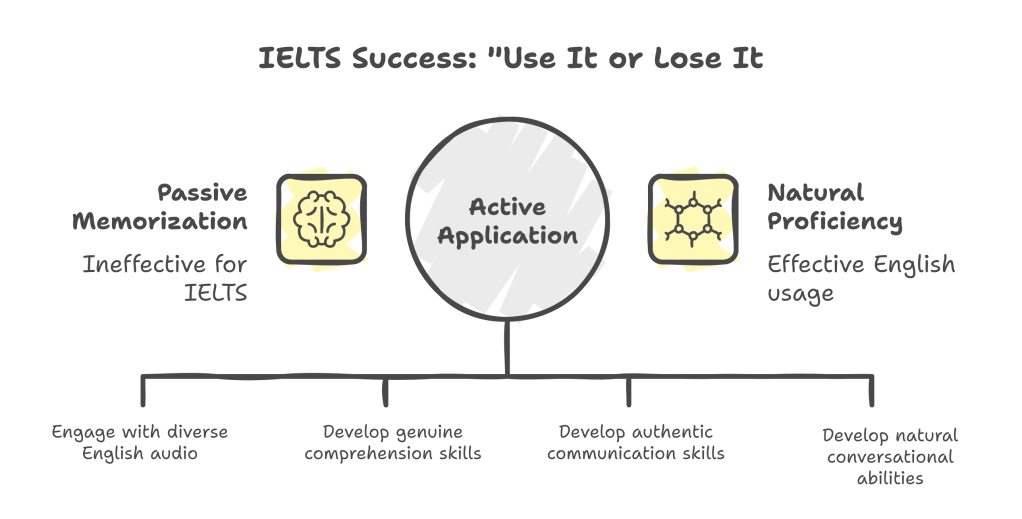
When preparing for the IELTS exam, many test-takers fall into the trap of treating it like a traditional academic test where cramming facts and memorizing templates might work. However, IELTS is fundamentally different—it’s an English proficiency test that evaluates your ability to use the language naturally and effectively in real-world contexts. This is where the “use it or lose it” principle becomes crucial for achieving your target band score.
Understanding the “Use It or Lose It” Philosophy
The “use it or lose it” approach is rooted in how our brains actually acquire and retain language skills. Unlike factual information that can be memorized temporarily, language proficiency requires consistent, active engagement to develop neural pathways that make English usage feel natural and automatic. When you actively use what you learn, you strengthen these connections. When you don’t, they weaken—hence, “use it or lose it.”
This principle applies to every aspect of IELTS preparation, from vocabulary acquisition to complex grammatical structures, and from listening comprehension strategies to speaking fluency. The key insight is that knowing about English is vastly different from being able to use English effectively under exam conditions.
Why Memorization Falls Short in IELTS
The Template Trap
Many test-takers believe they can succeed by memorizing essay templates, standard phrases, or prepared answers for speaking topics. While these might provide temporary confidence, they often backfire during the actual exam. IELTS examiners are trained to identify memorized content, and using pre-learned chunks without genuine understanding can result in lower scores for several reasons:
- Lack of flexibility: Memorized templates don’t adapt well to unexpected question variations
- Unnatural language flow: Rehearsed phrases often sound mechanical and disconnect from authentic communication
- Limited vocabulary demonstration: Relying on templates prevents you from showcasing your true vocabulary range
- Coherence issues: Force-fitting memorized content can create logical gaps in your responses
The Passive Learning Problem
Traditional study methods that focus on passive consumption—reading grammar rules, listening to explanations, or reviewing vocabulary lists—create an illusion of progress. You might feel like you’re learning, but without active application, this knowledge remains inert. When exam pressure mounts, passive knowledge often fails to translate into effective performance.
Implementing “Use It or Lose It” Across All IELTS Sections
Listening: Active Engagement Beyond Practice Tests
Instead of: Simply completing practice tests and checking answers Do this: Engage with diverse English audio content daily
- Listen to podcasts on topics that interest you and summarize key points
- Watch documentaries and predict what speakers will say next
- Practice shadowing exercises with news broadcasts to improve your ear for different accents
- Use English audio while doing daily activities to normalize English input
- Actively predict, question, and respond mentally to what you hear
Application Strategy: Choose one podcast episode weekly and listen three times—first for general understanding, second for specific details, and third while taking notes as if it were an IELTS listening task.
Reading: Critical Thinking Over Speed Reading
Instead of: Racing through practice passages focused only on finding answers Do this: Develop genuine reading comprehension skills
- Read articles from sources similar to IELTS passages (The Guardian, National Geographic, Scientific American) and discuss them with study partners
- Practice identifying authors’ attitudes and purposes in various texts
- Compare how different writers approach similar topics
- Analyze the structure of well-written articles to understand organization patterns
- Engage with texts by asking questions: “What evidence supports this claim?” or “How might critics respond to this argument?”
Application Strategy: Daily reading habit of 30 minutes using authentic materials, followed by teaching or explaining the content to someone else—this forces active processing of information.
Writing: Communication Over Mechanical Structure
Instead of: Learning essay formulas and practicing isolated writing tasks Do this: Develop authentic written communication skills
- Write daily journal entries about current events, expressing your opinions with supporting reasons
- Engage in online discussions or forums where you must articulate complex ideas clearly
- Practice explaining processes or describing changes you observe in your environment
- Write letters or emails to English-speaking friends or pen pals
- Create content on topics you’re passionate about—blog posts, social media content, or reviews
Application Strategy: Write something in English every day, even if it’s just a paragraph. Focus on clarity and coherence rather than perfect grammar. Then, once weekly, apply IELTS-specific requirements to your natural writing style.
Speaking: Conversation Over Recitation
Instead of: Memorizing answers to common IELTS topics Do this: Develop natural conversational abilities
- Engage in regular conversations with English speakers about varied topics
- Practice thinking aloud in English during daily activities
- Record yourself discussing current events or personal experiences, then analyze your fluency and coherence
- Join English-speaking clubs, online conversation groups, or language exchange programs
- Practice impromptu speaking on random topics to build flexibility
Application Strategy: Daily English self-talk sessions where you explain your day, discuss news events, or debate pros and cons of various issues. This builds the mental agility needed for IELTS speaking tasks.
Building Consistent Application Habits
The 80/20 Rule for IELTS Success
Dedicate 80% of your study time to active use and application, and only 20% to passive learning activities like reviewing grammar rules or memorizing vocabulary lists. This ratio ensures that you’re building practical proficiency rather than theoretical knowledge.
Cross-Section Integration
Don’t compartmentalize your practice. Instead, integrate skills across sections:
- Use vocabulary from reading passages in your speaking practice
- Apply listening strategies to understand pronunciation patterns for your own speaking
- Draw writing inspiration from high-quality reading materials
- Use speaking practice to reinforce grammar patterns needed for writing
The Spiral Learning Approach
Rather than mastering one skill before moving to another, cycle through all areas regularly with increasing complexity. For example:
- Week 1: Basic opinion expression across all sections
- Week 2: Adding supporting details and examples
- Week 3: Incorporating complex grammatical structures
- Week 4: Refining accuracy and natural flow
This approach ensures continuous reinforcement and prevents skill decay.
Measuring Real Progress vs. False Confidence
Authentic Assessment Methods
Track your progress through real-world application rather than just practice test scores:
- Can you have spontaneous conversations about complex topics without preparation?
- Do you naturally use varied vocabulary and grammar structures when writing informally?
- Can you understand authentic English content without struggling?
- Are you thinking in English rather than translating from your native language?
The Comfort Zone Challenge
Regularly push beyond familiar territory. If you’re comfortable discussing education and technology, deliberately practice with arts, environment, or social issues. If you typically write formal essays, try informal letters or reports. This versatility is crucial for IELTS success.
Common Pitfalls to Avoid
Over-reliance on IELTS-specific Materials
While IELTS practice materials are important, using only these resources creates an artificial learning environment. Real English proficiency comes from engaging with authentic materials and situations.
Perfectionism Paralysis
Many students wait until they feel “ready” before applying what they’ve learned. This approach is counterproductive. Make mistakes early and often—they’re learning opportunities, not failures.
Inconsistent Practice
Intensive study sessions followed by long breaks are less effective than consistent daily practice. Language skills are like physical fitness—they require regular maintenance.
Creating Your “Use It or Lose It” Study Plan
Daily Non-Negotiables (15-30 minutes each)
- English Input: Consume authentic English content (news, podcasts, videos)
- Active Output: Speak or write something original in English
- Skill Integration: Apply something you learned yesterday in a new context
Weekly Intensives (2-3 hours each)
- Deep Reading: Analyze complex texts for structure and argumentation
- Extended Speaking: Have lengthy conversations or practice presentations
- Writing Projects: Compose longer pieces that require organization and development
Monthly Assessments
Take full practice tests not just to check your score, but to identify which skills need more active application in your daily routine.
Conclusion: Making English a Living Skill
The “use it or lose it” approach transforms IELTS preparation from test cramming into genuine English skill development. When you actively engage with the language daily, apply lessons immediately, and integrate skills across contexts, you build the kind of natural proficiency that IELTS examiners recognize and reward.
Remember, IELTS success isn’t about perfect memorization—it’s about demonstrating that you can use English effectively for academic and professional purposes. By making English a living part of your daily experience rather than just a subject to study, you’re not only preparing for the test but developing skills that will serve you well beyond the exam room.
The journey may require more effort than passive studying, but the results are more reliable, longer-lasting, and genuinely useful for your future academic and professional endeavors. Start applying what you learn today—because in language learning, as in life, you truly do use it or lose it.
#IELTSGuidePhil #IELTS #IELTSPreparation #IELTSSuccess #UseItOrLoseIt #ActiveLearning #LanguageLearning #EnglishProficiency #IELTSTips #StudyStrategy #ExamPreparation #EnglishFluency #IELTSStudy #LanguageSkills #TestPrep #EnglishLearning #StudyTips #IELTSGoals #PracticalEnglish #SkillBuilding #LearningTips
 IELTS Guide Phil
Leave a comment