
In the high-stakes environment of the IELTS exam, one critical mistake can significantly impact your band score and future opportunities. While it might seem counterintuitive, the path to IELTS success isn’t about showcasing everything you’ve ever learned about English—it’s about demonstrating complete mastery of what you genuinely know. This is the essence of the “100% Rule”: on test day, only use skills, techniques, vocabulary, and strategies that you are absolutely confident in.
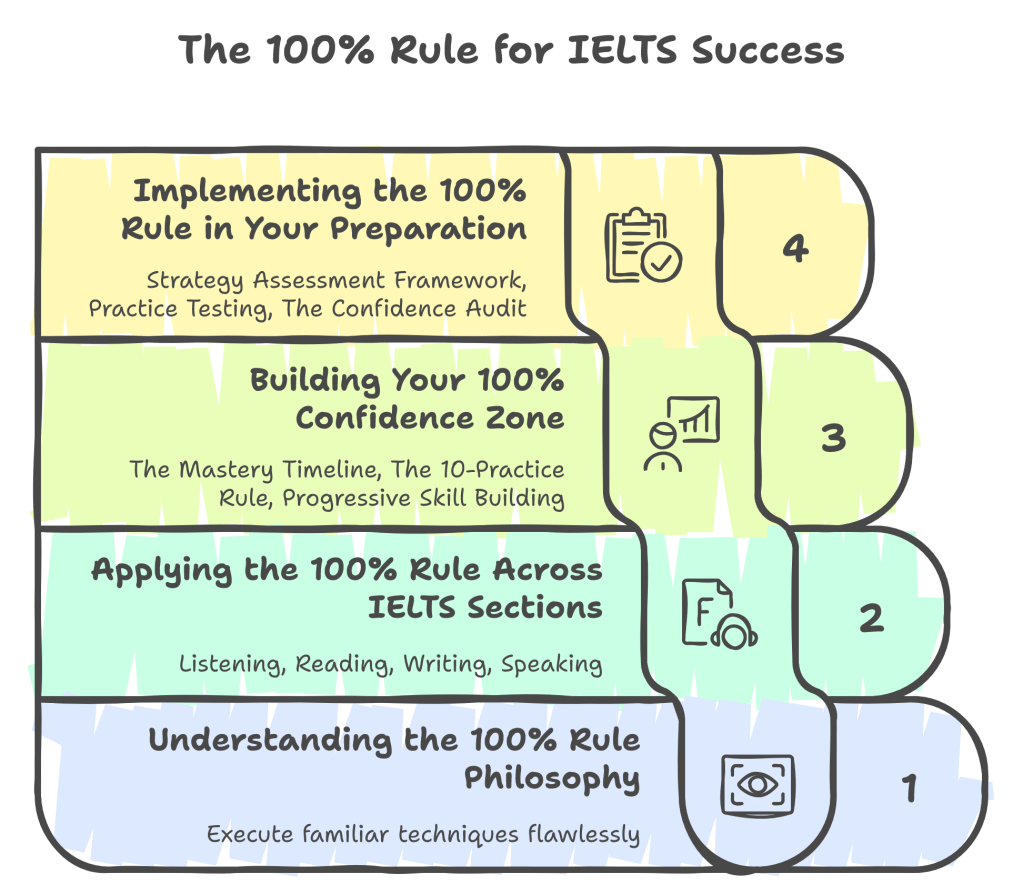
Understanding the 100% Rule Philosophy
The 100% Rule operates on a simple but powerful principle: it’s better to execute familiar techniques flawlessly than to attempt advanced skills that you haven’t fully mastered. IELTS examiners and automated scoring systems are designed to detect authenticity, accuracy, and natural language use. When you attempt something you’re uncertain about, several things can go wrong:
- Accuracy drops dramatically, affecting your grammar and vocabulary scores
- Fluency becomes choppy as you hesitate and self-correct
- Coherence suffers when complex structures don’t work as intended
- Confidence erodes, creating a negative spiral that impacts the entire exam
The 100% Rule doesn’t mean limiting yourself to basic English. Instead, it means building a reliable foundation of skills that you can deploy confidently under pressure, then gradually expanding this foundation during your preparation period.
The Psychology Behind Test-Day Performance
Pressure and Cognitive Load
Under exam conditions, your cognitive resources are already stretched. You’re managing time pressure, test anxiety, complex instructions, and the need to monitor your performance simultaneously. When you add the mental burden of attempting unfamiliar techniques, you create cognitive overload that can cause even your strongest skills to falter.
Research in cognitive psychology shows that under stress, people default to their most practiced behaviors. Skills that feel uncertain in practice will become unreliable under pressure. This is why the 100% Rule emphasizes deep mastery over superficial familiarity.
The Confidence-Performance Loop
Confidence and performance create a positive feedback loop in language testing. When you use techniques you’re certain about, you perform them well, which boosts your confidence, which improves your subsequent performance. Conversely, uncertainty creates hesitation, leading to mistakes, which undermines confidence and creates a downward spiral.
Applying the 100% Rule Across IELTS Sections
Listening: Stick to Proven Prediction Strategies
What NOT to do on test day:
- Attempt complex note-taking systems you’ve only practiced a few times
- Use unfamiliar abbreviation systems under time pressure
- Try advanced prediction techniques you’re not completely comfortable with
100% Rule Application:
- Use only the prediction strategies you’ve practiced extensively and can apply automatically
- Stick to abbreviation systems that feel natural and don’t require conscious thought
- Employ familiar listening techniques that you’ve used successfully in multiple practice sessions
Confidence Building Strategy: Practice each listening technique until it becomes automatic. If you can’t apply a strategy while having a conversation or watching TV, don’t rely on it during the exam. Your listening techniques should be so well-practiced that they enhance rather than distract from your comprehension.
Reading: Master Your Skimming and Scanning Approach
What NOT to do on test day:
- Experiment with new time management approaches you haven’t thoroughly tested
- Attempt unfamiliar question-type strategies
- Use complex passage analysis techniques you’re unsure about
100% Rule Application:
- Employ only the skimming and scanning techniques that consistently work for you in practice
- Use familiar approaches for each question type—True/False/Not Given, matching headings, etc.
- Stick to proven time allocation strategies that you’ve validated through multiple full-length practice tests
Confidence Building Strategy: Create a personal “reading playbook”—a set of strategies that work reliably for you. Test this playbook under various conditions until you can apply it without conscious effort. If a technique doesn’t work consistently in practice, don’t count on it working under exam pressure.
Writing: Deploy Only Mastered Structures and Vocabulary
What NOT to do on test day:
- Attempt complex grammatical structures you’ve recently learned but haven’t fully internalized
- Use sophisticated vocabulary that you’re not completely confident about
- Try new essay organization patterns you haven’t practiced extensively
100% Rule Application:
- Use grammatical structures that you can produce accurately and naturally
- Deploy vocabulary that you genuinely understand and can use correctly in various contexts
- Follow essay organization patterns that you’ve practiced until they feel automatic
Confidence Building Strategy: Build your writing around a core set of reliable structures and vocabulary. Gradually expand this core during preparation, but only add new elements to your “test-day arsenal” after you’ve used them successfully in multiple practice essays. Create a personal vocabulary bank of words and phrases you’re 100% confident about.
Task 1 Specific Application:
- Use only the descriptive language and comparison structures you’ve mastered
- Stick to familiar ways of describing trends, changes, and data relationships
- Employ proven paragraph organization that doesn’t require conscious planning
Task 2 Specific Application:
- Develop and practice 2-3 reliable essay structures that work for different question types
- Build a bank of connecting words and phrases you can use automatically
- Practice expressing complex ideas using grammar and vocabulary you’re completely comfortable with
Speaking: Authentic Communication Over Impressive Performance
What NOT to do on test day:
- Force in recently learned idioms or advanced vocabulary that doesn’t come naturally
- Attempt complex grammatical structures that make you hesitate or self-correct frequently
- Use memorized phrases that don’t fit naturally into the conversation
100% Rule Application:
- Communicate using vocabulary and structures that feel natural and automatic
- Express complex ideas using language patterns you’re completely comfortable with
- Focus on clear, coherent communication rather than linguistic acrobatics
Confidence Building Strategy: Develop your speaking around topics and language that genuinely reflect your interests and natural communication style. Practice expressing complex thoughts using familiar language patterns until you can do so fluently and accurately.
Building Your 100% Confidence Zone
The Mastery Timeline
Building 100% confidence in a skill follows a predictable pattern:
- Initial Learning Phase: You understand the concept but application is conscious and effortful
- Practice Phase: You can apply the skill with concentration but it requires mental resources
- Fluency Phase: The skill becomes automatic and doesn’t interfere with other cognitive tasks
- Mastery Phase: You can apply the skill reliably under pressure and adapt it to unexpected situations
Only skills that have reached the Mastery Phase should be part of your test-day strategy.
The 10-Practice Rule
A useful guideline is that any technique, vocabulary item, or strategy should be successfully applied in at least 10 different practice contexts before you consider it “test-day ready.” This might mean:
- Using a grammatical structure correctly in 10 different writing tasks
- Successfully applying a listening strategy across 10 different audio types
- Deploying vocabulary naturally in 10 different speaking contexts
- Executing a reading technique effectively across 10 different passage types
Progressive Skill Building
Rather than cramming new techniques close to your test date, follow a progressive building approach:
3 Months Before Test: Focus on expanding your skill set, experimenting with new techniques 2 Months Before Test: Narrow down to techniques that show promise, intensive practice 1 Month Before Test: Finalize your test-day toolkit, focusing only on reliable skills Test Week: Practice only with your established, confident techniques
Common Violations of the 100% Rule (And Their Consequences)
The “Impress the Examiner” Trap
Many candidates believe they need to use the most advanced vocabulary and complex structures to achieve high band scores. This often backfires when:
- Complex vocabulary is used incorrectly, lowering lexical resource scores
- Advanced grammar is attempted but executed poorly, reducing accuracy scores
- Natural flow is disrupted by forced complexity, affecting fluency and coherence
Better Approach: Use simpler language accurately and naturally. Band 7-9 scores come from appropriate and accurate language use, not from complexity for its own sake.
Last-Minute Strategy Changes
Some candidates learn new techniques days before the test and attempt to use them. This typically results in:
- Increased anxiety as unfamiliar techniques feel unreliable
- Cognitive overload as mental resources are diverted from actual English use
- Inconsistent performance as some techniques work while others fail
Better Approach: Finalize your strategy at least two weeks before the test and use remaining time to reinforce confidence in your chosen approach.
The “Safety Net” Fallback
Candidates sometimes prepare backup strategies for difficult situations but don’t practice these thoroughly. Under pressure, poorly-practiced backup strategies often fail when needed most.
Better Approach: Your primary strategies should be so well-developed that they handle most situations effectively. If you need backup strategies, practice them to the same level of confidence as your main approaches.
Implementing the 100% Rule in Your Preparation
Strategy Assessment Framework
For each technique or strategy in your preparation, ask:
- Automaticity: Can I apply this without conscious effort while focusing on other tasks?
- Reliability: Does this work consistently across different practice contexts?
- Pressure-Resistance: Have I tested this successfully under time pressure and stress conditions?
- Adaptability: Can I modify this technique when unexpected situations arise?
- Integration: Does this technique work smoothly with my other strategies?
Only techniques that meet all five criteria should be part of your test-day approach.
Practice Testing Your 100% Zone
Regularly take practice tests using only your “100% confident” skills. This serves two purposes:
- It reveals whether your confident skills are sufficient for your target band score
- It identifies skills that feel confident in isolation but become unreliable in full test conditions
The Confidence Audit
One month before your test, conduct a thorough audit:
Vocabulary: Create a list of words and phrases you can use accurately and naturally. Stick to this list during the test.
Grammar: Identify structures you can produce correctly without hesitation. These form your grammatical toolkit for test day.
Strategies: List techniques that work reliably for you across different practice scenarios.
Topics: Note subjects you can discuss confidently and thoroughly (especially important for Speaking Part 2).
Advanced Applications of the 100% Rule
Situational Confidence
Some skills might be 100% reliable in certain contexts but not others. For example:
- You might be completely confident discussing technology topics but uncertain about environmental issues
- Certain grammatical structures might be reliable in writing but feel awkward in speaking
- Some listening strategies might work perfectly with American accents but feel uncertain with British accents
Map your confidence levels across different contexts and prepare accordingly.
The Strategic Simplicity Advantage
The 100% Rule often leads to what experts call “strategic simplicity”—using straightforward language to express complex ideas effectively. This approach has several advantages:
- Higher accuracy rates as you’re using familiar language patterns
- Better fluency since you’re not struggling with unfamiliar structures
- Clearer communication as simple, well-constructed sentences are often more effective than complex, uncertain ones
- Reduced anxiety from knowing you can handle any topic with your reliable skills
Confidence Under Pressure Training
To truly test whether a skill is “100% confident,” practice it under increasingly challenging conditions:
- Time pressure scenarios
- Noisy environments (for listening practice)
- Interrupted practice sessions
- Multiple skills simultaneously
- When you’re tired or stressed
Skills that remain reliable under these conditions are truly test-day ready.
Recovery Strategies When Things Go Wrong
Even with the 100% Rule, unexpected situations can arise during the test. Prepare confidence-based recovery strategies:
Listening Recovery
If you miss something despite using your reliable techniques:
- Use your well-practiced context-cluing skills rather than attempting unfamiliar strategies
- Stick to your proven prediction methods for upcoming questions
- Don’t abandon reliable techniques because of one difficult section
Reading Recovery
When facing unexpectedly difficult passages:
- Return to your most basic, reliable skimming and scanning techniques
- Use familiar question-type approaches rather than experimenting with new methods
- Trust your established time management strategy
Writing Recovery
If you realize you’ve made an error or your essay isn’t developing as planned:
- Use familiar vocabulary and structures to complete your response
- Apply your most reliable organization patterns
- Don’t attempt to demonstrate new skills while under pressure
Speaking Recovery
When you stumble or feel uncertain during speaking:
- Return to topics and language you’re completely comfortable with
- Use your most natural vocabulary and structures
- Maintain fluency with familiar language rather than attempting impressive recovery
Long-term Benefits of the 100% Rule
Building Genuine Proficiency
The 100% Rule encourages deep learning rather than surface-level familiarity. This approach builds genuine English proficiency that serves you well beyond the IELTS test in academic and professional contexts.
Sustainable Confidence
Success achieved through the 100% Rule builds lasting confidence in your English abilities. You know that your good performance reflects genuine skill rather than lucky guessing or temporary memorization.
Transferable Skills
The principle of mastering fundamentals before attempting advanced techniques applies to many areas of life. Students who learn this approach for IELTS often apply it successfully to other academic and professional challenges.
Conclusion: Confidence as Your Competitive Advantage
In IELTS, your greatest competitive advantage isn’t the complexity of your English—it’s the confidence and reliability with which you use it. The 100% Rule transforms test day from a high-risk performance into a demonstration of skills you’ve genuinely mastered.
Remember that IELTS band scores are achieved through consistent, accurate, and appropriate language use across all test sections. A candidate who uses band 6-7 level English with complete confidence and accuracy will often outperform someone attempting band 8-9 level language with uncertainty and errors.
The 100% Rule requires discipline during preparation—you must resist the temptation to keep adding new techniques and instead focus on perfecting what you know. However, this approach pays dividends on test day when your well-practiced skills perform reliably under pressure.
Your test-day performance should feel like a natural demonstration of abilities you’ve developed and refined over time, not a high-stakes experiment with unfamiliar techniques. When you can walk into the IELTS exam knowing that every strategy you plan to use has been tested and proven reliable, you transform a potentially stressful experience into a confident showcase of your English proficiency.
Master what you know, and let that mastery carry you to your target band score.
#IELTSGuidePhil #IELTS #IELTSPreparation #IELTSSuccess #100PercentRule #IELTSConfidence #TestDayStrategy #IELTSTips #ExamConfidence #IELTSMastery #StudyStrategy #TestPrep #IELTSStudy #ExamPreparation #LanguageLearning #IELTSGoals #StudyTips #ExamSuccess #IELTSAdvice #PracticeToMastery #ReliableSkills
 IELTS Guide Phil
Leave a comment