
Pronunciation is the final piece of the IELTS Speaking puzzle, representing 25% of your total band score. This criterion evaluates how clearly and naturally you produce English sounds, words, and connected speech. Unlike the other three criteria that focus on content and structure, pronunciation is about the physical production of speech and how well listeners can understand you. Mastering pronunciation can be the difference between a good score and an exceptional one. You can watch this YouTube video explainer by IELTS Guide Phil.
What is Pronunciation in IELTS?
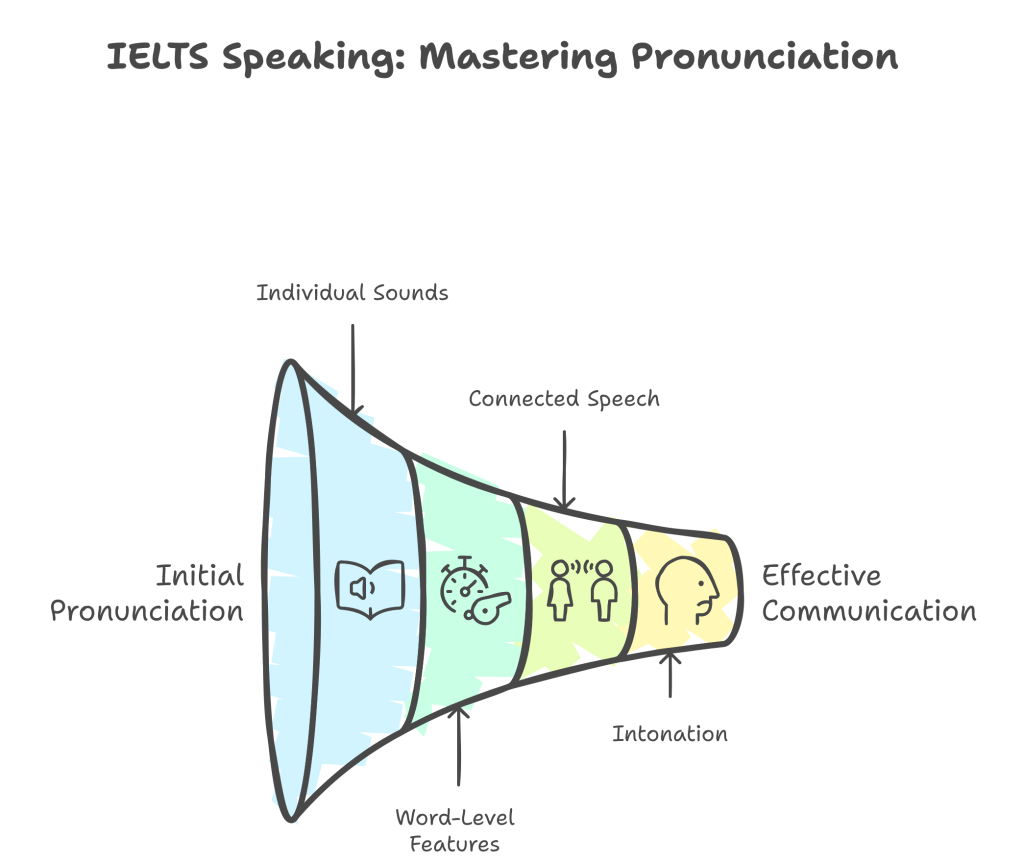
Pronunciation encompasses several interconnected elements of spoken English:
Individual Sounds (Phonemes):
- Vowel sounds (/i:/, /ɪ/, /e/, /æ/, etc.)
- Consonant sounds (/θ/, /ð/, /ʃ/, /ʒ/, etc.)
- Consonant clusters (str-, -nts, -ths)
Word-Level Features:
- Word stress patterns
- Weak forms of function words
- Syllable structure and timing
Connected Speech:
- Linking between words
- Rhythm and timing
- Sentence stress and emphasis
Intonation:
- Rising and falling patterns
- Question intonation
- Emotional and attitudinal meaning
The key insight is that IELTS pronunciation isn’t about achieving a “perfect” native accent—it’s about being clearly understood and using pronunciation features that support effective communication.
Understanding the Band Descriptors
Band 9 – Expert User
- Uses a full range of pronunciation features with precision and subtlety
- Sustains flexible use of features throughout
- Is effortless to understand
- Shows complete control of phonological features
Band 8 – Very Good User
- Uses a wide range of pronunciation features
- Sustains flexible use most of the time
- Is easy to understand throughout; L1 accent has minimal effect on intelligibility
- Shows good control with occasional lapses
Band 7 – Good User
- Shows all positive features of Band 6 and many positive features of Band 8
- Uses a range of pronunciation features with mixed control
- Generally easy to understand throughout; L1 accent may affect clarity occasionally
- Shows good control of phonological features
Band 6 – Competent User
- Uses a range of pronunciation features with mixed control
- Shows some effective use of features but not sustained
- Generally intelligible throughout, though misunderstandings can occur
- L1 accent may noticeably affect intelligibility
Band 5 – Modest User
- Shows some effective use of pronunciation features
- Sustained use is limited
- Overall intelligible despite L1 influence
- Mispronunciations may strain the listener at times
Band 4 and Below
- Uses a limited range of pronunciation features
- Attempts to control features but lapses are frequent
- Mispronunciations are frequent and cause strain for the listener
- Difficult to understand at times
Key Components of Effective Pronunciation
1. Individual Sound Production
Problematic Vowel Sounds:
- /i:/ vs /ɪ/: “sheep” vs “ship”, “reach” vs “rich”
- /e/ vs /æ/: “pen” vs “pan”, “bed” vs “bad”
- /ɔ:/ vs /ɒ/: “caught” vs “cot”, “saw” vs “sock”
Challenging Consonant Sounds:
- /θ/ vs /f/: “think” vs “fink”, “mouth” vs “mouf”
- /ð/ vs /d/: “this” vs “dis”, “breathe” vs “breed”
- /v/ vs /w/: “very” vs “wery”, “visit” vs “wisit”
- /r/ vs /l/: “right” vs “light”, “pray” vs “play”
2. Word Stress Patterns
Two-Syllable Words:
- Nouns: Usually first syllable (PRE-sent, RE-cord)
- Verbs: Usually second syllable (pre-SENT, re-CORD)
Multi-Syllable Words:
- Photography (pho-TOG-ra-phy)
- Economic (e-co-NOM-ic)
- University (u-ni-VER-si-ty)
3. Connected Speech Features
Linking:
- Consonant to vowel: “an apple” → “a-napple”
- Vowel to vowel: “go out” → “go-wout”
- Consonant to consonant: “big car” → “bi-gcar”
Weak Forms:
- “and” → /ən/ or /n/
- “to” → /tə/
- “can” → /kən/ (positive), /kænt/ (negative)
- “was” → /wəz/
4. Rhythm and Stress Patterns
English follows a stress-timed rhythm:
- “The CATS are SLEEping in the GARden”
- Content words receive stress
- Function words are typically unstressed and shortened
5. Intonation Patterns
Statement Intonation (falling): “I live in London ↘”
Yes/No Question Intonation (rising): “Are you coming tonight ↗”
Wh-Question Intonation (falling): “Where do you work ↘”
List Intonation: “I like apples ↗, oranges ↗, and bananas ↘”
Pronunciation by IELTS Speaking Parts
Part 1 – Personal Questions
Focus Areas:
- Clear articulation of personal information
- Correct stress on names, places, and occupations
- Natural intonation for simple responses
Example Analysis: Question: “What’s your job?” Response: “I work as a SOFTWARE engiNEER in a TECH company.”
- Stress on: SOFTWARE, -NEER, TECH
- Clear /w/ sound in “work”
- Schwa in unstressed syllables
Part 2 – Long Turn
Focus Areas:
- Sustained clear pronunciation over 2 minutes
- Narrative stress patterns
- Smooth transitions between ideas
- Descriptive intonation patterns
Example Analysis: Topic: Describe a memorable journey Response: “The JOURney I’d like to deSCRIBE took PLACE last SUMmer when I TRAveled to JaPAN…”
- Content word stress maintained
- Weak forms: “I’d” /aɪd/, “to” /tə/
- Rising intonation on incomplete thoughts
Part 3 – Abstract Discussion
Focus Areas:
- Complex sentence intonation
- Contrastive stress for emphasis
- Opinion-marking intonation
- Academic register pronunciation
Example Analysis: Topic: Education systems Response: “While tradiTIOnal eDUcation has its MERits, I beLIEVE that MOdern apPROACHes…”
- Contrastive stress: tradiTIOnal vs MOdern
- Opinion markers with appropriate intonation
- Complex sentence rhythm
Common Pronunciation Challenges by Language Background
Spanish Speakers
Common Issues:
- /i/ vs /ɪ/: “sheet” vs “shit”
- /b/ vs /v/: “berry” vs “very”
- Adding /e/ before /sp/, /st/: “especial” instead of “special”
Solutions:
- Practice minimal pairs extensively
- Focus on lip position for /v/
- Practice consonant clusters without vowel insertion
Chinese Speakers
Common Issues:
- /r/ vs /l/ confusion
- Missing final consonants
- Tone transfer affecting intonation
Solutions:
- Tongue position practice for /r/ and /l/
- Final consonant completion exercises
- English rhythm pattern practice
Arabic Speakers
Common Issues:
- /p/ vs /b/ confusion
- Vowel length distinctions
- /θ/ and /ð/ sounds
Solutions:
- Lip closure practice for /p/
- Timed vowel exercises
- Tongue tip placement for th-sounds
Japanese Speakers
Common Issues:
- /r/ and /l/ distinction
- Consonant cluster difficulties
- Vowel insertion in clusters
Solutions:
- Minimal pair drills
- Cluster pronunciation without vowels
- Connected speech practice
Advanced Pronunciation Techniques
1. Thought Groups and Pausing
Break speech into meaningful chunks: “If I had more time | I would definitely travel more | especially to countries | I’ve never visited before.”
2. Emphatic Stress
Use stress to highlight important information:
- “I LOVE chocolate” (not just like)
- “She’s ALWAYS late” (emphasizing frequency)
- “THAT’S the problem” (identifying specific issue)
3. Contrastive Stress
Highlight differences through stress:
- “I said FIFTEEN, not FIFTY”
- “It’s not what you SAID, it’s HOW you said it”
- “I prefer TEA to coffee”
4. Intonation for Attitude
Express emotions and attitudes through pitch changes:
- Enthusiasm: Higher pitch range, more variation
- Uncertainty: Rising intonation on statements
- Contrast: Fall-rise intonation
- Finality: Strong falling intonation
Practical Improvement Strategies
1. Sound Awareness Building
- Phoneme identification: Use pronunciation apps or dictionaries
- Minimal pair practice: Focus on problematic sound contrasts
- Recording comparison: Record yourself vs. native speaker models
- Mirror practice: Watch mouth movements while practicing
2. Connected Speech Training
- Shadowing exercises: Repeat after audio simultaneously
- Chunk practice: Focus on thought groups rather than individual words
- Linking exercises: Practice specific connecting patterns
- Weak form integration: Learn common reductions
3. Rhythm and Stress Development
- Beat tapping: Tap rhythm while speaking
- Stress marking: Mark content words in practice texts
- Sentence stress drills: Practice emphasizing different words
- Poetry reading: Use rhythmic texts for practice
4. Intonation Training
- Humming practice: Hum intonation patterns without words
- Emotion practice: Express same content with different attitudes
- Question types: Master different question intonation patterns
- Conversation practice: Focus on natural dialogue patterns
Technology Tools for Pronunciation
Mobile Apps
- Sounds Pronunciation App: Individual phoneme practice
- ELSA Speak: AI-powered pronunciation feedback
- Speechling: Human coach pronunciation assessment
- Forvo: Native speaker pronunciation dictionary
Online Resources
- Cambridge Online Dictionary: Pronunciation with audio
- YouGlish: Real-world pronunciation examples from videos
- Rachel’s English: Detailed pronunciation tutorials
- Pronunciation Studio: British English focused training
Recording and Analysis
- Voice Memo apps: Self-monitoring and comparison
- Audacity: Free audio editing for detailed analysis
- Language exchange platforms: Real conversation practice
- Online tutoring: Professional pronunciation coaching
Common Pronunciation Mistakes and Solutions
Mistake 1: Ignoring Word Stress
Problem: All syllables pronounced with equal stress Example: “in-for-ma-tion” instead of “in-for-MA-tion” Solution: Learn stress patterns systematically and practice with exaggerated stress initially
Mistake 2: Monotone Delivery
Problem: Flat intonation throughout speech Solution: Practice varying pitch for different sentence types and emotions
Mistake 3: Sound Substitution
Problem: Replacing difficult sounds with easier ones Example: “sink” instead of “think” Solution: Learn correct tongue and lip positions through focused practice
Mistake 4: Overpronunciation
Problem: Pronouncing every sound too clearly, including weak forms Example: “I AM going TO the SHOP” instead of natural “I’m going tə thə shop” Solution: Learn and practice natural weak forms and reductions
Mistake 5: Spelling Pronunciation
Problem: Pronouncing words as they’re spelled rather than as they sound Example: “Wednesday” as “Wed-nes-day” instead of “Wenz-day” Solution: Learn common spelling-sound discrepancies in English
Mistake 6: L1 Rhythm Transfer
Problem: Using native language rhythm patterns in English Solution: Practice English stress-timing through rhythm exercises
Daily Pronunciation Practice Routine
5-Minute Quick Sessions
- Warm-up: Jaw, tongue, and lip exercises (1 minute)
- Sound focus: Practice 5 minimal pairs (2 minutes)
- Connected speech: Read aloud with focus on linking (2 minutes)
15-Minute Focused Sessions
- Individual sounds: Target specific problematic phonemes (5 minutes)
- Word stress: Practice multi-syllable words (3 minutes)
- Sentence stress: Read passages marking content words (4 minutes)
- Recording: Record and analyze short speech sample (3 minutes)
30-Minute Comprehensive Sessions
- Phoneme drills: Systematic sound practice (8 minutes)
- Connected speech: Shadowing exercises (7 minutes)
- Intonation patterns: Question and statement practice (5 minutes)
- Rhythm training: Stress-timing exercises (5 minutes)
- Free speech: Practice with self-monitoring (5 minutes)
Frequently Asked Questions
Q: Do I need to sound like a native speaker to get Band 9? A: No. IELTS pronunciation focuses on intelligibility and control of features, not native-like accent. You can achieve Band 9 with a clear foreign accent as long as you demonstrate sophisticated control of pronunciation features.
Q: Which accent should I use – British or American? A: Either is acceptable, and mixing them won’t significantly impact your score. Focus on consistency and clarity rather than perfect accent adherence. Choose the variety you’re most comfortable with and have most exposure to.
Q: How important are individual sound errors compared to overall intelligibility? A: Overall intelligibility is more important. Occasional sound errors won’t severely impact your score if communication remains clear. However, systematic sound errors that cause confusion will affect your band score.
Q: Can I improve pronunciation quickly before the test? A: While some improvement is possible, pronunciation typically requires consistent long-term practice. Focus on your most problematic areas and prioritize features that most affect intelligibility. Word stress and connected speech often show faster improvement than individual sounds.
Q: Should I focus more on sounds or on stress and intonation? A: Both are important, but stress and intonation often have greater impact on intelligibility. If time is limited, prioritize word stress, sentence stress, and basic intonation patterns while addressing your most problematic individual sounds.
Q: How do I know if my pronunciation is good enough for my target band? A: Record yourself regularly and compare with band descriptors. Seek feedback from teachers or native speakers. If listeners understand you easily without strain and you demonstrate range in pronunciation features, you’re likely in the higher bands.
Q: What if I can hear the difference but can’t produce it correctly? A: This is common in pronunciation learning. Perception often develops before production. Continue practicing with awareness – your production will gradually match your perception with consistent effort and proper technique.
Q: Are there any pronunciation features I should avoid in IELTS? A: Avoid overly casual speech features like extreme reductions or very informal intonation patterns. Also avoid hypercorrection – trying so hard to be clear that you sound unnatural. Aim for clear, natural speech appropriate for a formal interview.
Test Day Pronunciation Tips
Before the Test:
- Warm up your mouth: Do tongue twisters and articulation exercises
- Practice with mirrors: Check your mouth movements for key sounds
- Listen to English: Tune your ear to English rhythm and intonation
- Stay relaxed: Tension affects pronunciation negatively
During the Test:
- Speak clearly but naturally: Don’t over-articulate or speak too slowly
- Monitor your pace: Rushing leads to pronunciation errors
- Use appropriate volume: Ensure the examiner can hear you clearly
- Don’t worry about perfection: Focus on communication over perfect pronunciation
Managing Nerves:
- Breathe properly: Support your voice with good breathing
- Stay confident: Minor pronunciation errors are normal
- Self-correct briefly: If you notice an error, correct it and move on
- Focus on meaning: Prioritize getting your message across clearly
Long-Term Pronunciation Development
Building Awareness:
- Daily listening: Expose yourself to various English accents and styles
- Phonetic learning: Study IPA symbols for better sound awareness
- Video observation: Watch mouth movements in English media
- Error identification: Learn to recognize your specific challenges
Systematic Practice:
- Regular sessions: Consistent daily practice beats intensive occasional sessions
- Progressive difficulty: Start with individual sounds, progress to connected speech
- Variety in practice: Use different materials and contexts
- Integration focus: Practice pronunciation within meaningful communication
Professional Support:
- Pronunciation coaching: Consider specialized pronunciation training
- Speech therapy: For persistent difficulties affecting communication
- Language exchange: Practice with native speakers for natural feedback
- Group classes: Learn alongside others with similar challenges
Conclusion
Mastering pronunciation for IELTS requires understanding that it’s not about perfection—it’s about effective communication. Focus on the features that most impact intelligibility: clear individual sounds, appropriate word stress, natural rhythm, and meaningful intonation patterns.
Remember that pronunciation improvement is a gradual process requiring consistent practice and patience. Don’t expect overnight changes, but celebrate small improvements along the way. The most successful candidates balance accuracy with naturalness, demonstrating control over pronunciation features while maintaining clear, confident communication.
Your accent is part of your identity, and IELTS recognizes this. The goal isn’t to eliminate your accent but to ensure it doesn’t interfere with communication. With systematic practice and awareness of the key features assessed, you can achieve the pronunciation band score you need for your goals.
Most importantly, use every opportunity to speak English in real contexts. Join conversation groups, practice with language partners, or engage in English-speaking activities you enjoy. The more you use English naturally, the more automatic good pronunciation becomes.
Perfect your IELTS pronunciation through focused practice and awareness. Remember: clarity and control matter more than sounding like a native speaker.
#IELTSGuidePhil #IELTSSpeaking #Pronunciation #IELTSPronunciation #EnglishPronunciation #IELTSPreparation #SpeakingSkills #PhoneticsPractice #IELTS #EnglishLearning #IELTSTips #SpeakingTest #EnglishSounds #IELTSSuccess #EnglishFluency #WordStress #IELTSBandScore #SpeakingPractice #EnglishSpeaking #IELTSCoaching #IntonationPractice #ConnectedSpeech #EnglishRhythm #PronunciationTraining
 IELTS Guide Phil
Leave a comment