
Grammatical Range and Accuracy represents 25% of your IELTS Speaking score, making it one of the four crucial assessment criteria. This criterion evaluates not only your knowledge of English grammar structures but also your ability to use them accurately and appropriately in spontaneous speech. Understanding what examiners look for can transform your speaking performance from adequate to exceptional. You can watch this YouTube video explainer by IELTS Guide Phil.
What is Grammatical Range and Accuracy?
Grammatical Range and Accuracy encompasses two fundamental aspects of your English grammar skills:
Range refers to the variety of grammatical structures you can use effectively:
- Simple, compound, and complex sentence structures
- Different tense forms and aspects
- Various conditional forms
- Passive voice constructions
- Modal verbs and their variations
- Question forms and embedded questions
Accuracy measures how correctly you use these grammatical structures:
- Subject-verb agreement
- Correct tense usage
- Proper word order
- Accurate use of articles, prepositions, and pronouns
- Consistent grammar throughout your response
This criterion doesn’t expect perfect grammar—even native speakers make occasional slips. Instead, it assesses your overall grammatical competence and whether errors impede communication.
Understanding the Band Descriptors
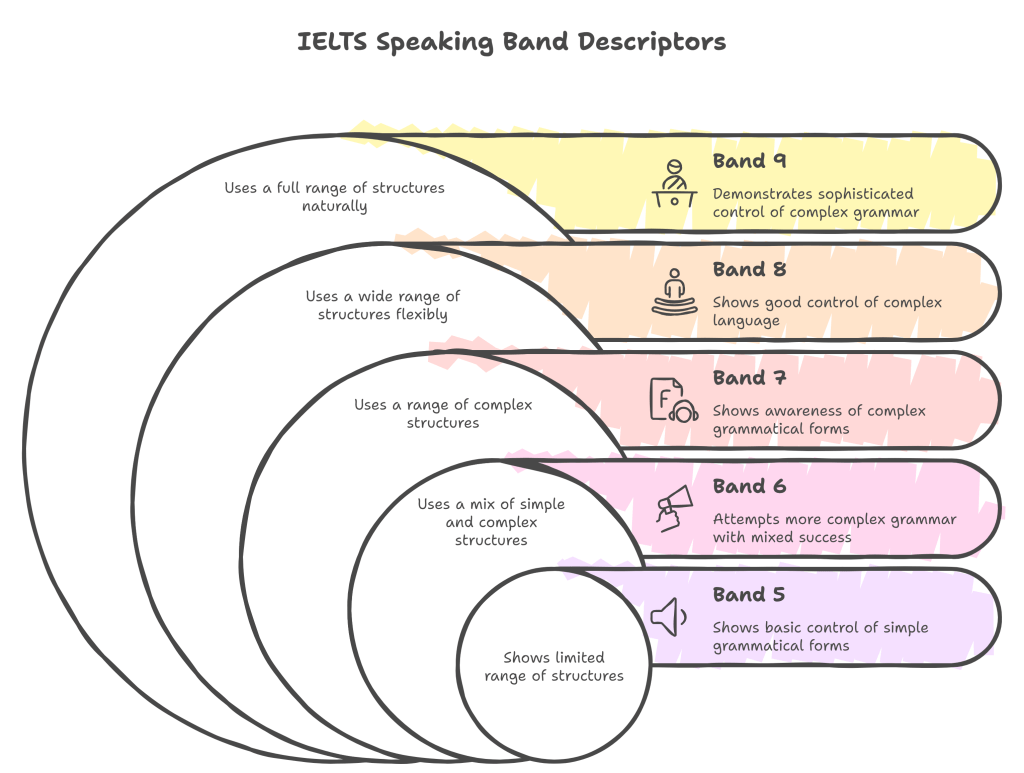
Band 9 – Expert User
- Uses a full range of structures naturally and appropriately
- Produces consistently accurate structures apart from ‘slips’ characteristic of native speaker speech
- Shows complete flexibility in grammatical usage
- Demonstrates sophisticated control of complex grammar
Band 8 – Very Good User
- Uses a wide range of structures flexibly
- Majority of sentences are error-free
- Makes only occasional errors or inappropriacies
- Shows good control of complex language features
Band 7 – Good User
- Uses a range of complex structures with some flexibility
- Frequently produces error-free sentences
- Has good control of grammar despite some errors
- Shows awareness of complex grammatical forms
Band 6 – Competent User
- Uses a mix of simple and complex structures
- Makes some errors in complex structures but rarely impedes communication
- Shows generally good control of simple structures
- Attempts more complex grammar with mixed success
Band 5 – Modest User
- Shows limited range of structures with repetitive patterns
- Attempts complex sentences but with frequent errors
- Errors may impede meaning at times
- Shows basic control of simple grammatical forms
Band 4 and Below
- Very limited range of structures
- Frequent errors that often impede communication
- Relies heavily on simple sentence patterns
- Shows little control of complex grammar
Key Grammatical Structures for High Scores
1. Complex Sentence Structures
Simple Enhancement: “I like traveling because it’s interesting.”
Complex Development: “What I find particularly fascinating about traveling is the opportunity it provides to immerse myself in different cultures, which has fundamentally broadened my perspective on life.”
2. Advanced Tense Usage
Basic Past Description: “I went to university and studied business.”
Advanced Temporal Relationships: “By the time I had completed my business degree, I had already been working part-time in marketing for two years, which gave me invaluable practical experience that complemented my theoretical knowledge.”
3. Conditional Structures
First Conditional: “If I have time tomorrow, I will visit the museum.” Second Conditional: “If I were the mayor, I would invest more in public transportation.” Third Conditional: “If I had studied harder in school, I might have pursued a career in medicine.” Mixed Conditionals: “If I hadn’t moved abroad, I wouldn’t be as confident speaking English as I am now.”
4. Passive Voice Variations
Present Passive: “English is spoken worldwide.” Past Passive: “The building was constructed in 1995.” Perfect Passive: “The project has been completed ahead of schedule.” Modal Passive: “This issue should be addressed immediately.”
5. Advanced Modal Usage
Certainty/Uncertainty: “It must be challenging” / “It might have been difficult” Advice/Recommendation: “You ought to consider…” / “I’d suggest that you…” Past Speculation: “She can’t have finished already” / “They must have left early”
Practical Examples by Question Types
Part 1 – Personal Questions
Basic Response: “I work in a bank. I like my job because it’s good.”
Advanced Response: “I’ve been working in the financial sector for the past five years, having started as a junior analyst before being promoted to my current role as a senior consultant. What I particularly appreciate about my position is the intellectual challenge it presents, as I’m constantly required to analyze complex market trends and develop strategic recommendations for our clients.”
Part 2 – Long Turn
Topic: Describe a person who has influenced you
Basic Grammar: “My teacher influenced me. She was very good. She helped me with English. I learned a lot from her.”
Advanced Grammar: “The person who has had the most profound impact on my development would have to be my high school English teacher, Mrs. Johnson. Not only did she possess an extraordinary ability to make literature come alive, but she also demonstrated unwavering patience when helping struggling students like myself. Had it not been for her encouragement, I doubt I would have developed the confidence to pursue higher education. What made her teaching style so effective was her belief that every student could succeed, provided they were given the right support and motivation.”
Part 3 – Abstract Discussion
Topic: Education systems
Basic Grammar: “Education is important. All countries should have good education. Students need to study hard.”
Advanced Grammar: “While it’s undeniable that education plays a crucial role in societal development, I believe the effectiveness of any educational system largely depends on how well it adapts to the changing needs of the modern workforce. Countries that have invested heavily in technology-enhanced learning and critical thinking skills tend to produce graduates who are better equipped to navigate the complexities of the 21st century. However, this isn’t to say that traditional educational approaches lack merit—rather, I’d argue that the most successful systems are those which manage to strike a balance between preserving valuable traditional elements while embracing innovative methodologies.”
Essential Grammar Structures by Proficiency Level
Band 6-7 Target Structures
- Complex sentences with subordinate clauses
- Present perfect and past perfect tenses
- Comparative and superlative forms
- First and second conditionals
- Passive voice in common tenses
- Modal verbs for speculation and advice
- Relative clauses (defining and non-defining)
Band 7-8 Target Structures
- Mixed conditionals
- Perfect continuous tenses
- Subjunctive mood
- Inversion for emphasis
- Cleft sentences (“What I find interesting is…”)
- Advanced passive constructions
- Reduced relative clauses
- Participle clauses
Band 8-9 Target Structures
- Complex conditional forms
- Sophisticated modal expressions
- Advanced participial constructions
- Ellipsis and substitution
- Fronting and emphasis
- Complex noun phrases
- Advanced discourse markers
Common Grammar Mistakes and Solutions
Mistake 1: Subject-Verb Agreement Errors
Problem: “The number of students who studies abroad have increased.” Solution: “The number of students who study abroad has increased.” Fix: Remember that “number” (singular) is the subject, not “students.”
Mistake 2: Incorrect Tense Sequencing
Problem: “When I was young, I will play football every day.” Solution: “When I was young, I would play football every day.” Fix: Use “would” for past habits, not “will.”
Mistake 3: Conditional Form Errors
Problem: “If I would have more time, I will travel more.” Solution: “If I had more time, I would travel more.” Fix: Second conditional uses “if + past simple” and “would + base verb.”
Mistake 4: Article Usage Problems
Problem: “I think the education is very important for the society.” Solution: “I think education is very important for society.” Fix: Don’t use articles with abstract nouns used in general sense.
Mistake 5: Preposition Confusion
Problem: “I’m interested for learning languages.” Solution: “I’m interested in learning languages.” Fix: Learn fixed preposition patterns with adjectives.
Mistake 6: Passive Voice Misuse
Problem: “This problem should be solve immediately.” Solution: “This problem should be solved immediately.” Fix: Use past participle in passive constructions.
Advanced Grammar Techniques
1. Emphasis Structures
Cleft Sentences:
- “What really matters is the quality of education.”
- “It was my mother who inspired me to become a teacher.”
Fronting:
- “Rarely have I encountered such dedication.”
- “Not only did she help me academically, but she also supported me emotionally.”
2. Sophisticated Conditionals
Mixed Conditionals:
- “If I had learned Spanish earlier, I would be working in Madrid now.”
- “If she were more organized, she wouldn’t have missed the deadline yesterday.”
Alternative Conditional Forms:
- “Were I in your position, I would accept the offer.”
- “Had we left earlier, we might have avoided the traffic.”
3. Advanced Passive Constructions
Get Passive: “The project got completed ahead of schedule.” Have Something Done: “I had my essay proofread by a native speaker.” Need + -ing: “This issue needs addressing immediately.”
4. Complex Modality
Past Modal Speculation:
- “She must have been working late.” (strong certainty)
- “He might have forgotten about the meeting.” (possibility)
- “They can’t have finished already.” (impossibility)
Grammar Development Strategies
1. Structure Awareness Building
- Identify patterns in your current speech
- Record yourself regularly to spot recurring errors
- Focus on one structure at a time for improvement
- Practice transformation exercises (active to passive, direct to reported speech)
2. Contextual Grammar Practice
- Topic-based grammar study (past tenses for storytelling, conditionals for hypothetical situations)
- Functional practice (agreeing/disagreeing, speculating, describing)
- Register awareness (formal vs. informal grammar choices)
3. Error Analysis and Correction
- Keep an error diary noting frequent mistakes
- Understand error causes (L1 interference, overgeneralization)
- Practice specific corrections repeatedly
- Monitor improvement through regular self-assessment
4. Complex Structure Integration
- Combine multiple structures in single responses
- Practice subordination over coordination
- Use embedding techniques for sophisticated expression
- Develop fluency with advanced forms through repetition
Grammar Practice Activities
Daily Exercises:
- Sentence Transformation: Convert 10 simple sentences to complex ones daily
- Tense Timeline: Practice sequencing events with appropriate tenses
- Conditional Ladder: Create chains of conditional sentences
- Modal Meaning: Practice expressing the same idea with different modals
- Passive Practice: Transform active sentences to passive and vice versa
Speaking-Specific Practice:
- Grammar Integration: Practice incorporating target structures naturally
- Error Monitoring: Record and analyze your grammatical accuracy
- Structure Forcing: Deliberately use specific structures in responses
- Complex Response Building: Gradually increase sentence complexity
Frequently Asked Questions
Q: How important is perfect grammar in IELTS Speaking? A: Perfect grammar isn’t required. Even Band 9 speakers make occasional “slips” similar to native speakers. Focus on overall accuracy and clear communication rather than perfection. Minor errors won’t significantly impact your score if they don’t impede understanding.
Q: Should I use complex grammar even if I’m not confident? A: Use complex structures you’re reasonably confident with. It’s better to use simpler grammar accurately than complex grammar incorrectly. However, you need to show some range, so practice intermediate-level structures until they become natural.
Q: What’s the difference between grammar mistakes and slips? A: Mistakes are systematic errors showing lack of knowledge (wrong rule application). Slips are random errors despite knowing the correct form. Examiners distinguish between these—occasional slips are acceptable, but frequent mistakes indicate lower grammatical competence.
Q: How can I improve my grammar range quickly? A: Focus on high-impact structures: conditionals, perfect tenses, passive voice, and complex sentences. Practice these systematically rather than trying to learn everything at once. Quality practice with fewer structures beats superficial exposure to many.
Q: Is it better to speak slowly for better grammar accuracy? A: Speak at a natural pace while maintaining accuracy. Artificially slow speech sounds unnatural and may actually increase errors due to overthinking. Practice until complex structures become automatic through repetition.
Q: Can I recover from grammar mistakes during the test? A: Yes, self-correction is natural and doesn’t significantly penalize you. If you notice an error, correct it briefly and continue. Don’t dwell on mistakes or apologize repeatedly, as this disrupts fluency.
Q: How do I know which grammar structures to prioritize? A: Focus on structures commonly needed for IELTS topics: past narratives (perfect tenses), hypothetical situations (conditionals), opinions (modal verbs), descriptions (relative clauses), and abstract discussions (passive voice, complex sentences).
Q: What if my native language interferes with English grammar? A: Identify specific interference patterns and practice targeted corrections. Common issues include article usage, word order, and tense systems. Awareness of your L1 influence helps you monitor and correct these patterns consciously.
Grammar by IELTS Speaking Parts
Part 1 – Getting to Know You
Key Structures:
- Present simple and continuous for habits and current situations
- Present perfect for life experiences
- Comparative forms for preferences
- Simple conditionals for hypothetical preferences
Example Enhancement: Basic: “I like movies.” Advanced: “I’ve always been fascinated by cinema, particularly films that challenge conventional storytelling techniques.”
Part 2 – Long Turn
Key Structures:
- Narrative tenses (past simple, continuous, perfect)
- Descriptive language with relative clauses
- Complex sentences with subordination
- Time sequencing and connecting devices
Example Enhancement: Basic: “I went to a concert. It was good. I enjoyed it.” Advanced: “The concert I’d like to describe took place last summer at an outdoor venue, which provided the perfect atmosphere for what turned out to be an unforgettable evening of music.”
Part 3 – Abstract Discussion
Key Structures:
- Complex conditionals for hypothetical scenarios
- Passive voice for general statements
- Modal verbs for speculation and advice
- Advanced connectors for argumentation
Example Enhancement: Basic: “Technology is good for education.” Advanced: “While technology has undoubtedly revolutionized educational methodologies, I believe its effectiveness ultimately depends on how skillfully it’s integrated with traditional pedagogical approaches.”
Final Tips for Grammar Success
Remember that grammatical range and accuracy is about demonstrating controlled use of English grammar structures. Focus on using a variety of constructions accurately rather than attempting every complex structure you know.
During preparation, identify your grammatical strengths and weaknesses through practice tests and feedback. Concentrate on eliminating frequent errors while gradually expanding your range of structures. Practice integrating new grammar naturally into your speech rather than forcing it artificially.
On test day, monitor your grammar without overthinking. If you make an error, correct it briefly and continue. Use structures you’re confident with while occasionally attempting more complex forms to demonstrate range. Remember that communication is key—choose grammar that helps express your ideas clearly and effectively.
Most importantly, develop your grammar through extensive practice in realistic speaking contexts. Join conversation groups, work with speaking partners, or practice with online platforms. The more you use complex grammar in natural conversation, the more automatic it becomes during your IELTS Speaking test.
Master grammatical range and accuracy to unlock higher IELTS Speaking scores. Remember: it’s about demonstrating controlled variety, not showcasing every grammar rule you know.
#IELTSGuidePhil #IELTSSpeaking #GrammarRangeAndAccuracy #IELTSGrammar #EnglishGrammar #IELTSPreparation #SpeakingSkills #GrammarMastery #IELTS #EnglishLearning #IELTSTips #SpeakingTest #AdvancedGrammar #IELTSSuccess #EnglishFluency #GrammarAccuracy #IELTSBandScore #SpeakingPractice #EnglishSpeaking #IELTSCoaching #ComplexGrammar
 IELTS Guide Phil
Leave a comment