
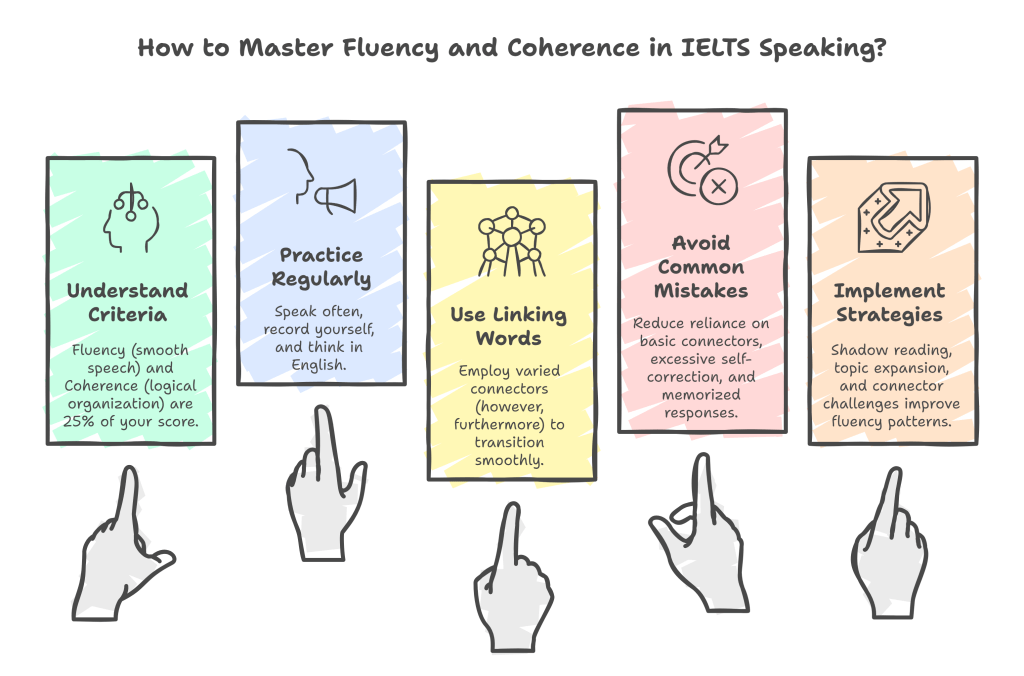
The IELTS Speaking test can feel intimidating, but understanding two crucial assessment criteria—Fluency and Coherence—can significantly boost your confidence and score. These criteria account for 25% of your overall Speaking band score, making them essential components of your IELTS preparation strategy. You can watch this YouTube video explainer by IELTS Guide Phil.
Understanding Fluency and Coherence
Fluency refers to your ability to speak smoothly and continuously without excessive hesitation, repetition, or self-correction. It’s about maintaining a natural flow of speech that allows your ideas to come across clearly and effortlessly.
Coherence focuses on the logical organization and connection of your ideas. It involves using appropriate linking words, maintaining topic relevance, and presenting thoughts in a way that’s easy for the examiner to follow.
Together, these criteria evaluate how naturally and logically you can express yourself in English during the 11-14 minute speaking assessment.
What Examiners Look For
Fluency Indicators
- Natural pace: Speaking at a comfortable speed without rushing or dragging
- Minimal hesitation: Occasional pauses are normal, but excessive “um,” “uh,” or long silences reduce fluency
- Self-correction: Some correction is natural, but frequent stopping and restarting disrupts flow
- Connected speech: Linking words and sounds naturally, as native speakers do
Coherence Indicators
- Logical sequencing: Ideas follow a clear, understandable order
- Appropriate linking: Using discourse markers and transitional phrases effectively
- Topic maintenance: Staying relevant to the question throughout your response
- Clear development: Building on ideas progressively rather than jumping randomly between thoughts
Band Score Breakdown
Band 9: Speaks fluently with only rare repetition or self-correction. Uses a full range of connectors and discourse markers naturally and appropriately.
Band 7: Speaks at length without noticeable effort. Shows flexibility and precise usage of linking devices, though some under/overuse may occur.
Band 6: Maintains flow of speech but uses repetition and self-correction. Uses linking devices but not always appropriately, with some mechanical overuse.
Band 5: Maintains speech with noticeable effort, frequent repetition, and self-correction. Overuses simple connectors and may be repetitive due to limited vocabulary.
Practical Examples
High Fluency and Coherence (Band 7-8):
Question: “Describe a memorable holiday you’ve taken.”
Response: “Well, I’d have to say that my trip to Japan last spring was absolutely unforgettable. Initially, I was quite nervous about the language barrier, but as it turned out, the experience exceeded all my expectations. What made it particularly special was the perfect timing—we arrived just as the cherry blossoms were blooming. Moreover, the contrast between traditional temples and modern cityscapes created this fascinating cultural blend that I found captivating throughout our two-week stay.”
Lower Fluency and Coherence (Band 5-6):
Question: “Describe a memorable holiday you’ve taken.”
Response: “Um, I went to… to Japan. It was good. The… the cherry blossoms were beautiful. I mean, really beautiful. And also, um, we visited temples. Many temples actually. The food was different. Very different from my country. But good, you know? The people were nice. Very nice people in Japan. So… yeah, it was a good holiday.”
Essential Dos and Don’ts
✅ DO:
For Fluency:
- Practice speaking regularly, even if just to yourself
- Record yourself to identify hesitation patterns
- Use natural fillers like “well,” “actually,” or “you know” sparingly
- Maintain steady breathing to support continuous speech
- Think in English rather than translating from your native language
For Coherence:
- Plan your response structure: introduction, main points, conclusion
- Use varied linking words (however, furthermore, in addition, on the other hand)
- Stay on topic throughout your response
- Develop each idea with examples or explanations
- Practice transitioning smoothly between different aspects of a topic
❌ DON’T:
For Fluency:
- Rush through your speech to appear more fluent
- Repeat the same words or phrases excessively
- Stop mid-sentence to restart frequently
- Leave long, uncomfortable silences
- Apologize repeatedly for language mistakes
For Coherence:
- Jump between unrelated ideas without connection
- Overuse basic connectors like “and,” “but,” “so”
- Go off-topic or provide irrelevant information
- Use linking words incorrectly or inappropriately
- Present ideas in a confusing or illogical sequence
Common Mistakes and How to Fix Them
Mistake 1: Over-reliance on Basic Connectors
Problem: Using “and,” “but,” “so” repeatedly Solution: Expand your repertoire with phrases like “what’s more,” “on the contrary,” “as a result,” “in spite of this”
Mistake 2: Excessive Self-Correction
Problem: Constantly stopping to fix minor errors Solution: Accept that small mistakes are normal; focus on getting your message across clearly
Mistake 3: Memorized Responses
Problem: Delivering rehearsed answers that don’t address the specific question Solution: Practice flexible thinking and adapting your knowledge to different question variations
Mistake 4: Inappropriate Pausing
Problem: Pausing in the middle of phrases or at grammatically incorrect points Solution: Practice chunking information into meaningful groups and pausing at natural break points
Mistake 5: Lack of Development
Problem: Giving short, underdeveloped answers Solution: Use the “PREP” method (Point, Reason, Example, Point) to structure fuller responses
Improvement Strategies
Daily Practice Techniques:
- Shadow Reading: Listen to English audio and repeat simultaneously to improve flow
- Topic Expansion: Take any topic and speak about it for 2 minutes, focusing on logical development
- Connector Challenge: Practice using different linking words in the same context
- Recording Analysis: Record yourself weekly and note improvements in fluency patterns
Structural Frameworks:
- Past experiences: Background → What happened → Impact → Reflection
- Opinions: Position → Reasons → Examples → Conclusion
- Comparisons: Similarities → Differences → Personal preference → Justification
Frequently Asked Questions
Q: How important are hesitations in the IELTS Speaking test? A: Occasional hesitations are completely natural and won’t significantly impact your score. However, frequent or lengthy pauses, especially mid-sentence, can reduce your fluency score. Practice speaking about familiar topics to build confidence and reduce hesitation.
Q: Can I use the same linking words throughout my speaking test? A: While you can repeat some connectors, showing variety demonstrates higher language proficiency. Examiners look for natural, appropriate use of different linking devices rather than mechanical repetition of the same few phrases.
Q: What should I do if I lose track of my thoughts mid-answer? A: Don’t panic. Use phrases like “What I mean to say is…” or “Let me put it another way…” to buy thinking time and redirect your response. It’s better to acknowledge the moment briefly than to struggle silently.
Q: How long should my answers be in each part of the speaking test? A: Part 1: 30-45 seconds per question; Part 2: Exactly 2 minutes; Part 3: 30-60 seconds, depending on question complexity. Practice timing yourself to develop an internal sense of appropriate length.
Q: Is it better to speak slowly and correctly or quickly with some mistakes? A: Natural pace with minor mistakes is preferable to artificially slow, overly careful speech. Fluency includes natural speed and rhythm. Minor grammatical errors won’t severely impact your score if your meaning is clear.
Q: How can I improve my coherence if English isn’t my first language? A: Focus on logical thinking patterns rather than complex vocabulary. Practice organizing your thoughts before speaking: main idea first, followed by supporting details. Regular exposure to English media helps you internalize natural speech patterns.
Q: Should I memorize answers for common IELTS topics? A: Memorization is counterproductive and often obvious to examiners. Instead, prepare flexible ideas and vocabulary around common themes. Practice adapting your knowledge to different question variations for more natural responses.
Final Tips for Test Day
On exam day, remember that the examiner wants you to succeed. Approach the speaking test as a conversation rather than an interrogation. Maintain eye contact, smile when appropriate, and don’t be afraid to show your personality. If you make a mistake, correct it briefly and move on without dwelling on it.
Focus on communicating your ideas clearly rather than demonstrating every grammar rule you know. The most successful candidates balance accuracy with natural expression, creating responses that feel genuine and engaging.
Remember, achieving high scores in Fluency and Coherence is about consistent practice and gradual improvement. Start implementing these strategies in your daily English practice, and you’ll notice significant improvements in your speaking confidence and ability.
Ready to boost your IELTS Speaking score? Start practicing these fluency and coherence strategies today, and remember that consistency is key to improvement.
#IELTSGuidePhil #IELTS #IELTSSpeaking #FluencyAndCoherence #IELTSPreparation #EnglishSpeaking #IELTSTips #SpeakingTest #IELTSBandScore #EnglishFluency #IELTSSuccess #SpeakingSkills #IELTSCoaching #EnglishLearning #IELTSExam #SpeakingPractice
 IELTS Guide Phil
Leave a comment