
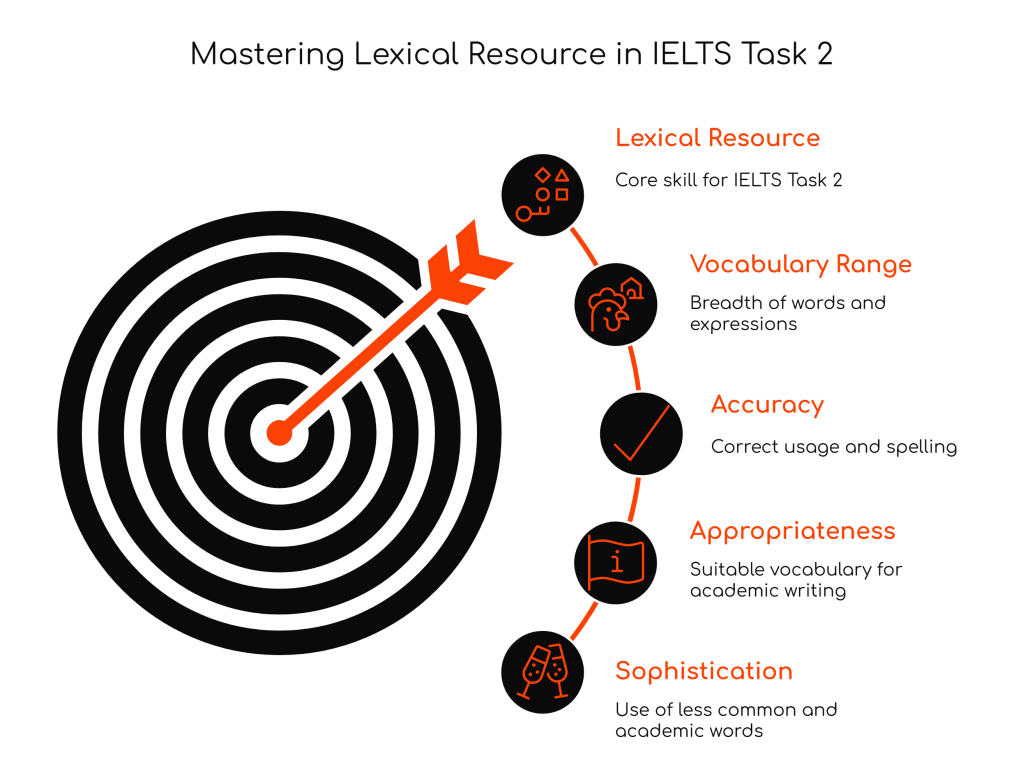
Lexical Resource is one of the four crucial assessment criteria in IELTS Writing Task 2, accounting for 25% of your overall score. This criterion evaluates your ability to use a wide range of vocabulary accurately and appropriately when expressing ideas, developing arguments, and discussing complex topics in essay format. You can watch this YouTube video explainer by IELTS Guide Phil.
Whether you’re taking Academic or General Training IELTS, Task 2 requires you to write a 250-word essay responding to various question types including opinion essays, discussion essays, problem-solution essays, and advantage-disadvantage essays. Your lexical resource demonstrates your capacity to articulate sophisticated thoughts with precision and variety.
What is Lexical Resource in Task 2?
Lexical Resource in Task 2 evaluates:
- Range of vocabulary: Breadth and variety of words and expressions
- Accuracy: Correct usage, spelling, and word formation
- Appropriateness: Suitable vocabulary for academic essay writing
- Precision: Exact word choices that convey intended meanings
- Sophistication: Use of less common and academic vocabulary
- Flexibility: Ability to paraphrase and express ideas in multiple ways
Band Descriptors for Lexical Resource
Band 9
- Uses a wide range of vocabulary with very natural and sophisticated control of lexical features
- Rare minor errors occur only as ‘slips’
- Demonstrates complete command of less common lexical items
- Uses vocabulary with full flexibility and precise usage
Band 8
- Uses a wide range of vocabulary fluently and flexibly to convey precise meanings
- Skilfully uses uncommon lexical items but there may be occasional inaccuracies in word choice and collocation
- Shows good control of style and collocation
Band 7
- Uses a sufficient range of vocabulary to allow some flexibility and precise usage
- Uses less common lexical items with some awareness of style and collocation
- May produce occasional errors in word choice, spelling and/or word formation
Band 6
- Uses an adequate range of vocabulary for the task
- Attempts to use less common vocabulary but with some inaccuracy
- Makes some errors in spelling and/or word formation, but they do not impede communication
Band 5
- Uses a limited range of vocabulary, but this is minimally adequate for the task
- May make noticeable errors in spelling and/or word formation that may cause some difficulty for the reader
Essential Vocabulary Categories for Task 2
1. Academic Discourse Markers
Introducing arguments:
- It is widely acknowledged that, It is generally accepted that
- There is compelling evidence to suggest, Research indicates
- Proponents of this view argue, Critics contend that
- From a theoretical perspective, In practical terms
Adding information:
- Furthermore, Moreover, Additionally, In addition to this
- What is more, Equally important, Not only… but also
- Similarly, Likewise, In the same vein, Along the same lines
Contrasting ideas:
- However, Nevertheless, Nonetheless, Conversely
- On the contrary, In contrast, By contrast, Alternatively
- While, Whereas, Although, Despite the fact that
Showing cause and effect:
- Consequently, As a result, Therefore, Thus
- Hence, Accordingly, For this reason, Due to this
- This leads to, This results in, This gives rise to
Concluding:
- In conclusion, To summarize, In summary, To conclude
- Overall, All things considered, Taking everything into account
- Ultimately, Finally, In the final analysis
2. Opinion and Attitude Vocabulary
Strong agreement:
- I firmly believe, I am convinced that, I strongly advocate
- It is undeniable that, There is no doubt that, Unquestionably
- I wholeheartedly support, I am of the firm conviction
Partial agreement:
- To some extent, To a certain degree, Partially
- I tend to agree that, I am inclined to believe
- While I acknowledge that, I partially support the view
Disagreement:
- I strongly disagree with, I am opposed to the notion
- I refute the claim that, I challenge the assumption
- This view is fundamentally flawed, I find this argument unconvincing
Expressing certainty/uncertainty:
- Undoubtedly, Certainly, Definitely, Without question
- Possibly, Potentially, Presumably, It seems likely that
- There is a possibility that, It appears that, Arguably
3. Academic Vocabulary for Common Topics
Education:
- curriculum, pedagogy, educational outcomes, academic achievement
- literacy, numeracy, critical thinking, intellectual development
- educational institutions, academic standards, scholastic performance
- lifelong learning, educational reform, academic rigor
Technology:
- technological advancement, digital revolution, automation
- artificial intelligence, connectivity, digitalization
- innovation, technological literacy, cyber security
- sustainable technology, technological dependency
Environment:
- environmental degradation, sustainability, conservation
- carbon footprint, renewable energy, biodiversity
- climate change mitigation, ecological balance
- environmental consciousness, green technology
Society and Culture:
- social cohesion, cultural diversity, societal values
- demographic changes, urbanization, globalization
- social inequality, cultural preservation, community engagement
- intercultural understanding, social mobility
Economy and Work:
- economic prosperity, financial stability, employment opportunities
- economic disparity, labor market, occupational skills
- entrepreneurship, economic growth, productivity
- work-life balance, job satisfaction, career advancement
4. Sophisticated Synonyms and Variations
Important → crucial, vital, essential, paramount, significant, pivotal Good → beneficial, advantageous, positive, favorable, constructive Bad → detrimental, harmful, adverse, negative, counterproductive Big → substantial, considerable, significant, extensive, massive Small → minimal, negligible, modest, limited, marginal Show → demonstrate, illustrate, reveal, indicate, manifest Make → create, generate, produce, establish, facilitate Think → believe, consider, contend, maintain, assert
Examples of Effective Lexical Resource Usage
Example 1: Opinion Essay Introduction
Basic version: “Many people think technology is good for education. I agree with this idea because technology helps students learn better.”
Enhanced version with better lexical resource: “The integration of technology into educational systems is increasingly regarded as a transformative force in contemporary learning environments. I firmly believe that technological advancement significantly enhances educational outcomes by facilitating interactive learning experiences and expanding access to diverse educational resources.”
Example 2: Problem-Solution Essay Body Paragraph
Basic version: “Traffic is a big problem in cities. It makes air dirty and wastes time. The government should make better public transport.”
Enhanced version with better lexical resource: “Urban congestion represents one of the most pressing challenges facing metropolitan areas worldwide. This phenomenon not only contributes to environmental degradation through increased emissions but also results in substantial economic losses due to reduced productivity. To address this issue comprehensively, municipal authorities should invest in sustainable transportation infrastructure, including efficient public transit systems and dedicated cycling networks.”
Example 3: Discussion Essay Argument
Basic version: “Some people like working from home, but others don’t. Working from home is good because you save travel time, but it’s bad because you feel alone.”
Enhanced version with better lexical resource: “The debate surrounding remote work arrangements reveals compelling arguments on both sides. Proponents emphasize the considerable benefits of telecommuting, including enhanced work-life balance and reduced commuting expenses. Conversely, critics highlight the potential drawbacks, particularly the risk of social isolation and the challenges of maintaining professional collaboration in virtual environments.”
Dos and Don’ts
✅ DOS
- Use topic-specific vocabulary – Deploy relevant academic terms for your subject
- Vary your language consistently – Avoid repetition through strategic synonyms
- Employ sophisticated connectors – Use advanced linking words appropriately
- Demonstrate lexical flexibility – Show ability to paraphrase and rephrase
- Use precise vocabulary – Choose exact words that convey your intended meaning
- Include less common vocabulary – Incorporate advanced terms naturally
- Maintain academic register – Keep formal, scholarly tone throughout
- Practice collocations – Use natural word combinations
- Check word formation – Ensure correct use of prefixes, suffixes
❌ DON’ts
- Don’t repeat key words excessively – Vary your vocabulary strategically
- Don’t force complex vocabulary – Only use words you understand completely
- Don’t ignore register – Avoid informal or conversational language
- Don’t make spelling errors – Accuracy is crucial for higher bands
- Don’t use inappropriate collocations – Learn natural word partnerships
- Don’t rely on basic vocabulary – Show range with sophisticated choices
- Don’t use vague language – Be specific and precise in word selection
- Don’t ignore word formation rules – Check adjective/adverb forms
- Don’t overuse certain connectors – Vary your discourse markers
Common Mistakes and How to Fix Them
Mistake 1: Repetitive Vocabulary
Problem: “Education is important. Important education helps students. Students need important skills for important jobs.”
Fix: “Education is crucial for human development. Quality schooling enables learners to acquire essential competencies. Students require vital skills to secure meaningful employment opportunities.”
Mistake 2: Inappropriate Register
Problem: “Lots of folks think that kids shouldn’t use phones at school ’cause it’s super distracting.”
Fix: “Many educators argue that mobile devices should be prohibited in academic settings due to their potentially disruptive influence on learning environments.”
Mistake 3: Incorrect Collocations
Problem: “We should make strong efforts to do solutions for environmental problems.”
Fix: “We should make concerted efforts to implement solutions for environmental challenges” or “We should develop comprehensive strategies to address environmental issues.”
Mistake 4: Overuse of Simple Connectors
Problem: “First, technology is good. Second, it helps students. Also, teachers like it. And it’s cheap too.”
Fix: “Primarily, technological integration offers substantial benefits. Furthermore, it enhances student engagement significantly. Additionally, educators increasingly embrace digital tools. Moreover, cost-effectiveness makes implementation feasible.”
Mistake 5: Word Formation Errors
Problem: “The government should take responsibility measures to solve this problematic.”
Fix: “The government should implement responsible measures to address this problem” or “Authorities should adopt accountability measures to resolve these issues.”
Mistake 6: Vague Language
Problem: “Technology does things that are good for society and makes stuff better.”
Fix: “Technological advancement generates substantial societal benefits by enhancing communication efficiency, improving healthcare delivery, and facilitating educational access.”
Building Your Task 2 Lexical Resource
1. Create Topic-Based Word Banks
Environment vocabulary bank:
- Climate: global warming, greenhouse effect, carbon emissions, renewable energy
- Conservation: biodiversity preservation, sustainable practices, ecological footprint
- Problems: pollution, deforestation, habitat destruction, species extinction
- Solutions: environmental legislation, conservation initiatives, green technology
Education vocabulary bank:
- Learning: academic achievement, intellectual development, cognitive skills
- Methods: pedagogical approaches, curriculum design, assessment strategies
- Technology: e-learning platforms, digital literacy, online resources
- Outcomes: educational attainment, academic performance, learning objectives
2. Master Collocations
Strong collocations for Task 2:
- “conduct research” not “do research”
- “raise awareness” not “make awareness”
- “address issues” not “solve issues” (though solve problems is correct)
- “implement policies” not “make policies”
- “foster development” not “help development”
- “mitigate effects” not “reduce effects”
3. Learn Academic Word Families
Analyze family:
- analyze (verb), analysis (noun), analytical (adjective), analytically (adverb)
Significant family:
- signify (verb), significance (noun), significant (adjective), significantly (adverb)
Economy family:
- economize (verb), economy (noun), economic/economical (adjectives), economically (adverb)
4. Practice Paraphrasing Techniques
Original: “Many people believe that…” Paraphrases:
- “It is widely held that…”
- “There is a prevailing view that…”
- “A substantial proportion of the population maintains that…”
- “Common perception suggests that…”
Advanced Lexical Strategies
1. Use Sophisticated Hedging Language
Instead of absolute statements:
- “Technology always improves education” Use hedged language:
- “Technology tends to enhance educational outcomes”
- “Technological integration generally facilitates learning processes”
- “There is considerable evidence suggesting that technology improves education”
2. Employ Academic Intensifiers
Rather than basic intensifiers (very, really, so):
- Use: considerably, substantially, significantly, remarkably
- Example: “significantly enhance” instead of “really improve”
3. Utilize Nominalization
Transform verbs into nouns for academic style:
- “When people consume more” → “Increased consumption”
- “If governments invest in” → “Government investment in”
- “Technology develops rapidly” → “Rapid technological development”
4. Apply Sophisticated Sentence Starters
Instead of basic openings:
- “I think…” → “From my perspective…” / “I maintain that…”
- “Many people…” → “A considerable proportion of society…” / “Contemporary discourse suggests…”
- “It is good…” → “This approach proves beneficial…” / “Such measures yield positive outcomes…”
Question-Type Specific Vocabulary
1. Opinion Essays (Agree/Disagree)
Key phrases:
- “I wholeheartedly endorse the view that…”
- “I find myself in complete agreement with…”
- “I am inclined to support the notion that…”
- “I fundamentally disagree with the proposition that…”
- “This perspective lacks sufficient justification because…”
2. Discussion Essays (Discuss Both Views)
Key phrases:
- “Proponents of this view argue that…”
- “Those who advocate for… contend that…”
- “Critics of this approach maintain that…”
- “While acknowledging the merits of both perspectives…”
- “Having considered both sides of the argument…”
3. Problem-Solution Essays
Key phrases:
- “This issue stems from…” / “The root cause lies in…”
- “To address this challenge comprehensively…”
- “A viable solution would involve…”
- “Implementing such measures would result in…”
- “The effectiveness of this approach depends on…”
4. Advantage-Disadvantage Essays
Key phrases:
- “The primary benefit of this approach is…”
- “A significant drawback of this system is…”
- “While this offers considerable advantages…”
- “The potential risks associated with…”
- “Weighing the pros and cons reveals…”
Sample High-Band Response Analysis
Task: Some people believe that universities should accept equal numbers of male and female students in every subject. To what extent do you agree or disagree?
Sample excerpt (Band 8-9): “The proposition that higher education institutions should maintain gender parity across all academic disciplines represents a contentious issue in contemporary educational discourse. While I acknowledge the underlying objective of promoting gender equality, I maintain that such rigid quotas would prove counterproductive and potentially discriminatory.
Proponents of this approach argue that enforced gender balance would dismantle systemic barriers that have historically disadvantaged women in certain fields, particularly STEM disciplines. They contend that numerical parity would foster more inclusive learning environments and challenge stereotypical assumptions about gender-specific aptitudes. Furthermore, advocates suggest that such measures would ensure equal representation in traditionally male-dominated professions, thereby advancing broader societal equality objectives.
However, I find this argument fundamentally flawed for several compelling reasons. Primarily, implementing arbitrary quotas based solely on gender fails to acknowledge individual merit and academic capability, which should remain the paramount criteria for university admission. Such policies risk undermining the principle of meritocracy that underpins quality higher education systems.”
Lexical strengths demonstrated:
- Sophisticated academic vocabulary: “contentious,” “discourse,” “rigid quotas,” “counterproductive”
- Complex noun phrases: “systematic barriers,” “stereotypical assumptions,” “arbitrary quotas”
- Advanced connectors: “Furthermore,” “However,” “Primarily”
- Precise word choices: “dismantle,” “foster,” “undermining”
- Academic register maintained consistently
- Topic-specific terminology: “STEM disciplines,” “meritocracy,” “higher education institutions”
Frequently Asked Questions
Q1: How many sophisticated words should I include in my essay?
A: Quality over quantity. Aim to use advanced vocabulary naturally throughout your essay rather than forcing complex words. For Band 7+, demonstrate consistent use of less common lexical items with good control.
Q2: Should I memorize lists of academic vocabulary?
A: Memorization alone isn’t sufficient. Learn words in context, understand their collocations, and practice using them in sentences. Focus on words relevant to common IELTS topics.
Q3: What if I’m not sure about a word’s meaning?
A: Only use vocabulary you’re confident about. It’s better to use simpler words correctly than sophisticated words incorrectly. Build your vocabulary gradually through extensive reading and practice.
Q4: How can I avoid repetition effectively?
A: Develop synonym sets for common words in your topic area. Practice paraphrasing the same idea in multiple ways. Use pronouns and varied sentence structures to avoid repetitive patterns.
Q5: Is it better to use simple or complex vocabulary?
A: Use appropriate vocabulary for your level. Band 6 requires adequate range, Band 7 needs some less common items, Band 8-9 demands sophisticated control. Match your ambition to your ability.
Q6: How important are collocations?
A: Very important for higher bands. Natural word combinations show sophisticated language control. Learn common academic collocations like “conduct research,” “implement policies,” “address concerns.”
Q7: Should I use topic-specific terminology?
A: Yes, when relevant and accurate. Using appropriate subject-specific vocabulary demonstrates range and precision. However, ensure you understand these terms completely before using them.
Q8: How do I improve my word formation accuracy?
A: Study word families systematically. Learn how to form nouns, verbs, adjectives, and adverbs from root words. Practice identifying and correcting word formation errors in your writing.
Q9: Can I use contractions in Task 2?
A: No, maintain formal academic register throughout. Use full forms: “cannot” instead of “can’t,” “do not” instead of “don’t.” This applies to both Academic and General Training Task 2.
Q10: What’s the difference between band 7 and band 8 lexical resource?
A: Band 7 shows sufficient range with some less common vocabulary and occasional errors. Band 8 demonstrates wide range with skillful use of uncommon items, more sophisticated control, and fewer inaccuracies.
Q11: How do I know if my vocabulary is appropriate for the topic?
A: Read extensively about common IELTS topics. Notice which words and phrases academic writers use. Practice writing on various topics to develop topic-specific vocabulary naturally.
Q12: Should I use very formal or archaic vocabulary?
A: No, use contemporary academic vocabulary. Avoid overly formal or outdated expressions that sound unnatural. Aim for sophisticated but contemporary language that educated speakers would use today.
Conclusion
Mastering Lexical Resource in IELTS Writing Task 2 requires systematic vocabulary development combined with strategic application. Success depends on building topic-specific word banks, understanding collocations, maintaining academic register, and demonstrating flexible use of sophisticated vocabulary.
Focus on accuracy first, then gradually expand your range. Practice paraphrasing, learn academic discourse markers, and develop sensitivity to register and appropriateness. Remember that consistent use of varied, accurate vocabulary throughout your essay is more valuable than occasional sophisticated words used incorrectly.
Regular practice with different essay types, combined with extensive reading of academic texts, will help you develop the lexical sophistication needed for higher IELTS bands. Your vocabulary should serve your ideas, not overshadow them.
Ready to elevate your IELTS Writing Task 2 vocabulary? Implement these lexical strategies systematically and watch your ability to express complex ideas with precision and sophistication improve dramatically.
#IELTSGuidePhil #IELTS #IELTSWriting #IELTSTask2 #IELTSAcademic #IELTSGeneralTraining #LexicalResource #IELTSVocabulary #IELTSPreparation #IELTSEssay #AcademicWriting #IELTSStudy #IELTSTips #EnglishLearning #IELTSBand7 #IELTSBand8 #IELTSBand9 #TestPreparation #EnglishTest #StudyAbroad #IELTSSuccess #WritingSkills #VocabularyBuilding #AcademicVocabulary #EnglishGrammar #IELTSExam #AdvancedEnglish #IELTSWritingTips #EssayWriting
 IELTS Guide Phil
Leave a comment