
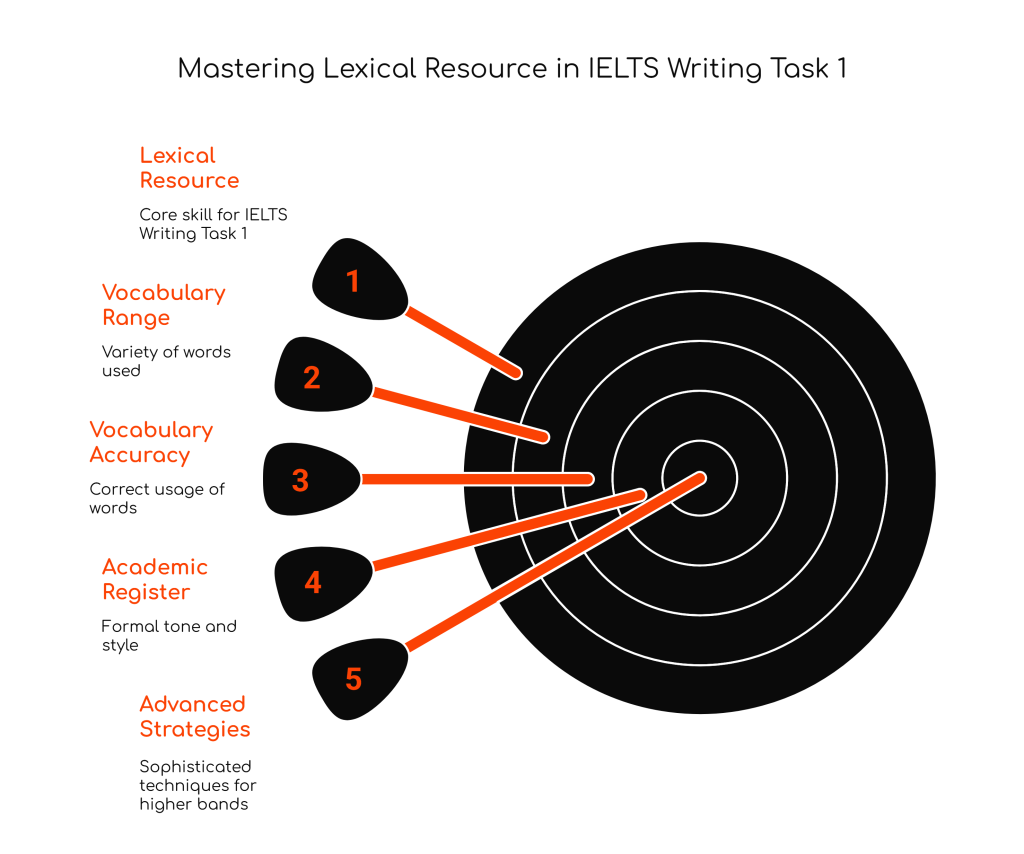
Lexical Resource is one of the four crucial assessment criteria in IELTS Writing Task 1 Academic, accounting for 25% of your overall score. This criterion evaluates your ability to use a wide range of vocabulary accurately and appropriately when describing visual data such as graphs, charts, tables, diagrams, and maps.
Understanding and mastering Lexical Resource can significantly boost your IELTS Writing score, helping you achieve the band you need for your academic or professional goals. You can watch this YouTube video explainer by IELTS Guide Phil.
What is Lexical Resource?
Lexical Resource refers to your range and accuracy of vocabulary usage. The IELTS examiners assess:
- Range of vocabulary: How varied and extensive your word choices are
- Accuracy: How correctly you use words in terms of meaning, spelling, and word formation
- Appropriateness: How suitable your vocabulary is for the academic context
- Precision: How exactly your words convey the intended meaning
Band Descriptors for Lexical Resource
Band 9
- Uses a wide range of vocabulary with very natural and sophisticated control of lexical features
- Rare minor errors occur only as ‘slips’
Band 8
- Uses a wide range of vocabulary fluently and flexibly to convey precise meanings
- Skilfully uses uncommon lexical items but there may be occasional inaccuracies in word choice and collocation
Band 7
- Uses a sufficient range of vocabulary to allow some flexibility and precise usage
- Uses less common lexical items with some awareness of style and collocation
- May produce occasional errors in word choice, spelling and/or word formation
Band 6
- Uses an adequate range of vocabulary for the task
- Attempts to use less common vocabulary but with some inaccuracy
- Makes some errors in spelling and/or word formation, but they do not impede communication
Band 5
- Uses a limited range of vocabulary, but this is minimally adequate for the task
- May make noticeable errors in spelling and/or word formation that may cause some difficulty for the reader
Essential Vocabulary Categories for Task 1
1. Trend Language
Upward trends:
- increase, rise, grow, climb, soar, surge, rocket, escalate
- go up, move upward, trend upward, experience growth
Downward trends:
- decrease, decline, fall, drop, plummet, plunge, tumble, dip
- go down, move downward, trend downward, experience a reduction
Stability:
- remain stable, stay constant, maintain levels, plateau
- show little variation, fluctuate around, hover around
Fluctuation:
- fluctuate, vary, oscillate, swing between
- show volatility, experience ups and downs
2. Degree and Speed Adverbs
Degree:
- dramatically, significantly, considerably, substantially
- moderately, slightly, marginally, fractionally
- sharply, steeply, gradually, steadily
Speed:
- rapidly, quickly, swiftly, suddenly, abruptly
- slowly, gradually, progressively, consistently
3. Data Description Vocabulary
Comparative language:
- higher than, lower than, greater than, less than
- exceed, surpass, outpace, lag behind
- the highest, the lowest, the peak, the trough
Proportions and fractions:
- approximately, roughly, around, about
- exactly, precisely, just over, just under
- a quarter, a third, half, two-thirds, three-quarters
4. Time Expressions
Periods:
- during the period, over the timeframe, throughout
- from… to, between… and, in the span of
- initially, subsequently, finally, ultimately
Specific times:
- at the beginning, in the middle, towards the end
- in the early stages, in the latter part
- by the end of the period, at the conclusion
Examples of Effective Lexical Resource Usage
Example 1: Line Graph Description
Basic version: “The graph shows that sales went up from 2020 to 2023.”
Enhanced version with better lexical resource: “The line graph illustrates that sales experienced a steady upward trajectory, climbing progressively from $2 million in 2020 to reach a peak of $5.8 million by 2023.”
Example 2: Bar Chart Description
Basic version: “Country A had more exports than Country B.”
Enhanced version with better lexical resource: “Country A significantly outpaced Country B in terms of export volumes, with figures that substantially exceeded those of its counterpart by approximately 40%.”
Example 3: Pie Chart Description
Basic version: “Technology was the biggest part at 35%.”
Enhanced version with better lexical resource: “The technology sector dominated the chart, accounting for just over one-third of the total market share at 35%, making it the most substantial component of the economy.”
Dos and Don’ts
✅ DOS
- Vary your vocabulary – Use synonyms to avoid repetition
- Use precise language – Choose words that convey exact meanings
- Employ academic vocabulary – Use formal, sophisticated terms
- Check collocations – Ensure words naturally go together
- Use appropriate register – Maintain formal, academic tone
- Include less common vocabulary – Demonstrate range with advanced terms
- Proofread for accuracy – Check spelling and word formation
❌ DON’ts
- Don’t repeat the same words – Avoid using “increase” five times
- Don’t use informal language – Avoid contractions and casual expressions
- Don’t force complex vocabulary – Only use words you’re confident about
- Don’t ignore word formation – Check that adjectives/adverbs are correctly formed
- Don’t use vague language – Avoid words like “thing” or “stuff”
- Don’t overcomplicate – Clarity is more important than complexity
- Don’t ignore spelling – Accuracy is crucial for higher bands
Common Mistakes and How to Fix Them
Mistake 1: Repetitive Vocabulary
Problem: “The graph shows an increase in 2020, then shows another increase in 2021, and shows a big increase in 2022.”
Fix: “The graph illustrates a rise in 2020, followed by further growth in 2021, culminating in a dramatic surge in 2022.”
Mistake 2: Incorrect Collocations
Problem: “The numbers made a high increase.”
Fix: “The figures experienced a sharp increase” or “The numbers rose dramatically.”
Mistake 3: Informal Language
Problem: “Sales went through the roof in Q4.”
Fix: “Sales soared dramatically in the fourth quarter.”
Mistake 4: Imprecise Vocabulary
Problem: “The thing went up a lot.”
Fix: “Export revenues increased substantially.”
Mistake 5: Word Formation Errors
Problem: “There was a significantly rise.”
Fix: “There was a significant rise” or “Figures rose significantly.”
Mistake 6: Overuse of Simple Verbs
Problem: “Prices went up, then went down, then went up again.”
Fix: “Prices initially climbed, subsequently declined, before recovering in the final period.”
Building Your Lexical Resource
1. Create Word Families
Group related words together:
- Increase: rise, grow, climb, surge, escalate, mount, advance
- Fast: rapidly, swiftly, dramatically, sharply, abruptly
- Big: substantial, significant, considerable, marked, pronounced
2. Learn Collocations
Master natural word combinations:
- “sharp decline” not “sharp decrease”
- “steady growth” not “stable growth”
- “dramatic surge” not “dramatic jump”
3. Study Academic Vocabulary Lists
Focus on Academic Word List (AWL) items commonly used in data description:
- constitute, comprise, account for, represent
- fluctuate, vary, oscillate, stabilize
- predominant, substantial, marginal, negligible
4. Practice Paraphrasing
Transform basic sentences into more sophisticated versions:
- “It was 20%” → “It accounted for one-fifth of the total”
- “It went up” → “It experienced an upward trajectory”
- “The biggest” → “The most substantial/significant/predominant”
Advanced Lexical Strategies
1. Use Sophisticated Sentence Starters
Instead of “The graph shows…”, use:
- “The data reveals…”
- “The chart illustrates…”
- “The figures demonstrate…”
- “The statistics indicate…”
2. Employ Advanced Descriptive Language
- “witnessed a meteoric rise”
- “experienced a precipitous decline”
- “demonstrated remarkable stability”
- “exhibited considerable volatility”
3. Use Academic Hedging Language
- “approximately,” “roughly,” “around”
- “appears to,” “seems to,” “tends to”
- “generally,” “typically,” “predominantly”
Sample High-Band Response Analysis
Task: The line graph shows the number of international students in three countries from 2010 to 2020.
High-band response excerpt: “The line graph delineates the enrollment figures for international students across three nations throughout a decade-long period from 2010 to 2020.
Initially, the United States dominated international student intake, accommodating approximately 800,000 students in 2010. This figure experienced steady growth, culminating in a peak of 1.2 million by 2018, before witnessing a marginal decline to 1.1 million by 2020.
Conversely, the United Kingdom demonstrated more volatile patterns, with enrollment figures oscillating between 400,000 and 600,000 throughout the timeframe. The data reveals a pronounced surge from 2015 to 2017, where numbers escalated from 450,000 to their zenith of 580,000, subsequently plateauing for the remainder of the period.”
Lexical strengths:
- Sophisticated vocabulary: “delineates,” “accommodating,” “culminating,” “oscillating”
- Varied trend language: “steady growth,” “marginal decline,” “pronounced surge”
- Academic register maintained throughout
- Precise data description with appropriate hedging
Frequently Asked Questions
Q1: How many different words do I need to know for IELTS Writing Task 1?
A: While there’s no specific number, aim to master 50-100 key vocabulary items across different categories (trends, comparisons, time expressions, data description). Quality and accuracy matter more than quantity.
Q2: Should I use a thesaurus to find complex words?
A: Use a thesaurus carefully. Only incorporate words you’re confident about using correctly. It’s better to use simpler vocabulary accurately than complex words incorrectly.
Q3: How can I avoid repeating the same words?
A: Create synonym lists for common words. For “increase,” learn alternatives like rise, grow, climb, surge, escalate. Practice using different words in similar contexts.
Q4: What if I make spelling mistakes?
A: Minor spelling errors won’t severely impact your score if they don’t impede understanding. However, frequent mistakes can lower your band. Always proofread and practice spelling of key Task 1 vocabulary.
Q5: How formal should my vocabulary be?
A: Use formal, academic vocabulary throughout. Avoid contractions, informal expressions, and overly casual language. The register should be consistent with academic writing standards.
Q6: Can I use the same vocabulary for all chart types?
A: While core vocabulary (trends, comparisons) applies to all charts, some vocabulary is chart-specific. For example, “segments” for pie charts, “categories” for bar charts, or “stages” for process diagrams.
Q7: How important is it to use uncommon vocabulary?
A: Using less common vocabulary appropriately can boost your score, but accuracy is paramount. Band 7+ requires some uncommon lexical items, but they must be used correctly and naturally.
Q8: What’s the difference between lexical resource and grammatical range?
A: Lexical resource focuses on vocabulary choice, range, and accuracy, while grammatical range examines sentence structures, tenses, and grammatical accuracy. Both are separate assessment criteria.
Conclusion
Mastering Lexical Resource in IELTS Writing Task 1 Academic requires systematic practice and strategic vocabulary development. Focus on building a diverse range of accurate, appropriate vocabulary while maintaining precision and academic register. Remember that consistency in using varied, sophisticated vocabulary correctly is more valuable than occasionally using complex words inappropriately.
Regular practice with different chart types, combined with focused vocabulary building and attention to collocations, will help you achieve the lexical sophistication needed for higher IELTS bands.
Ready to boost your IELTS Writing score? Practice implementing these lexical strategies in your Task 1 responses and watch your vocabulary range and accuracy improve significantly.
#IELTSGuidePhil #IELTS #IELTSWriting #IELTSTask1 #IELTSAcademic #LexicalResource #IELTSVocabulary #IELTSPreparation #IELTSStudy #IELTSTips #AcademicWriting #EnglishLearning #IELTSBand7 #IELTSBand8 #IELTSBand9 #TestPreparation #EnglishTest #StudyAbroad #IELTSSuccess #WritingSkills #VocabularyBuilding
 IELTS Guide Phil
Leave a comment