
IELTS Writing Task 2 requires you to write a 250+ word essay in response to a given topic. Grammatical Range and Accuracy is one of the four assessment criteria, worth 25% of your total score. In essay writing, demonstrating sophisticated grammatical structures while maintaining accuracy is crucial for achieving higher band scores and effectively presenting complex arguments. You can watch this YouTube video explainer by IELTS Guide Phil.
What is Grammatical Range and Accuracy in Essay Writing?
Grammatical Range refers to the variety and sophistication of grammatical structures you use throughout your essay. This includes complex sentences, various clause types, different verb forms, and advanced grammatical constructions that support academic argumentation.
Grammatical Accuracy refers to how correctly you use these structures. In Task 2, accuracy is particularly important because grammatical errors can undermine your argument’s credibility and impede the reader’s understanding of complex ideas.
Band Score Descriptors for Grammatical Range and Accuracy
Band 9
- Uses a wide range of structures with full flexibility and accuracy
- Rare minor errors occur only as ‘slips’
- Grammar enhances meaning and supports sophisticated argumentation
Band 8
- Uses a wide range of structures flexibly and accurately
- Majority of sentences are error-free
- Makes only occasional errors that do not impede communication
Band 7
- Uses a variety of complex structures
- Frequently produces error-free sentences
- Has good control of grammar and punctuation but may make a few errors
- Grammar generally supports clear expression of ideas
Band 6
- Uses a mix of simple and complex sentence forms
- Makes some errors in grammar and punctuation but they rarely reduce communication
- Attempts complex grammar with reasonable success
Band 5
- Uses only a limited range of structures
- Attempts complex sentences but these tend to be less accurate than simple sentences
- Frequent grammatical errors may cause some difficulty for the reader
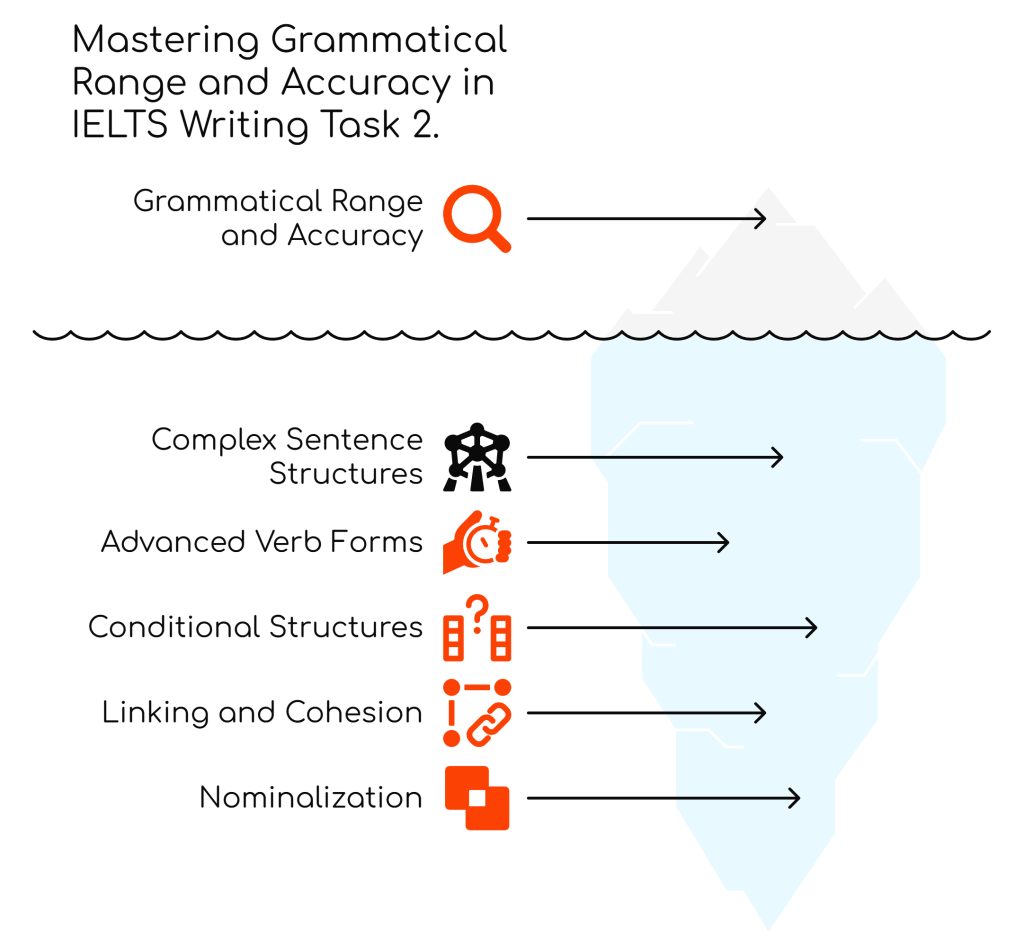
Essential Grammar Structures for Task 2 Essays
1. Complex Sentence Structures
Subordinate Clauses
- Cause and effect: “Because technology has advanced rapidly, many traditional jobs have become obsolete.”
- Concession: “Although some argue that homework is unnecessary, I believe it plays a crucial role in education.”
- Condition: “If governments invest more in renewable energy, environmental problems could be significantly reduced.”
Relative Clauses
- Defining: “Students who study abroad often develop greater independence.”
- Non-defining: “Social media, which has transformed communication, presents both opportunities and challenges.”
2. Advanced Verb Forms
Perfect Tenses
- Present Perfect: “Technology has revolutionized the way we work and communicate.”
- Past Perfect: “By the time governments had recognized the problem, significant damage had already occurred.”
- Future Perfect: “By 2050, renewable energy will have replaced fossil fuels in many countries.”
Passive Voice
- “Serious consideration should be given to environmental protection.”
- “It has been argued that education is the key to reducing inequality.”
Modal Verbs for Academic Writing
- Certainty: “This will undoubtedly lead to significant changes.”
- Probability: “Such policies might result in improved outcomes.”
- Necessity: “Governments must address these issues immediately.”
3. Conditional Structures
Real Conditionals
- First conditional: “If we continue to ignore climate change, future generations will suffer the consequences.”
- Zero conditional: “When people have access to education, societies generally prosper.”
Hypothetical Conditionals
- Second conditional: “If everyone used public transport, air pollution would decrease dramatically.”
- Third conditional: “If governments had acted earlier, the current crisis could have been prevented.”
- Mixed conditionals: “If we had invested in education decades ago, we would not be facing these problems today.”
4. Advanced Linking and Cohesion
Complex Conjunctions
- “Notwithstanding these concerns, the benefits outweigh the drawbacks.”
- “Insofar as technology improves efficiency, it should be embraced.”
- “Inasmuch as education affects society, investment is crucial.”
Sophisticated Transitions
- “Furthermore,” “Nevertheless,” “Consequently,” “Conversely”
- “On the contrary,” “By the same token,” “In light of this”
5. Nominalization and Abstract Language
- Instead of: “When people consume too much, it harms the environment.”
- Use: “Excessive consumption contributes to environmental degradation.”
Essay Type Examples with Grammar Focus
Opinion Essays
Topic: Some people believe that technology has made our lives more complicated. To what extent do you agree or disagree?
❌ Poor grammar: “I think technology make life complicated. People use phone too much and this is bad. Before, life was simple but now everything is difficult because of technology.”
✅ Good grammar: “While technology has undoubtedly transformed modern society, I believe that rather than complicating our lives, it has actually streamlined many processes and enhanced our capabilities. Although some argue that the constant connectivity creates stress, the efficiency gains and improved communication far outweigh these concerns.”
Discussion Essays
Topic: Some people think that zoos are cruel and should be closed down. Others believe that zoos can be useful for protecting wild animals. Discuss both views and give your opinion.
❌ Poor grammar: “Some people think zoos are bad for animals. Other people think zoos help animals. Both sides have good points. I will discuss them.”
✅ Good grammar: “While animal rights advocates contend that confining wild animals in artificial environments constitutes cruelty, conservation biologists argue that modern zoos serve as crucial sanctuaries for endangered species. Having considered both perspectives, I believe that well-managed zoos, despite their limitations, play an indispensable role in wildlife preservation.”
Problem-Solution Essays
Topic: Traffic congestion is becoming a serious problem in many cities. What are the causes of this problem and what solutions can you suggest?
❌ Poor grammar: “Traffic jam is big problem in cities. Too many cars cause this. Government should make more buses and trains to solve it.”
✅ Good grammar: “Urban traffic congestion has reached critical levels in numerous metropolitan areas worldwide, stemming primarily from rapid population growth and inadequate infrastructure development. Should governments implement comprehensive public transportation systems while simultaneously restricting private vehicle usage, these chronic bottlenecks could be substantially alleviated.”
Advantage-Disadvantage Essays
Topic: Many people now work from home instead of traveling to work every day. What are the advantages and disadvantages of this trend?
❌ Poor grammar: “Working from home has good things and bad things. Good is you save money and time. Bad is you feel lonely and cannot focus good.”
✅ Good grammar: “The proliferation of remote working arrangements has fundamentally altered traditional employment patterns, offering unprecedented flexibility while simultaneously creating new challenges. Although telecommuting eliminates commuting costs and provides better work-life balance, it may also lead to social isolation and reduced collaborative opportunities.”
Common Mistakes and How to Fix Them
Mistake 1: Repetitive Sentence Structures
❌ “Education is important. Education helps people get jobs. Education improves society.”
✅ “Education plays a crucial role in personal development. Not only does it enhance employment prospects, but it also contributes to societal progress by creating informed citizens.”
Mistake 2: Incorrect Complex Sentence Formation
❌ “Although technology is useful, but it can be dangerous.”
✅ “Although technology is useful, it can be dangerous.” OR “Technology is useful, but it can be dangerous.”
Mistake 3: Misused Conditional Structures
❌ “If people would exercise more, they will be healthier.”
✅ “If people exercised more, they would be healthier.” (Second conditional)
✅ “If people exercise more, they will be healthier.” (First conditional)
Mistake 4: Inappropriate Passive Voice
❌ “Education should be invested in by governments.” (awkward passive)
✅ “Governments should invest in education.” (clear active voice)
✅ “Investment in education should be prioritized.” (natural passive)
Mistake 5: Overuse of Simple Conjunctions
❌ “Technology is good and it helps people and it makes life easier and everyone should use it.”
✅ “Technology offers numerous benefits, primarily by facilitating daily tasks and enhancing communication. Consequently, its adoption should be encouraged across all sectors of society.”
Mistake 6: Incorrect Modal Verb Usage
❌ “People must to understand the importance of education.”
✅ “People must understand the importance of education.”
Mistake 7: Inconsistent Tense Usage
❌ “Climate change affects the environment and will caused many problems in the future.”
✅ “Climate change affects the environment and will cause many problems in the future.”
Essential Dos and Don’ts
✅ DOs
1. Use a Variety of Sentence Types
- Combine simple, compound, and complex sentences
- Include different clause types (relative, adverbial, noun clauses)
- Vary sentence beginnings and lengths
2. Employ Advanced Grammatical Structures
- Use perfect tenses where appropriate
- Include conditional sentences
- Employ nominalization for academic tone
3. Demonstrate Sophisticated Linking
- Use advanced conjunctions and transitions
- Show clear relationships between ideas
- Create cohesive paragraphs through grammar
4. Match Grammar to Purpose
- Use tentative language for uncertain claims
- Employ emphatic structures for strong arguments
- Choose appropriate formality level
5. Show Flexibility with Voice
- Use active voice for clarity and directness
- Use passive voice for diplomatic language or focus shifts
- Balance both voices appropriately
❌ DON’Ts
1. Don’t Overuse Simple Sentences
- Avoid string of short, choppy sentences
- Don’t repeat basic sentence patterns
- Move beyond subject-verb-object structures
2. Don’t Force Overly Complex Grammar
- Avoid unnecessarily complicated constructions
- Don’t sacrifice clarity for complexity
- Ensure complex structures are accurate
3. Don’t Ignore Parallelism
- Maintain consistent grammatical forms in lists
- Keep parallel structure in comparisons
- Ensure balance in coordinate constructions
4. Don’t Mix Conditionals Incorrectly
- Don’t combine “if” with “would” in the same clause
- Avoid mixing conditional types inappropriately
- Keep conditional logic consistent
5. Don’t Overuse Passive Voice
- Avoid making writing unnecessarily wordy
- Don’t obscure who is responsible for actions
- Balance with active constructions
Grammar Patterns for Different Essay Functions
Introducing Arguments
- “It can be argued that…”
- “There is considerable evidence to suggest that…”
- “It is widely acknowledged that…”
- “One school of thought maintains that…”
Presenting Evidence
- “Research indicates that…”
- “Studies have demonstrated that…”
- “Statistical evidence reveals that…”
- “Empirical data suggests that…”
Showing Contrast
- “Conversely,” “Nevertheless,” “In contrast,” “However”
- “While… this may be true, it is equally valid that…”
- “Despite these advantages, there are notable drawbacks…”
- “Notwithstanding these benefits…”
Expressing Cause and Effect
- “As a result of…” “Consequently,” “Therefore,” “Thus”
- “Such measures would lead to…” “This gives rise to…”
- “The primary factor contributing to…” “This stems from…”
Drawing Conclusions
- “In light of the evidence presented…”
- “Taking all factors into consideration…”
- “The analysis clearly demonstrates that…”
- “On balance, it appears that…”
Expressing Degrees of Certainty
- High certainty: “It is evident that…” “Undoubtedly,” “Certainly”
- Medium certainty: “It seems likely that…” “Probably,” “Apparently”
- Low certainty: “It is possible that…” “Potentially,” “Conceivably”
Advanced Grammar Features for Higher Bands
1. Inversion for Emphasis
- “Rarely has such rapid change been witnessed.”
- “Not only does education improve individual prospects, but it also…”
- “Should governments fail to act, serious consequences will follow.”
2. Cleft Sentences for Focus
- “It is the lack of funding that hampers educational progress.”
- “What concerns experts most is the rate of environmental degradation.”
3. Subjunctive Mood
- “It is essential that governments take immediate action.”
- “I recommend that this policy be implemented nationwide.”
4. Nominalization for Academic Tone
- Instead of: “When the economy grows, people live better.”
- Use: “Economic growth contributes to improved living standards.”
5. Reduced Relative Clauses
- “Policies implemented without public consultation often fail.”
- “The data collected from urban areas reveals concerning trends.”
Practice Strategies
1. Sentence Combining Exercises
Practice joining simple sentences using various grammatical structures:
- Simple: “Technology is advancing. Jobs are changing.”
- Complex: “As technology advances, traditional job markets are undergoing fundamental transformation.”
2. Grammar Transformation Practice
- Convert active to passive voice where appropriate
- Practice different ways to express the same idea
- Work on nominalizing verb phrases
3. Essay Analysis
Study high-scoring essays and identify:
- Types of complex sentences used
- Variety in sentence beginnings
- Balance of simple and complex structures
4. Timed Writing with Grammar Focus
- Set specific grammar goals for each practice essay
- Focus on incorporating 2-3 advanced structures per paragraph
- Time yourself to simulate exam conditions
Frequently Asked Questions
Q1: How many different grammar structures should I use in my Task 2 essay?
A: There’s no specific number, but aim for variety across different types: complex sentences, various tenses, conditionals, and different voices. Quality and accuracy are more important than quantity.
Q2: Should I use very advanced grammar to get Band 9?
A: Advanced grammar can help, but only if used accurately. Band 9 responses show “full flexibility and accuracy.” It’s better to use moderately complex structures correctly than to attempt very advanced ones with errors.
Q3: Is it better to use more complex sentences or ensure accuracy?
A: Balance both. For Band 7+, you need variety AND accuracy. Use complex structures you’re confident with, and gradually expand your range through practice.
Q4: How important is the passive voice in Task 2?
A: Passive voice is useful for academic writing, especially when discussing general trends or when the actor is unknown/unimportant. However, don’t overuse it – balance with active voice for clarity.
Q5: Can I get penalized for using too many simple sentences?
A: Yes, for higher bands. Band 6 requires “a mix of simple and complex sentence forms.” Band 7+ requires “a variety of complex structures.” Simple sentences alone won’t achieve higher scores.
Q6: What’s the most common grammar mistake in Task 2?
A: Run-on sentences and comma splices are very common. Also, incorrect use of linking words and inconsistent verb tenses throughout the essay.
Q7: Should I use contractions in Task 2?
A: Generally no. Task 2 requires formal academic writing. Use full forms: “cannot” instead of “can’t,” “do not” instead of “don’t.”
Q8: How can I show grammatical range in my conclusion?
A: Use different structures than in your introduction. If you opened with a simple statement, conclude with a complex sentence. Vary your summarizing language and use different grammatical patterns.
Q9: Is it okay to repeat grammatical structures across paragraphs?
A: Some repetition is natural, but try to vary your structures. If you start one paragraph with “Although,” try beginning the next with “Despite” or “While.”
Q10: How do I avoid making my sentences too complex?
A: Remember that clarity is key. If a sentence has more than 2-3 clauses, consider breaking it down. Each sentence should express one main idea clearly.
Grammar Checklist for Task 2
Before submitting your essay, check:
Sentence Variety
- [ ] Mix of simple, compound, and complex sentences
- [ ] Different sentence beginnings
- [ ] Varied sentence lengths
Complex Structures
- [ ] At least 2-3 complex sentences per paragraph
- [ ] Appropriate use of subordinate clauses
- [ ] Correct conditional structures
Verb Forms
- [ ] Consistent and appropriate tenses
- [ ] Correct modal verb usage
- [ ] Appropriate active/passive voice balance
Linking and Cohesion
- [ ] Effective use of conjunctions and transitions
- [ ] Clear relationships between ideas
- [ ] Cohesive flow between sentences and paragraphs
Academic Tone
- [ ] Formal register throughout
- [ ] No contractions or informal language
- [ ] Appropriate hedging and certainty expressions
Final Tips for Success
- Start with accuracy, then build complexity – Master basic structures before attempting advanced ones
- Practice specific grammar patterns – Focus on structures commonly needed in essays
- Read model essays analytically – Identify grammatical structures and their purposes
- Time yourself regularly – Practice using varied grammar under time pressure
- Get feedback on your grammar – Work with teachers to identify your weak points
- Keep a grammar error log – Track and address your most common mistakes
- Balance complexity with clarity – Don’t sacrifice understanding for sophisticated structures
- Practice different essay types – Each type may require different grammatical approaches
Conclusion
Mastering Grammatical Range and Accuracy in IELTS Writing Task 2 requires developing a toolkit of varied grammatical structures that can support sophisticated argumentation while maintaining clarity and precision. Success comes from balancing complexity with accuracy, using grammar strategically to enhance your arguments, and demonstrating flexibility across different essay types and functions.
Remember that grammar in Task 2 should serve your ideas, not overshadow them. The most effective essays use varied, accurate grammar to present compelling arguments clearly and persuasively. Consistent practice with feedback, combined with systematic study of grammatical patterns, will help you achieve the range and accuracy needed for your target band score.
#IELTSGuidePhil #IELTS #IELTSWriting #IELTSTask2 #IELTSEssay #IELTSGrammar #IELTSPreparation #AcademicWriting #EnglishGrammar #IELTSBand7 #IELTSBand8 #IELTSBand9 #ComplexSentences #EssayWriting #IELTSStudy #TestPreparation #WritingSkills #IELTSExam #LanguageLearning #TestTaking #IELTSHelp #StudyTips #EnglishLanguageLearning #IELTSSuccess #GrammarTips #ArgumentativeWriting #IELTSOpinionEssay #IELTSDiscussionEssay #ConditionalSentences #PassiveVoice #AdvancedGrammar
 IELTS Guide Phil
Leave a comment