
One of the four key criteria that IELTS examiners use to evaluate your Writing Task 1 performance is Grammatical Range and Accuracy. This criterion accounts for 25% of your total score and can significantly impact your overall band score. Understanding how to demonstrate both variety and precision in your grammar is essential for achieving your target score. You can watch this YouTube video explainer by IELTS Guide Phil.
What is Grammatical Range and Accuracy?
Grammatical Range refers to the variety of grammatical structures you use in your writing. This includes different sentence types, verb tenses, clause structures, and grammatical constructions.
Grammatical Accuracy refers to how correctly you use these grammatical structures. Even if you use complex grammar, errors can lower your score if they impede communication or occur frequently.
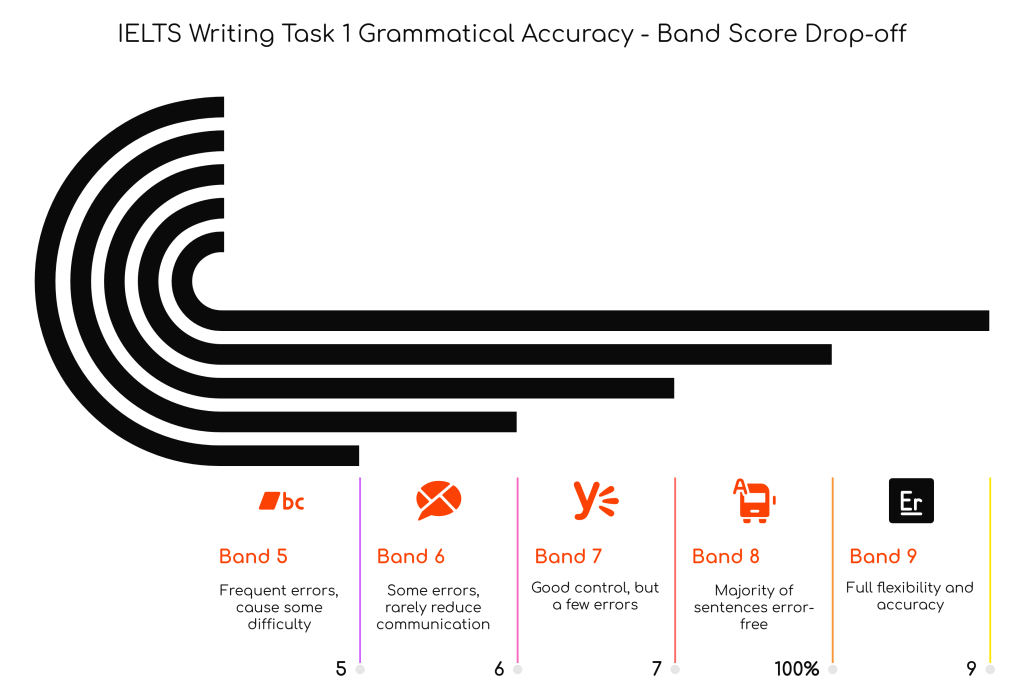
Band Score Descriptors for Grammatical Range and Accuracy
Band 9
- Uses a wide range of structures with full flexibility and accuracy
- Rare minor errors occur only as ‘slips’
Band 8
- Uses a wide range of structures flexibly and accurately
- Majority of sentences are error-free
- Makes only occasional errors
Band 7
- Uses a variety of complex structures
- Frequently produces error-free sentences
- Has good control of grammar and punctuation but may make a few errors
Band 6
- Uses a mix of simple and complex sentence forms
- Makes some errors in grammar and punctuation but they rarely reduce communication
Band 5
- Uses only a limited range of structures
- Attempts complex sentences but these tend to be less accurate than simple sentences
- Frequent grammatical errors may cause some difficulty for the reader
Essential Grammar Structures for Task 1
1. Verb Tenses
- Simple Past: “The population increased from 2000 to 2010.”
- Present Perfect: “The number has risen dramatically since 1990.”
- Past Perfect: “By 2005, unemployment had reached its peak.”
- Future forms: “The graph shows projected growth that will continue until 2030.”
2. Comparative and Superlative Forms
- “Sales were significantly higher in quarter two.”
- “France had the largest market share.”
- “The most dramatic change occurred in the final period.”
3. Passive Voice
- “A steady increase was observed in renewable energy consumption.”
- “The data is presented in percentages.”
4. Complex Sentence Structures
- Relative clauses: “Germany, which had the highest exports, showed consistent growth.”
- Participle clauses: “Starting at 20%, the figure rose steadily.”
- Conditional sentences: “If the trend continues, levels will exceed 50% by 2025.”
5. Varied Sentence Beginnings
- “Despite initial fluctuations, the trend remained upward.”
- “Following a brief decline, figures recovered quickly.”
- “In contrast to the previous year, 2020 showed remarkable growth.”
Examples of Good Grammar Usage
Example 1: Line Graph Description
❌ Poor grammar: “The graph show that people use internet more in 2020 than 2010. It increase very much.”
✅ Good grammar: “The graph demonstrates that internet usage increased dramatically between 2010 and 2020, rising from 45% to 78% of the population.”
Example 2: Bar Chart Analysis
❌ Poor grammar: “Men and women has different preference. Men like sports more but women prefer shopping.”
✅ Good grammar: “While men showed a stronger preference for sports activities (65% compared to 35% for women), women demonstrated greater interest in shopping, with 70% participating compared to only 25% of men.”
Example 3: Pie Chart Description
❌ Poor grammar: “Transportation take biggest part of budget which is 40%. Food is second bigger with 25%.”
✅ Good grammar: “Transportation accounted for the largest proportion of the budget at 40%, followed by food expenditure, which represented 25% of total spending.”
Common Mistakes and How to Fix Them
Mistake 1: Subject-Verb Agreement Errors
❌ “The data show that consumption have increased.”
✅ “The data show that consumption has increased.” (consumption = singular)
✅ “The figures show that consumption levels have increased.” (levels = plural)
Mistake 2: Incorrect Article Usage
❌ “Graph shows increase in the unemployment.”
✅ “The graph shows an increase in unemployment.”
Mistake 3: Wrong Preposition Usage
❌ “The percentage increased in 45% to 67%.”
✅ “The percentage increased from 45% to 67%.”
Mistake 4: Inconsistent Tense Usage
❌ “The graph showed data from 2010 to 2020. In 2015, the figure increases to 30%.”
✅ “The graph shows data from 2010 to 2020. In 2015, the figure increased to 30%.”
Mistake 5: Run-on Sentences
❌ “The population grew steadily from 2000 to 2010 and then it started to decline because of economic problems and people moved to other cities and this trend continued until 2020.”
✅ “The population grew steadily from 2000 to 2010. However, it then began to decline due to economic problems, with many people relocating to other cities. This downward trend continued until 2020.”
Essential Dos and Don’ts
✅ DOs
1. Vary Your Sentence Structures
- Mix simple, compound, and complex sentences
- Use different sentence beginnings
- Incorporate various grammatical constructions
2. Use Appropriate Tenses
- Past tense for historical data
- Present tense for current trends or general statements
- Future forms for projections
3. Check Subject-Verb Agreement
- Singular subjects take singular verbs
- Plural subjects take plural verbs
- Be careful with collective nouns
4. Use Complex Grammar Accurately
- Only use structures you’re confident about
- Practice complex constructions before the test
5. Proofread Your Work
- Check for common errors
- Ensure consistency in tense usage
- Verify punctuation
❌ DON’Ts
1. Don’t Overuse Simple Sentences
- Avoid writing only basic sentence structures
- Don’t repeat the same patterns throughout
2. Don’t Force Complex Grammar
- Avoid using complex structures incorrectly
- Don’t sacrifice accuracy for complexity
3. Don’t Ignore Articles
- Remember to use ‘a’, ‘an’, ‘the’ appropriately
- Be particularly careful with uncountable nouns
4. Don’t Mix Tenses Inappropriately
- Stay consistent with your chosen tense
- Don’t jump between past and present randomly
5. Don’t Write Run-on Sentences
- Break long sentences into shorter, clearer ones
- Use appropriate punctuation
Practice Strategies
1. Sentence Transformation Exercises
Practice converting simple sentences into more complex ones:
- Simple: “Sales increased in 2020.”
- Complex: “Despite economic challenges, sales demonstrated a remarkable increase in 2020.”
2. Grammar Pattern Practice
Study and practice common IELTS Task 1 patterns:
- Trend language with various tenses
- Comparison structures
- Data presentation language
3. Error Correction
Review sample Task 1 responses and identify grammatical errors. Practice correcting them and understanding why they’re wrong.
4. Timed Writing Practice
Write complete Task 1 responses within 20 minutes, focusing on using varied and accurate grammar structures.
Frequently Asked Questions
Q1: How important is grammatical accuracy compared to range?
A: Both are equally important. While demonstrating range shows your grammatical knowledge, accuracy ensures clear communication. Aim for a balance: use varied structures that you can control accurately.
Q2: Should I use very complex grammar to get a high score?
A: Not necessarily. Band 7-8 responses often use moderately complex grammar accurately rather than attempting overly complex structures with errors. Focus on using a variety of structures correctly.
Q3: How many grammatical errors are acceptable?
A: This depends on your target band score. For Band 7, occasional errors are acceptable if they don’t impede communication. For Band 8+, errors should be rare and minor.
Q4: Can I get Band 7 with mostly simple sentences?
A: It’s unlikely. Band 7 requires “a variety of complex structures.” You need to demonstrate some complex grammar alongside simple sentences.
Q5: What’s the most common grammatical error in Task 1?
A: Subject-verb agreement errors and incorrect use of articles are extremely common. Also, many students struggle with appropriate preposition usage in data descriptions.
Q6: How can I avoid run-on sentences?
A: Use punctuation effectively, vary your sentence lengths, and break complex ideas into multiple sentences. Each sentence should express one main idea clearly.
Q7: Is it better to use active or passive voice?
A: Both are useful. Active voice is generally clearer, but passive voice is often appropriate for describing data and trends objectively: “A significant increase was observed in…”
Q8: How do I know if my grammar is varied enough?
A: Check if you’re using different sentence beginnings, various clause types (relative, adverbial, etc.), different tenses appropriately, and a mix of simple, compound, and complex sentences.
Final Tips for Success
- Practice regularly with authentic IELTS materials
- Focus on accuracy first, then gradually increase complexity
- Learn from your mistakes by keeping an error log
- Time yourself to simulate exam conditions
- Get feedback from qualified instructors when possible
- Study model answers to see how high-scoring responses use grammar
- Read extensively to internalize correct grammatical patterns
Remember, achieving high scores in Grammatical Range and Accuracy requires consistent practice and attention to detail. Focus on using grammar that serves your communication purpose effectively, and always prioritize clarity and accuracy over unnecessary complexity.
Conclusion
Mastering Grammatical Range and Accuracy in IELTS Writing Task 1 is achievable with focused practice and understanding of what examiners are looking for. By incorporating varied sentence structures, maintaining grammatical accuracy, and avoiding common mistakes, you can significantly improve your performance in this crucial assessment criterion. Remember that consistent practice with feedback is key to developing both the range and accuracy needed for your target band score.
#IELTSGuidePhil #IELTS #IELTSWriting #IELTSTask1 #IELTSGrammar #IELTSPreparation #IELTSAcademic #EnglishGrammar #IELTSBand7 #IELTSBand8 #IELTSStudy #TestPreparation #AcademicWriting #EnglishLanguageLearning #IELTSSuccess #GrammarTips #WritingSkills #IELTSExam #LanguageLearning #TestTaking #IELTSHelp #StudyTips
 IELTS Guide Phil
Leave a comment