
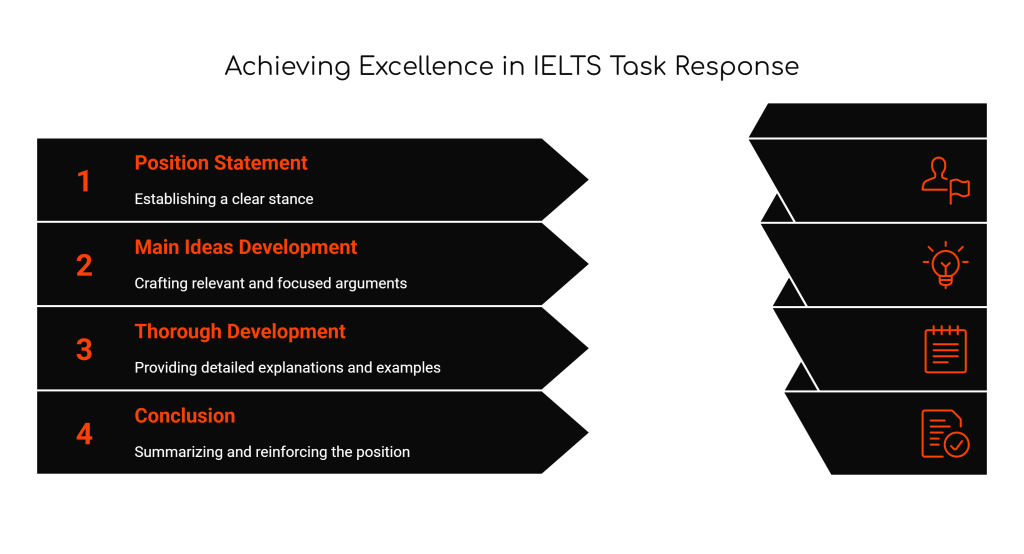
Task Response is the most critical marking criterion in IELTS Writing Task 2, accounting for 25% of your overall score. It measures how effectively you address the essay question and develop your arguments. Understanding this criterion is essential for achieving Band 7+ scores, as even excellent grammar and vocabulary cannot compensate for poor task response. You can watch this YouTube video explainer by IELTS Guide Phil.
What is Task Response?
Task Response evaluates how well you understand and respond to the essay question. It assesses your ability to:
- Address all parts of the task completely
- Present a clear position throughout the response
- Develop ideas thoroughly with relevant examples and explanations
- Stay on topic and maintain focus
- Present a logical conclusion that follows from your arguments
Band Score Requirements for Task Response
Band 9
- Fully addresses all parts of the task
- Presents a fully developed position with relevant, fully extended, and well-supported ideas
- Demonstrates complete understanding of the question
- Maintains consistent focus throughout
Band 7-8
- Addresses all parts of the task (Band 8) or covers all requirements sufficiently (Band 7)
- Presents a clear position throughout the response
- Main ideas are well-developed with relevant support
- May have occasional lapses in focus (Band 7)
Band 5-6
- Addresses the task only partially (Band 5) or adequately (Band 6)
- Position may be unclear or inconsistent
- Some main ideas are developed but may lack focus or contain irrelevant detail
- Limited development of supporting ideas
Band 3-4
- Does not address the task appropriately
- Position is unclear or not maintained
- Ideas are limited and poorly developed
- May be largely off-topic or repetitive
Types of IELTS Task 2 Questions
1. Opinion Essays (Agree/Disagree)
Question pattern: “Do you agree or disagree with this statement?” Task Response requirements:
- State your opinion clearly in the introduction
- Maintain consistent position throughout
- Provide reasons supporting your viewpoint
- Address counterarguments (for higher bands)
Example question: “Some people believe that children should be taught to be competitive in school. Others think cooperation is more important. Do you agree or disagree?”
2. Discussion Essays (Both Sides)
Question pattern: “Discuss both views and give your opinion” Task Response requirements:
- Present both sides fairly and objectively
- Provide clear examples for each viewpoint
- Give your personal opinion (essential for Task Response)
- Balance the discussion appropriately
Example question: “Some people think that universities should provide graduates with practical skills. Others believe that academic study is more important. Discuss both views and give your opinion.”
3. Advantages/Disadvantages Essays
Question pattern: “What are the advantages and disadvantages?” or “Do advantages outweigh disadvantages?” Task Response requirements:
- Address both advantages and disadvantages
- Provide specific examples for each
- If asked about outweighing, give clear judgment
- Maintain balanced or weighted approach as required
Example question: “In many countries, people are moving from rural to urban areas. What are the advantages and disadvantages of this trend?”
4. Problem/Solution Essays
Question pattern: “What are the causes and solutions?” or “What problems does this cause?” Task Response requirements:
- Identify specific problems or causes
- Propose realistic, relevant solutions
- Develop each point thoroughly
- Address all parts of the question
Example question: “Traffic congestion is becoming a serious problem in many cities. What are the causes of this problem and what solutions can you suggest?”
5. Two-Part Questions
Question pattern: Two separate questions requiring distinct answers Task Response requirements:
- Answer both questions completely
- Treat each question with equal importance
- Provide specific examples for both parts
- Maintain clear structure separating the two parts
Example question: “Why do people choose to live in big cities? What problems do they face there?”
Essential Components for High Task Response
1. Complete Question Analysis
Before writing, spend 3-5 minutes analyzing:
- Question type – What structure is required?
- Key terms – What specific topics must be addressed?
- Task words – What exactly are you asked to do?
- Number of parts – How many elements need addressing?
2. Clear Position Statement
Your introduction must establish:
- Your understanding of the question
- Your position (where relevant)
- Preview of main arguments (optional but helpful)
Strong position example: “While competition can motivate students to achieve better results, I believe that teaching cooperation is far more beneficial for children’s overall development and future success in the workplace.”
3. Relevant Main Ideas
Each body paragraph should contain:
- One clear main idea that directly addresses the question
- Explanation of why this idea is important
- Specific examples to support your point
- Connection back to the question
4. Thorough Development
Avoid superficial treatment by:
- Explaining consequences – What happens because of this?
- Providing specific examples – Real situations, not hypothetical ones
- Making connections – How does this relate to the bigger picture?
- Adding depth – Why is this significant?
Question Analysis Strategies
Opinion Essays Strategy
- Identify the statement – What claim is being made?
- Consider both sides – Even if you disagree, understand the opposing view
- Choose your position – Strongly agree, partially agree, or disagree?
- Plan supporting arguments – Why do you hold this view?
Discussion Essays Strategy
- Identify both viewpoints – What are the two contrasting opinions?
- Find examples for each – How can you support both sides?
- Form your opinion – Which side do you lean toward, or is there middle ground?
- Plan balanced coverage – Equal development for both views
Problem/Solution Strategy
- Identify the issue – What is the main problem being discussed?
- Brainstorm causes – What creates this problem?
- Generate solutions – How can these causes be addressed?
- Evaluate feasibility – Are your solutions realistic?
Essential Dos and Don’ts
✅ DO:
- Address every part of the question – Missing elements = lower Task Response
- Maintain clear position – Your stance should be evident throughout
- Use specific examples – Real situations are more convincing than hypotheticals
- Stay focused – Every sentence should relate to the question
- Plan thoroughly – 5 minutes planning saves 10 minutes writing
- Write a proper conclusion – Summarize your position and main points
- Develop ideas fully – Each main point needs explanation and examples
❌ DON’T:
- Go off-topic – Stay strictly within the question’s scope
- Repeat the question – Paraphrase it instead
- Give unclear positions – Ambiguity hurts Task Response
- Provide superficial examples – “For example, in my country…” without specifics
- Change your opinion – Maintain consistency throughout
- Address only part of the question – All elements must be covered
- Write irrelevant conclusions – Don’t introduce new ideas
Common Mistakes and How to Fix Them
Mistake 1: Not Addressing All Parts of the Question
Problem: Focusing on only one aspect of a multi-part question.
Example question: “Some people think that governments should spend money on faster public transportation. Others believe that money should be spent on other priorities such as education and healthcare. Discuss both views and give your opinion.”
Poor response: Only discussing transportation benefits without addressing education/healthcare or giving personal opinion.
Fix: Create a checklist:
- ✅ Transportation advantages
- ✅ Education/healthcare importance
- ✅ Personal opinion with justification
Mistake 2: Unclear Position
Problem: Being wishy-washy or contradicting yourself.
Example: ❌ “I think competition is good for students but cooperation is also important and both are necessary so it depends on the situation.”
Fix: Take a clear stance with nuanced reasoning: ✅ “While both competition and cooperation have educational value, I believe that cooperation should be prioritized because it develops essential life skills that serve students better in their future careers and relationships.”
Mistake 3: Superficial Development
Problem: Mentioning ideas without proper explanation or examples.
Poor example: ❌ “Competition is bad because it causes stress. This is harmful to students.”
Fix: Develop the idea thoroughly: ✅ “Excessive competition can create harmful stress levels in students, leading to anxiety, depression, and even academic burnout. For instance, in South Korea’s highly competitive education system, teenage suicide rates have increased dramatically due to academic pressure, with many students reporting feeling overwhelmed by constant comparison with peers.”
Mistake 4: Off-Topic Content
Problem: Including interesting but irrelevant information.
Question about urban migration, poor response includes: ❌ “Cities also have better shopping centers and entertainment facilities like cinemas and restaurants, which make life more enjoyable.”
Fix: Stay focused on the question’s scope: ✅ “Urban areas offer superior employment opportunities with higher salaries and career advancement prospects, which directly addresses people’s economic motivations for migration.”
Mistake 5: Weak Examples
Problem: Using vague, hypothetical, or personal examples.
Poor examples: ❌ “For example, if someone works hard, they will be successful.” ❌ “In my experience, I have seen that…” ❌ “My friend told me that…”
Fix: Use specific, concrete examples: ✅ “For instance, Finland’s education system emphasizes collaborative learning over competition, resulting in consistently high international rankings and lower student stress levels compared to exam-focused systems like those in Singapore or Japan.”
Sample Response Analysis
Question: Some people believe that unpaid community service should be a compulsory part of high school programs. To what extent do you agree or disagree?
Band 9 Response Analysis:
Introduction: “Community service programs have become increasingly common in educational institutions worldwide. While some argue that mandatory volunteer work places unnecessary burden on students, I strongly believe that compulsory community service should be integrated into high school curricula due to its significant benefits for both personal development and society.”
Analysis: ✅ Clear position, paraphrases question, previews argument
Body Paragraph 1: “Firstly, mandatory community service develops essential life skills that traditional classroom learning cannot provide. Through volunteering activities, students gain practical experience in problem-solving, leadership, and communication while working with diverse community members. For example, students participating in habitat restoration projects learn project management skills while contributing to environmental conservation. Similarly, those working in elderly care facilities develop empathy and interpersonal skills that prove invaluable in both personal relationships and future careers. These competencies are increasingly valued by universities and employers, making such programs beneficial for students’ future prospects.”
Analysis: ✅ Clear main idea, thorough explanation, specific examples, connection to broader significance
Body Paragraph 2: “Furthermore, compulsory community service addresses critical social needs while fostering civic responsibility among young people. Many communities face volunteer shortages in essential services such as literacy programs, environmental cleanup, and support for vulnerable populations. High school students can provide consistent, energetic assistance to these initiatives. Research from the Corporation for National and Community Service shows that areas with mandatory student volunteer programs experience 23% higher volunteer retention rates in adulthood, suggesting that early exposure to community service creates lifelong civic engagement. This creates a positive cycle where communities benefit both immediately and long-term.”
Analysis: ✅ Second strong argument, specific statistics, long-term implications addressed
Body Paragraph 3: “Critics argue that mandatory service contradicts the voluntary spirit of community work and may create resentment among students. However, this concern overlooks the educational value of structured civic engagement. Just as students are required to study mathematics or literature to develop cognitive abilities, mandatory community service develops social and ethical capabilities essential for citizenship. Moreover, evidence from countries like Germany and Costa Rica, where community service is compulsory, shows high satisfaction rates among participants who initially resisted but later valued the experience.”
Analysis: ✅ Addresses counterargument, provides evidence, maintains position
Conclusion: “In conclusion, while concerns about mandatory community service merit consideration, the substantial benefits for both individual development and social welfare make such programs essential. High schools should implement compulsory community service as it creates more well-rounded citizens while addressing genuine community needs.”
Analysis: ✅ Summarizes position, acknowledges opposition, reaffirms stance
Why This Achieves Band 9 Task Response:
- Fully addresses the question with clear extent of agreement
- Consistent position maintained throughout
- Well-developed arguments with specific examples and evidence
- Addresses counterarguments while maintaining position
- Relevant examples from multiple countries with specific data
- Clear conclusion that follows logically from arguments
Advanced Task Response Strategies
1. The Thesis Statement Technique
Create a roadmap in your introduction: “I strongly agree with this statement because community service develops practical skills, addresses social needs, and creates lifelong civic engagement habits.”
2. The Counterargument Method
Strengthen your position by addressing opposition:
- Acknowledge the opposing view
- Explain why it has some merit
- Show why your position is stronger
- Use evidence to support your refutation
3. The Consequence Chain
Develop ideas by exploring implications:
- State your main point
- Explain immediate effects
- Discuss long-term consequences
- Connect to broader societal impact
4. The Comparative Analysis
Use comparisons to strengthen arguments:
- Compare different countries/systems
- Contrast past and present situations
- Analyze successful vs. unsuccessful examples
Final Tips for Task Response Success
- Question analysis is crucial – Spend 5 minutes understanding exactly what’s asked
- Plan your position – Know your stance before you start writing
- Use the full word count – 250+ words allows for proper development
- Every paragraph should advance your argument – No filler content
- Conclude decisively – Your ending should reflect your introduction
- Practice different question types – Each requires different approaches
- Read sample essays critically – Analyze how they address the question
- Time management – 40 minutes total, including 5 minutes planning
Remember, Task Response is about demonstrating clear thinking and thorough argumentation. Your ability to analyze questions, take positions, and develop ideas with relevant examples determines your success in this crucial criterion.
Ready to master IELTS Writing Task 2 Task Response? Practice analyzing different question types and developing clear, well-supported arguments. Remember, a strong Task Response demonstrates your ability to think critically and communicate complex ideas effectively.
#IELTSGuidePhil #IELTS #IELTSWriting #IELTSTask2 #TaskResponse #IELTSEssay #IELTSPreparation #IELTSTips #IELTSStudy #EnglishTest #IELTSSuccess #WritingSkills #IELTSBand7 #IELTSBand8 #IELTSBand9 #TestPreparation #EnglishLearning #IELTSCoach #StudyTips #IELTSStrategy #EssayWriting #ArgumentativeEssay #AcademicWriting #CriticalThinking
 IELTS Guide Phil
Leave a comment