
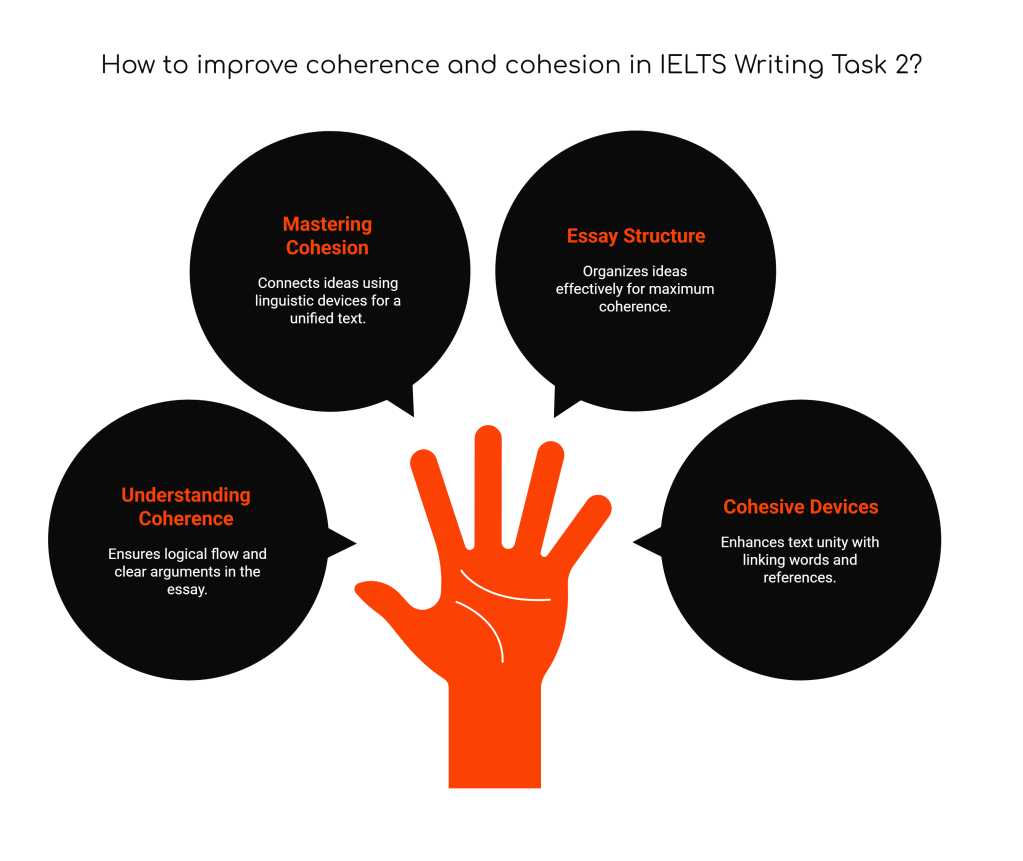
IELTS Writing Task 2 carries more weight than Task 1, contributing twice as much to your overall Writing band score. Among the four assessment criteria, Coherence and Cohesion often determines whether candidates achieve their target band score or fall short. This comprehensive guide will transform your essay writing from disorganized thoughts into compelling, logically structured arguments that impress IELTS examiners. You can watch this YouTube video explainer by IELTS Guide Phil.
Whether you’re taking Academic or General Training IELTS, the Task 2 requirements remain the same: write a 250+ word essay responding to a given prompt. Your success depends largely on how coherently you present your ideas and how cohesively you connect them.
Understanding Coherence and Cohesion in Essay Writing
Coherence in Essays
Coherence means your essay makes logical sense as a whole. A coherent essay:
- Has a clear central argument or position
- Develops ideas in logical sequence
- Maintains focus on the topic throughout
- Presents arguments that support the main thesis
- Shows clear relationships between ideas
Cohesion in Essays
Cohesion refers to the linguistic devices that bind your text together. Cohesive essays use:
- Appropriate linking words and transitional phrases
- Clear pronoun references and substitution
- Repetition and variation of key terms
- Parallel structures and consistent patterns
- Effective paragraphing with clear topic sentences
Think of coherence as your essay’s “skeleton” (the logical structure) and cohesion as the “connective tissue” (the language that holds it together).
IELTS Task 2 Essay Types and Their Coherence Requirements
Understanding different essay types helps you organize ideas coherently:
1. Opinion Essays (Agree/Disagree)
Structure: Clear position → Supporting arguments → Conclusion Coherence focus: Consistent stance throughout, logical argument progression
2. Discussion Essays (Discuss Both Views)
Structure: Introduction → View A → View B → Personal opinion → Conclusion Coherence focus: Balanced treatment, clear transitions between opposing views
3. Problem-Solution Essays
Structure: Introduction → Problems → Solutions → Conclusion Coherence focus: Clear cause-effect relationships, practical connections
4. Advantages-Disadvantages Essays
Structure: Introduction → Advantages → Disadvantages → Conclusion/Opinion Coherence focus: Balanced analysis, comparative structure
5. Two-Part Questions
Structure: Introduction → Answer Part 1 → Answer Part 2 → Conclusion Coherence focus: Clear address of both parts, logical connection between them
The Perfect Essay Structure for Maximum Coherence
Standard 4-Paragraph Structure:
Introduction (50-60 words):
- Hook + Background + Thesis statement
- Clear position or roadmap for discussion
Body Paragraph 1 (100-120 words):
- Topic sentence + Explanation + Example + Link
Body Paragraph 2 (100-120 words):
- Topic sentence + Explanation + Example + Link
Conclusion (40-50 words):
- Restate thesis + Summarize main points + Final thought
Alternative 5-Paragraph Structure (for complex topics):
- Introduction
- Body Paragraph 1 (First main point)
- Body Paragraph 2 (Second main point)
- Body Paragraph 3 (Third main point or counterargument)
- Conclusion
Essential Cohesive Devices for Task 2
Linking Words by Function:
Adding Information:
- Furthermore, Moreover, Additionally
- In addition, What is more, Besides
- Not only… but also, As well as
Showing Contrast:
- However, Nevertheless, Nonetheless
- On the other hand, In contrast, Conversely
- While, Whereas, Although, Despite
Giving Examples:
- For instance, For example, Such as
- To illustrate, Namely, In particular
- A case in point is, Take… for instance
Showing Cause and Effect:
- Therefore, Thus, Consequently
- As a result, Hence, Accordingly
- Due to, Because of, Owing to
Sequencing Ideas:
- Firstly, Secondly, Finally
- Initially, Subsequently, Ultimately
- To begin with, In addition, In conclusion
Emphasizing Points:
- Indeed, In fact, Certainly
- Clearly, Obviously, Undoubtedly
- Most importantly, Above all, Particularly
Advanced Cohesive Techniques:
Pronoun Reference:
- “These factors contribute to…” (referring back to previously mentioned points)
- “Such measures would…” (referring to proposed solutions)
- “This trend indicates…” (referring to a described pattern)
Substitution:
- “This issue” (instead of repeating “climate change”)
- “These individuals” (instead of repeating “young people”)
- “Such policies” (instead of repeating “government regulations”)
Ellipsis and Parallel Structure:
- “Some people prefer online learning; others, traditional classrooms.”
- “Technology can enhance education, improve communication, and increase efficiency.”
Examples of Excellent Coherence and Cohesion
Example 1: Opinion Essay
Topic: “Some people think that universities should provide graduates with the knowledge and skills needed in the workplace. Others think that the true function of a university is to give access to knowledge for its own sake, regardless of whether the course is useful to an employer. What, in your opinion, should be the main function of a university?”
Poor coherence and cohesion: “Universities are important. Students need jobs. Some courses are not useful. Employers want skills. Knowledge is also important. Universities should do both things. This is my opinion.”
Excellent coherence and cohesion: “Higher education institutions face a fundamental dilemma regarding their primary purpose: should they prioritize practical job preparation or pursue knowledge for intellectual enrichment? While both approaches have merit, I believe universities should primarily focus on developing workplace-ready graduates while maintaining their traditional academic mission.
Firstly, the economic reality of student debt necessitates career-focused education. Most graduates today accumulate substantial loans that can only be repaid through well-paying employment. For instance, engineering students who learn industry-relevant software and project management skills are significantly more likely to secure lucrative positions than those with purely theoretical knowledge. This practical approach not only benefits individual students but also strengthens the economy by producing a skilled workforce.
However, universities must also preserve their role as centers of intellectual inquiry. Pure research and theoretical study often lead to breakthrough discoveries that eventually transform society. Take, for example, the development of the internet, which emerged from academic computer science research with no immediate commercial application. Therefore, while career preparation should be prioritized, institutions should continue to support faculty research and offer courses in fundamental disciplines.
In conclusion, although both practical training and academic pursuit have value, universities should primarily emphasize employability while preserving space for traditional scholarship. This balanced approach ensures graduates can repay their educational investment while maintaining the intellectual foundations that drive long-term innovation.”
Example 2: Problem-Solution Essay
Topic: “Traffic congestion is becoming a huge problem for many major cities. Suggest some measures that could be taken to reduce traffic in big cities.”
Poor coherence and cohesion: “Traffic is bad. Cars cause pollution. People are late for work. Government should do something. Public transport helps. Bicycle lanes are good. Working from home reduces traffic.”
Excellent coherence and cohesion: “Urban traffic congestion has reached crisis levels in numerous metropolitan areas worldwide, creating environmental, economic, and social challenges. Fortunately, several practical measures can effectively address this growing problem.
The most impactful solution involves expanding and improving public transportation systems. When cities invest in reliable, frequent, and comfortable buses, trains, and subways, citizens naturally shift away from private vehicle use. Singapore’s Mass Rapid Transit system exemplifies this approach, carrying over three million passengers daily and significantly reducing road congestion. Moreover, electric public transport not only decreases traffic volume but also reduces harmful emissions.
Another effective strategy focuses on encouraging flexible work arrangements. By promoting remote work and flexible hours, employers can dramatically reduce peak-hour traffic volume. The COVID-19 pandemic demonstrated that many jobs can be performed effectively from home, suggesting that permanent adoption of such policies could permanently alleviate rush-hour gridlock. Additionally, staggered work schedules ensure that not all employees travel simultaneously, thus distributing traffic flow more evenly throughout the day.
In conclusion, while traffic congestion poses significant urban challenges, comprehensive solutions combining improved public transport with flexible work policies can substantially reduce this problem. These measures require coordinated government and private sector efforts, but the long-term benefits for cities and citizens far outweigh the initial implementation costs.”
Common Coherence and Cohesion Mistakes
Mistake 1: Overusing Basic Connectors
Incorrect: “Firstly, education is important. Secondly, health is important. Thirdly, the economy is important. Finally, the environment is important.”
Correct: “Education forms the foundation of societal development. Equally crucial, healthcare systems ensure population wellbeing, while economic stability provides the resources for both educational and medical advancement. Underpinning all these priorities, environmental protection safeguards the planet for future generations.”
Mistake 2: Unclear Pronoun References
Incorrect: “Many countries have aging populations. This creates economic problems. They need to find solutions. It is becoming urgent.”
Correct: “Many countries face aging populations. This demographic shift creates significant economic challenges as fewer working-age individuals support growing numbers of retirees. These nations must develop comprehensive strategies to address the crisis, and such planning is becoming increasingly urgent.”
Mistake 3: Illogical Paragraph Progression
Incorrect structure: Para 1: Education is expensive Para 2: Technology helps learning
Para 3: Students have financial problems Para 4: Online courses are popular
Correct structure: Para 1: Education costs are rising (establish problem) Para 2: Financial barriers affect student access (develop problem) Para 3: Technology offers cost-effective solutions (present solution) Para 4: Online learning demonstrates practical benefits (support solution)
Mistake 4: Mechanical Linking Word Usage
Incorrect: “However, education is important. Moreover, it helps society. Furthermore, students benefit. Nevertheless, it costs money.”
Correct: “Education plays a vital role in societal development by creating informed citizens and skilled workers. While the individual benefits are substantial—including better career prospects and intellectual growth—the financial burden often prevents equal access to quality learning opportunities.”
Mistake 5: Lack of Topic Sentence Unity
Incorrect paragraph: “Technology improves education. However, some teachers resist change. Online learning is convenient. Traditional methods have advantages. Students prefer interactive lessons.”
Correct paragraph: “Technology integration in education faces significant resistance from traditional educators. Many experienced teachers worry that digital tools might replace personal interaction or diminish their classroom authority. Despite these concerns, evidence suggests that when properly implemented, educational technology actually enhances rather than replaces traditional teaching methods, creating opportunities for more personalized and engaging learning experiences.”
Advanced Coherence and Cohesion Strategies
1. Thematic Progression Patterns
Simple Linear Progression: Topic A → Comment about A → Topic B (related to A) → Comment about B
Constant Theme Progression: Topic A → Comment 1 → Topic A → Comment 2 → Topic A → Comment 3
Split Rheme Progression: Topic A → Comment (X + Y) → Topic X → Comment → Topic Y → Comment
2. Sophisticated Reference Systems
Lexical chains: Use related words throughout your essay
- “pollution” → “contamination” → “environmental damage” → “ecological harm”
Demonstrative reference: Use “this/these/such” effectively
- “This approach suggests…” (referring to previously mentioned strategy)
- “Such measures would…” (referring to proposed solutions)
3. Advanced Transition Techniques
Transitional sentences: Bridge paragraphs smoothly
- “While individual actions are important, government policy plays an equally crucial role.”
- “Having examined the benefits, we must now consider the potential drawbacks.”
Echo transitions: Repeat key terms from the previous paragraph
- Para 1 ends: “…significant environmental benefits.”
- Para 2 starts: “These environmental advantages, however, must be weighed against economic costs.”
Essay-Specific Coherence Strategies
Opinion Essays (Agree/Disagree)
- Maintain consistent position throughout
- Use strengthening language: “strongly believe,” “completely agree”
- Acknowledge counterarguments briefly before refuting them
- End with reinforcement of your position
Discussion Essays
- Present balanced treatment of both views
- Use comparative language: “while X argues…, Y contends…”
- Signal transitions between viewpoints clearly
- Reserve personal opinion for designated section
Problem-Solution Essays
- Establish clear cause-effect relationships
- Use problem-oriented language in first half
- Switch to solution-focused language in second half
- Show how solutions address specific problems
Advantages-Disadvantages Essays
- Use parallel structure for balance
- Group related advantages/disadvantages
- Use comparative language throughout
- Weigh relative importance in conclusion
Band-Specific Requirements
Band 6 Requirements:
- Arranges information coherently with overall progression
- Uses cohesive devices effectively but with some mechanical usage
- May have faulty cohesion within/between sentences
Band 7 Requirements:
- Logically organizes information with clear progression
- Uses range of cohesive devices appropriately
- Generally effective paragraphing
Band 8 Requirements:
- Sequences information logically with smooth progression
- Wide range of cohesive devices used naturally
- Skillful paragraphing with variety
Band 9 Requirements:
- Cohesion doesn’t attract attention (seamless)
- Skillful management of paragraphing
- Full range of devices used with complete flexibility
Practical Exercises for Improvement
Exercise 1: Improve Paragraph Unity
Identify the topic sentence and eliminate irrelevant information:
“Online education has revolutionized learning accessibility. Students can study from anywhere with internet connection. Traditional universities have beautiful campuses. Working professionals can earn degrees while maintaining their careers. Some people prefer face-to-face interaction. The flexibility of online learning suits modern lifestyles.”
Exercise 2: Add Sophisticated Cohesive Devices
Improve this choppy paragraph:
“Climate change affects agriculture. Farmers struggle with unpredictable weather. Crop yields decrease. Food prices rise. Consumers face higher costs. Governments must act quickly.”
Exercise 3: Create Logical Paragraph Progression
Reorganize these ideas for a discussion essay about social media:
- Young people become addicted to social platforms
- Social media connects people globally
- Privacy concerns arise from data collection
- Businesses use social media for marketing
- Mental health issues increase among teenagers
- Long-distance relationships are maintained through social platforms
Quick Assessment Checklist
Before submitting your Task 2 essay, verify:
Coherence:
- [ ] Does my thesis clearly state my position/approach?
- [ ] Does each body paragraph have a clear main idea?
- [ ] Do my arguments logically support my thesis?
- [ ] Is there logical progression between paragraphs?
- [ ] Does my conclusion effectively summarize and reinforce?
Cohesion:
- [ ] Have I used a variety of linking words appropriately?
- [ ] Are my pronoun references clear and unambiguous?
- [ ] Do I use topic sentences to introduce paragraph content?
- [ ] Are transitions between ideas smooth and logical?
- [ ] Have I avoided overusing simple connectors like “and,” “but”?
Overall Structure:
- [ ] Is my introduction engaging and clear?
- [ ] Do body paragraphs follow PEEL structure (Point, Explain, Example, Link)?
- [ ] Does each paragraph connect to the overall argument?
- [ ] Is my word count appropriate (250-280 words ideal)?
- [ ] Does my writing flow naturally without mechanical connections?
Time Management for Coherent Writing
Planning Phase (5 minutes):
- Analyze the question thoroughly
- Brainstorm ideas and choose your position
- Create a basic outline with main points
- Plan your paragraph structure
Writing Phase (30 minutes):
- Introduction: 5 minutes
- Body Paragraph 1: 10 minutes
- Body Paragraph 2: 10 minutes
- Conclusion: 5 minutes
Review Phase (5 minutes):
- Check coherence: Do ideas flow logically?
- Check cohesion: Are connections clear?
- Fix any obvious errors
- Ensure word count is adequate
Sample Paragraph Templates
PEEL Structure for Body Paragraphs:
Point: [Topic sentence with clear main idea] Explain: [Develop the idea with reasoning/analysis] Example: [Provide specific illustration or evidence] Link: [Connect back to thesis or transition to next point]
Example PEEL Paragraph:
Point: “The primary benefit of renewable energy lies in its environmental sustainability.” Explain: “Unlike fossil fuels, solar and wind power generate electricity without releasing harmful greenhouse gases, thus helping combat climate change while preserving natural resources for future generations.” Example: “Denmark exemplifies this approach, deriving over 50% of its electricity from wind power and achieving significant reductions in carbon emissions as a result.” Link: “This environmental advantage, combined with decreasing technology costs, makes renewable energy an increasingly attractive option for nations worldwide.”
Final Success Strategies
1. Read High-Quality Essays Regularly
- Analyze how ideas connect and flow
- Notice sophisticated cohesive devices in context
- Study various essay types and their organizational patterns
2. Practice Specific Skills
- Write topic sentences for different paragraph types
- Practice using advanced linking words in context
- Work on smooth transitions between opposing ideas
3. Get Feedback on Coherence
- Ask others to identify your main argument after reading
- Check if your paragraph progression makes sense to readers
- Verify that your examples clearly support your points
4. Develop Your Own Style
- Find natural ways to express complex relationships
- Build a toolkit of sophisticated transitions
- Create templates that work for your thinking patterns
5. Practice Under Time Pressure
- Write complete essays in 40 minutes regularly
- Focus on clear organization even when rushed
- Develop automatic responses for common essay types
Remember, coherence and cohesion in Task 2 writing is about creating compelling arguments that readers can follow effortlessly. Your goal is to guide readers through your reasoning so smoothly that they focus on your ideas rather than how you’ve connected them.
Master these skills through consistent practice, and watch your Task 2 scores soar from good to exceptional!
#IELTSGuidePhil #IELTS #IELTSWritingTask2 #IELTSEssay #CoherenceAndCohesion #IELTSPreparation #IELTSTips #IELTSStudy #EssayWriting #WritingSkills #EnglishTest #TestPreparation #IELTSSuccess #AcademicWriting #IELTSBand7 #IELTSBand8 #IELTSBand9 #StudyAbroad #EnglishLanguage #IELTSCoaching #ExamPreparation #LanguageLearning #ArgumentativeEssay #OpinionEssay #DiscussionEssay #ProblemSolutionEssay
 IELTS Guide Phil
Leave a comment