
Achieving a high score in IELTS Writing Task 1 Academic requires more than just accurate grammar and vocabulary. One of the four key assessment criteria that can make or break your score is Coherence and Cohesion. This criterion evaluates how logically your ideas flow and how well your writing holds together as a unified piece. You can watch this YouTube video explainer by IELTS Guide Phil.
In this comprehensive guide, we’ll explore everything you need to know about coherence and cohesion to boost your IELTS Writing Task 1 score from Band 6 to Band 8+.
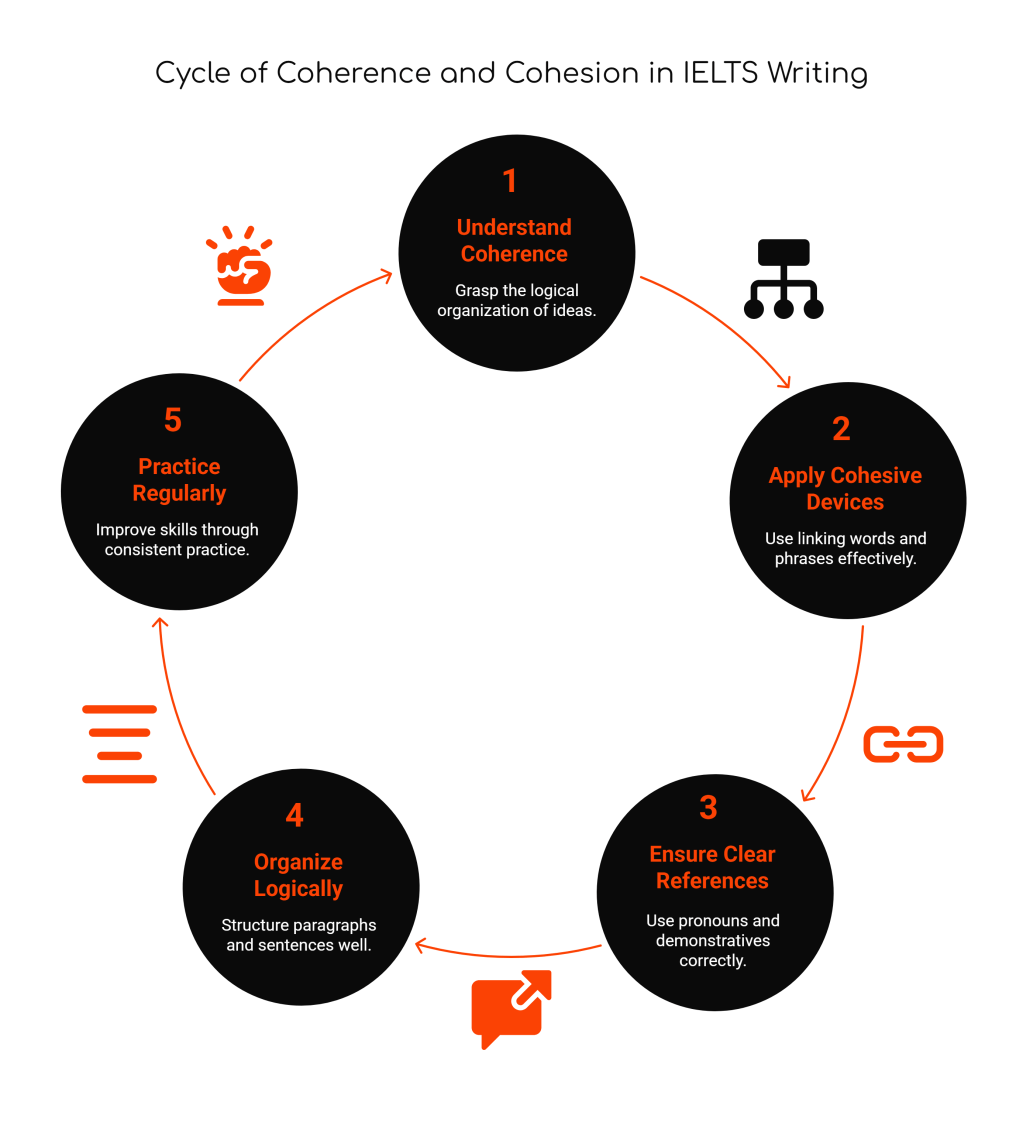
What Are Coherence and Cohesion?
Coherence
Coherence refers to the logical flow and organization of your ideas. A coherent text makes sense to the reader because:
- Ideas are presented in a logical sequence
- Each paragraph has a clear purpose
- The overall structure supports your main message
- Information is relevant and well-organized
Cohesion
Cohesion refers to the grammatical and lexical connections between sentences and paragraphs. Cohesive writing uses:
- Linking words and phrases
- Pronoun references
- Repetition and synonyms
- Parallel structures
Think of coherence as the “big picture” organization and cohesion as the “glue” that holds your sentences together.
The IELTS Band Descriptors for Coherence and Cohesion
Understanding what examiners look for at different band levels helps you target your improvements:
Band 9: Uses cohesion in such a way that it attracts no attention; skilful management of paragraphing Band 8: Sequences information and ideas logically; manages all aspects of cohesion well Band 7: Logically organizes information and ideas; uses a range of cohesive devices appropriately Band 6: Arranges information and ideas coherently; uses cohesive devices effectively, but cohesion within and/or between sentences may be faulty or mechanical
Essential Components of Coherence and Cohesion
1. Logical Structure
Your Task 1 response should follow this proven structure:
Introduction (1 sentence): Paraphrase the question Overview (1-2 sentences): Highlight the main trends or key features Body Paragraph 1 (2-3 sentences): Describe specific details Body Paragraph 2 (2-3 sentences): Describe additional specific details
2. Cohesive Devices
Master these essential linking words and phrases:
For showing trends:
- increased/decreased
- rose/fell
- climbed/dropped
- peaked/reached a low
For making comparisons:
- similarly, likewise
- in contrast, however
- whereas, while
- compared to, in comparison with
For sequencing:
- initially, at first
- subsequently, then
- finally, ultimately
- over the period shown
For adding information:
- furthermore, moreover
- in addition, additionally
- also, as well as
3. Reference Words
Use pronouns and demonstratives effectively:
- “The chart shows data for three countries. These figures reveal…”
- “Sales increased in January. This rise continued…”
- “Both cities experienced growth, but the latter grew more rapidly.”
Examples of Good Coherence and Cohesion
Example 1: Line Graph Description
Poor coherence and cohesion: “The graph shows temperature. January was cold. July was hot. Spring had increasing temperature. Autumn had decreasing temperature.”
Good coherence and cohesion: “The line graph illustrates average monthly temperatures in London throughout the year. Overall, temperatures follow a predictable seasonal pattern, with the lowest point occurring in January and the peak in July. Initially, temperatures remain low during winter months, then gradually increase through spring, reaching their highest levels in summer before declining again in autumn.”
Example 2: Bar Chart Description
Poor coherence and cohesion: “Men like football. Women like tennis. Basketball is popular. Swimming is not popular with men.”
Good coherence and cohesion: “The bar chart compares sports preferences between men and women. Most notably, football dominates among male participants, whereas tennis shows the highest popularity among females. In contrast, basketball demonstrates relatively equal appeal across both genders, while swimming shows significantly lower participation rates, particularly among men.”
Common Mistakes and How to Fix Them
Mistake 1: Overusing Simple Conjunctions
Incorrect: “Sales increased and profits rose and the company expanded and…”
Correct: “Sales increased, leading to higher profits. Consequently, the company was able to expand its operations.”
Mistake 2: Mechanical Use of Linking Words
Incorrect: “Firstly, sales were high. Secondly, profits increased. Thirdly, costs rose.”
Correct: “Sales remained consistently high throughout the period. As a result, profits increased substantially, although operating costs also rose.”
Mistake 3: Unclear Pronoun References
Incorrect: “The chart shows data for cars and trucks. They increased significantly.” (What increased?)
Correct: “The chart shows data for cars and trucks. Sales of both vehicles increased significantly.”
Mistake 4: Repetitive Vocabulary
Incorrect: “The number increased. The figure increased. The amount increased.”
Correct: “The number rose sharply. This figure climbed steadily before the amount peaked at year-end.”
Mistake 5: Illogical Paragraph Organization
Incorrect: Mixing different time periods or categories within paragraphs
Correct: Group related information logically – by time periods, categories, or similar trends
Dos and Don’ts
✅ DOs
Do use a clear structure:
- Start with an introduction that paraphrases the question
- Include an overview with main trends
- Organize body paragraphs logically
Do vary your cohesive devices:
- Mix different types of linking words
- Use reference words appropriately
- Employ substitution and ellipsis when suitable
Do ensure smooth transitions:
- Connect ideas within sentences
- Link sentences within paragraphs
- Bridge paragraphs with appropriate transitions
Do group related information:
- Put similar trends together
- Compare and contrast systematically
- Follow chronological or categorical order
❌ DON’Ts
Don’t overuse linking words:
- Avoid stuffing every sentence with connectors
- Don’t use inappropriate or forced transitions
Don’t create unclear references:
- Ensure pronouns have clear antecedents
- Avoid ambiguous “this” or “these” without clarification
Don’t jump between ideas randomly:
- Maintain logical flow throughout
- Avoid sudden topic changes
Don’t repeat the same structures:
- Vary sentence beginnings
- Use different cohesive devices
Practice Exercises
Exercise 1: Improve Cohesion
Rewrite this paragraph using better cohesive devices:
“The population of City A was 2 million in 2000. The population of City A increased to 2.5 million in 2010. The population of City A reached 3 million in 2020. City B had different trends. City B started at 1.5 million. City B stayed the same.”
Exercise 2: Fix Coherence Issues
Reorganize this information logically:
“In 2020, unemployment was 8%. Education spending decreased by 15%. In 2010, unemployment was 12%. Healthcare funding increased by 10%. In 2015, unemployment dropped to 10%. Education received more funding in 2020.”
Advanced Tips for Higher Bands
For Band 7+:
- Use a wider range of cohesive devices naturally
- Ensure all paragraphs have clear central topics
- Make implicit connections between ideas explicit
For Band 8+:
- Achieve seamless flow that doesn’t draw attention to linking words
- Use sophisticated reference systems
- Demonstrate complete control over paragraphing
For Band 9:
- Create text that flows so naturally that cohesive devices are barely noticeable
- Show masterful control of all organizational features
- Achieve perfect logical progression throughout
Quick Reference Checklist
Before submitting your Task 1 response, check:
- [ ] Does my introduction clearly paraphrase the question?
- [ ] Have I included a clear overview with main trends?
- [ ] Are my body paragraphs logically organized?
- [ ] Do I use a variety of cohesive devices appropriately?
- [ ] Are all pronoun references clear?
- [ ] Does each paragraph have a central focus?
- [ ] Do my ideas flow logically from sentence to sentence?
- [ ] Have I avoided overusing simple conjunctions like “and”?
- [ ] Are my transitions between paragraphs smooth?
- [ ] Does my conclusion (if included) add value without repetition?
Final Thoughts
Mastering coherence and cohesion in IELTS Writing Task 1 Academic requires consistent practice and attention to detail. Remember that these skills develop gradually – focus on implementing one improvement at a time rather than trying to perfect everything simultaneously.
The key to success lies in creating writing that feels natural and effortless to read, where ideas flow smoothly and logically from one to the next. With dedicated practice using the strategies outlined in this guide, you’ll see significant improvement in your coherence and cohesion scores.
Start practicing today, and watch your IELTS Writing Task 1 scores soar!
#IELTSGuidePhil #IELTS #IELTSWriting #IELTSTask1 #IELTSAcademic #CoherenceAndCohesion #IELTSPreparation #IELTSTips #IELTSStudy #WritingSkills #EnglishTest #TestPreparation #IELTSSuccess #AcademicWriting #IELTSBand7 #IELTSBand8 #StudyAbroad #EnglishLanguage #IELTSCoaching #ExamPreparation #LanguageLearning
 IELTS Guide Phil
Leave a comment