
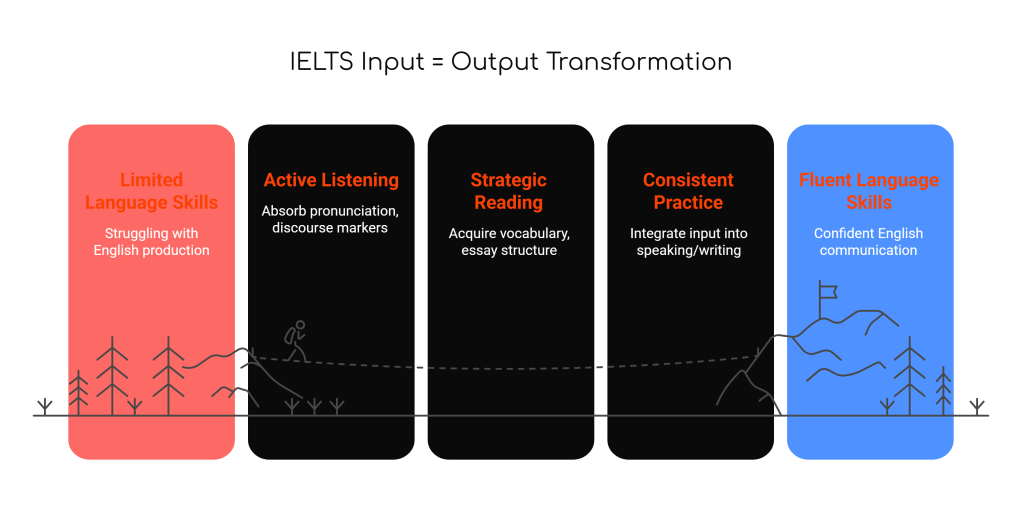
If you’ve ever wondered why some IELTS candidates seem to effortlessly produce fluent, sophisticated responses in Speaking and Writing while others struggle despite hours of practice, the answer often lies in a simple but powerful concept: Input = Output.
Your ability to speak and write effectively in English is directly proportional to the quality and quantity of English you consume through listening and reading. In IELTS terms, excelling in the receptive skills (Listening and Reading) creates the foundation for success in the productive skills (Speaking and Writing).
Understanding the Input-Output Connection
Think of your brain as a language database. Every conversation you hear, every article you read, every podcast you listen to adds vocabulary, sentence structures, and expressions to this database. When it’s time to speak or write, your brain draws from this accumulated input to produce output.
The Science Behind It:
- Vocabulary Acquisition: Encountering words in context through listening and reading helps you understand their nuanced meanings and appropriate usage
- Pattern Recognition: Repeated exposure to sentence structures and grammatical patterns makes them feel natural when you use them
- Collocations and Natural Expressions: Input helps you learn which words naturally go together, making your output sound more native-like
How Listening Skills Enhance Speaking Performance
1. Pronunciation and Intonation Modeling
When you actively listen to native speakers, you unconsciously absorb pronunciation patterns, stress, and intonation. This directly improves your speaking clarity and naturalness.
Example:
- Input: Listening to a BBC podcast about climate change where you hear “The unprecedented rise in global temperatures has significant implications for future generations.”
- Output: In IELTS Speaking Part 3, you confidently use: “The unprecedented changes we’re seeing have significant implications for how we approach education.”
2. Natural Discourse Markers and Transitions
Listening exposes you to how native speakers connect ideas, pause, and transition between thoughts.
Common Discourse Markers Absorbed Through Listening:
- “Having said that…” (contrast)
- “What’s more…” (addition)
- “In other words…” (clarification)
- “That reminds me…” (topic shift)
3. Spontaneous Language Production
Regular listening practice trains your brain to process and respond to English in real-time, crucial for IELTS Speaking’s spontaneous nature.
Strategy: Listen to interview-style podcasts and pause to answer questions before hearing the interviewee’s response. This mimics IELTS Speaking conditions.
How Reading Skills Boost Writing Performance
1. Sophisticated Vocabulary and Academic Register
Academic reading exposes you to formal vocabulary and complex sentence structures essential for IELTS Writing Task 2.
Example:
- Input: Reading “The proliferation of digital technology has fundamentally transformed how we conceptualize education.”
- Output: Writing “The proliferation of social media platforms has fundamentally transformed interpersonal communication patterns.”
2. Essay Structure and Argumentation Patterns
Quality reading materials demonstrate effective argumentation, paragraph development, and logical flow.
Common Patterns Learned Through Reading:
- Problem-Solution Structure: Identifying issues, analyzing causes, proposing solutions
- Compare-Contrast Organization: Balanced analysis of different perspectives
- Cause-Effect Relationships: Logical connections between ideas
3. Cohesion and Coherence
Reading well-written texts shows you how ideas connect smoothly using cohesive devices and logical progression.
Practical Strategies for Maximizing Input-Output Transfer
For Listening → Speaking Transfer
1. Active Shadowing
- Listen to 2-3 minute segments of podcasts or TED talks
- Immediately repeat what you heard, mimicking pronunciation and intonation
- Focus on capturing the speaker’s rhythm and stress patterns
2. Question-Response Practice
- Listen to interview segments
- Pause before answers and formulate your own response
- Compare your answer with the speaker’s approach
3. Topic-Specific Listening
- Choose materials related to common IELTS themes (education, environment, technology)
- Create a vocabulary bank of expressions from each listening session
- Practice using these expressions in mock speaking responses
For Reading → Writing Transfer
1. Model Analysis
- Read high-quality articles on IELTS topics
- Identify thesis statements, topic sentences, and supporting evidence
- Note sophisticated vocabulary and sentence structures
- Practice rewriting paragraphs using similar structures with different content
2. Vocabulary Harvesting
- Keep a dedicated notebook for academic vocabulary
- Record not just words but complete phrases and collocations
- Practice using new vocabulary in original sentences
3. Structure Mapping
- Analyze essay organization in quality sources
- Create templates based on effective structures you encounter
- Practice adapting these structures to different IELTS questions
Common Mistakes and How to Fix Them
Mistake 1: Passive Consumption Without Analysis
The Problem: Many students listen and read without actively analyzing language patterns.
The Fix:
- Take notes while listening/reading
- Identify 3-5 useful expressions from each session
- Practice using these expressions within 24 hours
Mistake 2: Focusing Only on Content, Ignoring Language
The Problem: Students focus on what is being said rather than how it’s being expressed.
The Fix:
- Dedicate 30% of your attention to language features
- Notice sentence beginnings, transitions, and conclusions
- Ask yourself: “How did the speaker/writer express this idea?”
Mistake 3: Mismatched Input and Output Levels
The Problem: Reading overly simple texts but expecting to write at Band 7+ level.
The Fix:
- Choose input materials slightly above your current level
- Gradually increase complexity as your skills improve
- Aim for academic journals, quality newspapers, and professional podcasts
Mistake 4: Inconsistent Practice
The Problem: Sporadic listening and reading practice doesn’t create lasting neural pathways.
The Fix:
- Establish daily minimums (20 minutes listening, 15 minutes reading)
- Track your practice using apps or journals
- Focus on consistency over intensity
Advanced Strategies for Band 8+ Performance
1. Cross-Skill Integration
Practice exercises that combine multiple skills:
- Listen to a debate and write a summary of arguments
- Read an article and record yourself discussing the main points
- Watch a documentary segment and write your opinion on the topic
2. Register Awareness
Develop sensitivity to different language registers:
- Formal Academic: Journal articles, research papers
- Semi-Formal: Quality newspapers, professional blogs
- Conversational: Podcasts, interviews, documentaries
3. Cultural Context Absorption
Beyond language, absorb cultural references and contexts that make your responses more sophisticated:
- Historical references
- Contemporary issues
- Global perspectives on universal topics
Creating Your Personal Input-Output System
Daily Routine Recommendations
Morning (15-20 minutes)
- Listen to news podcasts during commute/exercise
- Focus on current affairs and global issues
Afternoon (20-30 minutes)
- Read one quality article related to IELTS topics
- Take notes on vocabulary and structures
Evening (10-15 minutes)
- Review and practice using new language from the day
- Record yourself using new expressions
Weekly Deep Dives
- Monday: Education topics (TED-Ed, educational podcasts)
- Tuesday: Environmental issues (BBC Nature, scientific articles)
- Wednesday: Technology and society (tech podcasts, innovation articles)
- Thursday: Health and lifestyle (medical journals, health podcasts)
- Friday: Culture and arts (cultural programs, arts reviews)
- Weekend: Mixed review and integration practice
Measuring Your Progress
Input Quality Indicators
- Can you understand main ideas without subtitles/dictionary?
- Are you noticing language patterns and structures?
- Do new words and expressions feel familiar after exposure?
Output Improvement Markers
- Speaking: More natural pausing, improved pronunciation, richer vocabulary
- Writing: Complex sentence structures, sophisticated vocabulary, better flow
Integration Success Signs
- Unconscious use of phrases you’ve heard/read recently
- Natural incorporation of academic vocabulary
- Improved fluency and confidence in both productive skills
Conclusion
The IELTS Input = Output principle isn’t just theory—it’s a practical pathway to significant score improvements. By strategically consuming high-quality English input through listening and reading, you’re not just preparing for two sections of the test; you’re building the linguistic foundation that will elevate your performance across all four skills.
Remember, language learning is cumulative. Every podcast episode, every article, every listening exercise adds to your linguistic repertoire. The key is consistency, active engagement, and strategic practice that connects what you consume with what you produce.
Start implementing these strategies today, and watch as your IELTS Speaking and Writing naturally improve through the power of quality input. Your future self—and your IELTS scores—will thank you.
Ready to transform your IELTS preparation? Start with just 30 minutes of strategic listening and reading practice today. The journey to your target band score begins with a single input.
#IELTS #IELTSPreparation #IELTSListening #IELTSReading #IELTSSpeaking #IELTSWriting #EnglishLearning #IELTSTips #IELTSStrategies #EnglishFluency #IELTSSuccess #LanguageLearning #IELTSSkills #EnglishTest #IELTSCoaching #StudyAbroad #EnglishProficiency #IELTSExam #TestPreparation #AcademicEnglish #IELTSGuidePhil
 IELTS Guide Phil
Leave a comment