
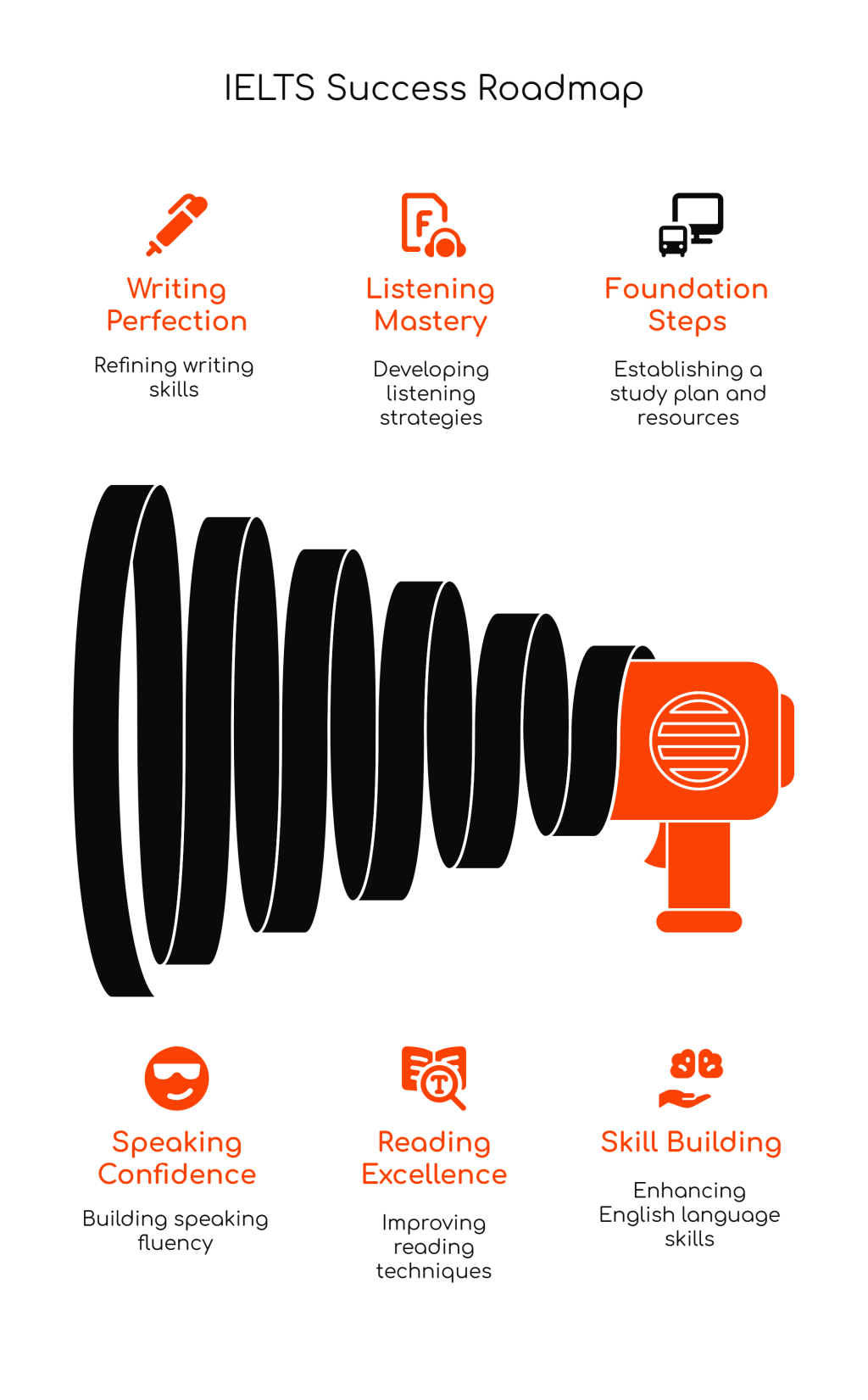
Success in IELTS doesn’t happen by accident. It’s the result of systematic preparation, strategic practice, and consistent effort across multiple areas. This comprehensive guide presents 100 actionable steps that will take you from initial preparation through test day and beyond, ensuring you maximize your chances of achieving your target band score.
Whether you’re just beginning your IELTS journey or looking to improve your previous attempts, these steps provide a clear roadmap to success. Follow them systematically, adapt them to your specific needs, and watch your confidence and competence grow.
Getting Started: Foundation Steps (Steps 1-15)
1. Define your specific IELTS goals clearly. Write down exactly why you need IELTS, what band score you require overall and for each skill, and your deadline for achieving this score.
2. Choose between Academic and General Training modules based on your specific requirements. Academic is for university study, while General Training is typically for immigration or work purposes.
3. Take a comprehensive diagnostic test to establish your current proficiency level across all four skills. Use official IELTS practice materials for the most accurate assessment.
4. Calculate the gap between your current level and target score. This will help you estimate the preparation time needed and prioritize your study efforts.
5. Research and select quality IELTS preparation materials. Invest in official Cambridge IELTS books, reputable online platforms, and supplementary resources from recognized publishers.
6. Find a qualified IELTS teacher or coaching program if you need structured guidance. Look for instructors with proven track records and specific IELTS expertise.
7. Create a realistic study schedule that fits your lifestyle and commitments. Aim for consistent daily practice rather than irregular intensive sessions.
8. Set up a dedicated study space free from distractions, with all necessary materials organized and easily accessible.
9. Register for your IELTS test date once you’ve established a realistic timeline for your preparation. Having a concrete deadline creates urgency and focus.
10. Familiarize yourself with the IELTS band descriptors for all four skills. Understanding how you’ll be assessed is crucial for targeted improvement.
11. Learn about the test format and timing for each section. Know exactly what to expect on test day to avoid surprises and anxiety.
12. Understand the scoring system and how overall band scores are calculated from individual skill scores.
13. Research your test center location and plan your route. Visit the center beforehand if possible to reduce test day stress.
14. Gather all required identification documents and ensure they meet IELTS requirements well before your test date.
15. Create a progress tracking system to monitor your improvement over time and identify areas needing additional focus.
Building Core English Skills (Steps 16-35)
16. Expand your vocabulary systematically using spaced repetition techniques. Focus on academic vocabulary and topic-specific terminology commonly used in IELTS.
17. Learn collocations and phrasal verbs that are frequently tested in IELTS. Understanding how words naturally combine will improve your lexical resource score.
18. Study advanced grammar structures including complex sentences, conditional forms, and passive voice constructions that demonstrate higher-level English proficiency.
19. Practice pronunciation regularly using recording apps or working with native speakers. Clear pronunciation significantly impacts your speaking band score.
20. Develop your reading speed through timed practice sessions. IELTS Reading requires processing large amounts of text quickly while maintaining comprehension.
21. Improve your listening skills by exposing yourself to various English accents (British, American, Australian, Canadian) commonly featured in IELTS tests.
22. Enhance your writing accuracy by learning to self-edit effectively. Practice identifying and correcting common grammatical errors in your own work.
23. Build fluency in speaking through regular conversation practice. Focus on expressing complex ideas smoothly without excessive hesitation.
24. Learn academic writing conventions including formal register, objective tone, and appropriate linking devices for coherent essay structure.
25. Practice paraphrasing skills essential for avoiding repetition and demonstrating lexical variety in both writing and speaking tasks.
26. Develop critical thinking abilities to analyze arguments, evaluate evidence, and form well-reasoned opinions on various topics.
27. Improve your spelling accuracy by learning common spelling patterns and practicing words frequently misspelled by IELTS candidates.
28. Master punctuation rules including proper use of commas, semicolons, and apostrophes in academic writing contexts.
29. Learn to identify main ideas and supporting details in complex texts, a crucial skill for both Reading and Listening sections.
30. Practice summarizing information concisely and accurately, an essential skill for IELTS Writing Task 1 and overall comprehension.
31. Develop your ability to make inferences from written and spoken texts, going beyond literal comprehension to understand implied meanings.
32. Learn to recognize text organization patterns such as cause-effect, comparison-contrast, and problem-solution structures.
33. Practice identifying writer’s attitudes and opinions in reading passages, distinguishing between facts and viewpoints.
34. Improve your ability to follow spoken instructions and understand complex explanations in various contexts.
35. Develop cultural awareness of English-speaking countries to better understand context in reading and listening materials.
Mastering IELTS Listening (Steps 36-45)
36. Learn the four-section structure of IELTS Listening and understand how difficulty progresses from Section 1 to Section 4.
37. Practice active listening techniques including predicting content, focusing on keywords, and understanding context clues.
38. Master different question types including multiple choice, form completion, map labeling, and matching exercises.
39. Develop effective note-taking strategies that capture essential information without missing subsequent content.
40. Learn to handle distractors – incorrect information deliberately included to test your attention and understanding.
41. Practice spelling while listening as incorrect spelling results in lost marks even when you hear the correct answer.
42. Improve your number recognition including dates, times, prices, and telephone numbers commonly tested in Section 1.
43. Learn to follow maps and diagrams while listening to directions and descriptions, a common task in Sections 1 and 2.
44. Practice listening for specific information such as names, places, and factual details in various contexts.
45. Develop strategies for academic lectures (Section 4) including understanding main points, examples, and speaker attitudes.
Excelling in IELTS Reading (Steps 46-55)
46. Learn the three-passage structure and understand how to allocate your 60 minutes effectively across all sections.
47. Master skimming techniques to quickly grasp main ideas and overall text structure before attempting questions.
48. Develop scanning skills to locate specific information rapidly without reading every word.
49. Practice different question types including True/False/Not Given, matching headings, and sentence completion tasks.
50. Learn to identify keywords in questions and locate their paraphrased equivalents in the passage.
51. Understand the difference between True/False/Not Given and Yes/No/Not Given questions, avoiding common confusion.
52. Practice time management strategies ensuring you attempt all questions within the allocated time limit.
53. Learn to handle unfamiliar vocabulary using context clues and word formation knowledge rather than panicking.
54. Develop strategies for matching exercises including matching headings to paragraphs and information to categories.
55. Practice reading academic texts from various disciplines to familiarize yourself with different writing styles and terminology.
Perfecting IELTS Writing (Steps 56-70)
56. Understand the requirements for both Task 1 (describing data/processes) and Task 2 (essay writing) thoroughly.
57. Learn to analyze the task prompt carefully, ensuring you address all parts of the question completely.
58. Master Task 1 graph descriptions including trends, comparisons, and significant data points using appropriate vocabulary.
59. Practice describing processes and diagrams with clear sequencing and appropriate linking words.
60. Develop strong Task 2 essay structures with clear introductions, body paragraphs, and conclusions.
61. Learn to write compelling thesis statements that directly address the question and preview your main arguments.
62. Practice developing arguments with relevant examples, explanations, and evidence to support your position.
63. Master academic linking devices to create coherent and cohesive writing that flows logically from idea to idea.
64. Learn appropriate academic vocabulary for expressing opinions, making comparisons, and discussing abstract concepts.
65. Practice writing within time limits – 20 minutes for Task 1 and 40 minutes for Task 2.
66. Develop self-editing skills to identify and correct errors in grammar, vocabulary, and organization.
67. Learn to vary your sentence structures using simple, compound, and complex sentences appropriately.
68. Practice writing introductions and conclusions that effectively frame your response without repetition.
69. Master the art of paraphrasing the question in your introduction without copying the original wording.
70. Learn to write balanced arguments that consider multiple perspectives while maintaining a clear position.
Succeeding in IELTS Speaking (Steps 71-80)
71. Understand the three-part structure of the Speaking test and what’s expected in each section.
72. Practice Part 1 personal questions about familiar topics like work, study, hobbies, and daily routines.
73. Master Part 2 long turn speaking by practicing 2-minute presentations on various topics with minimal preparation.
74. Develop Part 3 discussion skills for more abstract and analytical conversations with the examiner.
75. Learn to extend your answers naturally without rambling, providing relevant details and examples.
76. Practice thinking in English to reduce translation time and improve fluency during the test.
77. Develop strategies for handling difficult questions including asking for clarification when necessary.
78. Learn to express opinions confidently and support them with reasons and examples.
79. Practice using a range of grammatical structures to demonstrate your language proficiency.
80. Work on natural pronunciation and intonation that enhances communication rather than hindering it.
Test Strategies and Techniques (Steps 81-90)
81. Learn effective time management for each section, practicing with strict time limits regularly.
82. Develop educated guessing strategies for questions you’re unsure about, especially in Reading and Listening.
83. Practice transferring answers efficiently in Listening and Reading to avoid careless mistakes.
84. Learn to stay calm under pressure through regular timed practice and relaxation techniques.
85. Master the art of moving on from difficult questions to ensure you attempt all sections.
86. Practice reading instructions carefully to avoid losing marks through misunderstanding requirements.
87. Develop strategies for handling nerves including breathing techniques and positive self-talk.
88. Learn to use preparation time effectively in Speaking Part 2 to organize your thoughts quickly.
89. Practice recovering from mistakes gracefully rather than letting them affect your subsequent performance.
90. Develop test day routines that help you feel confident and prepared on the actual exam day.
Final Preparation and Test Day (Steps 91-100)
91. Take full-length practice tests under realistic exam conditions at least once per week in the final month.
92. Analyze your practice test results systematically to identify remaining weaknesses and adjust your preparation accordingly.
93. Review and consolidate all learned strategies and techniques through focused revision sessions.
94. Prepare all necessary documents and organize everything you need for test day well in advance.
95. Plan your test day schedule including travel time, arrival at the center, and what to do between sections.
96. Get adequate rest in the week leading up to your test, avoiding last-minute cramming that increases anxiety.
97. Eat a proper breakfast on test day to ensure you have sustained energy throughout the long examination.
98. Arrive at the test center early to familiarize yourself with the environment and complete check-in procedures calmly.
99. Stay positive and confident during the test, remembering that you’ve prepared thoroughly and systematically.
100. After the test, reflect on your performance and plan next steps based on how you felt about each section.
Conclusion: Your Path to IELTS Success
These 100 steps provide a comprehensive roadmap to IELTS success, covering every aspect of preparation from initial goal-setting through test day performance. Remember that success comes from consistent application of these strategies rather than perfection in any single area.
Not every step will be equally relevant to every student – adapt this guide to your specific needs, strengths, and weaknesses. The key is systematic preparation that addresses all aspects of the test while building genuine English proficiency.
Your IELTS journey is unique, but these proven steps have helped thousands of students achieve their target band scores. Trust the process, stay committed to consistent practice, and approach your test with confidence knowing you’ve prepared thoroughly and strategically.
Success in IELTS opens doors to incredible opportunities – university education, professional advancement, and life in English-speaking countries. These 100 steps are your roadmap to those opportunities. Follow them diligently, and your IELTS success story begins now.
#IELTSRoadmap #IELTSSuccessSteps #StudyBlueprint #TargetBandScore #IELTSStrategy #StepByStepIELTS #IELTSGoals #BandScoreJourney #IELTSPlan #StudyMilestones #RoadToSuccess #IELTSGuidePhil #ComprehensivePrep #IELTS2025 #SuccessRoadmap
 IELTS Guide Phil
Leave a comment